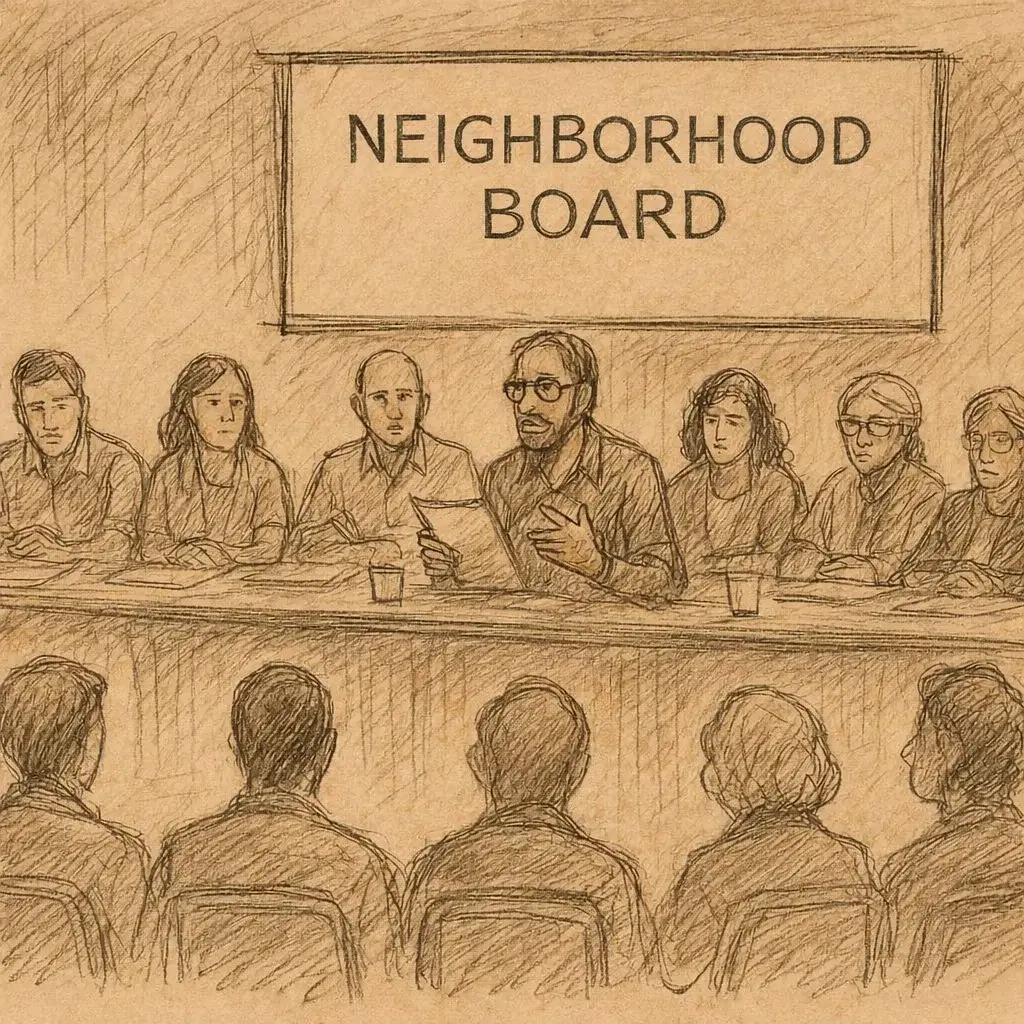
No 08 McCully - Mōʻiliʻili Neighborhood Board Regular Meeting October 2026
Listen to this article:
8 McCully-Moiliili Neighborhood Board Meeting – October 27, 2026
Opening, Quorum, and Temporary Meeting Site
The board convened in a new temporary meeting location that is expected to serve as its home for the next several months. The chair welcomed residents who traveled outside their usual part of the neighborhood and noted that the site has restrooms and drinking fountains, although Wi-Fi was not yet available. Roll call established that nine members were present, including online participants, out of 13 board seats, providing a quorum. The board later noted that one seat remained vacant and encouraged members and residents to recruit a candidate so the year could end with a full board.
Fire Department Activity and Holiday Safety
Honolulu Fire Department Captain Keith Endo of Engine 29 reported Station 29’s September activity, including eight nuisance fires, defined as rubbish or similar outdoor fires not involving a structure or vehicle, 99 medical calls, and three hazardous-material incidents. With the holiday season approaching, HFD advised residents to use electrical decorations and devices certified by nationally recognized testing laboratories and to follow manufacturers’ instructions. Residents were urged to remain present and alert whenever cooking indoors or outdoors, keep combustible materials away from heat and flames, and exercise heightened caution while driving or walking, particularly between dusk and dawn. In response to a question about a woman living near the end of University Avenue at Hīhīwai Street who had reportedly declined ambulance transport, HFD explained that emergency personnel generally cannot compel transport when an individual is medically stable, able to answer assessment questions, and not experiencing an immediate medical emergency; responders can primarily provide information and referrals.
District 1 Police Statistics and Staffing
HPD Sergeant Paul Aquavella presented September 2026 statistics for District 1 beat B178 near O‘Leary Street. Motor-vehicle theft declined from five cases in the prior month to one, while burglaries rose from one to three. Thefts remained at three, unauthorized entries into motor vehicles increased from two to four, and assaults declined from seven to three. One fourth-degree sexual-assault case was reported after none the prior month, while graffiti and drug cases remained at zero. Total calls for service decreased from 474 in August to 364 in September. Because vehicle break-ins increased, HPD advised residents to remove valuables and bags from sight, even when the contents appear unimportant, lock their vehicles, and keep their keys with them.
Sergeant Aquavella also discussed HPD’s department-wide effort to increase patrol staffing by approximately 100 officers. Districts 1 and 7 were each expected to gain roughly four to six officers on the road, which HPD hopes will increase police visibility and reduce response times. Upcoming academy classes were described as comparatively large, although retention will determine how quickly staffing recovers. HPD is authorized for approximately 2,100 sworn positions but had about 1,750 officers, leaving a shortage of roughly 350 to 400 positions. Residents were invited to attend Police Chief Arthur “Joe” Logan’s town hall at Mission Memorial Auditorium from 6 to 8 p.m. that Thursday, as well as another public-safety town hall on November 17. Chief Lazar was also tentatively expected to attend the board’s November 30 meeting.
District 7 Crime Data, Impaired Driving, and Sarah’s Law Concerns
District 7 Lieutenant Thompson reported 16 motor-vehicle thefts, two burglaries, 17 thefts, four unauthorized-entry-to-motor-vehicle cases, and 5,808 total calls for service during September. HPD’s holiday impaired-driving campaign was scheduled to begin November 1. Residents were advised to choose a designated driver or arrange a taxi or rideshare before drinking, provide nonalcoholic options and sober transportation when hosting gatherings, wear seat belts, and safely pull over and report suspected impaired drivers. Thompson said he was interested in seeing whether the new patrol officers would reduce case backlogs and improve response times.
A resident raised an extended concern about the implementation of “Sarah’s Law,” describing a friend who reportedly admitted drinking one beer, tested below the legal alcohol limit, but was arrested after officers discovered that his license had been suspended through an SR-21 insurance-related process. Thompson said his understanding was that Sarah’s Law concerns repeated driving-without-a-license offenses and may elevate conduct to a felony after a specified number of citations or convictions, possibly three within five years. He explained that an SR-21 can relate to license revocation associated with insurance issues but declined to assess the particular arrest because he had not been present and the accused person would need to proceed through due process. The resident alleged that officers had misused the law after failing to establish DUI and asked that District 7’s major attend future board meetings. The chair ended the exchange after determining that the general concern had been placed on the record.
Another resident asked about a Civil Beat report describing trespassing, vandalism, and illegal gambling at an affordable-housing property, possibly across from the board’s usual meeting site, and questioned whether HPD normally reports such conditions to the Department of Planning and Permitting or whether residents must contact both agencies. The lieutenant’s connection failed before a full answer could be given. The chair suggested raising the issue with the mayor’s representative or at one of the upcoming police town halls.
Water Supply and Power-Outage Conservation
Board of Water Supply representative Steven Nordstrom reported that there were no water-main breaks in the McCully area during September. He reminded residents that electric outages limit the utility’s ability to pump groundwater into reservoirs, leaving only the water already stored in those reservoirs available to the community. During an outage and immediately after power is restored, residents should limit water use to essential cooking, drinking, and personal hygiene. Continued conservation after restoration gives electric pumps time to replenish reservoirs, and both water pressure and normal service may take time to recover after a prolonged or widespread outage. Updates are available through the Board of Water Supply website and social-media accounts.
Board Minutes, Annual Recesses, and Holiday Parades
The board approved the written summaries of its prior regular meeting without objection. It also voted to recess on meeting dates that conflict with Memorial Day and the December holiday period, when meeting facilities and services may be unavailable. The board then approved participation in two holiday events: the Mayor’s Tree Lighting Ceremony and Parade on Saturday, December 5, 2026, at 5 p.m., and the Kaimukī-Kapahulu-Mōʻiliʻili Christmas Parade hosted by the Lions Club on Thursday, December 10, 2026, at 6:30 p.m. The mayoral parade would involve neighborhood board members marching collectively, while the December 10 parade would include a McCully-Mōʻiliʻili board banner. Approval allows the Neighborhood Commission to plan for items such as shirts, banners, and candy, although individual members were not committing themselves to attend.
Urban Forestry Responsibilities and Tree Inventory
Community Forester Navin Tagor explained that the Division of Urban Forestry operates under the Department of Parks and Recreation, which oversees nearly 400 parks, five botanical gardens, 11 community gardens, and two nature preserves. Urban Forestry is responsible for approximately 87,000 public trees across Oʻahu, representing an estimated asset value of nearly $500 million. The inventory includes approximately 27,000 to 28,000 park trees and nearly 60,000 street trees. The nursery and landscape section grows, plants, waters, and maintains young trees and handles pest control, while the arboriculture section inspects and prunes mature trees, performs removals and specialized root work, and provides 24-hour emergency response. About 95% of mature-tree maintenance is contracted, generally on an 18-month to two-year pruning cycle.
The division has only about 27 staff directly working with trees islandwide. Tagor said Honolulu’s built environment presents a major constraint because many sidewalks and rights-of-way were not designed with sufficient soil or space for mature trees. Parks therefore offer the largest immediate planting opportunities, while street-tree planting is more difficult in narrow urban corridors. Urban Forestry also handles trees in medians and sidewalks where appropriate and works with the Department of Transportation Services on tree selection for major Complete Streets capital projects.
Storm Damage, Tree Safety, and Species Selection
Tagor described 2026 as an unusually storm-heavy year that generated thousands of tree-related work orders. One storm, Lala, produced approximately 530 work orders by itself. Firefighters often help clear smaller fallen trees because they have equipment distributed among multiple stations, while Urban Forestry crews handle large or technically difficult removals. The division is reviewing which species failed, how they failed, and whether targeted height reduction or species-specific management is warranted. The department does not plan broad, indiscriminate cutting of large trees; instead, it intends to retain shade-producing trees where possible and replace vulnerable species with hardier ones.
Residents asked about the broad-canopied monkeypod and Moreton Bay fig trees along Paki Avenue and Kapiʻolani Park. Tagor said trained arborists inspect these trees and contractors reduce excess weight at branch ends so the trees catch less wind. He characterized them as hardy species, noting that figs can live as long as 1,000 years and monkeypods approximately 300 years, while the local trees are generally less than a century old. Although any tree can fail, he said the inspected trees were considered safe. The division is also favoring native and Polynesian-introduced “canoe” plants in its nursery. Because urban soils are compacted and polluted, only about 60 species are known to perform reliably in many Honolulu street conditions. Trees planted in public urban settings are generally grown to 15- or 25-gallon size and seven to ten feet in height so they are more resistant to theft, vandalism, and environmental stress. Current native-tree inventory may need another four to five years to mature to that size.
Community Tree Plan and Canopy Goal
Urban Forestry is developing a ten-year Community Tree Plan to increase Oʻahu’s tree canopy. A 2018 City Council resolution set a goal of 35% canopy coverage by 2035, but a recent assessment found that many urban Honolulu areas have only about 12% to 20% coverage. Tagor said temperatures begin to decrease more substantially when neighborhood canopy approaches 30%. Community engagement is scheduled to begin in January 2027, with Trees for Honolulu’s Future hosting an event for the McCully-Mōʻiliʻili area sometime between January and June, supplemented by online surveys and other feedback opportunities. Trees for Honolulu’s Future was selected through a bid process to conduct outreach from Kakaʻako through Waiʻalae. Residents will be asked which species they want so the city can source and grow trees several years ahead of planting.
Residents can work with the city through Adopt-a-Park, street-tree requests, and community-stewardship programs. Private owners, condominium associations, and homeowner groups were encouraged to seek planting opportunities on their own land, particularly where sidewalks are too narrow for street trees. The city has distributed approximately 800 fruit trees over the preceding two years, including ʻulu, citrus, and avocado, but is scaling back broad giveaways because many recipients did not plant or maintain the trees. The division is considering a more targeted request system and invited residents to contact staff directly.
Fruit Trees, Public Food Production, and Coconut Rhinoceros Beetles
Board members strongly supported planting fruit trees to address food insecurity, but Tagor explained that DPR currently is not authorized to deliberately plant fruit-producing trees in parks for public distribution. The department is chartered as a recreation agency and lacks a formal system for distributing taxpayer-funded food. Urban Forestry staff are interested in finding a safe approach, but changes may require substantial community advocacy, City Council action, and possibly amendments to the department’s scope. Private landowners can request food-producing trees through the city’s evolving adoption program.
Regarding coconut rhinoceros beetles, the division manages roughly 8,000 coconut palms but has concentrated costly systemic injections and soil treatments in high-use Waikīkī locations where palm failure could endanger many pedestrians. Effective treatments require repeated flower trimming and maintenance beyond the department’s current budget and staffing. State agencies are exploring biological controls and methods to treat compost and other beetle-breeding sites before insects mature. Tagor encouraged communities to care for, harvest, and use coconut palms so there is stronger public support for preserving them. Albizia management generally falls outside the division’s urban jurisdiction and is primarily handled by the state Department of Land and Natural Resources, although the city trims albizia bordering certain parks.
Requested Tree Work and Small Planting Sites
Residents proposed converting remnant city parcels, including small fenced areas along Kapiʻolani Boulevard between University Avenue and Isenberg Street, into community-maintained miniature tree gardens. One resident thanked the city for pruning low, horizontal branches on University Avenue shower trees but questioned the removal of a mature tree at University Avenue and Kūhiō-area streets rather than relocating it. Concern was also raised about approximately eight recently planted trees on Hīhīwai Street near Ala Wai Elementary School. Although the custodian had kept their watering bags filled and replacement support stakes had been installed, six trees were leaning in the trade winds. Tagor agreed to submit a work order to have them straightened and supported. Residents with narrow sidewalks were still encouraged to submit planting requests so staff could evaluate any grass strip or other available space; a planting strip generally needs to be more than about two feet wide.
University of Hawaiʻi Federal Funding and Immigration Impacts
University of Hawaiʻi representative Elmer Kai followed up on federal funding and policy developments. UH initially faced approximately $72 million in federal cuts affecting 76 programs and grants and about 69 employees whose jobs were lost or placed on hold. Many employees were later brought back, but only temporarily because appropriated federal funding was moving slowly through the administrative process. The lack of predictable, long-term funding makes it difficult to retain staff who may be assured of only one or two additional months of work. Approximately 30 people in the McCully-Mōʻiliʻili area were described as directly affected as employees or participants in community organizations connected to those programs. A more recent report showed UH extramural funding down approximately 2% to 3%, representing more than $73 million, primarily because of delays in releasing funds rather than the absence of appropriations.
Kai also discussed an August federal policy that would have shortened the authorized duration of international students’ and scholars’ visas and required them to reapply to remain beyond a fixed period. A federal judge stayed the policy on September 14, one day before its September 15 deadline, allowing students and scholars to continue largely under the prior process. UH emphasized that international students and employees are embedded in Hawaiʻi’s academic and community life and asked residents to encourage the congressional delegation to support a stable resolution.
Neighborhood Boards and Capital Improvement Planning
Mānoa Neighborhood Board member Dylan Armstrong, speaking in his individual capacity, urged the board to make greater use of its authority as a community-planning body. He defined a capital improvement plan as a medium-range, generally four- to six-year, budgeted plan for infrastructure such as facilities, sites, equipment, roads, utilities, trees, and physical service-delivery systems. The Neighborhood Plan expressly authorizes boards to participate in capital-improvement planning, allowing them to comment on city, state, federal, OHA, and other public infrastructure budgets.
Honolulu’s approximately $5 billion annual budget includes roughly $1.2 billion in capital improvements. Nearly half supports Department of Environmental Services sewer and refuse work, while approximately $207 million supports roads, bridges, bikeways, drainage, streetlights, and related transportation infrastructure. Another $144 million is directed toward affordable housing and homeless-service facilities. Examples of major projects included approximately $244 million for wastewater-treatment-plant upgrades and $76 million for Salt Lake Boulevard widening and associated circulation, resilience, and sustainability work. Armstrong suggested that boards identify specific needs, such as a traffic study at King and University, shade along a corridor, drainage works, or a social-service facility, rather than framing requests as broad policy goals. Boards can develop many project ideas but should rank their highest priorities and, where possible, consider costs and expected benefits.
Because the board planned a December recess, Armstrong advised placing project ideas on the November agenda, refining them in January and February, and submitting them before the city’s March budget process. Starting in April would effectively miss the next city budget cycle, while state requests must be considered even earlier because the governor begins presenting budget proposals in December. Public agenda discussions would allow residents to participate before the board adopts a final priority list.
Flood Mitigation as a Capital Priority
Several residents and members argued that flood mitigation should be the dominant capital priority for the Ala Wai watershed, rather than a collection of smaller improvements. A Mānoa resident affected by repeated flooding between 2004 and 2026 had requested reconstruction of part of the Mānoa Stream wall near Mānoa Valley District Park. Other possible approaches included bioswales, curb extensions designed to retain runoff, and other measures that allow stormwater to soak into soil rather than flow rapidly into streams. Armstrong noted that McCully-Mōʻiliʻili is built over porous limestone and subsurface water systems, so runoff decisions in upland Mānoa and Pālolo directly influence lower communities.
Residents called for all neighborhood boards in the Ala Wai watershed to coordinate one set of flood-mitigation priorities covering Mānoa, Pālolo, Makiki, and downstream areas. They argued that preventing stream overtopping and managing surface water should take precedence over smaller sidewalk or traffic projects because a major flood would produce extensive damage and recovery costs. Armstrong agreed that community members and boards are planners under the Neighborhood Plan and offered to assist with the process.
Safer Streets Initiative and Crash Data
Department of Transportation Services planner Kaylin Bubeloff presented proposed safety improvements for Beretania, South King, and Young streets. These are among seven Tier 1 high-injury corridors identified by Honolulu’s Vision Zero Action Plan and Oʻahu Pedestrian Plan; the other corridors are Kapiʻolani Boulevard, Kaheka Street, Piʻikoi Street, and Wilder Avenue. Between 2015 and 2024, 18 people were killed on the portions of Beretania, King, and Young included in the initiative. Although motor vehicles account for the largest total number of crashes because they make the most trips, pedestrians, bicyclists, motorcyclists, and moped riders represent a disproportionately large share of serious injuries and deaths.
Beretania Street’s concerns include its width of roughly five lanes in many locations, disconnected and unprotected bicycle facilities, long distances between pedestrian crossings, lengthy crossings, outdated signals, and conflicts between turning drivers and pedestrians. South King Street has similar issues, along with conflicts involving its two-way bikeway and vehicles turning across it; the bikeway ends at Isenberg Street without a clear safe continuation. Young Street is narrower and carries less traffic but has visibility problems at driveways and uncontrolled crossings because vehicles park too close to sight lines. It also has heavy cross-traffic conflicts at streets such as Piʻikoi, Keeaumoku, and Pensacola.
Proposed Complete Streets Improvements
DTS is considering protected bicycle lanes, concrete or delineator buffers, bus-only lanes, accessible curb ramps, updated traffic signals, dedicated left-turn arrows, bicycle signals, curb extensions, marked parking, speed humps, speed tables, raised crosswalks, rapid-flashing pedestrian beacons, refuge islands, better lighting, and intersection or roadway reconfiguration. The city emphasized that speed is central to crash severity: a pedestrian hit at 20 mph has roughly a 90% chance of survival, while one struck near 50 mph has only about a 10% chance. “Complete Streets” means designing for people of all ages and abilities who walk, use wheelchairs, bicycle, ride transit, or drive, with the final design varying by the character of each street.
A public meeting on the three corridors was scheduled for Wednesday, November 4, 2026, at 5:30 p.m. at Central Union Church at Punahou and Beretania streets. DTS also opened an online map on which users can mark exact problem locations and suggest changes. The Department of Facility Maintenance planned to repave Wilder, Beretania, Pensacola, and Piʻikoi over the following one to two years. Near-term improvements associated with paving would generally be limited to paint, striping, signage, and flexible delineators, while concrete construction and signal changes would require later capital projects. Honolulu’s 2012 Complete Streets law requires the city to consider multimodal improvements whenever it works on a transportation facility.
Bicycle, Pedestrian, and Signal Concerns
Board members and residents said physical separation alone would not solve bicycle crashes caused by drivers who fail to look in both directions before entering or crossing a bikeway. Suggested measures included signs warning that bicycle traffic comes from both directions, signal phases that release bicycles and pedestrians several seconds before motor vehicles, and infrastructure that more strongly changes driver behavior. DTS said leading pedestrian intervals and bicycle signal timing are under consideration for long-term projects, along with accessible pedestrian signals. Staff also noted that raising the visibility and prominence of bicycle facilities can make drivers more aware of cyclists, as has occurred along portions of King Street.
Residents criticized signals that stop pedestrians well before parallel vehicle traffic, describing the practice as an unnecessary penalty for walking. They requested modernization that gives pedestrians more usable crossing time. One speaker cited Portland, Oregon’s signal coordination, where drivers traveling at the legal speed encounter fewer red lights, and contrasted it with Honolulu’s long blocks, where drivers accelerate toward the next red signal. University Avenue and King Street were identified as a location where pedestrians frequently encounter drivers entering the crosswalk despite the pedestrian right-of-way.
DTS explained that King and Beretania were converted to one-way streets during a mid-20th-century national trend intended to move commuters quickly between downtown business districts and suburban communities. Many cities have since reversed such conversions because of their effects on the neighborhoods through which traffic passes. Honolulu is not currently proposing to restore two-way traffic because that would be a major capital project, but staff welcomed the idea for future study.
Kapiʻolani Boulevard, Date Street, and Local Safety Requests
A member called attention to the recent traffic death near Kapiʻolani Boulevard and Date Street, where increased turning activity is anticipated around the new Kū‘ilei Place development. DTS said Kapiʻolani Boulevard, Kaheka Street, and lower Piʻikoi Street would be addressed in the next group of safety meetings, tentatively in January or February 2027. Residents requested continuous flexible barriers to restrict dangerous left turns, rumble strips for traffic leaving the Kapiʻolani off-ramp, and stronger speed control.
Other requests included more speed humps near schools and freeway entrances, physical barriers to keep parked cars away from driveways and corners, improved sight lines on Young Street, and reconsideration of bicycle-lane placement on King Street. One resident objected to certain elements previously discussed for Date Street, including a second sidewalk and pedestrian islands without corresponding speed-control measures, and emphasized preservation of the historic Date Street Bridge. The resident argued that engagement should occur before planners develop detailed designs so projects reflect local conditions.
Sidewalk Widening and Bus-Stop Improvements
A resident described narrow and uneven sidewalks on Beretania between Punahou and Alexander streets, including asphalt patches and sections only two or three feet wide that are difficult for people using walkers. DTS said the city usually avoids acquiring private land because of cost and instead looks for unused public right-of-way, grass strips, or space between trees. Moving curbs is expensive because it often requires drainage reconstruction, but incremental widening may be possible even where some tree-related pinch points remain. Residents were encouraged to identify exact locations for evaluation. The board also asked that long-term corridor projects include accessible pedestrian signals, leading pedestrian intervals, and improved bus stops with more seating and shelters. DTS said signal and accessibility improvements could be considered during capital design, although they are outside the scope of short-term repaving.
Ala Pono Bicycle and Pedestrian Bridge
DTS provided an update on the planned Ala Pono bridge. After approximately five years of environmental review, including negotiations over historic-preservation impacts with local and federal agencies, the environmental assessment and required mitigation had been finalized. The city was procuring a design-build contractor, which would combine final design and construction rather than require separate bidding processes. The project has approximately $25 million in federal BUILD grant funding, creating urgency to obligate or spend the money before it lapses. DTS referred residents to its newsletter and recent city press release for additional details.
Community Recognition and Affordable Housing Introduction
During community concerns, a resident expressed appreciation for the many years of service by Senator Leslie Harris, praising his knowledge of the state constitution, stewardship of land and community, and ethical leadership. Jonah Kogan also introduced himself as the developer of a proposed Bill 7, Chapter 32 affordable-housing project on Hauʻoli/Houston-area streets between King and Date streets and offered to make a full presentation at a future meeting. Another resident thanked the board for making meetings available by Zoom, explaining that remote access allows caregivers and others unable to attend in person to participate. She encouraged wider publicity of the online option to increase community involvement.
Mayor’s Office Updates
Henry Gabriel of the Department of Environmental Services represented the mayor’s office while the regular representative visited refuse facilities. The October mayoral newsletter highlighted expansion of the Community Outreach Response and Engagement program beyond its pilot phase, HPD’s selection of two new deputies, and a 20-person city team sent to assist Kauaʻi during an emergency. Residents were reminded that the general election was November 3 and that mail ballots began going out on October 16.
DTS was redesigning Kīhīwai Street near Ala Wai Elementary School to include shoulder-parking lanes, painted curb extensions, in-street school-crossing signs, and a school-zone speed limit of 20 mph. Keeaumoku Street’s speed limit would also be reduced from 25 to 20 mph on school days between 6 a.m. and 6 p.m., and a work order had been issued to the Department of Facility Maintenance. The mayor’s representative also reiterated the November 4 Complete Streets meeting.
Church Noise, Park Lighting, and Pest Management
The Department of Planning and Permitting had reviewed complaints concerning Olivet Baptist Church at 1775 South Beretania Street. The property holds an existing use permit and operates a daycare from 7 a.m. to 5 p.m., Sunday activities from 9 a.m. to 1 p.m. and 6 to 9 p.m., and a Wednesday meeting from 7 to 8 p.m. A site inspection did not identify excessive noise from children in the established playground, and residents were told to refer after-hours noise to HPD. A resident clarified that the complaint concerned a separate open grassy area being used regularly as a second playground without the six-foot wall and vegetation required around the formal playground. The resident said DPP had acknowledged the use but stated it could not require a wall because the church opposed it. Gabriel recommended pursuing the matter with DPP management and ensuring the exact property address and permit conditions are reviewed.
The bee problem previously reported to DPR had been resolved. Lighting replacement at Old Stadium Park had been placed on a capital-improvement list and will depend on available funding and priority. A work order concerning Magic Island lighting was submitted to DFM’s street-lighting division on October 21 after renewed outages that residents said began in late August or early September. Environmental Services is also building a coconut rhinoceros beetle website with state grant support. The site, expected to launch within about three months, will provide management guidance and training for agencies and residents.
Section 8 Communication Problems
A board member raised a Department of Community Services problem that could jeopardize housing assistance. Her office attempted to fax an employment verification required for a Section 8 case to the official downtown number, 768-7039, on August 13, but the line remained busy. The document was then sent to a Kapolei fax number shown on the same cover sheet. On October 21, the housing recipient was warned that benefits might be terminated because the verification had not been received, and another attempt to use the downtown fax number failed. The board asked DCS to explain how it ensures that official fax lines work and how documents received at the Kapolei office are transferred to downtown staff. Gabriel agreed to investigate and provide a response.
Council Office and Electronic-Waste Collection
Heath Williams, substituting for Councilmember Scott Nishimoto’s regular representative, announced an electronic-waste collection at Mānoa Elementary School on Saturday, November 7. Residents could bring old computers, mobile phones, and similar electronics for recycling or appropriate disposal. No other major council announcements were presented.
State Stream Clearing and Emergency-Facility Follow-Up
Governor’s office representative Gary provided several follow-ups. State and city crews began clearing Mānoa Stream near Mānoa District Park on August 3. The first phase at the park was complete, although orange fencing remained to protect hydro-mulched areas while grass reestablishes. During the first week of October, crews worked between the Woodlawn and East Mānoa Road bridges near Mānoa Marketplace and removed an estimated 1,300 cubic yards of mud, rock, and green waste. Trees growing in the streambed and obstructing flow were removed, as were decayed bank-side trees that could fall into homes or block the channel. Erosion matting and hydro-mulch were being installed along exposed banks, including near UH faculty housing. Work was scheduled on weekdays from 7 a.m. to 5 p.m., excluding holidays, and agencies would continue assessing whether more clearing is needed.
In response to an earlier question about infrastructure failure on Hawaiʻi Island, HDOT said it knew of no such collapse on the north side but reported that a section of Māmalahoa Highway between mile markers 49.3 and 49.4 washed out on the south side after Storm Lala dropped more than 32 inches of rain. Flooding from Pā‘o Stream overwhelmed a retaining wall, although the bridge remained structurally intact, and repairs were completed by August 24.
The Department of Education advised that general deferred-maintenance counts do not directly indicate whether a school can serve as an emergency shelter. Schools do not open automatically; only designated sites are activated, and residents should follow city announcements before traveling to one. The Division of Boating and Ocean Recreation said it does not control upstream Ala Wai catchment systems or outfalls and maintains only a debris trap in the Ala Wai Small Boat Harbor. In January 2025, state and city agencies removed 12 dump-truck loads of storm debris from the Diamond Head end of the Ala Wai Canal near the Library for the Blind and Print Disabled. Current state efforts are concentrated on upstream stream clearing, including Mānoa Stream and other flood-prone areas such as Waiāhole and Waikāne.
Ala Wai Canal, Kūpuna Housing, and Waikīkī Improvements
Senator Moriwaki’s representative reported that recently released Ala Wai Canal funding would address deferred maintenance, including deteriorating portions of the canal wall and dredging by DLNR. A resident requested the detailed plans, asking whether work would occur on the mauka or makai side, whether the mauka wall would be raised to match the makai side, and whether the work would be subject to appropriate historic and legal review. The representative agreed to obtain the plans. Other released funds in the district included a kūpuna supportive-housing pilot project and Waikīkī Beach sand-replenishment improvements. With the legislative session approaching, residents were invited to submit bill and capital-improvement ideas, particularly because Senator Moriwaki serves as vice chair of the Senate Ways and Means Committee.
Legislative Session Outreach and Adjournment
Representative Tam’s office reported that preparations were underway for the next legislative session and invited residents to submit policy and budget proposals. The office’s newsletter would be forwarded to the board for distribution. No representatives from several other listed legislative offices were present. The chair thanked attendees, asked for assistance returning tables and chairs because the facility needed to be vacated promptly, and adjourned the meeting.