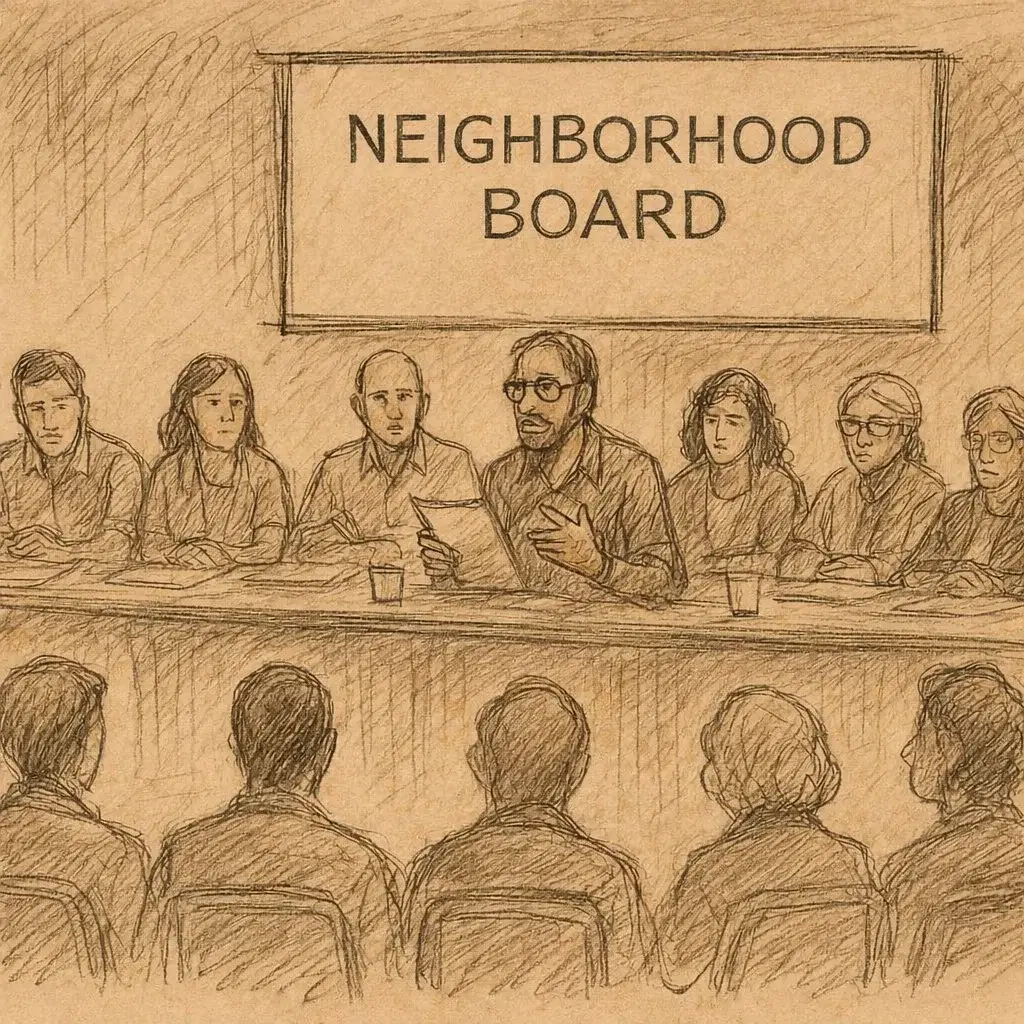
No 9 Waikīkī Legislative Engagement Committee Meeting September 2026
Listen to this article:
9 Waikiki Neighborhood Board Meeting – September 15, 2026
Street Peddling
The Legislative Engagement Committee concluded a discussion already in progress concerning street peddling, an issue that has surfaced repeatedly at Waikīkī Neighborhood Board meetings. Both committee members placed their support on the official record and agreed to ask Chair Finley to place the matter on a future full-board agenda. The committee’s action would allow the broader board to consider a formal position and possible legislative response to peddling in Waikīkī.
Shopping Cart Possession and City Council Bill 53
The committee reviewed Honolulu City Council Bill 53, which would prohibit possessing or using a shopping cart on Oʻahu unless the cart is identified by its legal owner and is being used on premises under that owner’s legal control. Under the current draft, an unauthorized user could face a fine of up to $2,000, imprisonment for up to 30 days, or both. The bill had passed first reading with support from eight sitting council members, but no committee hearing had yet been scheduled. Members thanked Council Chair Tommy Waters for introducing the measure quickly in response to concerns raised in Waikīkī and agreed to move it to the full Neighborhood Board for broader discussion and possible supportive testimony. Participants described abandoned carts crowding bus stops, entering streams and the Ala Wai Canal, occupying parks, and creating environmental, sanitation, and public-health problems. Supporters also characterized unauthorized cart use as theft whose costs are ultimately passed on to paying customers. A condominium resident reported that his building regularly contained carts from Walmart, City Mill, Nordstrom Rack, Costco, and Foodland; identifiers had allegedly been removed from some carts, and management allowed residents to use them in elevators and around the property. He suggested that condominiums instead purchase shared plastic utility carts for residents, as some buildings already do.
Bill 53 Enforcement, Stored Property, and Houseless Residents
Discussion of Bill 53 also focused on enforcement logistics and its effect on houseless people. One participant cautioned that the bill establishes penalties but does not explain how police would physically remove or impound carts. Under the city’s Stored Property Ordinance process, Department of Facility Maintenance crews—not ordinarily individual police officers—have the capacity to remove belongings, store them for approximately 45 days, or dispose of them, and questions remain about whether those crews have enough staffing, vehicles, and storage space to manage more frequent enforcement. A former law-enforcement officer explained that a cart involved in an arrest could technically become evidence; officers might photograph it rather than fill an evidence facility with carts and then attempt to return it to the original retailer. Participants suggested advocating during the City Council’s January budget deliberations for additional stored-property crews and storage capacity. Concerns were also raised that many houseless people use carts to transport essential belongings and that enforcement can result in the loss of vital records needed to obtain housing or services. Some members questioned whether fining or jailing a person experiencing homelessness addresses the underlying problem, while others argued that homelessness should not excuse theft. The committee ultimately voted to advance the bill to the full board, where these concerns and possible amendments could be discussed before the board decides whether to submit testimony. The transcript referred to bringing the matter to a “September 8” board meeting, although that date precedes this September 15 committee meeting.
Senior Property-Tax Valuation Cap and Bill 67
The committee considered Honolulu City Council Bill 67 of 2025, which would cap annual assessed-value growth for owner-occupied real property belonging to a taxpayer age 65 or older. The cap would be the lower of 2% of the preceding tax year’s assessed value or the annual inflation rate, subject to specified exceptions, and would take effect for tax years beginning July 1, 2027. The proposal was raised because older Waikīkī residents on fixed incomes have asked for lower and more predictable property-tax obligations. Bill 67 passed first reading on November 5, 2025, but the Budget Committee postponed it in July 2026 to an unspecified date. The committee agreed to bring it to the full board and discussed asking for authority to contact council members and request that it be scheduled. The Department of Budget and Fiscal Services opposes the measure because it would reduce city revenue, although no clear estimate of the loss was cited during the meeting. Some participants supported relief for kūpuna but argued that eligibility should depend on financial ability rather than age alone, noting that an affluent person over 65 could receive the benefit while a younger resident with little income would not. Others observed that an age-based rule may be easier to administer than individualized means testing. Concerns were also voiced that excessive exemptions could reduce funding for services needed by lower-income residents. The full board will be asked to explore the proposal and possible alternatives.
Home-Exemption Effective Date for New Purchasers
The committee discussed requesting legislation to change when the city’s homeowner property-tax exemption takes effect. Current rules require ownership to be recorded by September 30 for the exemption to apply in the next tax cycle, so someone purchasing shortly after that deadline may wait nearly a year while paying taxes on the property’s full assessed value. Existing exemptions are $120,000 for owners under 65 and $160,000 for owners 65 or older; beginning July 1, 2027, those amounts will rise by $20,000 to $140,000 and $180,000, respectively. As an example, the committee estimated that a $1 million home purchased on October 15 would generate approximately $3,500 in annual property tax without the exemption. A qualifying owner under 65 would otherwise reduce the taxable value to $880,000 and pay just over $3,000, saving more than $400, but would lose that immediate benefit because the purchase occurred after September 30. Participants favored linking the exemption to the date the transaction is recorded instead of a single annual cutoff and asked that Chair Waters’ office be contacted proactively to research or introduce a bill. The issue also affects local buyers acquiring property from nonresidents: one recent purchaser reportedly continued paying the prior out-of-state owner’s higher tax classification until the next cycle. The committee viewed that delay as potentially penalizing local ownership and discouraging transfers from nonresident to resident owners.
Ala Wai Boat Harbor Liveaboard Permits
The committee discussed possible state legislation or administrative action concerning liveaboard permits at the Ala Wai Boat Harbor. State law allows as many as 129 vessels to receive principal-habitation permits, yet participants understood that none were currently being authorized and that earlier permits had been revoked by the Department of Land and Natural Resources. Members asked Representative Adrian Tam and Senator Sharon Moriwaki to determine why DLNR has not exercised its authority, what past problems prompted the change, and whether legislation should require that a minimum number or percentage of the 129 authorized permits be issued. Supporters described liveaboard arrangements as one possible affordable-housing option and said there is demonstrated demand. Representative Tam said DLNR had experienced problems with liveaboards in the past but would seek a more specific explanation.
Harbor Management, Fees, and Public-Private Partnership
Representative Tam reported that he and Senator Moriwaki had introduced legislation to create a public-private partnership for managing the Ala Wai Boat Harbor while the state retains ownership of the land. A request for proposals was being drafted. He described the harbor as being in severe disrepair, partly because DLNR and its Division of Boating and Ocean Recreation lack adequate funding and charge comparatively low slip and liveaboard rates. Kewalo Basin, which is managed through a public-private partnership, was cited as a possible model. Participants discussed whether liveaboard fees could provide substantial maintenance revenue. One example assumed $250 per month for each of 129 permits, yielding $387,000 annually; at $500 per month, revenue would double. It was noted that actual rates likely vary by vessel size and may begin near $300 per month, while boat owners also face significant maintenance and utility costs. Suggestions included a graduated system in which larger or more expensive vessels pay considerably more while some spaces remain affordable. Members said issuing permits, charging appropriate rates, and reinvesting the revenue could improve harbor conditions. Representative Tam agreed to provide future updates on the partnership, permit history, and RFP.
Waikiki War Memorial Natatorium
The committee considered supporting a renewed version of Senate Bill 3291 from the 2026 session. That measure would have authorized general obligation bonds for capital improvements to rehabilitate the Waikiki War Memorial Natatorium, create a broader Waikiki War Memorial Complex, and construct a War Memorial Center. It proposed $30 million for the nonprofit War Memorials of Hawaii, Inc. to acquire land, rehabilitate the natatorium and memorial complex, and plan, design, and build the center in coordination with the Hawaiʻi Community Development Authority and business, community, government, and military organizations. The bill had only two introducers, Senators Les Ihara Jr. and Kurt Fevella, neither of whom will return to the Legislature, and it was deleted after being placed on a Senate Water and Land Committee agenda without receiving a hearing. Although the natatorium lies outside the Waikīkī Neighborhood Board’s technical boundaries, speakers described it as a major shoreline landmark and an important memorial to Hawaiʻi’s World War I veterans. Community members opposed allowing decades of neglect to end in demolition and supported identifying a viable path for rehabilitation.
Natatorium Design, Funding, and Jurisdiction
Participants examined whether responsibility for the natatorium belongs primarily to the city, the state, or both. Representative Tam agreed to review why Senate Bill 3291 stalled and to speak with Representative Tina Grandinetti, whose district includes the site, about possible legislation. Others recalled that the city completed an environmental impact statement around summer 2018 under Mayor Kirk Caldwell. That study reportedly considered four alternatives, ranging from basic hazard mitigation to major redevelopment, with a preferred concept preserving the arches and bleachers while replacing the former pool with a perimeter deck or dock following its footprint. The preferred option was estimated at roughly $40 million at the time, approximately half of the Department of Parks and Recreation’s annual capital-improvement budget, and the city had expected a nonprofit partner to raise about $10 million. Sea-level rise, storm exposure, changing pool standards, structural conditions, and escalating construction costs were cited as barriers to restoring the original ocean pool. Suggestions included the perimeter-deck concept or a smaller symbolic community pool on adjacent land. Members warned against allowing city-state jurisdictional uncertainty to leave the project without an accountable lead agency. The committee will research prior studies, funding responsibilities, and current status, and may invite mayoral staff member Andy Sugg to brief a future full-board meeting. The matter was not immediately forwarded to the next board agenda so that more information could first be gathered.
Electronic Wayfinding Kiosks and Senate Bill 2353
The committee received a status update on an effort related to Senate Bill 2353, previously described as a “billboard” proposal. A Waikīkī Improvement Association representative clarified that the intended devices are six- or seven-foot electronic kiosks rather than large overhead billboards. The kiosks would be placed on public property and could provide maps, visitor directions, restaurant and activity information, public-service announcements, emergency evacuation information, and paid marketing. Similar digital directories already exist on private shopping-center property, but legislation would be needed to authorize their use in public spaces. The Waikīkī Neighborhood Board had opposed the earlier bill because its wording appeared broad enough to allow large billboards, and legislators reportedly shared confusion about its scope. Waikīkī Improvement Association staff said Trevor, who was absent, was working on revised language that would define the kiosks more narrowly. Members saw potential value in wayfinding for residents and visitors but wanted clarity on who would select advertisements, how prominent commercial material would be, and whether public information would remain the primary function. The issue will remain on the committee’s agenda for an update, possibly before the end of 2026.
Sit-Lie Ordinance and Wheelchair Exception
The committee revisited a Public Safety Committee concern about the city’s sit-lie ordinance. Major Okamoto had reported that the ordinance’s exception for wheelchair users prevents officers from applying it to individuals in wheelchairs even when they are blocking sidewalks, loitering, aggressively panhandling, creating a nuisance, or otherwise engaging in conduct that the ordinance was intended to address. Participants emphasized the need to preserve protections for people whose disabilities require them to remain seated while allowing police to address obstructive conduct based on behavior rather than wheelchair use itself. The prosecutor’s office had been asked two meetings earlier to explore revised language and had also been communicating with Chair Waters’ office about this and other measures, including street peddling and shopping carts. No substantive update had been received, so the committee will continue monitoring the issue and may ask the council chair’s office to follow up.
Skateboarding and Multimodal Transportation
A new proposal was raised to repeal or revise Waikīkī’s prohibition on skateboarding in streets, particularly in designated bicycle lanes. One participant said he had been cited while skateboarding in the Kalākaua Avenue bike lane, and a business owner had previously reported that employees were cited for skating in the street. Members distinguished this rule from restrictions on skateboards, bicycles, roller skates, one-wheels, and similar devices on crowded sidewalks, which several speakers supported for pedestrian safety. They argued, however, that a blanket Waikīkī street prohibition is outdated when the city is trying to reduce automobile use and promote multimodal transportation. Allowing skateboards in bike lanes was presented as a micro-mobility option that could reduce congestion on Kalākaua Avenue, Kūhiō Avenue, and Ala Wai Boulevard, improve employee access to Waikīkī businesses, and complement buses, bicycles, scooters, and a possible future Skyline extension to Ala Moana Center. Others noted that skateboards lack handlebars and conventional brakes and may present greater control and injury risks in traffic. The committee agreed to place the subject on its next agenda and identify the specific ordinance for review.
Condominium Ombudsman Proposal
A resident requested early advocacy for a state condominium ombudsman’s office that could assist unit owners and associations with governance, management, construction, financial, and regulatory disputes. He described condominium associations as small governments subject to state condominium law as well as city building and safety requirements, but said owners often struggle to obtain meaningful assistance from management companies, the Department of Commerce and Consumer Affairs, the Regulated Industries Complaints Office, or the Department of Planning and Permitting. Examples cited included recurring fire-alarm failures during rain, allegedly improper waterproofing, unpermitted painting and spalling work, incorrectly installed reinforcing steel on lanais, difficulty obtaining inspections, unauthorized use of shopping carts, and fraud or embezzlement concerns. He referenced a reported $650,000 embezzlement involving Hawaiian Properties and said problems at older condominium buildings can directly affect structural and fire safety.
Ombudsman Funding and 2027 Legislative Strategy
The proposed ombudsman office has been introduced in past legislative sessions, including measures sponsored by Representative Kim Coco Iwamoto and Senator Les Ihara Jr., but did not advance. The resident said an earlier proposal was overly detailed and that a revised measure should follow simpler laws already enacted in several other states. His model would require no general-fund appropriation because it would be financed through a small assessment on each condominium owner, estimated at approximately $1.50 to $3 per unit. He criticized the recently completed Condominium Property Regime Task Force for failing to produce effective reforms, although a Legislative Reference Bureau study reportedly identified ombudsman programs operating in multiple states. He urged the committee to begin advocacy well before the 2027 session, meet with legislators, secure sponsors, and work with the chairs of the House and Senate consumer-protection committees rather than waiting for a bill number during session. He offered to provide the prior bill language, examples from other states, the task-force and reference-bureau materials, written testimony, and photographs documenting building problems. The committee chair invited him to submit those materials for a future agenda, noting that once a 2027 bill is introduced, the full Neighborhood Board could consider formal testimony.
Next Steps and Adjournment
The committee reiterated that its purpose is to provide a setting outside regular Neighborhood Board meetings where residents, board members, agency representatives, and legislators can develop ideas for city and state legislation. Several matters—including peddling, shopping-cart regulation, senior property-tax relief, homeowner exemption timing, liveaboard permits, natatorium rehabilitation, electronic kiosks, sit-lie enforcement, skateboarding rules, and condominium oversight—will either proceed to the full board or remain under committee review pending additional research. Participants were invited to email further proposals for future agendas. The meeting adjourned after the chair thanked attendees and described the session as another successful Legislative Engagement Committee meeting.