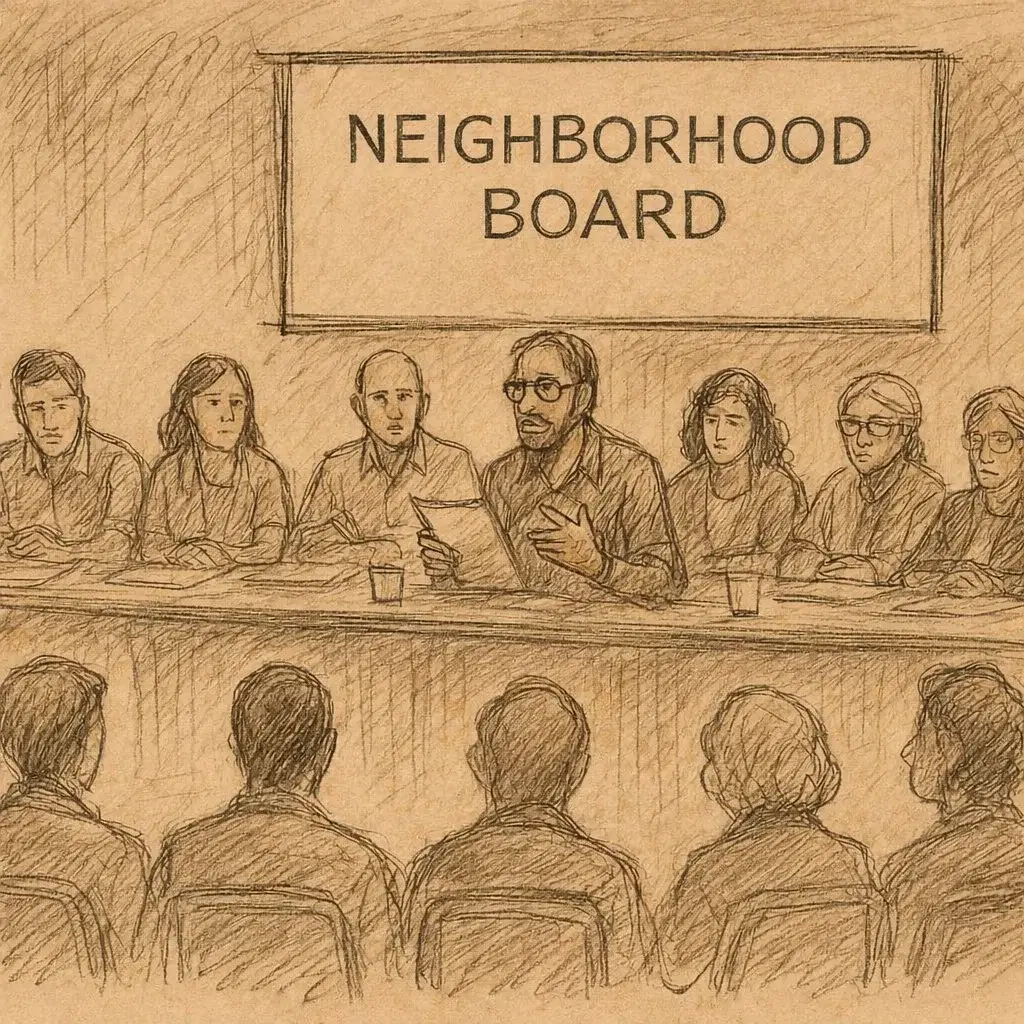
No 09 Waikīkī Neighborhood Board Regular Meeting August 2026
Listen to this article:
9 Waikiki Neighborhood Board Meeting – August 12, 2026
Board Opening and Membership
Chair Bob Finley opened the August meeting and asked members to introduce themselves. Attending in person were Catherine Henske, Lisa Cabanero, Rolf Nordahl, Cory Derazia, and Ken Jacobs from Sub-District 1; Jillian Anderson, Ren Amu, and Daniel Jacobs from Sub-District 2; and Tim Hike and Shannon Smith from Sub-District 3, along with Board Vice Chair Lou Odeshek and Chair Finley. Sarah Wirth of Sub-District 1 and Board Secretary Melissa Felix of Sub-District 3 participated online. Jordan provided sound support, and Anson served as the neighborhood assistant. Henske later corrected her introduction to state that she represents Sub-District 3 rather than Sub-District 1. The Honolulu Fire Department was initially absent and provided no report, and there was also no report from the Board of Water Supply.
Honolulu Police Department Statistics
Lieutenant Kitagawa presented Honolulu Police Department statistics for July 2026 and compared them with the previous reporting period. Robberies rose from zero to two, burglaries increased from eight to 13, assaults rose from 37 to 43, and sex crimes increased from five to seven. Thefts declined from 156 to 145, while incidents reported under the “UNV” category fell from 16 to seven. There was one citation or incident involving a bicycle or skateboard on a sidewalk, compared with two previously. Speeding enforcement produced six citations, down from 14, with no warnings or arrests in either period. Parking enforcement generated 1,409 actions, compared with 1,534 previously, and loud-muffler or prohibited-noise enforcement declined from 10 incidents to two. Park-closure enforcement increased substantially, from 41 citations and six arrests to 94 citations and 12 arrests, with no warnings. Calls for service rose from 4,554 to 4,681, and operating a vehicle under the influence, or OVUII, cases increased from seven to 11.
Late-Night Motorcycles and Fireworks
Several residents and board members again identified motorcycle noise as a major nighttime problem. Catherine Henske reported that motorcyclists had resumed gathering in the Honolulu Zoo parking lot, revving engines, circling the lot, and racing along Kapahulu Avenue as late as 11 p.m. through 3 a.m. She also described unsolicited firecrackers and larger displays occurring well beyond the Fourth of July period. Lieutenant Kitagawa said officers had been stationed in the zoo parking lot on several nights and agreed to continue and strengthen that presence. He acknowledged that July had been especially busy because of summer tourism and school vacations and said HPD hoped to devote more attention to loud-muffler enforcement during the next month.
Community Noise Monitoring Data
Waikiki resident Serge Nicholson presented independent data from a microprocessor-based noise-monitoring system that he built and operated for approximately 96 hours. He cited information from the company associated with the existing noise-camera effort indicating that motorcycles produce 72% of the measured noise. Nicholson’s chart showed motorcycle disturbances occurring approximately four times per hour overnight and as often as 16 times per hour in the evening, with Friday and Saturday identified as the busiest periods. Daniel Jacobs added that the device, placed on the 26th floor of Nicholson’s building and set to register noise over 90 decibels associated with loud mufflers rather than sirens or voices, recorded 546 events from August 7 through August 11. Nicholson proposed restricting motorcycles from selected streets or gathering areas, although HPD said it did not have unilateral authority to close streets and could instead increase enforcement. Jacobs urged HPD to move beyond repeated discussion given the duration and scale of the problem.
Legal Limits on Noise Enforcement
Public Safety Committee Chair Tim Hike explained that loud-muffler violations are generally infractions that officers must personally witness. Prior recordings or resident documentation do not automatically establish the violation, while disorderly conduct is a criminal offense but requires an identifiable victim, and an officer cannot simply serve as that victim. These legal standards restrict how HPD can use data collected by residents. Hike said the committee was working with Senator Sharon Moriwaki, Council Chair Tommy Waters, and Representative Adrian Tam on possible legislative changes that could increase penalties and make noise laws easier to enforce. He encouraged residents to attend the Public Safety Committee’s longer, issue-specific meetings for direct discussion with police representatives.
Streetlight Outage on Kuhio Avenue
Melissa Felix reported that streetlights had been completely out for several weeks along Kuhio Avenue, beginning near the Domino’s Pizza location and continuing toward Kapahulu Avenue. She associated the darkened stretch with increased numbers of houseless people sleeping near the power facility, the Denny’s parking area, and other locations along Kuhio. She planned to file a report through the Honolulu 311 system. Lieutenant Kitagawa said he would notify dispatch that evening and request attention from Hawaiian Electric or the agency responsible for the lighting outage.
Waikiki Post Office Encampment
Resident John Dutzman thanked HPD and the Waikiki Business Improvement District for addressing a growing nighttime encampment at the Waikiki post office. He said between 10 and 25 people had been sleeping on the sidewalk, front steps, and entrance area. Because the post office is federal property, HPD had lacked direct authority to issue trespass warnings without a property representative. The Waikiki Business Improvement District’s ambassadors entered into an arrangement with the Postal Service allowing them to act as authorized representatives for trespass enforcement and coordinate with police. Following the first action on a Friday, the area remained clear on Saturday and Sunday mornings. HPD described the arrangement as a successful jurisdictional coordination that allows warnings, removals, and arrests when necessary.
Commercial Loading-Zone Enforcement
Hector Uridian asked for a more efficient method of enforcing permitted commercial loading and unloading zones. He said permit holders pay about $200 annually for the right to use these spaces for approximately 10 minutes, but unauthorized vehicles frequently occupy them, sometimes for days, particularly on Namahana Street and in metered loading areas. Under the current process described by Uridian, a permit holder must call the non-emergency police number, wait 30 minutes to an hour for an officer, and then display the commercial permit before a citation can be issued for a single space. Because drivers making deliveries cannot wait that long, violations usually go unreported. He asked whether parking enforcement personnel could be authorized to issue citations directly. HPD agreed to examine the wording of the applicable law and determine whether enforcement could be improved.
Commercial Use of Public Parking Near the Ilikai
Resident Gilbert questioned whether a hot dog business near the Ilikai and lagoon-side pedestrian ramp was lawfully using public parking stalls for private commercial activity. He said the stand had regularly occupied an adjacent public stall for roughly two years and had taken two stalls the previous evening, reducing already limited public parking while operating a for-profit business. He asked whether residents should call the non-emergency police number and whether the operator’s permits could be checked. Lieutenant Kitagawa recognized the business being described and agreed to investigate its permit status.
Early-Morning Private Trash Collection
Greg, a former Waikiki board member and representative of kūpuna and retiree advocacy organizations, repeatedly raised concerns about Honolulu Disposal Service vehicles collecting trash before dawn. He said pickups and scout trucks had awakened him as early as 4:30 a.m. and that he had called HPD on consecutive mornings after drivers refused his requests to leave. He cited Hawaiʻi Department of Health rules under Title 11, Chapter 46 and said trucks had also driven the wrong direction on one-way streets. He referred to an earlier town hall at which a minimum 6 a.m. start had reportedly been discussed for complaint hotspots, although he argued that even 6 a.m. may not comply with state noise standards. Other residents said the most disruptive sound was not necessarily the impact of metal dumpsters but the repeated backup alarms of scout trucks that retrieve containers from individual buildings for extended periods.
Trash Collection Safety Debate
Council Chair Tommy Waters said the city administration, including former Managing Director Mike Formby and several department directors, had studied the issue and concluded that later pickups could create traffic and pedestrian safety problems. Delaying collection until after 6:30 a.m. could also limit a truck to one trip to the H-POWER or ReWorld facility before congestion made a second trip difficult. Residents challenged the lack of documented injuries from daytime trash collection and argued that the city was trading a hypothetical collision risk for widespread sleep disruption and health effects. Suggestions included assigning an additional employee to direct pedestrians and traffic, using quieter backup technology, beginning some collections around 9 p.m., testing rubber or plastic dumpsters reinforced with metal bases, and conducting a pilot project to determine whether daytime collection could be done safely. Waters expressed openness to a pilot, while residents requested another town hall, direct enforcement of existing health regulations, and involvement from the new managing director, HPD, the mayor, and the governor.
Commercial Food Court Noise and Odors
Arslan Kalaway, speaking for himself and his father-in-law Alexander, reported problems from a recently established food court near Keoniana Street and Kalakaua Avenue. He said approximately eight food wagons were operating there and producing continuous amplified music and cooking odors. The noise prevented his father-in-law from resting and made it difficult to open apartment windows during hot weather. The family had called police twice and was directed to the neighborhood board. Chair Finley said the City Council was working on legislation related to such issues and encouraged the residents to raise the matter with the council representative. Daniel Jacobs said he knew the property owner and would make contact. He also recalled a prior presentation proposing a roughly nine- to 11-story private college or university building on the site, suggesting that the food-truck use may be temporary, although the current development status was unclear.
Ilikai-Area Towing Before Closing Time
Gilbert also reported that a city-contracted towing company appeared to be removing vehicles from public parking near the Ilikai before the posted 10:30 p.m. closing time. He had witnessed and photographed a vehicle being towed at approximately 10:10 p.m. and submitted the evidence to police so the owner would know the vehicle had been removed prematurely. He believed the vehicle belonged to a visitor and asked the city department administering the towing contract to review whether the contractor was complying with its terms.
Kuhio Beach Restroom Closure and Sanitation
Nicole Anchetta again asked for a specific timetable for reopening the Kuhio Beach restroom, which she said had been closed for four years. She described a series of shifting explanations: replacement parts were reportedly ordered in September with a six- to eight-week delivery estimate; the parts were still unavailable in December; a March 2 reopening date passed without completion; and workers later returned after parts were said to have arrived, only for an electrical issue to delay the project again. Anchetta said a mechanical contractor had already identified an electrical issue near the beginning of the year, so the latest explanation did not appear new. She also described inconsistent cleaning near Ohua Avenue, standing water around showers, and a pond-like area that children enter even though it may contain bleach or water used for bathing. She requested warning signs, regular cleaning, and a definitive repair schedule rather than referrals to restrooms approximately a quarter-mile away.
Restroom Funding and Enforcement
Council Chair Waters said the City Council had appropriated money for restroom repairs, but execution of the work rests with the mayor and city administration rather than through a bill ordering a specific bathroom to be fixed. He said deteriorated restrooms are an islandwide problem and that newly repaired facilities are sometimes quickly damaged. He advocated more frequent park-staff checks—potentially several times daily—to address people disconnecting water lines, bathing in facilities, or leaving water and damage behind. He agreed that the community and council should continue pressing the administration for immediate completion of the Kuhio Beach project.
Affordable Housing and Area Median Income
Jason Liang clarified comments he had made at the previous meeting about an EAH affordable-housing proposal. He supports developing the housing but asked the board and developer to ensure that some units are committed to households earning 30% or less of area median income, a group he described as severely underserved by existing affordable-housing programs. He asked the board to retain this priority as the project moves forward and to seek a clear commitment from the developer regarding the number of extremely low-income households to be served.
Property-Tax Assessment Proposal
Liang announced that the inaugural meeting of a property-tax committee had taken place on July 17. Participants discussed a proposal modeled on California’s Proposition 13 that would generally freeze a property’s assessed value at the time of sale and limit subsequent assessment growth to approximately 2% annually. He invited interested residents to contact Bruce Wong at bwboom@gmail.com for information about future meetings.
Election Concerns and Voter Turnout
Chair Finley congratulated candidates and voters who participated in the primary election and encouraged Waikiki to equal or exceed that turnout in the remaining election. Tim Hike separately expressed anger that his vote had been “nullified,” said he planned to call for the city clerk’s resignation at the next City Council meeting, and asked the board to place the issue on a future agenda so it could formally object. The discussion later connected to litigation over Council Chair Waters’ eligibility to seek another term and the treatment of votes cast in that contest.
Jillian Anderson Named Sub-District 2 Vice Chair
The board returned to a nomination made at the previous meeting for Jillian Anderson to serve as vice chair of Sub-District 2. Because Anderson had not been present at that earlier meeting, the board could not complete the selection then. No additional candidates or objections were offered, and Anderson was confirmed by unanimous consent.
Community Proposals for New Committees
Laura Ruby asked the board to sponsor clean-elections legislation that would prohibit political action committee money and include other campaign-finance reforms. She also suggested establishing a flood-mitigation committee similar to committees operating in the McCully and Mānoa neighborhoods. In anticipation of future rail planning through or near Waikiki, she recommended a transportation or rail committee so residents could develop a position on whether transit should run at street level, use a streetcar model, or be elevated near high-rise buildings. She urged neighborhood boards to shape these decisions through coordinated, community-level planning.
Upcoming Waikiki Events
The board announced several scheduled events expected to affect traffic and activity in Waikiki. The Aloha Festivals Waikiki Hoʻolauleʻa was listed for Saturday, September 19, from 2 p.m. to midnight. The annual Aloha Festivals Floral Parade was scheduled for Saturday, September 26, from 8:30 a.m. to 1 p.m.; Chair Finley said it was believed to be the 80th parade, excluding the COVID interruption. The annual Duke’s OceanFest was scheduled from August 14 through August 24, with events centered near Kalakaua Avenue and Kuhio Beach and expected traffic impacts. Some OceanFest activities might require paid admission.
Liquor License Request
The only liquor-license matter reported was an application from Oshira Mama Waikiki restaurant at 2490 Kalakaua Avenue. The establishment requested a special license beginning September 1, 2026, and running through August 31, 2027, to provide time for the Honolulu Liquor Commission to schedule a formal hearing. No additional information or board action was presented.
New Driver’s Licenses and Veteran Plates
Mayor’s representative Nola reported that the city had introduced a redesigned Hawaiʻi driver’s license and identification card with a pastel rainbow design, a humuhumunukunukuāpuaʻa and coral reef on the back, and enhanced anti-counterfeiting, identity-theft, and fraud-prevention features. Existing cardholders do not need to replace their licenses or IDs before normal expiration. She also announced a Purple Heart specialty license plate marked “Combat Wounded.” Eligible veterans may purchase the plate for a one-time fee of $5.50.
New Police Chief David Lazar
The mayor’s office welcomed new Honolulu Police Chief David Lazar, formerly of San Francisco, whose wife’s family is from Oʻahu. Nola described him as hands-on, innovative, and forward-looking and said he was aware of the mayor’s policing priorities for Waikiki. Lazar planned to visit neighborhood boards and communities across the island. Chair Finley separately reported attending an August 6 meeting between the new chief, neighborhood board chairs, and City Council members. Approximately 30% of neighborhood board chairs attended and offered recommendations. Finley directed Waikiki’s detailed police concerns to the Public Safety Committee and said he looked forward to Lazar attending a future Waikiki meeting.
Reduced School-Zone Speed Limits
The mayor’s representative announced that the city had reduced the school-zone speed limit from 25 mph to 20 mph when children are present, applying from 6 a.m. to 6 p.m. on school days. Signs will be installed or replaced within 1,000 feet of schools. Because Oʻahu has more than 200 schools, the full sign replacement program is expected to take several years.
Oʻahu Clean Water Survey
The Department of Environmental Services invited residents to complete the Oʻahu Clean Water Survey by August 23, 2026. The survey is intended to identify public priorities for water quality and guide an integrated plan directing future funding toward wastewater and stormwater improvements. Nola noted that the issue is particularly relevant in dense communities such as Waikiki and asked the board to publicize the survey through its website.
Closure of Economic Revitalization Programs
Nola confirmed that the Office of Economic Revitalization would cease operating after August 14 because of funding cuts. Programs ending or being suspended included approximately $4 million in grants for businesses affected by the Kona Low storm, door-to-door small-business outreach, business connection hubs, the Idea2Biz incubation program, support for community business events, workforce development, regenerative tourism, and innovation and technology assistance. Board member Nate Sroka attributed the loss of services to budget reductions approved by six council members, including Waikiki’s representative. Residents asked what would happen to existing projects and data previously supported by the office.
Building Energy and Resiliency Reporting Dispute
Board members expressed concern about a resiliency or benchmarking report requiring condominiums and commercial buildings to provide electricity, water, gas, and waste-use data. Some condominiums had reportedly paid contractors as much as $6,000 to complete the submission. Henske asked whether buildings would be reimbursed, how the collected data would benefit participating properties, and whether major hotels had been required to complete the same process. Finley initially connected the program to the Office of Economic Revitalization’s closure, but Sroka clarified that the reporting program is administered by the Office of Climate Change, Sustainability and Resiliency and therefore was not among the discontinued economic-development programs. Participants also recalled conflicting guidance, including a statement attributed to Chair Waters that buildings did not have to file. The mayor’s representative agreed to investigate the program, its costs, the treatment of submitted data, and whether requirements had been applied consistently.
Noise-Camera Placement
Nicholson asked Representative Adrian Tam’s office to consider relocating the state’s existing noise camera from Ala Moana to Kalakaua Avenue, where he believed it would capture traffic feeding into Waikiki from three streets rather than monitoring only one traffic flow. Tam’s representative agreed to relay the suggestion to Transportation Director Ed Sniffen and said cameras could potentially be moved or expanded if the pilot program becomes permanent.
Keoniana Street Affordable-Housing Construction
Greg requested an investigation of construction at 444 and 448 Keoniana Street, where two single-family homes had been demolished and a 50-unit affordable-housing project was reportedly underway. He said pile driving had begun, workers had occupied much of the street with A-frames, and he could not find posted permits for the reserved parking. He was particularly concerned that the work appeared to be proceeding through a special assignment inspection rather than the normal building-permit process, which he believed reduced public notice and standard review. He also asked the city to remove extensive graffiti from the construction fence. Sarah Wirth performed a quick permit search and reported finding a demolition permit and four open or in-progress permits, including trenching work, although she could not confirm that all approvals were complete. The mayor’s and legislative representatives were asked to investigate further.
Governor’s Office Report
Governor’s representative Yvonne reported a strong electoral mandate for the governor and highlighted a record number of Department of Hawaiian Home Lands awards in July, totaling a couple hundred. She agreed to relay concerns about early trash collection, state noise regulations, and the Keoniana Street development. Tim Hike suggested that the state consider plastic or otherwise quieter dumpsters to reduce collection noise. Finley also offered historical advice related to the next Western Governors conference, recalling that special license plates used during a 1968 gathering had helped official vehicles avoid parking and speeding complications.
Centennial Park Construction
Rob Hale, chair of the Honolulu Rotary Club Centennial Park Committee, updated the board on the Rotary-supported city park. The Rotary Club signed its agreement with the city in 2016, but unforeseen conditions raised the estimated cost to roughly four times the original amount, forcing construction into phases that could begin only when funding was available. The first phase made the property green and opened it to the public. The current phase, intended to complete the park’s major construction, will replace the perimeter chain-link fence with a wall consisting of a low rock base and metal pickets. The new fence will sit on the actual park property line, leaving a larger green area outside it. The park is closed during construction and is expected to remain closed through the end of October. Remaining work after the fence includes signage and landscaping modifications.
Centennial Park Maintenance, Dogs, and Chickens
Hale said maintenance, dogs, homelessness, pigeons, and chickens had all become recurring operational concerns, with chickens currently generating the most complaints, including reports of roosters waking neighbors at 3 a.m. One suggestion was to allow more dogs in hopes that they would discourage chickens, but Hale noted that even a small percentage of dog owners failing to clean up had driven away children, picnickers, and people seeking to sit on the grass. Torch ginger had looked attractive but required weekly hand trimming beyond the city’s staffing capacity and created hiding spaces for unhoused people, so landscaping will be adjusted to make the park easier to maintain and more open. Hale hoped to develop a relationship with the Waikiki Business Improvement District or similar ambassador program because the Parks Department has no dedicated enforcement officers and must call HPD for minor violations. Once the new gates are installed, an existing contractor or ambassador group may be able to add Centennial Park to its nightly park-locking route. The city did not currently plan to widen surrounding sidewalks, and the exterior green space may instead function as a dog-walking area.
Recognition of Board Members
Council Chair Waters presented commendations to Catherine Henske and Jillian Anderson. Henske was recognized for long-term service on the Waikiki Neighborhood Board and broader civic and nonprofit volunteerism. Anderson was recognized for her work as research director for the Hawaiʻi State Minority Caucus, her neighborhood board service, and her leadership of the Legislative Engagement Committee. Waters also asked residents to support Shannon Smith’s pending commission appointment at the following day’s council meeting, although the specific commission was not identified.
Illegal Peddling and Street Performers
Waters discussed Bill 52, which would increase penalties for illegal peddling. Residents described persistent peddling along Kalakaua Avenue, sometimes involving alleged fraud. The bill is separate from a developing proposal to authorize street performers in designated areas through registration, payment of a fee, and possession of a general excise tax license. Waters said the Waikiki Business Improvement District was willing to assist, but city departments had been reluctant to administer the program. He was considering assigning responsibility to the Department of Enterprise Services through legislation and said the board’s help would be needed to select appropriate performance locations.
Shopping Cart Legislation
Bill 53 would make possession of a retailer’s shopping cart outside the associated shopping property unlawful and give police authority to confiscate it. Waters and Hike said more than 3,000 carts had been collected by the city during the previous year and that abandoned carts block sidewalks and waterways and are frequently found in the Ala Wai, harbors, and streams. Replacement costs were estimated at approximately $350 for carts bought cheaply in bulk and up to $1,000 each in other circumstances. Because grocers absorb those losses and are not necessarily insured for them, the speakers argued that shoppers ultimately pay through higher food prices. Board members were encouraged to testify, and a future board agenda may include formal support for Bills 52 and 53.
Homeowner Exemptions and Vehicle Taxes
Waters said Bills 45 and 46 would raise the real-property homeowner exemption from $140,000 to $160,000 and the kūpuna exemption from $180,000 to $200,000. Bill 47 would reduce or otherwise revise the city’s motor-vehicle weight tax, currently described as 7.5 cents per pound. Some owners of heavier vehicles pay close to $700 annually, substantially more than comparable charges on neighboring islands. Waters estimated that the bill as drafted could reduce city revenue by approximately $34 million and said he was considering an amendment excluding commercial vehicles so the relief would focus on residents.
Parking Near Hiking Trails
Bill 54 would address parking near popular hiking trails, particularly in neighborhoods where visitors block residential driveways, use private garden hoses to rinse off, and leave trash. Waters said online publicity had increased use of formerly less-known trails. Although the measure was not directed specifically at Waikiki, it was included among his pending council proposals.
Protection of Aquarium Fish
Resolution 26-159 would urge the State Board of Land and Natural Resources and the Division of Aquatic Resources to prohibit the commercial harvest of aquatic life from state marine waters for aquarium purposes. Waters said DLNR was preparing rules that would again permit collection and shipment of Hawaiʻi’s tropical fish to mainland aquariums. The resolution characterized that activity as unsustainable and asked the state to continue prohibiting it.
Council Term-Limit Litigation
Residents questioned Waters’ decision to seek another term after litigation raised concerns about whether his prior three-and-a-half-year term counted as a full term under the charter. Sarah Wirth and Greg argued that the public intended to limit council members to two elected terms and criticized the resulting uncertainty and nullification of votes. Waters said the legal language was open to interpretation because he had not served a full four-year term and that the Hawaiʻi Supreme Court should decide. He noted that under the lower-court reasoning, even a shortened one-year term might count as a full term for term-limit purposes. Waters said he expected to remain in office through January and did not want to serve where voters did not want him, pointing to the nearly 9,000 votes he had received. He also praised opponent Jason Lee’s campaign and encouraged him to remain involved.
Emergency Management Reviews
Hike asked when the council would hold a hearing on emergency-management performance and when after-action reports would be released for the recent tsunami response and the Kona Low storm. Waters said he had finally received the report for a tsunami warning that occurred roughly a year earlier and would distribute it to board members. He acknowledged severe evacuation gridlock on the Ala Wai and surrounding streets and said the city must learn from the event, particularly because a future locally generated tsunami may provide only an hour of warning. He noted that vertical evacuation or sheltering in place on upper floors may be more appropriate in some situations. The Kona Low after-action report remained outstanding, and Waters promised to continue pressing for it.
Kapahulu Crosswalk Improvements
Rolf Nordahl thanked Waters for funding and supporting work on Kapahulu Avenue crosswalks. The crossings had been repainted, and new pavement markings warning of pedestrian crossings had been added. He described the completed work as a long-awaited safety improvement.
Public Safety Committee Report
The Public Safety Committee met on July 29 at the Waikiki Business Improvement District office with online participation. Representatives from the Honolulu Prosecuting Attorney’s Office and HPD, including Major Okamoto, attended. The committee reported that the Safe and Sound Waikiki program had contributed to an overall reduction in crime. Discussion covered loud noise, traffic, homelessness, mental health, and substance abuse. The prosecutor’s office was reviewing the wheelchair exception in the sit-lie ordinances, while the Business Improvement District was encouraging business owners to press charges when crimes are committed against their establishments. Future work will consider increased penalties and more enforceable noise laws. The committee hoped to host a judiciary representative at its next meeting and later planned to examine how drug trafficking affects young people. Hike asked that committee minutes be attached to future board agendas so meeting reports could focus only on major developments.
Legislative Engagement Committee
Jillian Anderson announced that the Legislative Engagement Committee’s second meeting would be held Tuesday, August 25, at 6 p.m. at the Waikiki Business Improvement District headquarters. An agenda was expected approximately one week beforehand. She invited residents and board members to propose topics and hoped elected officials or their staff would participate. Anderson noted that peddling and abandoned shopping carts had been discussed at the committee’s first meeting and were already the subjects of City Council legislation, which she viewed as encouraging evidence that committee discussions could lead to action.
McCully Bridge Guardrail Repair
Anderson reported progress on the damaged guardrail where McCully Street turns onto Ala Wai Boulevard. A vehicle crashed through the southwestern section in October 2023, and the city installed a temporary repair using wood and orange netting in place of the original metal barrier. Following inquiries from residents of nearby condominiums, Anderson contacted the city and learned that the permanent repair had apparently fallen off the city’s active radar. The project has now been revived and is expected to be put out for bid during the current fiscal year.
Honolulu Zoo Education Tour
Henske announced that the Honolulu Zoo had offered an educational tour to two or three board members. Although the zoo is outside the relevant sub-district boundary, Rolf Nordahl and Melissa Felix expressed interest. Nordahl was asked to coordinate participation with Felix.
Minutes and Meeting Procedures
The board approved the previous month’s minutes with one abstention from Sarah Wirth. Greg noted that he had participated and spoken at the prior meeting but was not listed among attendees, and Chair Finley agreed to correct the record. Greg also objected to the board’s earlier decision to impose an 8:30 p.m. ending time without first placing the change on the agenda, arguing that the regular monthly meeting is where many residents prefer to raise concerns. The board anticipated receiving an updated Neighborhood Commission guidebook, the first major revision in approximately 10 years, summarizing meeting procedures under the Neighborhood Plan, state law, and Office of Information Practices guidance.
Kalakaua Avenue Utility Construction
Chair Finley announced that Hawaiian Electric would conduct street construction near the Kalia Cultural Entertainment Center at 2055 Kalakaua Avenue, close to Fort DeRussy. Work was scheduled from August 17 through October 17, excluding weekends and holidays. The extended project will involve digging in Kalakaua Avenue and may affect traffic and access in the area.
Adjournment
With no further business and the meeting finishing earlier than expected, Chair Finley formally adjourned the August 12, 2026 meeting, joking that he had never been provided a gavel.