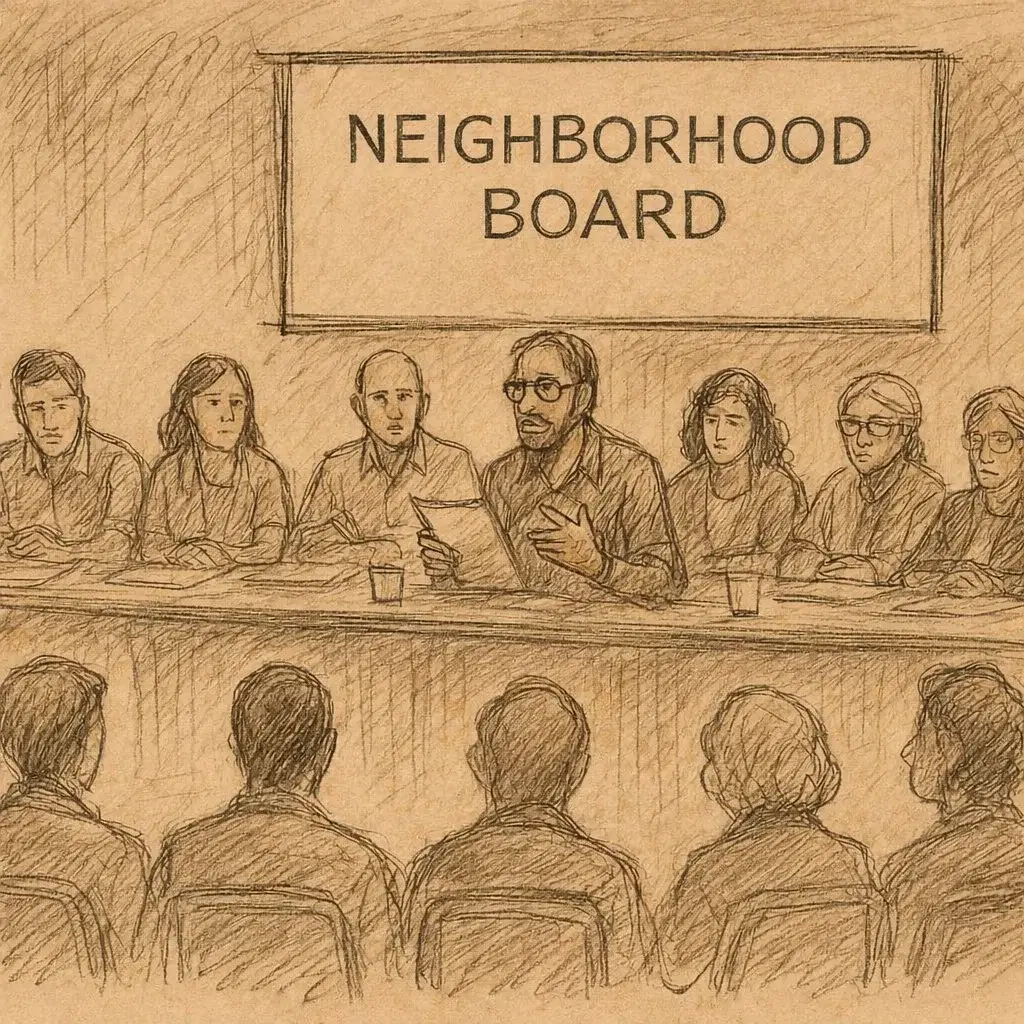
No 25 Mililani-Waipi'o-Melemanu Neighborhood Board Regular Meeting July 2026
Listen to this article:
25 Mililani-Waipio Neighborhood Board Meeting – July 23, 2026
Opening, Hybrid Meeting Arrangements, and Quorum
The Mililani-Waipiʻo-Melemanu Neighborhood Board No. 25 convened its first regular meeting of the 2026–2027 term at Mililani High School. Although the meeting title identifies July 23, the chair announced the meeting as Wednesday, July 22. Because the board’s usual H Building meeting room was unavailable, the in-person portion was held in the school cafeteria; future meetings were expected to return to the H Building. The meeting was conducted in a hybrid format with both in-person and online participation, and attendees were reminded to raise their hands and wait to be recognized to maintain order and decorum. The initial roll call found 18 members present, establishing a quorum, with additional members joining or confirming attendance later.
Election of Board Officers
The board elected officers for the 2026–2027 term. Danielle Bass was nominated to continue as chair and was elected with 21 votes in favor, none opposed, and no abstentions. Trevor Nagamine was the sole nominee for vice chair and accepted the nomination; the roll-call vote recorded 21 votes in favor, no opposition, and one abstention. The transcript then states that Sabrina Gustafson was elected secretary, although the recorded nomination and vote immediately preceding that announcement concerned Nagamine’s vice-chair nomination, creating an inconsistency in the meeting record. Ed Flores was nominated and unanimously elected treasurer with 21 votes in favor. Following the elections, the board proceeded with regular business.
Honolulu Fire Department Activity and Hiking Safety
Captain Marrero of the Mililani Fire Station reported June activity consisting of one structure fire, 12 activated alarms without fires, 64 medical emergencies, one motor-vehicle collision involving a pedestrian, and two other motor-vehicle crashes. The department’s monthly safety message focused on summer hiking. Residents were advised to select trails appropriate to their skill and stamina, consult official trail information at hawaiitrails.org, check rain, wind, and swell forecasts, stay on marked trails, avoid leaving a trail for photographs, hike with a companion, tell someone their plans, and allow enough time to return before dark. No questions were raised.
Honolulu Police Department Crime and Enforcement Statistics
Lieutenant Romel Baisa of the Honolulu Police Department’s Wahiawā station reported that Mililani experienced one assault, three burglaries, no robberies, four unauthorized entries into motor vehicles, and 770 calls for service during the preceding 30 days. Across the wider district covering Mililani, Wahiawā, and the North Shore, officers issued 549 parking citations, 598 traffic infractions, 87 traffic-crime citations, and 94 criminal citations. Police made 89 arrests associated with 164 charges. Because car break-ins had increased, HPD advised residents to remove or conceal all items from parked vehicles, including objects that may not appear valuable but could still prompt a thief to break a window. Drivers were urged to lock and physically check their vehicles, use factory-installed alarms, park in bright and well-traveled areas, use garages or driveways at home when possible, and position vehicles within range of security cameras or motion-activated lighting. No questions were asked.
Army Aviation Report
The agenda included a report from the U.S. Army Combat Aviation Brigade, 25th Infantry Division, but no representative was present online, so the board moved on without an update.
Board of Water Supply, Main Break, Xeriscape Sale, and Heavy Water
Kathleen Pahinui of the Honolulu Board of Water Supply reported a four-inch water-main break at 95 Levanʻu Place on June 22. She also announced the annual plant sale at the Halawa Xeriscape Garden on Saturday, August 1, from 9 a.m. to 1 p.m. The event would feature drought-tolerant, low-water plants, with shuttle service from parking near the industrial area and Department of Facility Maintenance yard. Responding to a question raised at the previous meeting, Pahinui explained that heavy water, or deuterium oxide, is water in which ordinary hydrogen atoms are replaced by the heavier hydrogen isotope deuterium. It is not radioactive, is safe in small amounts, and naturally makes up about 0.015% of normal water—roughly one molecule out of every 6,700. The Environmental Protection Agency neither regulates nor requires testing for heavy water, so it does not appear in standard water-quality reports.
Waterborne Illness and Produce-Washing Safeguards
Board member Marilyn Lee asked whether gastrointestinal illnesses occurring on the mainland could threaten Oʻahu’s drinking water. Pahinui explained that the Board of Water Supply operates a closed, pressurized distribution system and chlorinates water before distribution. Contamination would generally require an unusual failure, such as a reservoir running dry in combination with failed backflow protection or a pipe rupture that allowed outside material to enter. The utility would respond by flushing and taking other required corrective measures. Regarding locally grown produce, Pahinui said federal food-safety requirements—identified by the acronym FSMA—require fresh, potable water for washing and preparing vegetables, with the Hawaiʻi Department of Health responsible for regulation.
Recognition of Senator Michelle Kidani’s Staff
The board presented community service awards honoring the staff of retiring Senator Michelle N. Kidani. The chair credited board member Anne Freed with suggesting the recognition, community service awards chair Josie Kaʻanehe with preparing the certificates, and staff from the Neighborhood Commission Office and associated neighborhood boards with assisting. Lisa Barnett was recognized for serving as Senate Education Committee clerk from 2022 through 2026 and supporting measures including Act 156, Hawaiʻi’s first Harm to Students Registry, and Act 139, which expanded free school meals and protections against lunch shaming. Denisha Honda was honored for service beginning as a legislative aide in 2018 and as office manager from 2019 through 2026, including work supporting the Menstrual Equality Act and Act 242. Rihanna Ramos was recognized for joining the office in 2025, later becoming communications and community liaison, coordinating the annual student showcase during Legislative Education Week, and supporting Act 240, which allows qualifying veterans to receive high school diplomas. Arlen Redoble was honored for service as a 2025 summer intern and 2026 session staff member, constituent assistance, and commitment to learning the legislative process.
Additional Kidani Staff Recognitions
Mary Murrow was recognized for serving as community and constituent liaison from 2023 to 2024 and organizing the first statewide student showcase during Education Week at the State Capitol. Park Kalea Vahea was honored as Senator Kidani’s first office manager from 2009 through 2012 and for continued Senate service as deputy sergeant at arms beginning in 2016. Trevor Nagamine was recognized for serving on Kidani’s legislative session staff from 2009 through 2016 and later maintaining the connection between the senator and the neighborhood board by presenting and following up on monthly office reports through her retirement. Will Kane was recognized for serving as committee clerk from 2011 through 2014 while Kidani was vice chair of the Senate Ways and Means Committee, supporting capital-improvement funding, budget deliberations, and legislative negotiations. Joan and Jim Manke, who could not attend, were also recognized and were to receive certificates separately.
Senator Michelle Kidani’s Legislative and Community Legacy
The board honored Senator Michelle Kidani for 18 years in the Hawaiʻi State Senate and more than three decades of community leadership. The recognition recounted her Kanaka Maoli heritage, graduation from Farrington High School, early employment at Dole Cannery, a law office, and Hawaiian Telephone Company, and her move to Mililani Town in 1975. It noted her years coaching Bobby Sox softball, service beginning in 1995 on the Mililani Town Association board—where she became its longest-serving member—and earlier service on Neighborhood Board No. 25 and as executive assistant for the Neighborhood Commission Office. In the Senate, Kidani served four years as vice chair of Ways and Means, 10 years as chair of the Education Committee, later as its vice chair, and ultimately as Senate vice president. Her record included funding for the continued development of the University of Hawaiʻi–West Oʻahu, the Daniel K. Inouye College of Pharmacy at UH Hilo, and hundreds of millions of dollars in improvements to public schools statewide, including Mililani schools. She was credited with helping establish the School Facilities Authority and the Alternative Learning Program Support and Services initiative, Papahana o Kaiona.
Kidani’s Education and Student-Welfare Laws
The board highlighted several laws associated with Kidani’s legislative work. These included the Menstrual Equality Act, Act 113 of 2022, providing free menstrual products in public schools; Act 156 of 2024, creating a statewide Harm to Students Registry; Act 139 of 2025, broadening access to free school meals and protecting students from lunch shaming; and Act 240 of 2026, allowing veterans whose schooling was interrupted by military service to receive high school diplomas. The board praised Kidani’s integrity, compassion, commitment to public education, and service to Mililani and Hawaiʻi, congratulating her on retirement. The meeting recessed from 7:44 to 8 p.m. for presentation of certificates, lei, and photographs.
Mililani Educator Workforce Housing Purpose and Demand
Sherry Nakamura of the Hawaiʻi School Facilities Authority presented an update on the educator workforce housing project planned for Mililani High School, now officially named Kumelevai Hale. The authority and development partner Pacific Housing Assistance Corporation thanked residents and board members who participated in the environmental review, acknowledging that the project had a difficult beginning and that community comments shaped the final environmental assessment. Nakamura said housing costs remain a major obstacle to recruiting and retaining public-school teachers. Department of Education survey data showed that half of new teachers leave the profession within five years, approximately 40% may leave because of housing affordability, and 70% of educators who do not own homes would consider educator workforce rental housing. Among teachers at risk of leaving, 75% said they would remain if rental housing were available, while slightly more than half said they would likely sign a lease. Mililani ranked first among desired workforce-housing locations, reflecting its central access to nearby schools as well as the North Shore, ʻEwa, the Leeward Coast, and Honolulu.
Workforce Housing Site, Parking, and Project Schedule
The proposed development would occupy the southwest portion of the Mililani High School campus and include residential buildings, a courtyard, parking, landscaping, and replacement parking for spaces displaced by construction. The authority showed how the replacement lot would be reached and said traffic circulation and safe access remained under review. The agency continued discussing residents’ requests for a left turn out of the housing lot and possible use of the school’s signalized entrance. The project’s final environmental assessment had been completed and published, and Pacific Housing was preparing for the building-permit process. If work remains on schedule, construction could begin in the third quarter of 2027, continue for approximately two years, and finish in the second quarter of 2029. Building preparation would then occur, with educator occupancy targeted for the third quarter of 2029.
Environmental Assessment Findings and Public Comments
Consultants from PBR Hawaiʻi and AECOM summarized the environmental review. The draft environmental assessment was published January 23, 2026, beginning a 30-day review period that ended February 23. The final assessment and a finding of no significant impact were published May 23. Seventeen comments were submitted by six state agencies, several city departments and agencies, Hawaiian Electric, the neighborhood board, and four individuals. State reviewers included the departments of Defense, Education, Health, and Transportation and the Office of Planning and Sustainable Development. City reviewers included the departments of Design and Construction, Environmental Services, Facility Maintenance, and Planning and Permitting, along with the Honolulu Fire Department. Revisions added information about the DOE covered-play-court project, an additional participant in the cultural impact assessment, updated transportation analysis, U-turn volumes, and a new parking section and figure showing the relocated parking area. The transportation study will be updated again one year after occupancy.
Board Comments Addressed in the Final Assessment
The neighborhood board’s comments covered transportation, project costs and infrastructure, workforce need and equity, accessibility, site planning, school operations, security, property management, alternatives, cumulative effects, and community relations. The transportation report was revised to discuss study intersections, current counts, U-turns, possible signalization, and multimodal strategies, and both the state Department of Transportation and city Department of Transportation Services reviewed the analysis. Housing demand was addressed in the assessment and supporting appendix, while rent estimates, eligibility, and tenant priorities will be released separately once financing is set. The project will comply with Americans with Disabilities Act requirements and undergo Disability and Communication Access Board review. Plans call for a perimeter fence, secured entrances, coordination with the school during farmers markets and sporting events, a live-in manager, compliance administration, and maintenance personnel. Pacific Housing also intends to establish “good neighbor” practices covering operations, repairs, maintenance, and community coordination.
Housing Cost, Rent Levels, and Eligibility
Board member Anne Freed asked about construction cost, rents, and what would happen if teachers could not afford or fill the units. The current overall project estimate was approximately $80 million. Exact rents could not yet be established because they will depend on financing, construction costs, the year the project opens, and federal area median income calculations. The plan is to offer units across income levels at or below 120% of area median income. Teachers are expected to receive first preference, followed by other education employees under a preference list that was still being developed. Nakamura said the authority did not intend to open the development to the general public and emphasized that the financing and operating structure must preserve affordability. Freed clarified that she viewed the project as critical and noted that it originated as a Senator Kidani initiative.
Traffic Signals, Ingress, and Egress
Board member Sabrina Gustafson asked whether another traffic signal could legally or practically be installed near existing signals. AECOM representatives said there is no mandatory code spacing between signals, though a quarter mile is a common guideline. The distance between Kamehameha Highway and the Anania intersection is approximately a quarter mile. Current counts showed fewer than 30 vehicles per turning movement, well below typical signal-warrant thresholds of roughly 75 to more than 100 vehicles over the relevant periods, so the proposed intersection did not presently warrant a signal. Consultants noted that future decisions would also consider traffic volume and safety conditions.
Potential Access Through the School’s Signalized Entrance
Board member Dennis asked whether a gate could allow housing residents to use the existing signalized intersection at Anania Drive and Meheula Parkway rather than entering and exiting directly on Meheula Parkway. The project team explained that another planned project between the housing site and athletic fields complicates direct internal access. Nakamura said discussions were continuing with DOE and other stakeholders to balance resident access, student safety, separation of the housing development, and school operations. Chair Bass emphasized broad community concern about vehicles turning left across Meheula Parkway near the Church of Jesus Christ of Latter-day Saints, the post office, and an existing U-turn area used by motorists traveling between southwest Mililani and commercial destinations. She suggested that the board consider a future resolution supporting departure from the housing development through the controlled Anania Drive–Meheula Parkway intersection. No resolution was introduced or adopted at this meeting.
Hawaiian Name of the Housing Project
Board member Darsha Lee followed up on her earlier question about the Hawaiian word order in “Kumelevai Hale” rather than “Hale Kumelevai.” Nakamura said the naming consultant’s recommendation was to retain Kumelevai Hale but agreed to provide Lee with a written explanation of the linguistic reasoning.
Regular Meeting Schedule and Hybrid Format
The board unanimously approved its regular schedule for the term: meetings will occur on the fourth Wednesday of each month at 7 p.m. at Mililani High School, with a virtual participation component. After a late vote clarification, the final count was 23 in favor, none opposed, and no abstentions.
Board Recess Schedule
Chair Bass initially proposed three recesses during the term: August 26 and December 23, 2026, and April 28, 2027. Some members objected that three canceled meetings would reduce public access, delay committee work, and force more business into longer agendas. Other members supported retaining three recesses or at least preserving winter and spring breaks. Bass amended the proposal by removing the August recess. The board approved two recess dates—December 23, 2026, and April 28, 2027—with 20 votes in favor, none opposed, and three abstentions.
Public Testimony Rules
The board adopted a general three-minute limit for public comments, while allowing presentation length to be set by agreement between the presenter and chair. Anne Freed argued that three minutes could be too short for complex issues and suggested five minutes. Bass responded that a formal limit is necessary when attendance and testimony are heavy, citing a prior School Facilities Authority meeting with approximately 150 participants, while noting that the chair has discretion to allow additional time. The rule passed unanimously, 23–0.
Board Committees for 2026–2027
The board unanimously authorized the creation of nine committees for the new term. Their subject areas are community partnerships and outreach; community recognition and service awards; community maintenance and walk audits; planning, zoning, sustainable development, and climate resilience; transportation and the Oʻahu Metropolitan Planning Organization; military affairs and emergency management; health, houselessness, and human services; parks and recreation; and education. Committee membership and chair appointments were left to the board chair following the meeting. The June 24 meeting minutes were also approved without correction.
Wahiawā Pedestrian Bridge Community Meeting
Community member Nani Brown announced a meeting concerning the Wahiawā pedestrian bridge at the Whitmore Village Community Center on Friday, August 28, at 6 p.m. The meeting would involve the State Department of Transportation, and Brown asked Mililani residents to attend in solidarity with the Wahiawā community. She said she toured the site with a Hawaiian Civic Club on May 18 and observed that grading had already occurred, but a review of the permit indicated it was not issued until July 8. She alleged that work therefore began approximately two months before permit issuance.
Kamehameha Highway Potholes and Vehicle Damage
Community member Rhonda described poor pavement and numerous potholes along Kamehameha Highway between Mililani, Waipiʻo, and the Waikele area. She said her vehicle recently required approximately $8,000 in maintenance, including alignment-related work, and asked when repairs or resurfacing would occur. The concern was referred to state representatives because Kamehameha Highway is under state jurisdiction. Later in the meeting, Representative Trish La Chica’s office reported that a broader Kamehameha Highway project was completing environmental and design work and could begin construction around mid-to-late 2028, with completion anticipated in 2029. The work was described as including resurfacing and other infrastructure improvements. For immediate pothole repairs, residents were asked to provide photographs and exact locations so the office could submit requests to the State Department of Transportation. Board member Marilyn Lee also asked whether more durable asphalt could be used because repaired sections appear to deteriorate quickly; the office agreed to raise that question with DOT.
Swim Across America Event
Board member Darsha Lee announced an event at the K. Mark Takai Veterans Memorial Aquatic Center on August 8 from 9 a.m. to noon. The event will support the aquatic center’s renewal, cancer resources in Hawaiʻi, and Swim Across America. Lee said she would provide an online link in the meeting chat.
Governor’s Office and Lithium-Ion Battery Disposal
Tony Schwartz, representing Governor Josh Green, followed up on a prior question about the handling and off-island shipment of lithium-ion batteries. He distributed a Department of Health flyer last updated in September 2025 and cautioned residents to confirm that listed collection sites remain current. Hawaiʻi does not have a single statewide contract for shipping discarded lithium-ion batteries to the mainland. Instead, disposal is handled through county electronic-waste and hazardous-waste contractors and private recyclers. Stand-alone rechargeable and single-use lithium, lithium-ion, nickel-metal hydride, and nickel-cadmium batteries may be taken to city convenience centers or transfer stations, with terminals taped and batteries placed in clear plastic bags. Owners of home battery systems and electric vehicles were advised to contact the supplier, manufacturer, or dealership; some dealerships have arranged off-island shipment of electric-vehicle batteries. The Department of Health regulates but does not operate disposal facilities or directly collect batteries.
Battery Stockpiles and Water-Contamination Concerns
Board member Skyler Ross clarified that his concern was whether Hawaiʻi’s rapidly growing volume of lithium-ion batteries was outpacing off-island shipment capacity and creating local stockpiles. Anne Freed added a question about whether battery materials could leach into groundwater, referencing earlier pesticide contamination concerns and the Red Hill fuel crisis. The governor’s representative agreed to seek more information on shipment trends, local accumulation, disposal practices, and groundwater protections.
Mayor’s Office, Disaster Preparedness, and Leadership Changes
Jocelyn Zone, representing Mayor Rick Blangiardi, reported that the administration and city cabinet were coordinating efforts to strengthen hurricane and broader disaster preparedness. She also confirmed the appointment of a new Honolulu Zoo director who formerly led the Smithsonian’s National Zoo. In the managing director’s office, Mike Formby had departed, former deputy managing director Krishna Jayaram became managing director, and Ian Shoyer became deputy managing director. The city remained in communication with transportation officials regarding school-zone concerns and expected to provide a future update on the requested raised crossing near Kīpapa Elementary School.
Proposed Lāʻie Zip Line and Bike Trail
Board member Josie Kaʻanehe asked about reports of a commercial zip line and bike trail near the Mālaekahana Falls Trail in Lāʻie. She said social-media reports described mountaintop clearing, paid admission, and an expected 1,000 visitors per day, and asked who authorized the project. The mayor’s representative was unfamiliar with the proposal and agreed to investigate its permits and approvals.
Kōkua Command Center
Board member Darsha Lee asked how residents experiencing homelessness or seeking related assistance should access the Kōkua Command Center, including whether there is an online entry point or whether people should continue working through local outreach providers. The mayor’s representative was unfamiliar with the named initiative and agreed to research its purpose, access process, and relationship to existing outreach services.
City Council Legislation and Local Transportation Work
Aaron from Councilmember Val Okimoto’s office reported that the next full Council meeting was scheduled for August 12, with committee meetings later in August. Bill 41 would align city and state rules governing electric bicycles, electric micromobility devices, and related transportation. Bill 46 would increase the real-property tax exemption for homeowners age 65 and older from $180,000 to $200,000 beginning in 2029. Bill 47 would reduce the vehicle weight tax by 1.5 cents per pound from the current rate of seven cents, while Bill 67 would cap property-tax assessment increases at 2% or inflation, whichever is lower. The Department of Transportation Services planned to extend the existing shoulder parking lane along the north side of Anania Drive and Anania Place. The council office also secured citation and removal of three abandoned vehicles—two on ʻOkāwala Street and one on Keaholani Avenue.
Office of Economic Revitalization and Mount Kaʻala Gondola
Kelly Anaya, representing Councilmember Matt Weyer, said the councilmember objected to the Council’s override of the mayor’s line-item vetoes because it eliminated 15 Office of Economic Revitalization positions. The office would be left with six employees and was expected to cease operations by September 30. Weyer credited OER personnel with assisting flood victims, small businesses, farmers, and vulnerable residents. OER was scheduled to hold a community career fair at Leilehua High School the following day from 9 a.m. to 1 p.m. Anaya also reported that the Department of Planning and Permitting had reconsidered the Mount Kaʻala gondola project’s 2019 conditional-use permit and determined that the proposed gondola was not accessory to agricultural activity. Weyer thanked residents and the Mililani-Waipiʻo board for supporting North Shore opposition to the project.
Senate District 18 Vacancy
No report was presented for Senate District 18 because the seat no longer had a serving legislator following Senator Kidani’s retirement. The chair noted that Kidani’s former staff remained employed in the district office and could continue receiving constituent calls and service requests.
Adult Education Reorganization and Kīpapa Raised Crosswalk
Charles Miller, representing Senator Donovan Dela Cruz, reported that the Department of Education launched the Hawaiʻi State Community School for Adults on July 20. The new statewide organization combines the McKinley and Waipahu Community Schools for Adults and serves learners through 10 campuses. Programs include adult basic education, high-school equivalency preparation, English-language instruction, workforce development, and career pathways. Miller also reported that the proposed raised crosswalk near Kīpapa Elementary School had advanced to tenth place on the city’s design list, improving from approximately fourteenth place the previous month, but still awaited design work.
Representative Lauren Matsumoto’s Activities
Amanda Newman, representing Representative Lauren Matsumoto, said the representative had been traveling to legislative and government-affairs conferences to exchange policy ideas and identify approaches that could benefit the district. Matsumoto also supported Kīpapa Elementary School’s supply-distribution drive, which provided school materials and other resources to students and families preparing for the new school year. The office agreed to follow up directly with the State Department of Transportation on Kamehameha Highway pavement complaints.
Representative Trish La Chica’s District Projects and New Laws
Tosa Lovandon, representing Representative Trish La Chica, reported that the office worked with DOT to cut grass along H-2 where overgrowth had affected nearby kūpuna housing. The office was also coordinating on a raised crosswalk on Manilihili Street and pavement markings near Hampton Court to prevent vehicles from parking too close to entrances and exits. La Chica supported recently enacted measures including Senate Bill 3001, now Act 248, which establishes safeguards for artificial intelligence and protections for children, and House Bill 1888, now Act 234 and referred to as Natalie’s Law, which strengthens protections for educators, school communities, and education workers. The office continued coordinating repairs at Mililani Cemetery Road and gravel work on the Mililani Town Association bridge path.
Education, Climate, and Community Cleanup Initiatives
Representative La Chica participated in educational and economic-development programs, including a visit to a California teacher-to-teacher learning model and discussions about blue-economy opportunities in Washington. She served on a climate-policy panel with students at Punahou, spoke alongside navigator Nainoa Thompson at the third annual Charter School Summit, and attended an Alternative Learning Program Support showcase highlighting student business and media accomplishments. Her office planned an August graffiti cleanup along Kamehameha Highway, Waipiʻo Uka, and Moaniani Street in partnership with HPD and MOCA, with supplies to be provided and details to follow.
Central Oʻahu Hospital and Nurses’ Contract Concerns
A representative from Representative Amy Perruso’s office reported that Perruso joined nurses at The Queen’s Medical Center–Wahiawā campus to support their effort for a fair contract following Queen’s acquisition of Wahiawā General Hospital in 2024. Because the facility serves much of Central Oʻahu, Perruso was revisiting the area’s certificate-of-need and health-care capacity issues. She maintained that Central Oʻahu needs a full hospital rather than only an emergency room and sought neighborhood-board support for that position.
Next Meeting and Broadcast Schedule
The chair announced that the board’s next regular meeting would be Wednesday, August 26, 2026, at 7 p.m. in Mililani High School’s H Building, with virtual participation available. This announcement reflected the board’s earlier decision to remove August from the recess schedule. Recordings of board meetings were scheduled for broadcast on ʻŌlelo Channel 49 on the second Thursday of each month at 9 a.m. and on ʻŌlelo Views Channel 54 on the first and third Saturdays at 9 a.m. The meeting adjourned at 9:25 p.m.