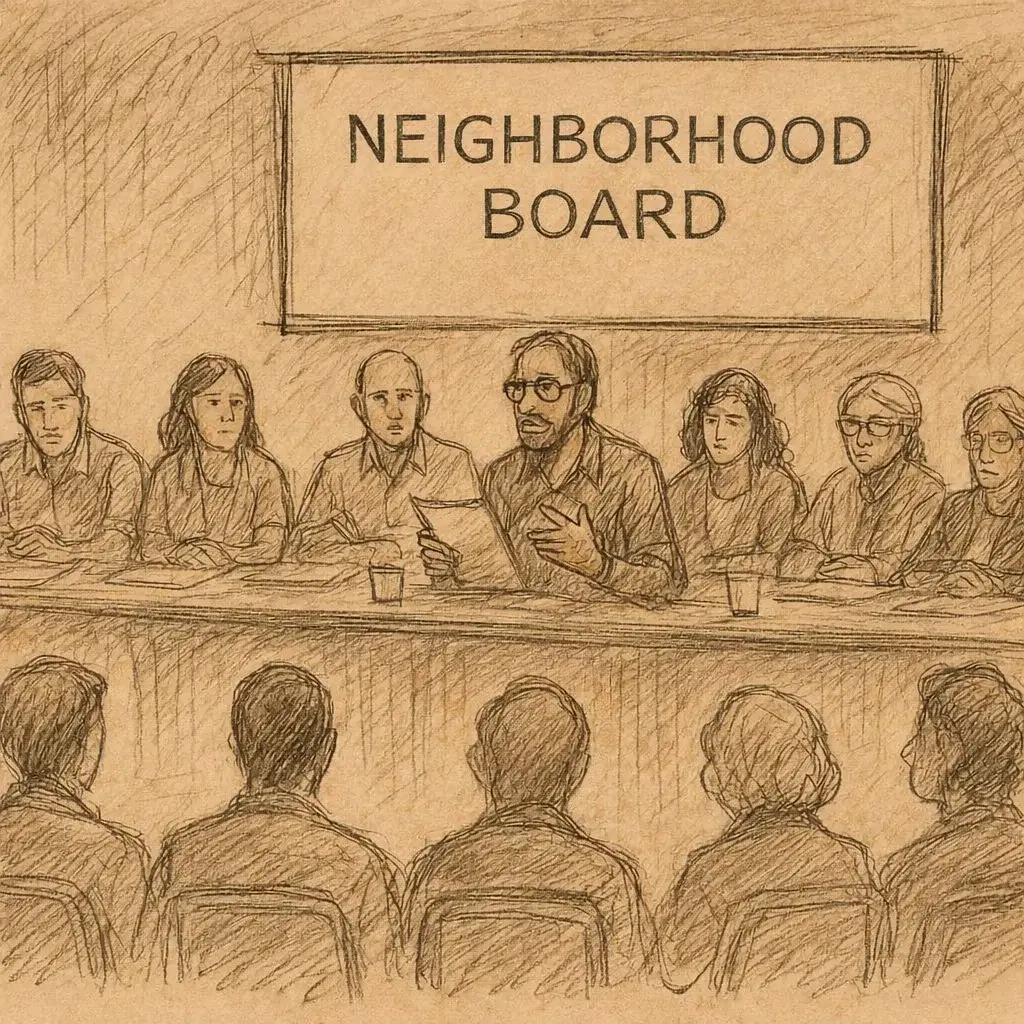
No 7 Mānoa Neighborhood Board Regular Meeting November 2026
Listen to this article:
7 Manoa Neighborhood Board Meeting – November 5, 2026
Call to Order and Attendance
Vice Chair Fukumoto called the meeting to order and presided because Chair Nogaji was recovering from an illness, although he attended. Roll call established an initial quorum of 11 members. Participants were repeatedly reminded to speak directly into the microphones so people attending through Webex could hear the proceedings. The Honolulu Fire Department was not represented, while the Honolulu Police Department participated online. The board’s current meeting-site lease was also nearing its end, making this the final meeting at the existing venue.
Police Report and ATM Safety
Lieutenant Nakamura reported Honolulu Police Department statistics for October compared with the previous month. Motor-vehicle thefts increased from six to nine, burglaries rose from two to five, and general thefts decreased from 15 to nine; thefts from vehicles remained at zero. The broader police district recorded 5,720 calls for service, with additional data available through HPD’s website. HPD’s monthly safety advice focused on ATM use: customers should remain aware of their surroundings, avoid nighttime withdrawals when possible, use machines inside open businesses, prepare cards and other materials in advance, never share a PIN, and avoid displaying or withdrawing large amounts of cash. Member Fox reported a burglary at a house under renovation at 2315 Māʻili Way, where intruders allegedly broke in and stole thousands of dollars’ worth of construction equipment, and asked that HPD ensure the incident was documented.
Mayor’s Office and Sunshine Law Concerns
Mayor Rick Blangiardi’s representative, Director Gavin Thornton, had no outstanding report items but answered questions. Members again raised concerns about applying the state Sunshine Law to neighborhood boards, arguing that advisory boards need greater ability to communicate among themselves and noting that the Legislature has exempted itself. Thornton said this was primarily a state legislative matter but agreed to convey the concern. The board also asked how to prioritize a long list of potential capital-improvement projects when funding is limited. Thornton did not recommend a specific ranking method but said the public board discussion itself was useful for determining what residents regard as most important.
City Council Updates, Complete Streets, and Council Reorganization
Heath Williams represented Councilmember Scott Nishimoto, who was attending another meeting. Discussion initially centered on an upcoming collection event at Mānoa Elementary School, later clarified by Representative Andrew Garrett as a broad recycling and donation drive rather than only an e-waste event. Member Fox requested a fuller community discussion and report on Honolulu’s Complete Streets program, expressing concern about how road redesigns could affect emergency access and neighborhood conditions; Williams noted that the city’s Complete Streets plan and related materials are available online. Member Armstrong also urged residents to submit testimony against City Council Resolution 26-247, concerning a proposed council reorganization. He said five councilmembers had disregarded foundational principles of government and referred to a critical Honolulu Star-Advertiser editorial, while adding that he would support a properly handled reorganization that gave Councilmember Nishimoto greater authority to represent the district.
Board of Water Supply
Board of Water Supply representative Dominic Diaz reported that four recent water-main breaks in Mānoa Valley had been repaired and the affected areas restored. Two breaks occurred on East Mānoa Road, one on Waʻalae Way, and one on Waʻakalua Place. Diaz did not have a separate monthly water report, but he highlighted numerous Board of Water Supply vacancies in business, engineering, information technology, senior management, and other fields. Interested applicants were directed to BWS employment resources, including BWSjobs.org.
Election Results and Legislative Planning
Representative Andrew Garrett discussed the results of the November 4 election, saying statewide turnout appeared likely to remain in the low-40-percent range. Approximately 30,000 Oʻahu ballots had not yet been tabulated, and several races were still within the margin that could trigger an automatic recount. Garrett noted that he and Senator Carol Fukunaga had already been reelected during the primary because neither faced an opponent. The House had not yet organized because of pending results, but he expected leadership and committee assignments within several weeks and hoped to continue serving in a higher-education role. He invited the board and residents to propose legislation well before the January 20 opening of the session, explaining that his office could introduce and research bills but would need the original community advocates to help champion them and submit testimony.
Flood-Control Work Near Hokulani Elementary
Garrett reported that the Department of Transportation’s flood-control work at Mānoa Valley District Park, along the stream, near Woodlawn Bridge, and in the drainage ditch parallel to the dog park had been completed. Because money remained, DOT planned an additional phase near Hokulani Elementary School and the Kuali Road area, which experienced serious flooding in March. The same contractor would work with the city Department of Facility Maintenance to break up three large boulders adjacent to the channel wall, remove certain trees and obstructions, and increase the channel’s flow capacity. Work was expected to begin November 9 and last approximately 45 days, weather permitting, with completion targeted for mid-January. Garrett emphasized that the project could not guarantee the elimination of flooding but was intended to reduce the risk of water overtopping the banks. He also identified the downstream area near Old Waiʻalae Road, where the Pālolo and Mānoa streams converge, as a possible future phase if more funding becomes available.
Stream Ecology and Alternative Flood Mitigation
Members and residents strongly questioned whether removing boulders and trees would damage the stream. Member Sofio said boulders create eddies, resting and spawning areas for aquatic life, support algae biofilm, and stabilize the streambed, while fallen trees can slow water, reduce erosion, and sometimes lessen flood risk. She referred to earlier work that stripped approximately 1,500 square feet of streambank and later required hydroseeding. Laura Ribby, associated with the area near the Hokulani fields, similarly argued that large trees can hold riprap in place and that only storm debris and smaller bent vegetation should be carefully removed. She also alleged that University of Hawaiʻi dormitory construction was releasing cement-laden soil into the stream, as indicated by changes in water color. Ribby described a lower-cost community proposal involving a berm to protect Hokulani Elementary and Kuali Lane, a controlled mauka inlet that would allow shallow floodwater onto the field only during high-water conditions, and a lower culvert returning water to the stream; she estimated the field would hold only two or three inches of water and drain within days. Garrett responded that DOT had engineering and hydrology expertise, that the boulders might be restricting flow, and that public safety had to be prioritized because the prior flood closed Hokulani for the remainder of much of the school year and forced students to relocate to schools in Kaimukī. He agreed to relay ecological concerns to DOT, although members objected that the November 9 start date left almost no time for formal board action.
Neighborhood Board Quorum and Sunshine Law Reform
A lengthy discussion revisited efforts to change quorum and voting rules for neighborhood boards. Member Moylan explained that vacancies currently function like “no” votes by raising the number needed for board action. Senator Fukunaga had introduced a bill to address the problem, while Moylan separately drafted a charter amendment that the Mānoa board unanimously endorsed. Although the state bill passed both legislative chambers, its operative language was removed in conference, resulting in what Moylan called a “zombie bill” that the governor signed without meaningful effect. He said the Neighborhood Commission Office had opposed the change and questioned how one city staff position could outweigh elected officials and community boards. Garrett acknowledged that the Legislature exempts itself from the Sunshine Law, partly because of its compressed 60-business-day session, and said conference committees can substantially alter bills. He offered to work with Senator Fukunaga to reintroduce the measure in the new two-year session, while advising advocates to consult the Neighborhood Commission in advance so the proposal would not again be undermined.
Neighborhood Commission Chair Patrick Smith clarified that the commission itself had unanimously supported removing neighborhood boards from Sunshine Law coverage because they are advisory bodies. He distinguished the commission’s position from that of the Neighborhood Commission Office and said reasonable people nevertheless disagree about whether open-meeting requirements should continue to apply. Members argued that neighborhood boards lack substantive authority and therefore should be able to communicate more freely when preparing recommendations or confronting city agencies. Garrett noted that the legislation would have to restart from the beginning in January, including committee hearings and potentially another conference process, but said its prior progress could help because lawmakers were already familiar with the issue.
Community Recycling and Donation Drive
Representative Garrett clarified that the collection event would occur Saturday, November 7, from 9:00 to 11:00 a.m. in the Mānoa Elementary School parking lot. Co-sponsored by Garrett, Councilmember Nishimoto, and Hawaiʻi Lions organizations, the drive would accept unlimited quantities of computers, printers, scanners, televisions, cellphones, ink cartridges, refrigerators, file cabinets, old car batteries, and HI-5 beverage containers. It would also collect canned food, gently used clothing, eyeglasses, and hearing aids for redistribution to community organizations and people in need. Tires, paint, motor oil, and other hazardous fluids would not be accepted. Questions could be directed to coordinator Rean Moncho at 808-291-6151.
Mānoa Christmas Parade
The Mānoa Lions Club’s annual Christmas parade was announced for Sunday, December 6, beginning at 4:00 p.m. The approximately 1.1-mile route would start at Noelani Elementary School and proceed to the gym area at Mānoa Valley District Park. Garrett invited residents to march with his group, distribute candy and other items, or attend along the route.
University of Hawaiʻi and Student Housing Priorities
In response to a question about state capital-improvement priorities, Garrett identified neighborhood public schools, roads, and the University of Hawaiʻi as major areas of concern. He said UH faces a deferred-maintenance backlog of several hundred million dollars. Student housing would be one of his principal priorities during the next legislative session, particularly the Hale Noelani site, where several buildings were demolished but the land has remained largely unused for approximately seven years. UH cannot currently guarantee incoming freshmen a campus dormitory. Garrett said this pushes students into surrounding neighborhoods, where multiple students may crowd into individual units, reducing the housing supply available to local residents and adding pressure to rents, traffic, and nearby communities. He invited additional suggestions for inclusion in a state capital-improvement bill.
Governor’s Office, Tourism, Economic Diversification, and Homelessness
Governor Josh Green’s representative, Lacey Goshi, announced technical-assistance workshops intended to help business owners, cultural practitioners, and nonprofit organizations explore opportunities in the visitor industry. Oʻahu workshops were scheduled for November 13 and 14 at the East-West Center, with registration through regenerativetourismhawaii.info. Member Watson asked the governor to provide a broader economic-diversification strategy that would reduce Hawaiʻi’s dependence on tourism and make greater use of agricultural land for local food production. Member Fox requested that the governor consider a homelessness steering committee linking city, state, and federal agencies. She said many unhoused people have lost identification or Social Security cards and may therefore be unable to access Social Security or veterans’ benefits for which they qualify. Goshi agreed to take both requests back to the governor’s office.
Ala Wai Bridge Debate
Resident Laura Ribby urged continued opposition to a proposed bridge across the Ala Wai Canal and referred residents to a “Protect Our Ala Wai and Lēʻahi” fundraising and advocacy effort. Member Moylan noted that the Mānoa Neighborhood Board had previously adopted a resolution opposing the bridge, based on a proposal Ribby brought before it, but said the Waikīkī Neighborhood Board had passed a resolution years earlier requesting such a bridge. He argued that bridges distribute rather than create traffic and questioned whether Mānoa should have intervened in a dispute involving another neighborhood. Garrett said Waikīkī’s support had been connected partly to creating an additional evacuation route during a natural disaster, although more recent planning has also emphasized vertical evacuation.
New Meeting Venue and Schedule
Chair Nogaji moved to relocate regular meetings to the multipurpose room at Mānoa Valley District Park and change the meeting day from the first Wednesday to the first Tuesday of each month. The board’s current lease was expiring, and suitable sites must accommodate a sizable audience, provide infrastructure for hybrid Webex participation, be consistently available, and charge a price the Neighborhood Commission Office can cover. The district park met those requirements but was unavailable on Wednesdays. A suggestion to identify Waioli Kitchen and the Mānoa Heritage Center as backup venues was not added because the Neighborhood Commission Office had not yet inspected them. If the district park arrangement were to fail, the default site would likely be the Neighborhood Commission Office at Kapālama Hale, with substantial online participation. The board unanimously approved the change, beginning with the January meeting.
Lowry Avenue Pedestrian Safety Resolution
The board considered a resolution supporting pedestrian-safety risk mitigation and Americans with Disabilities Act compliance along Lowry Avenue. Supporters described Lowry as a major cross-valley route used by schoolchildren, parents with strollers, wheelchair users, joggers, older residents, and people traveling to Mānoa Valley District Park. They said muddy, uneven grassy shoulders frequently force pedestrians into the street. Vanessa Destajo, the resolution’s author, said she had revised the measure in response to earlier board feedback and characterized it as a compromise rather than a mandate for sidewalks or painted lanes. She reported that 27 different people had submitted supportive testimony between September and November, while two opposition submissions had been received that day. Lowry resident Ray Tabata, who had lived there for more than 40 years, said the broad public right-of-way and continuous grassy strips created an opportunity for safer pedestrian access. A mother of twins said families with strollers regularly struggle to reach the park and argued that the community should not wait for a serious injury before acting. She cited a University of Hawaiʻi economist’s statement that pedestrians have accounted for approximately 23% of Hawaiʻi road deaths since 2000, compared with 13% nationally.
Opponents and undecided members questioned whether the proposal reflected the wishes of Lowry Avenue residents, whether the road was wide enough for pedestrian striping, and whether a city project might eliminate parking, increase vehicle speeds, remove mature trees, or alter Mānoa’s character. One member measured the relevant travel and pedestrian area on Metcalf Street at approximately 29 feet, compared with Lowry’s total width of about 24 feet. Others warned that even if the board requested tree preservation, utility locations, construction equipment, and cost considerations could lead to removals. Suggestions included lowering the speed limit from 25 to 20 mph, improving drainage and muddy shoulders, mowing or maintaining grassy walking areas, and asking adjacent owners to address specific trouble spots before pursuing a major infrastructure project. It was also noted that city law had changed so adjoining property owners would not necessarily be assessed for new sidewalk work. Member Armstrong emphasized that the operative language did not prescribe a single solution; it broadly asked traffic and accessibility experts to study and fund appropriate safety measures, which could include lower speeds rather than sidewalks.
Vice Chair Fukumoto opposed retaining the ADA finding without a citation to the applicable federal regulation and case law and argued that the street was too narrow for pedestrian lines on both sides. Other members maintained that Lowry serves all of Mānoa and that decisions should not be controlled solely by immediately adjacent owners. The resolution received eight votes in favor, five against, and one abstention. Because nine affirmative votes were required, it failed.
Capital-Improvement Proposals
The board began reviewing a 14-item list of possible capital-improvement projects, with the intent of discussing and eventually ranking proposals for city or state funding. Member Armstrong explained that the neighborhood plan expressly authorizes active participation in government capital-improvement proposals and that preliminary cost figures were based on available information and his urban and transportation planning experience. One proposal would convert the Mānoa Triangle traffic median into a more formal passive park at an estimated cost of $350,000. Ideas included restoring a drinking fountain with durable equipment, installing downward-facing lighting, creating a monument or statue connected to local history—possibly Queen Kaʻahumanu—trimming existing trees, removing grass that has spread into the roadway, planting native shrubs and groundcover, and improving signs or crosswalk markings. The concept did not include parking, sports facilities, or removal of the vegetated area.
A proposed update to the Mānoa Valley District Park master plan was estimated at $100,000. The existing plan was last updated in 1999, and a new process could examine current recreation, infrastructure, drainage, and accessibility needs, including whether the pool’s non-Olympic dimensions limit competitive use. A separate approximately $75,000 proposal would construct a flood-mitigation berm at the park to reinforce the perennial drainage channel and reduce water movement toward Lowry Avenue homes, with an optional $15,000 for vegetation. Member Watson proposed removing albizia trees near or within streams because fallen albizia contributed to the 2004 blockage and flooding near Noelani and Woodlawn Bridge. Vice Chair Fukumoto proposed undergrounding power lines on upper Mānoa Road near the five-way intersection, citing a utility pole that fell during roughly 40-mile-per-hour winds and could have sparked a rapidly spreading brush fire.
Other concepts included traffic-safety improvements at Dole and Alexander Streets, where an 82-year-old Mānoa resident was killed in March. The intersection already has four-way stop control, but possible measures include larger or better-positioned signs and an overhead flashing red signal. Armstrong said drivers turning toward the freeway during congested periods often fail to stop fully and noted the intersection’s proximity to Maryknoll and Punahou schools. A $1.2 million “Green Streets” concept would use nature-based stormwater infrastructure, including bioswales near the intersection of Kahaloa Drive, Woodlawn Drive, and Kalāwahine Street, to capture runoff, supplement existing drainage, and create visual separation without removing current vehicle lanes. Another approximately $1.2 million Green Streets proposal would convert concrete medians along University Avenue into bioswales and possibly improve stormwater capture at the Orvis Auditorium parking area through a separate UH appropriation. Time expired before every listed project, including a resident’s stream-disaster-safety concept, could be fully presented.
Capital-Improvement Committee
Because the board would recess before January and the CIP list involved numerous complex, potentially multimillion-dollar projects, Member Fox moved to create a committee to refine, consolidate, and rank the proposals. Supporters said several items overlapped—such as invasive-tree removal and utility undergrounding—and that a smaller committee could obtain expert input before bringing a more manageable recommendation to the full board. Opponents worried that a committee could become a “board within a board,” limiting the participation of newer members and presenting the full board with complex recommendations under time pressure. Others responded that committee meetings would be open to both board members and the community and would help develop rather than predetermine proposals. The committee was approved by a 12-2 vote. Chair Nogaji was authorized to appoint members, and Member Fox agreed to chair, with assistance in arranging meetings and minutes.
Proposed Stormwater and Wastewater Fee
The board briefly discussed a city proposal for an integrated stormwater and wastewater system and related utility fee that could impose a new charge on residents. Vice Chair Fukumoto encouraged people concerned about the fee to attend city meetings and participate before the proposal advanced. The next Stormwater Wastewater Advisory Group meeting—using the acronym SWAG—was announced for Monday, November 16, from 4:00 to 6:30 p.m. in the Pikake Room at the Neal S. Blaisdell Center. It was not confirmed whether remote Webex access would be available.
Minutes, Deferred Business, and Adjournment
The board reached the scheduled end of its meeting before it could complete approval of the October 7 minutes or address the remaining agenda items. Those matters were deferred. Vice Chair Fukumoto thanked attendees and noted that this was the board’s final meeting at the current site before the move to Mānoa Valley District Park. The meeting was then adjourned.