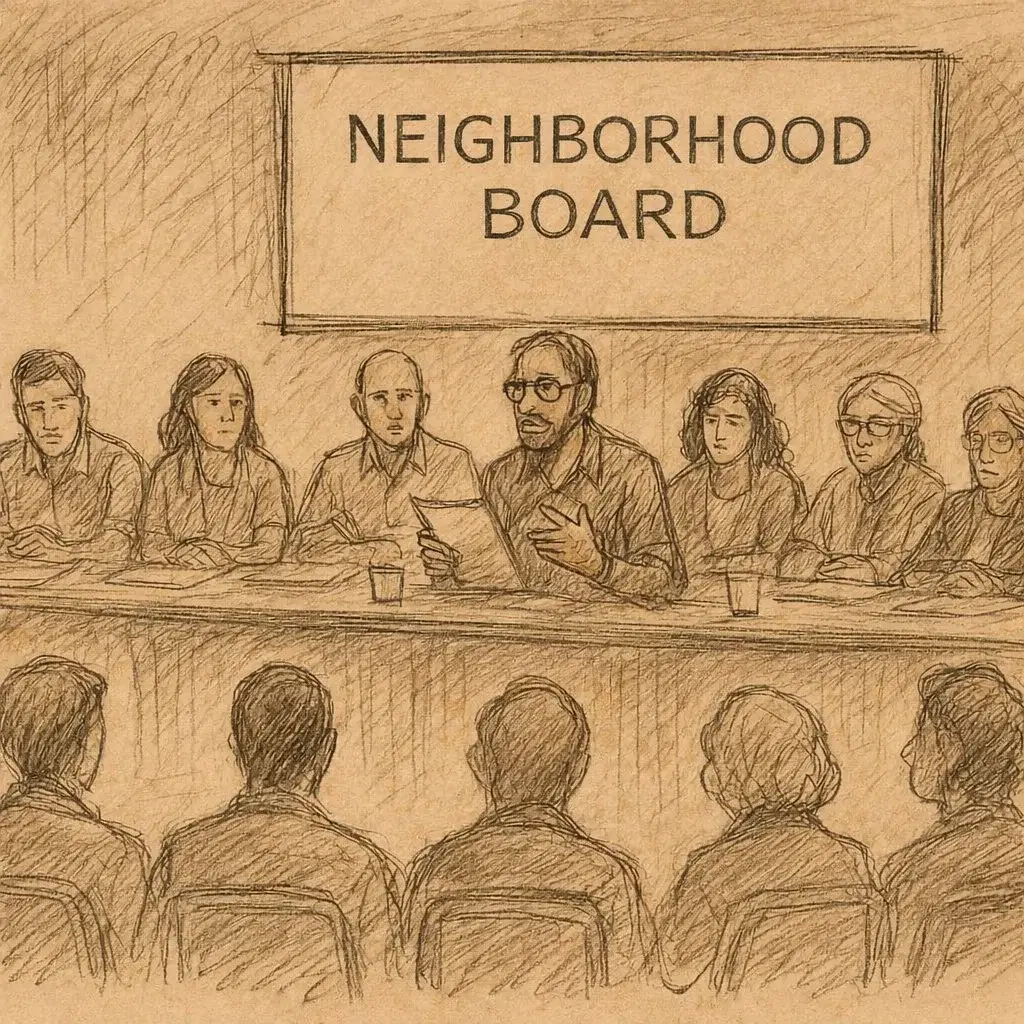
No 7 Mānoa Neighborhood Board Regular Meeting October 2026
Listen to this article:
7 Manoa Neighborhood Board Meeting – October 8, 2026
Call to Order and Quorum
Chair David Noguchi called the meeting to order at 6:30 p.m.; although the meeting is identified as the October 8 regular meeting, the transcript states October 7, 2026. Members attending remotely were reminded that their cameras had to remain on to count toward quorum. Twelve members were initially reported present, establishing a quorum. Because of the lengthy agenda and the need to leave the facility by approximately 8:15–8:20 p.m., the chair later imposed a two-minute speaking limit and repeatedly asked participants to keep discussion concise.
Honolulu Police Department Report and Halloween Safety
The Honolulu Police Department reported six motor-vehicle thefts, two burglaries, 15 thefts, and no unauthorized entries into motor vehicles during the preceding month. HPD also reported 5,808 calls for service. With Halloween approaching, the department advised families to use bright or reflective costumes, place emergency identification discreetly inside costumes or on bracelets, and equip trick-or-treaters with flashlights. Parents were encouraged to know who their children would be accompanying, retain contact information for other parents, supervise younger children, and inspect candy before it is eaten. Homeowners were asked to remove tripping hazards such as flowerpots, low branches, support wires, and garden hoses from porches and walkways.
Honolulu Fire Department Report and Seasonal Safety
The Honolulu Fire Department arrived later in the meeting after a delay caused by repairs to its truck. For the month, HFD responded to one brush fire, nine activated alarms, 41 medical incidents, and two mountain rescues. Its seasonal safety guidance urged residents to purchase electrical decorations and devices certified by a nationally recognized testing laboratory and to follow manufacturers’ instructions. Residents were also advised to remain present and alert while cooking indoors or outdoors, keep combustible materials away from heat and flames, and exercise heightened caution while walking or driving between dusk and dawn.
Mayor’s Office, Election Information, and Homelessness Audit Questions
Mayor Rick Blangiardi’s representative, Director Gavin Thornton, reminded residents that the November 3 general election would be conducted by mail and that ballots for active registered voters were expected to arrive around October 16. Election information was made available through the city elections website. A board member asked whether the U.S. Postal Service might decline to process ballots unless Hawaiʻi provided voter-database information to the federal government. Thornton was unfamiliar with the claim and agreed to research it. The same member asked about a Civil Beat report involving an alleged $21.3 million misuse of homelessness funding and whether the mayor intended to recover the money. Thornton explained that the article appeared to concern a state-funded homelessness program rather than a city initiative. He later reported through the meeting chat that he could find no reference in the article to the mayor or the City and County of Honolulu.
City Council Report, Community Cleanups, and “Monster Home” Enforcement
Council Member Scott Nishimoto’s office announced an electronic-waste collection drive scheduled for Saturday, November 7, and a park cleanup at Ala Moana beginning at 9 a.m. near the tennis courts. The office also offered to coordinate a future cleanup at Mānoa District Park with the board. A board member raised ongoing concerns about large “monster homes” proposed or constructed in Mānoa, particularly complaints involving Oʻahu Avenue and Maile Way. The member said residents had documented prior residency or zoning violations by a builder but had been unable to obtain a clear answer from the Department of Planning and Permitting about which agency was responsible for enforcement. Nishimoto’s representative said the council member had spoken with the DPP director after a recent meeting and that the office was arranging a meeting. Participation by affected residents was to be discussed separately.
University of Hawaiʻi Homecoming, Traffic Planning, and Veterans Day Flyover
University of Hawaiʻi at Mānoa representative Elmer Kai said a written response had been provided regarding earlier board questions about campus parking and traffic. He announced the return of homecoming activities to the Mānoa campus during the following week, with public and student events nearly every day. Activities would include a health day, community day, Mālama Hawaiʻi Day, and a marketplace on Bachman Lawn from 3:30 to 7 p.m. featuring food and other vendors. UH planned additional parking security and police support to maintain traffic flow and committed to ending events at a reasonable hour. Kai also gave advance notice of a November jet flyover honoring Veterans Day during a football game, with further details to be presented at the next meeting. After Kai left, a resident reported seeing clear water in Mānoa Stream turn gray near the demolition site of old UH dormitories on two occasions, including the previous Saturday. The resident characterized the discharge as construction-related concrete or demolition runoff and requested immediate corrective action.
Governor’s Office and State Agency Updates
Governor Josh Green’s representative, Lacey Goshi, announced that the Hawaiʻi Department of Agriculture and Biosecurity had launched an online invasive-species dashboard at biosecurity.hawaii.gov. The mapping tool allows residents to view reported locations of infestations, including little fire ants. The Department of Taxation also reminded taxpayers of deadlines for income tax, general excise tax, and transient accommodations tax filings, along with relief measures connected to Hurricanes Lala and Lowell; additional information was available at tax.hawaii.gov. The Department of Transportation invited the public to a blessing and reopening of the Aloha Tower observation deck on October 15 at 10:30 a.m. and a centennial celebration on October 16 at 5:30 p.m. Asked about the alleged $21.3 million homelessness-program loss, Goshi said the governor’s office had issued a response to the audit and offered to distribute it to the board.
Neighborhood Commission Guidance on Procedure, Sunshine Law, and Decorum
Neighborhood Commission Chair Patrick Smith addressed complaints about board operations after reviewing recordings of several recent regular meetings. Although he said nothing obvious stood out in the videos, he reminded board members and the public to avoid disruptive side conversations, use microphones, refrain from blurting out comments, and wait to be recognized by the chair. Smith emphasized that issues not properly listed on an agenda cannot be substantively discussed or acted upon, even when residents attend expecting discussion, because the board must comply with Hawaiʻi’s Sunshine Law and guidance from the Office of Information Practices. He said a forthcoming guidebook would offer additional direction on meeting procedures and efficiency. Smith also stated that the commission’s default position is to support the duly elected chair’s procedural decisions and encouraged members to address concerns directly with the chair before escalating them to the commission. Referring to reports of yelling during a committee meeting, he said passionate advocacy is appropriate only when conducted respectfully and warned that members unable to maintain proper temperament and decorum should not serve on the board.
Neighborhood Commission Office Executive Secretary Lloyd Yoynaka thanked members for volunteering and emphasized that the neighborhood board system exists principally to allow the public to communicate with and participate in government. He encouraged residents to regard the board as their own community forum and to take an active role in its work.
Coquí Frog Infestations and Volunteer Eradication Efforts
Representatives of Pālolo Coquí and the Oʻahu Invasive Species Committee described efforts to contain coquí frogs on Oʻahu. A breeding population has existed in Pālolo since approximately 2017, concentrated near the Zen Center, Korean church, and Waimala Stream. Although initially contained, the frogs began spreading during the previous summer because of favorable weather and continued reproduction. Residents learned that nighttime capture work depended heavily on volunteers because state agencies lack dedicated nighttime crews. The Department of Land and Natural Resources forestry crew protecting forest lands was described as having only four workers, while the Department of Agriculture team had approximately eight employees serving the entire island. Community volunteers have therefore been trained to hand-capture frogs and assist with citric-acid spraying.
Oʻahu was reported to have four breeding populations: Pālolo, Waimānalo, a smaller North Shore site, and Kuliʻouʻou. No breeding population was known to exist in Mānoa. Residents who hear the distinctive “coquí” call or encounter an unfamiliar insect or animal were urged to contact the statewide 643-PEST hotline or submit photographs and recordings through 643pest.org. Those interested in volunteering in Pālolo may email palolocoqui@gmail.com and join the group’s WhatsApp network; a website was also being developed.
The presenters explained that coquí frogs are usually beige, can change their appearance somewhat to match their surroundings, climb vegetation at night, and have distinctive toe pads. Dark, fast-moving frogs on the ground are more likely greenhouse frogs, while black-and-green poison dart frogs found in Hawaiʻi are not poisonous because they do not consume the diet that produces their toxins. Male coquí frogs make the loud call, guard eggs for about two weeks, and attract females, while females make only a quieter chirp. Volunteers sometimes capture females near males or recently hatched groups, but broad citric-acid spraying is used in core infestation areas because direct contact kills the frogs. The same method successfully eradicated an Oʻahu population in 2007.
Proposed Food Security Charter Amendment
Before a presentation on Charter Commission Proposal 119 CD1, a member moved to remove the item from the agenda. The motion received eight votes in favor and six against but failed because nine affirmative votes were required for official board action. The presenter explained that Kalani High School students had sought to participate in neighborhood board meetings as a civic-engagement project but had encountered practical scheduling difficulties. Proposal 119 CD1 would create a dedicated food security fund using one-half of one percent of existing annual real property tax revenue. It would not impose a new tax. The fund would support local agriculture, healthy-food access for food-insecure residents, food-system infrastructure, and long-term food resilience across Oʻahu. No further questions were raised.
Capital Improvement Planning and Community Priorities
Board member Dylan Armstrong presented an overview of capital improvement planning, describing it as medium-range budgeting for funded projects generally undertaken over four to six years, rather than immediate spending or long-range master planning. Armstrong noted that the City and County of Honolulu allocates approximately $1.2 billion of its roughly $5 billion annual budget to capital improvements. Mānoa’s estimated population of nearly 21,000 is about two percent of Oʻahu’s population of approximately 988,000, which would equal roughly $24 million if funding were distributed strictly by population, although capital projects do not follow neighborhood board boundaries.
Armstrong summarized major portions of the city’s current capital budget, including approximately $534 million for sewer and refuse projects; $207 million for transportation, facility maintenance, bikeways, highways, streets, bridges, drainage, and lighting; and $144 million for affordable housing and homeless-service facilities. Major individual projects included $244.2 million for upgrades to the Honouliuli and Sand Island wastewater treatment plants, approximately $76 million for widening Salt Lake Boulevard, and about $74 million to replace buses and Handi-Vans.
The board was encouraged to develop a ranked list of Mānoa priorities before the city budget cycle accelerates in early 2027. Ideas mentioned included recreation facilities, disaster mitigation, stormwater management, traffic safety, rebuilding the stream-channel wall on the Diamond Head side of Mānoa Valley District Park, restoring the former pedestrian bridge connecting the two sections of Pāwaʻina Street, and potentially considering a more costly vehicular bridge requiring land acquisition. Other suggestions included raised crosswalks rather than relying solely on flashing warning lights at dangerous crossings such as Dole Street and Alexander Street, and resurfacing or paving the H-1/University Avenue interchange ramps with concrete to reduce recurring potholes. Armstrong said the list was intended to begin a collaborative process rather than predetermine the final priorities.
Members debated whether to create a committee or permitted interaction group, receive proposals directly at regular meetings, or hold informal community discussions. Residents asked how they could submit their own projects and whether requests had to go through the board. The board clarified that residents may send testimony to nbtestimony@honolulu.gov, ask a board member to request an agenda item, or contact Council Member Nishimoto’s office and other elected officials directly. Commission guidance indicated that a permitted interaction group would require a defined scope and timeline and could delay action because the board could not act immediately upon the group’s initial report. Given the Legislature’s anticipated January 20, 2027 opening and the city budget process beginning shortly afterward, several speakers favored continuing the discussion during regular public meetings. The matter was expected to return in November, with the possibility of prioritizing a small number of projects before January.
Future Meeting Venue
The Neighborhood Commission Office informed the chair on September 28 that Noelani Elementary School would not renew the board’s facility-use permit because school personnel were no longer available to cover evening meetings. Consequently, the November 4, 2026 meeting was announced as the board’s final meeting at the Noelani cafeteria for the foreseeable future. The chair, commission staff, and Council Member Nishimoto’s office were exploring facilities at Mānoa Valley District Park, including the gym and nearby structures, and planned a site visit. Washington Middle School and Stevenson Middle School were also suggested because of their proximity and familiarity to Mānoa families, even though they are not technically inside the board district. The chair planned to provide an update in November.
September Meeting Minutes
The board approved the minutes of its September 2, 2026 meeting with one amendment. At the request of a community participant, the board removed language identifying a testifier’s subdistrict and asking whether two testifiers were related. The amendment was accepted without objection on privacy grounds, after which the revised minutes were approved without further objection.
Proposed Mānoa Stream Protection Resolution
Member Sofio sought to place a four-page resolution concerning protection and stewardship of Mānoa Valley and Mānoa Stream on the November agenda. She described the stream as a cultural, ecological, and historic resource originating in the Koʻolau Mountains and Waiakeakua Falls and used by families, children, kūpuna, and pets. She said the stream supports native ʻoʻopu species, including ʻoʻopu nākea, naniha, and nopili, as well as ʻaukuʻu, endangered manu-o-Kū, and hybrid koloa ducks. She criticized the early-August use of heavy machinery and removal of vegetation from approximately 15,000 square feet of streambank, saying the work caused heavy sediment and mud flows and proceeded without sufficient explanation, transparency, or due diligence.
The chair opposed placing the resolution on the next agenda because the board had already discussed the clearing project at length, including during a special meeting, had declined to send a letter criticizing the work, and had later sent a letter thanking city and state agencies for the project. The motion to place the new resolution on the November agenda received six votes in favor, five against, and two abstentions. It failed because it did not receive the required nine affirmative votes.
Lowry Avenue Pedestrian Safety and ADA Resolution
A proposed resolution supporting pedestrian-risk mitigation and Americans with Disabilities Act compliance on Lowry Avenue was also considered for placement on the November agenda. The chair explained that he had opposed an earlier version because it closely resembled a previously unsuccessful resolution, but he supported a substantially revised draft received approximately 48 hours before the meeting. The chair therefore agreed to place the revised resolution on the November agenda without requiring a board vote. Vanessa D’Estafo was identified through submitted public testimony as the principal drafter, and members were told they could send her suggested revisions before the next meeting.
Mānoa Banyan Court and Ālia Lane/St. Francis Redevelopment
No new information was reported concerning Mānoa Banyan Court. For the Ālia Lane project at the former St. Francis property, the chair reported that the Honolulu Zoning Board of Appeals had denied Mālama St. Francis Mānoa’s motion for summary judgment in September concerning the applicability of Hawaiʻi Revised Statutes Chapter 343, the state environmental review law. The broader permit appeal remained pending, with a contested-case hearing scheduled for May 6, 2027.
A member who attended the zoning hearing said that approximately 17 demolition permits had been in process since around August 18 and expressed concern that demolition of the St. Francis structures could begin before the appeal is resolved. The member requested renewed public support against the development and better notice from DPP regarding ministerial permits, which generally do not involve discretionary public review. Another member reported hearing that all proposed units had already been sold, largely to mainland buyers or investors, although the effect of the pending contested case on those transactions was unclear.
Without objection, the chair agreed to ask DPP to explain its process and rationale for approving the relevant permits. The chair also agreed to send a letter to the mayor and other responsible agencies restating the board’s previously adopted opposition to the project. The communication was expected to be sent within five to ten days.
Newman Center 5K Fun Run and Walk
Rosemary Casey of the Newman Center Holy Spirit Parish announced plans to revive a community fun run that had operated for approximately 20 years before being suspended during the COVID-19 pandemic. If approvals proceed as expected, the 5K run and walk will be held at 7 a.m. on Saturday, February 6, 2027. The proposed route would leave the university through the Pamoa gate, proceed along Pamoa Road, Ala Ula Avenue, Woodlawn Drive, and Kahaloa Drive, enter Mānoa Valley District Park for a turnaround, and return by the same general route. The organizers sought the board’s awareness and support, and no objections were raised.
Charter Commission Information and Meeting Broadcasts
The board announced that the Honolulu Charter Commission was holding public informational sessions on proposed charter amendments appearing on the general-election ballot. Dates, times, and locations for the remaining sessions were available through the link included on the meeting agenda. Residents were also reminded that Mānoa Neighborhood Board meetings are televised on ʻŌlelo Channel 49 on the fourth Saturday of each month at 3 p.m. and are available on YouTube through the agenda link.
Next Meeting and Adjournment
The next regular meeting was scheduled for Wednesday, November 4, 2026, at 6:30 p.m., with in-person participation at the Noelani Elementary School cafeteria and remote participation through WebEx. It will be the last meeting at Noelani under the current facility arrangement. With no additional community concerns or announcements, the meeting was adjourned.