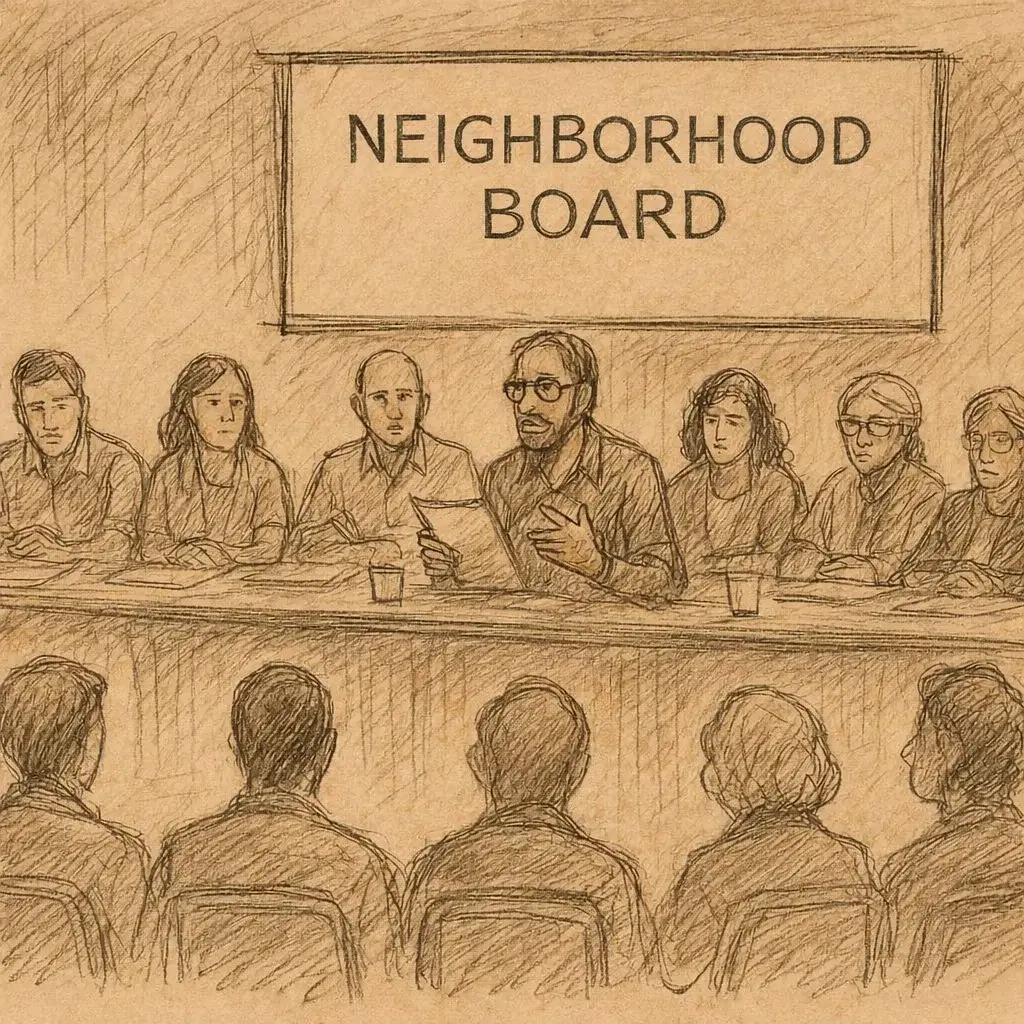
No 34 Makakilo - Kapolei - Honokai Hale Neighborhood Board Special Meeting November 2026
Listen to this article:
34 Makakilo-Kapolei-Honokai Hale Neighborhood Board Meeting – November 16, 2026
Special Meeting and Quorum
Chair Anthony Makana Paris convened the special meeting at 6:30 p.m. at Kapolei Hale, explaining that the facility’s availability required an earlier start than the board’s usual 7:00 p.m. meeting time. Because this was a special meeting, regular city and state agency presentations were omitted so the board could focus on Project Savoy, Amazon’s proposed Kapolei Robotics Sortable fulfillment center; the recommendations of the board’s Permitted Interaction Group, or PIG; and, if time allowed, preliminary feedback to Hawaiian Electric regarding proposed new turbines and increased generating capacity at Kalaeloa. Eight members, including the chair, were counted present in person or online, establishing quorum. Participants were asked to identify themselves when recognized and to state whether they supported, opposed, or were commenting with concerns on an agenda item.
Holiday Outreach and Community Events
Board member Kara England announced that Neighborhood Board No. 34 would host a table at the Villages of Kapolei Association’s Christmas fair on November 14 from 10:00 a.m. to 2:00 p.m. The table was planned to feature children’s crafts, interactive activities for adults and children, treats, and a theme centered on gratitude and actions residents can take to improve the community. England also promoted “Paniolo Nights at Kapolei Hale” on November 28, featuring a parade beginning at 5:30 p.m., food vendors, local crafters, and Christmas tree displays. Residents were encouraged to vote for the board’s tree, which would be placed at a more accessible height than the previous year’s display. The board sought volunteers to walk in the parade, with lineup expected around 4:00 p.m. near Kapolei High School; the Neighborhood Commission Office was to provide candy and board materials for distribution along the route.
Amazon Project Savoy Update
Amazon Senior Economic Development Manager Stephen Maduli-Williams presented an update on Project Savoy and its rezoning application following the September 2 Planning Commission hearing. He said Amazon had responded to approximately 90 questions from the PIG, supplied worker-safety documentation, shared an economic-impact analysis, arranged discussions with City of Fresno representatives about that city’s experience with an Amazon fulfillment center, and provided a tour of Amazon’s Sand Island facility. Amazon also analyzed where Sand Island employees live and reported that approximately 35% come from West Oʻahu. Maduli-Williams described the engagement as the beginning of a continuing relationship and said Amazon intended to remain transparent, although board members later criticized the company for taking several months to provide responses and for supplying some answers only in stages during September.
Capital Investment, Construction, and Employment
Amazon projected more than $600 million in private capital investment for the Kapolei facility and said approximately $25 million had already been spent or committed for roads, utilities, and infrastructure in the James Campbell Industrial Park before construction began. The company anticipated more than 1,000 full-time jobs with benefits from the first day of employment and approximately 800 construction jobs at peak activity. Amazon had selected Layton as the general contractor and expected roughly 90% union participation in construction, with an intention to use local workers, although company representatives would not guarantee that every union construction worker would be Hawaiʻi-based. The proposed facility was described elsewhere during the meeting as employing approximately 1,562 people, with Amazon stating that about 90% of those positions would be full-time and benefit-eligible. The facility would initially operate two shifts and could add a third shift if future demand justified it, potentially increasing employment beyond the initial workforce.
Wages, Benefits, and Career Development
Amazon said its average North American wage had recently risen from approximately $23 to $24 per hour and that starting pay for associates on Oʻahu was likely around $25 per hour. Night shifts could receive an additional differential of about $1.50 per hour, while weekend work could add approximately another dollar. Benefits were described as including medical, dental, and vision coverage from the first day, with most costs paid by Amazon, as well as life and disability insurance and a 401(k) plan with a company match. Amazon’s Career Choice program was said to provide up to $5,250 annually for associate or bachelor’s degrees, certificates, or GED completion without requiring repayment if an employee later left the company. Existing Hawaiʻi educational partners included the University of Hawaiʻi–West Oʻahu and Honolulu Community College, with Leeward Community College identified as a possible future partner. Training could include coding, artificial intelligence, machine learning, robotics, and other technical fields, creating possible pathways from entry-level fulfillment work to robotics technician or technology positions.
Local Hiring and Community Needs Assessment
Amazon proposed commissioning both a West Oʻahu community needs assessment and a workforce-development study. The needs assessment would inventory community strengths, deficiencies, and priority investments in areas such as parks, recreational equipment, farmers markets, youth programs, public facilities, and small-business support. Amazon expected to issue a request for proposals to a local consultant by the end of 2026, then share the findings with the neighborhood board and use them to guide future investment. The workforce study would identify barriers preventing West Oʻahu residents from obtaining Amazon jobs, locate community partners, and develop a local hiring strategy. Board and community members pressed Amazon to make binding commitments regarding the number and classification of jobs, wage floors, benefits, hours, and local hiring targets. Maduli-Williams referred to prior written responses but did not make new binding commitments during the meeting.
Traffic, Transportation, and Harborside Access
Traffic was a major concern because the project would bring employees, delivery vehicles, and heavy trucks into an area already affected by severe congestion. Amazon said its existing traffic study concluded that the facility would not have a detrimental effect and that it had hired another local consultant to conduct a peer review. The company argued that hiring from West Oʻahu, operating shifts outside traditional peak periods, providing bicycle storage and showers, and potentially using Enterprise shuttle service from transit hubs could reduce impacts. Residents disputed the suggestion that the project would not significantly affect traffic and emphasized their lived experience with long West Oʻahu commutes. Later testimony cited estimates of more than 6,000 vehicle trips per day, including approximately 500 heavy-truck trips, and questioned whether the study’s methodology and baseline data were current. Amazon said it expected the planned Harborside road and freeway interchange to be completed but had no current plan to help fund the interchange. The PIG recommended a new, Amazon-funded traffic analysis using current conditions and projected growth, including the buildout of Harborside, more than 650 housing and kūpuna units at Lima, and thousands of future homes in Makaʻīwa Hills. Written testimony also urged consideration of complete streets, safe walking routes, and bicycle infrastructure near schools and residences.
Height Variance, Zoning, and Environmental Review
Project Savoy would require changing the allowable building height from approximately 60 feet to 100 feet on a roughly 16.5-acre property. The proposed five-story structure was described as containing approximately 2.8 million square feet, with each floor comparable to ten football fields and total floor space approaching 50 football fields. Amazon said the additional height was essential to the facility’s design and that it would be highly unlikely to operate at the site if the rezoning and height request were denied. Opponents argued that the ʻEwa Development Plan envisions light-industrial uses as a transition into Kapolei and generally limits large buildings to around 60 feet, making the proposed scale inconsistent with the area’s intended form. Community members also objected that the city was relying on a 2006 environmental review prepared for a broader land reclassification rather than a modern, round-the-clock robotics fulfillment center. Amazon responded that the Department of Planning and Permitting had deemed the earlier review adequate, the site was already entitled for industrial development, and the company did not anticipate conducting a new environmental review. Opponents requested a project-specific environmental assessment and updated traffic study before—not after—approval.
Fire Protection and Emergency Preparedness
The PIG recommended that approval be conditioned on an independent assessment of whether Honolulu Fire Department Station 26 and other West Oʻahu emergency resources could safely serve a 100-foot-tall, highly automated fulfillment facility containing a very large volume of stored goods. The assessment would identify necessary equipment, specialized training, staffing, and station improvements, with Amazon expected to fund or participate in funding because its requested height variance and technological systems would create the need for the review. PIG members cited examples from other jurisdictions where Amazon had contributed millions of dollars to infrastructure or emergency-service needs, including a reported $2.3 million commitment in Hamilton Township. The board emphasized that it was not assuming firefighters lacked the capability to respond, but wanted that capability verified before the city approved a building substantially taller than the current limit.
Automation, Job Security, and Labor Organizing
Residents and labor representatives repeatedly asked whether Amazon would guarantee that workers would not later be displaced by automation. Amazon said the facility was already designed around a combination of human labor and robotics, with robots operating primarily on the first three levels to move products while associates performed other functions. The company anticipated as many as 1,500 employees and stated that the site was not designed to be fully automated, but Maduli-Williams declined to provide a binding promise that jobs would not be replaced by robotics over a fixed period. Amazon also denied that it converts fulfillment warehouses into data centers and said such a conversion was not planned for Kapolei. Representatives of Pride at Work Hawaiʻi, the Teamsters, and other participants questioned Amazon’s labor history and requested a written neutrality agreement preventing interference if employees chose to organize. Amazon said decisions about union membership belonged to employees and denied engaging in union-busting, but it would not commit during the meeting to a neutrality agreement. When a Teamsters representative cited thousands of mainland Amazon workers who had walked off the job or remained on strike, Maduli-Williams said he was not aware of the cited situation and would need to respond later.
Workplace Safety and Fulfillment-Center Conditions
Dr. Keoni Dudley presented “Why We Can’t Afford Amazon Public Areas Fulfillment Center,” arguing that the project’s promised jobs must be weighed against reported conditions at other Amazon facilities. He described a building containing millions of products—possibly more than 25 million—with thousands of robots, perhaps around 4,000, and the potential to process nearly 500,000 deliveries each day through approximately 50 loading docks. Drawing from external research, he cited accounts of employees walking up to 15 miles per shift, performing hundreds of squats, working ten-hour shifts beginning between 4:00 and 8:00 a.m., and facing mandatory extensions to 12-hour days and six-day weeks during peak periods. He quoted a worker who said scanner-based systems assigned and timed tasks, monitored “time off task,” and effectively limited time for restroom visits, water, or slower walking. Dudley cited research alleging Amazon serious-injury rates twice the national fulfillment-center average, with one Eastvale facility reportedly reaching four times the industry average; he also said two-thirds of new workers leave within 90 days and that annual turnover can equal 150% of a facility’s workforce. Amazon had earlier provided worker-safety documentation to the PIG, but community members continued to seek enforceable injury reporting, safety standards, and independent oversight.
Effects on Local Businesses and Household Security
Amazon stated that more than 1,000 Hawaiʻi-based small and medium-sized businesses already sell products through its platform and that more than 60% of items sold on Amazon come from small businesses. Maduli-Williams cited an Oxford Economics review of communities with fulfillment centers, saying the facilities had helped create more than 6,000 businesses over five years and raised average community income. Residents questioned whether those comparison communities were relevant to an isolated island economy and asked for more specific data about how many Hawaiʻi sellers were active, their sales volumes, profits after Amazon fees, and whether their customers were in Hawaiʻi or elsewhere. Amazon said individual seller revenue information was private. Dudley presented opposing research claiming that fulfillment centers can shift spending away from local stores, reduce retail employment, and force closures among independent apparel, toy, sporting-goods, and book businesses that cannot match Amazon’s prices or inventory. He also cited a University of Illinois study reporting food insecurity among 53% of Amazon workers and housing insecurity among 48%, though he acknowledged some wage information in his research might not be current. Speakers cautioned that Amazon’s economic influence could alter the community’s commercial fabric, schools, public services, housing demand, and food security.
Amazon’s Community Contributions and Disaster Response
Amazon highlighted prior assistance in Hawaiʻi, including delivery of more than 175,000 relief items after the Maui wildfires, shipment of 18,000 hygiene kits to Oʻahu following the Kona low storm, and continuing work with the Hawaiʻi Foodbank involving disaster relief, home food delivery, and donated products. Maduli-Williams said Amazon’s logistics capabilities could be particularly useful during natural disasters and pointed to the Sand Island facility’s recruitment of leaders with Hawaiʻi ties, including site leader Stephanie Kalihi of Nānākuli, as evidence of intentional local engagement. The PIG, however, reported that it could not independently verify the company’s community-support claims because Amazon did not provide donation letters, recipient confirmations, or comparable documentation requested during the review. The PIG did not conclude that the contributions had not occurred, only that it lacked evidence sufficient to verify them independently.
Cultural Resources, ʻĀina, and Food Sustainability
Community member Luko Alonzo Lapa asked how Amazon had addressed the concerns and recommendations in the project’s Kapaʻakai cultural analysis, which is intended to evaluate effects on Native Hawaiian cultural practices and resources. Although Maduli-Williams said he had reviewed the analysis, no detailed response to its recommendations was provided during the meeting. Lapa urged Amazon to move beyond monetary contributions and job creation by considering restoration of the health of the ʻāina, long-term food sustainability, and the cumulative effects of multiple industrial and energy projects entering West Oʻahu. Speakers stressed that Amazon’s mainland case studies could not automatically predict outcomes for Hawaiʻi because the islands face geographic isolation, dependence on imported goods, limited land and water, and distinctive cultural obligations. Dudley broadened that concern by discussing global population growth, food and water shortages, shrinking aquifers, and United Nations projections of severe resource pressure by 2050. He warned that excessive reliance on a single corporation could leave Hawaiʻi vulnerable if Amazon later downsized or abandoned the site, citing the company’s closure of 140 physical bookstores, electronics and toy stores, apparel stores, convenience stores, and supermarkets between 2022 and 2026 when they were not sufficiently profitable.
What Amazon Would Gain From Hawaiʻi
Residents asked Amazon to explain the expected revenue or profit it would derive from Hawaiʻi, noting that the company’s investment was motivated by customer demand and commercial return. Amazon said it had requested no state or county tax abatements, tax-increment financing, enterprise-zone funds, or other public incentives, and that the facility would be financed entirely with Amazon capital. Maduli-Williams could not provide an estimate of projected Hawaiʻi earnings, saying the principal business rationale was proximity to customers and existing demand. He explained that inventory would include frequently purchased household goods, products Hawaiʻi customers tend to buy every several months based on algorithmic demand, and less predictable items. The system would use both reactive and predictive information, and not every product would necessarily qualify for same-day delivery. Community members responded that Hawaiʻi residents were not merely project beneficiaries but the customers whose purchases would make the operation profitable, and they urged Amazon to recognize that relationship through long-term, meaningful community commitments.
PIG Formation and Community Review
Chair Paris presented the final report of the Project Savoy PIG, which the board established by an 8–0 vote on May 27, 2026. The group was directed to gather community input, assess potential impacts, explore mitigation and community benefits, and develop nonbinding recommendations within six months. Its membership included board members and representatives connected to neighborhood associations, Native Hawaiian health, cultural organizations, environmental and carbon initiatives, churches, Hawaiian civic clubs, farms, health centers, labor organizations, education, community development, and the Villages of Kapolei. Amazon participated through Maduli-Williams, the Kapolei Chamber of Commerce served as a community resource, and consultants included Jacob Akki of DTL Hawaiʻi and Kelly Trevino, who discussed Fresno’s FAT1 fulfillment center. The group held nearly twice the initially contemplated six meetings, beginning with a publicly noticed meeting on June 19, and completed a report exceeding 100 pages. The Planning Commission deferred its decision to allow the PIG and neighborhood board to complete their work.
PIG Findings and Information Gaps
The PIG reviewed Amazon’s city applications, Planning Commission materials, responses to community questions, logistics practices, legal and regulatory actions, workplace investigations, community case studies, the Fresno example, and observations from a tour of the Sand Island facility. It found inconsistencies among information in Amazon’s application, presentation materials, and statements to the community. The group also estimated the savings Amazon could realize by shifting inventory transportation from air freight to ocean freight so that community requests could be evaluated against the project’s economic benefits. Major deficiencies identified by the PIG included the absence of local baseline data, measurable performance targets, implementation timelines, assigned responsibility, public reporting, enforcement mechanisms, and corrective-action procedures. Although Amazon eventually answered approximately 90 questions, the PIG generated more than 90 follow-up questions and criticized the company’s slow and selective response process. Chair Paris characterized Maduli-Williams as a constructive individual representative but said the ultimate decisions rested with a much larger profit-focused corporation.
PIG Recommendations for Project Conditions
The PIG developed project recommendations covering local hiring, workforce development, paid training and apprenticeships, small-business support, affordable housing, community health and safety, environmental mitigation, community space, and transparent governance. It called for defined West Oʻahu hiring targets, a clear definition of who qualifies as a West Oʻahu resident, worker protections, public reporting, an independent health assessment, pollution monitoring, heat-resilience measures, safer transportation routes, and support for trees as regional shade and infrastructure rather than landscaping limited to Amazon’s property. The PIG did not recommend unconditional approval. Instead, it said that if the board supported the project, support should depend on an Amazon-funded fire-service assessment, a current traffic and infrastructure analysis, and an enforceable community benefits agreement. The report stressed that verbal assurances were insufficient because West Oʻahu had experienced broken development promises before, citing disputes over commitments to underground 48-kilovolt power lines associated with D.R. Horton’s Hoʻopili project.
West Oʻahu Community Fund
The board unanimously adopted Resolution 2026-11SA, supporting a community-led process to assess, design, and, if residents choose, establish a West Oʻahu Community Fund. The proposed entity would be independent of the PIG and neighborhood board, since the PIG would dissolve after delivering its report and the board had been advised that it could not itself sign a community benefits agreement. Community members could create a new 501(c)(3) nonprofit or work through an established organization such as the Hawaiʻi Community Foundation or the Hawaiian Council for administrative support. The fund would document existing conditions, publish community profiles and priority reports, receive developer contributions, and distribute grants through a transparent process to address locally selected needs. Examples included the Makakilo Drive extension, odors from the Makakilo quarry’s asphalt operations, cooling needs near Pālehua and former landfill areas, transportation, environmental mitigation, health, and public facilities. A possible financial model would spend 60% of annual receipts on current needs while retaining 40% as long-term capital for future generations and impacts that may outlast current residents. The concept was intended to provide developers with a single, regularly updated statement of community priorities while giving West Oʻahu residents direct control over benefits intended to offset the area’s disproportionate concentration of landfills, H-POWER, petroleum refining, and other industrial uses.
Public Opposition to Project Savoy
Labor, cultural, and community participants urged the board not to endorse the project without current studies and enforceable commitments. Teamsters Local 996 President and Principal Officer Kevin Holu said organized labor did not oppose jobs or investment in West Oʻahu but wanted commitments covering local hiring, wages, benefits, safety reporting, and the effect of automation placed in writing. He argued that the requested 100-foot height served Amazon’s delivery model rather than a public necessity and said the environmental and traffic information was inadequate for a project of this scale. Written opposition was also submitted by Pride at Work Hawaiʻi, Kamala Warner, Jonathan Huin, and the Prince Kūhiō Hawaiian Civic Club. Opponents emphasized that their concern was not which union, if any, represented workers, but whether future employees would have stable jobs, affordable benefits, safe working conditions, and the ability to remain in Hawaiʻi.
Board Votes on Amazon and Rezoning
After receiving Amazon’s presentation, Dr. Dudley’s opposition presentation, the PIG report, public testimony, and written comments, the board voted to oppose the Amazon Kapolei Robotics Sortable Fulfillment Center project as a whole. The motion cited Amazon’s past practices, current performance, unresolved PIG recommendations, delayed or incomplete communication, and insufficient disclosure about the project’s impacts and need for additional height. The vote was seven in favor of opposing the project and one abstention. The board then separately voted unanimously to oppose the project’s zone-change application. The board directed that the PIG report and its outstanding recommendations be forwarded as part of the explanation for its position, including concerns about environmental review, traffic, fire protection, labor practices, automation, community accountability, and the lack of binding commitments.
Hawaiian Electric Proposal Deferred
The agenda anticipated preliminary community feedback to Hawaiian Electric regarding new turbines and increased generation capacity at Kalaeloa. The chair described this as an early-scoping opportunity for the utility to hear from residents before plans advanced, and community comments during the Amazon discussion connected the energy proposal to broader concerns about industrial development and possible natural-gas use in West Oʻahu. Because the Amazon presentations, testimony, and board actions continued until nearly 9:00 p.m., the Hawaiian Electric item was deferred to a future board meeting without substantive presentation or action.
Next Meeting and Adjournment
The board announced that it would not hold its usual late-November meeting because of the holiday recess. The next regularly scheduled meeting was set for Wednesday, December 2, rather than the fourth week of December. With the Hawaiian Electric matter deferred and the Amazon-related votes completed, the special meeting adjourned at approximately 9:00 p.m.