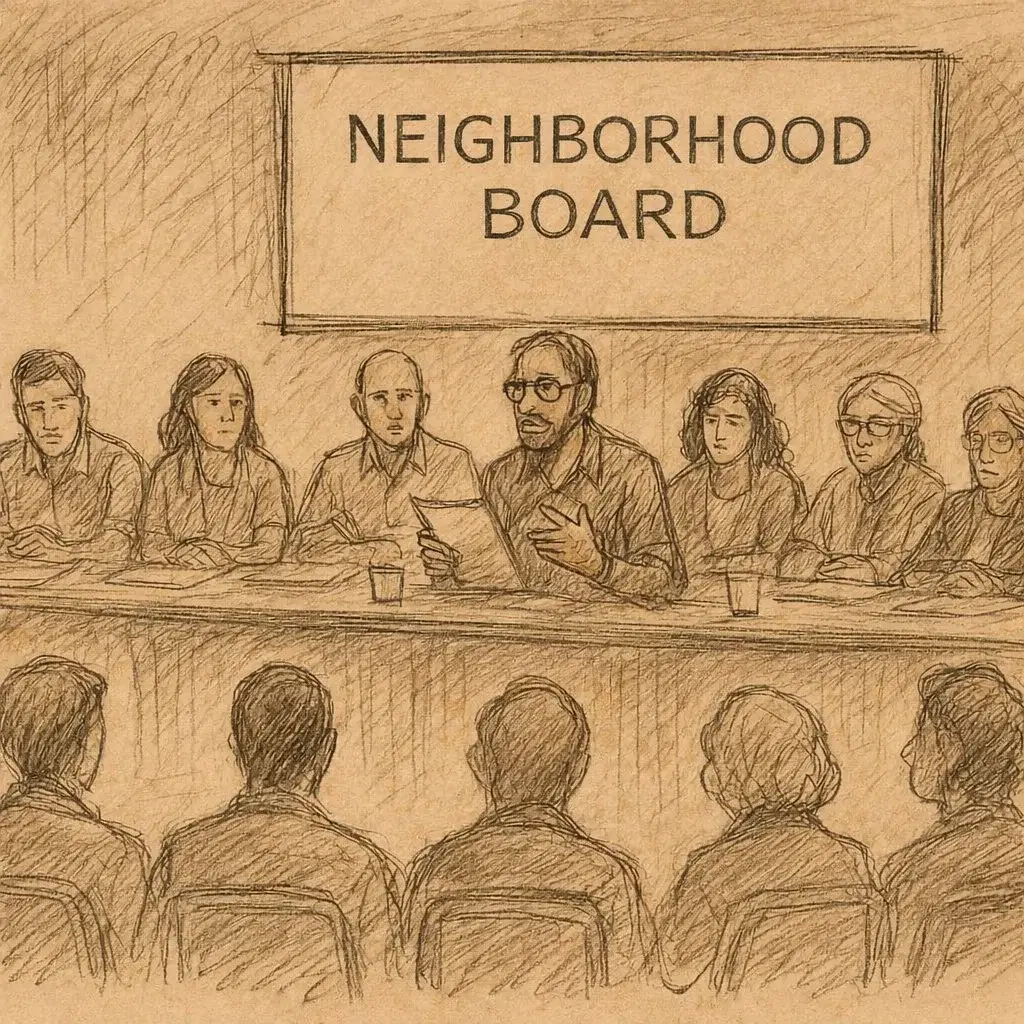
No 34 Makakilo-Kapolei-Honokai Hale Neighborhood Board Regular Meeting July 2026
Listen to this article:
34 Makakilo-Kapolei-Honokai Hale Neighborhood Board Meeting – July 23, 2026
Opening, Meeting Protocols, and Quorum
Chair Pro Tem Anthony Makana Paris called the annual organizing meeting to order, although the transcript’s opening announcement referred to it as the July 22 regular meeting. The hybrid forum was conducted from Room 312 at Kapolei Hale with Webex participation; the opening also contained a reference to Kapalama Hale. Attendees were asked to raise a physical or virtual hand, wait to be recognized, address comments through the chair, and observe the three-minute limit for public testimony. Reports were allotted up to 10 minutes, the Neighborhood Commission presentation 10 minutes, and the liquefied natural gas presentation 20 minutes. Paris announced that Neighborhood Board Assistant Melissa Uribio had become permanent and directed attendees to the online board packet for presentation materials and resolutions. Seven members—Bosler, Dudley, England, Kahele, Lidstone, Medeiros, and Paris—were present at roll call, establishing quorum; Ferreira and Ta‘ala were initially absent.
Honolulu Fire Department Activity and Hiking Safety
The Honolulu Fire Department reported that June 2026 included four structure fires, three brush fires, nine nuisance fires, no cooking fires, and 30 activated alarms without an actual fire, generally involving false alarms, water-related activations, malfunctions, or aging wiring. Emergency activity also included 166 medical alarms, three motor vehicle crashes, no pedestrian collisions, no mountain or ocean rescues, and one hazardous-materials incident. The department defined nuisance fires as incidents such as rubbish burning outside a structure or vehicle. Its summer hiking guidance advised residents to select official trails suited to their ability, consult HawaiiTrails.org, check rain, wind, and ocean-swell forecasts, remain on the trail, avoid taking risks for photographs, hike with a companion, tell someone the planned route, and allow enough time to return before dark.
Junkyards, Vacant Lots, and Wildfire Preparedness
Following up on questions from the previous meeting, HFD explained that junkyard monitoring is not solely within the department’s jurisdiction and may also involve the city Department of Environmental Services and state Department of Health. Drawing on lessons from the Lahaina wildfire, the department described wildfire readiness as a shared responsibility and identified the first five feet around a home as the most critical zone to clear of vegetation and combustible material. Residents concerned about vacant properties may contact the Fire Prevention Bureau’s Code Enforcement Section at 808-723-7161. HFD also supports participation in the Hawai‘i Firewise Program, home assessments, and use of the Ready, Set, Go Wildland Fire Action Guide through its partnership with the Hawai‘i Wildfire Management Organization; additional information is available at hwmo.org. A resident clarified that although five feet is the recommended immediate zone around individual homes, larger defensible spaces, such as approximately 35 feet, may apply along gulches, mountain edges, and common areas within communities such as Palehua Community Association properties.
Honolulu Police Department Crime, Traffic, and Staffing Report
District 8 Community Policing Team Corporal Cory Makino, joined online by Sergeant Fumi Moroka, reported June statistics. District 8 recorded 24 motor vehicle thefts, including six in Kapolei; 14 burglaries, including four in Kapolei; 106 thefts, including 39 in Kapolei; and 15 unauthorized entries into motor vehicles, including three in Kapolei. Officers issued 139 speeding citations, 1,502 other moving citations, 639 parking citations, and 2,805 citations overall. District 8 handled 8,938 calls for service, of which 2,993 were in Kapolei. In response to concern about police shortages, Makino said HPD continues trying to keep patrol positions staffed and is emphasizing recruitment department-wide, with increased hiring expected to be a priority for the incoming chief.
School Resource Officer Program
HPD reported that the school resource officer program at Kapolei High School was progressing well. Officers were building relationships with students by joining them at lunch and participating in extracurricular and school activities. The program was expected to expand to Nānākuli during the coming school year, with Kapolei’s SROs assisting in the transition and training of the new officers. The update addressed a question raised at the previous board meeting and indicated that the Kapolei deployment may serve as a model for expansion elsewhere in West O‘ahu.
Police Role in HOA Disputes, Power of Attorney, and Cybersecurity
A resident asked how HPD handles disputes between homeowners associations and individuals, including a recent incident involving an attempted trespass notice. Makino explained that officers generally do not intervene in purely civil disputes, but they may act if criminal conduct occurs or if intervention is needed to prevent an escalating confrontation from becoming violent. The resident also alleged that the Villages of Kapolei used a Canadian electronic-ballot company and released information concerning more than 4,000 homeowners internationally without consent, asking whether a complaint should go to an HPD cybersecurity unit or the FBI. Makino did not have an immediate answer but agreed to determine which agency has jurisdiction. Asked how officers would treat a notarized durable power of attorney under what the resident identified as Hawai‘i Revised Statutes Chapter 551E, he said officers evaluate each case according to its facts and generally rely on valid documentation, court orders, or other proof of authority. Residents who believe an responding officer has not adequately explained a decision may request a sergeant or other supervisor.
Police Recognition, Hazardous Driving, and Campbell Industrial Park Speeding
Jackie Zahn commended HPD personnel for quickly removing an abandoned jet ski from Makakilo after it remained roadside for months without reflectors and posed a collision hazard. She said Corporal Cooper, Acting Major Barrera, lieutenants, and other personnel coordinated with the abandoned-vehicle program, physically loaded the jet ski onto a truck, and completed the removal by 9:30 the next morning. She provided the board with the names of the personnel involved and asked that their service be formally recognized. Another resident reported vehicles traveling rapidly without lights near White Plains and the police academy area at approximately 8 or 9 p.m. Makino said some specialized police units use unmarked vehicles without patrol-style lights and sirens, but residents should report reckless or hazardous driving when uncertain. The resident also described frequent speeds of 50 to 60 mph through Campbell Industrial Park despite a 35-mph limit and requested early-morning enforcement in concealed locations.
Election of Board Chair and Discussion of Leadership
Anthony Makana Paris was nominated for another term as chair. Before the vote, Dr. Keoni Dudley asked Paris to describe his background and raised concerns about the board’s handling of disaster-preparedness coordination and the proposed Amazon facility, including Dudley’s exclusion from a permitted interaction group. Paris said he had lived in Kapolei for approximately eight years, was born and raised in West O‘ahu, grew up in Lualualei and Nānākuli, experienced a period of houselessness after his father was injured, and attended public schools and Kamehameha Schools. He earned a bachelor’s degree in environmental science and engineering from MIT and a law degree from the University of Hawai‘i Richardson School of Law; taught mathematics, astronomy, and college-readiness students through Chaminade University, Leeward Community College, and Upward Bound; and spent approximately 15 years doing policy work for the Ironworkers Stabilization Fund and construction industry. He said he had not worked for the fund for about four years, after long COVID led him to reassess his priorities. His current activities include leading Kaupele, a nonprofit focused on West O‘ahu reforestation and agritech education at Nānākuli High and Intermediate School; serving on the Wai‘anae Coast Comprehensive Health Center board; chairing the Prince Kūhiō Hawaiian Civic Club Scholarship Fund, which distributes approximately $30,000 annually; supporting native farming and fishing knowledge through roughly 6,000 annual calendar sales; and serving on his homeowners association board. He also described prior farming work involving sustainable propagation of maile.
Chair’s Response on Board Procedure and Re-election
Paris said his role as chair was to administer decisions made collectively by the board rather than substitute his personal preferences. He stated that the disaster-preparedness decision had been to work with the Pearl City Neighborhood Board on an event led by Chair Larry Veray and that membership on the Amazon-related permitted interaction group followed the adopted resolution and the order in which members had expressed interest. A proposal to substitute Dudley onto the group had not received a second. Paris emphasized that consistent procedures, including when the result disappoints an individual member, are necessary for public confidence. The board then re-elected him without stated opposition. Paris acknowledged that the chair often becomes a “lightning rod” when enforcing rules but said his responsibility was to protect the board’s collective process and advocate for its adopted positions.
Other Officer Elections
The board received a slate nominating Miki‘ala Lidstone as vice chair, Kara England as secretary, and Sheila Medeiros as treasurer. No competing nominations or public testimony were offered. All three were elected unanimously to serve from July 2026 through June 30, 2027.
Meeting Schedule, Recess, and Hybrid Format
The board retained its regular schedule of the fourth Wednesday of each month at 7 p.m., with both in-person and online participation. It will recess in November for the holiday period and ordinarily meet on the first Wednesday of December, or the second Wednesday if facility availability requires it. A suggestion to begin 30 to 60 minutes earlier was not adopted because many residents may still be commuting to West O‘ahu. Several members instead favored stronger efforts to finish by 10 p.m., consistent with the Neighborhood Commission Office’s general three-hour guideline and the board’s ‘Ōlelo contract. Paris said he would not end meaningful, rule-compliant community engagement solely because the broadcast period had expired, although the board should continue improving time management.
Public Testimony Rules and Agenda Placement
Members discussed whether to shorten testimony from three minutes to one minute during the final 30 or 60 minutes of long meetings. Amy Bosler opposed doing so because residents who had waited for hours should not have less time than earlier speakers. Moon Kahele and others suggested moving general public input nearer the beginning of the agenda, with legislative updates also placed earlier so elected officials and residents could interact before the room emptied. Vice Chair Lidstone supported restoring public input to an earlier location and suggested that board members also limit repetitive remarks. Paris explained that HFD and HPD reports are required to appear first and that elected officials may be placed on the agenda for dialogue if they identify a topic at least seven days in advance. Otherwise, officials speaking during general public input may share information and engage in limited dialogue, but the board cannot vote on an unposted issue. Members also discussed Robert’s Rules limits on board-member debate and the possibility of limiting repeat appearances at the microphone, but no motion to change the existing rules was made. The three-minute cumulative testimony system therefore remained in effect, with the chair retaining the ability to ask speakers voluntarily to shorten comments when time is limited.
Board of Water Supply Update
The Board of Water Supply reported no water-main breaks in Makakilo, Kapolei, Malu‘ōhai, or Palehua during June. Its annual Halawa Xeriscape Garden open house and plant sale was scheduled for Saturday, August 1, from 9 a.m. to 1 p.m., with free admission, street parking, and BWS shuttle service; plant purchases would require credit or debit cards because cash and checks would not be accepted. The annual “Imagine a Day Without Water” event was scheduled for September 26 from 10 a.m. to 2 p.m. at Wai‘anae Mall, with more details expected at the next meeting. Water Resources Program Administrator Barry Sugawa was scheduled to attend the August board meeting to answer questions about water resources, the desalination facility, and concerns raised previously about water demand and potential contamination connected with major computing or data-related development. BWS said those earlier questions had been documented so its specialist could prepare responses.
Mayor’s Office Written Update
Although no mayoral representative attended, the board reviewed highlights from the mayor’s written report. The Department of Transportation Services planned to implement Ordinance 24-32, lowering school-zone speed limits from 25 mph to 20 mph between 6 a.m. and 6 p.m. The Department of Environmental Services would continue evaluating plasma-arc gasification and other solid-waste technologies. The city was working on an emergency-access route connecting Makakilo Drive to Kualaka‘i Parkway. DTS attributed bus schedule inconsistencies partly to shortages of drivers and mechanics, prompting discussion of recruitment and the possibility that higher pay may be necessary. The Department of Design and Construction continued working on an ADA sidewalk redesign raised by Medeiros and anticipated submitting it by October 2026. City agencies were also meeting with the Department of Housing and Land Management and the Hawai‘i Housing Finance and Development Corporation concerning the long-delayed transfer of Villages of Kapolei infrastructure, including how to account for decades of city property taxes paid by homeowners who had not received full city services. The Office of Climate Change, Sustainability and Resiliency continued work on major initiatives and the O‘ahu Full Systems Plan, on which the board had previously submitted comments.
Nighttime Odor in Kapolei and Makakilo
Members reported a strong fuel-like or asphalt odor that had occurred at night for approximately two months, particularly from around 6 p.m. through the early morning and when north winds were blowing. Residents in Kapolei Knolls and surrounding areas had noticed the smell. Jackie Zahn suggested that current Grace Pacific asphalt work could be a source. The board asked the mayor’s office to contact Grace Pacific and relevant agencies to determine whether current operations were causing the odor and to explain the activity to affected residents.
Makakilo Roads, Speeding, Bicycle Spending, and West O‘ahu Priorities
Zahn argued that West O‘ahu infrastructure and safety needs were being neglected while the city spent money on lower-priority projects, including a cited $1.5 million for bicycles and downtown pedestrian improvements. She described severe speeding on Makakilo Drive, with cars traveling 50 to 60 mph, motorcycles and electric bicycles using sidewalks, and vehicles nearly entering residential properties and a swimming-pool area. She stressed that Makakilo has only one principal route in and out and that an emergency road restricted to police, fire, and ambulance access would not evacuate residents or relieve everyday congestion. She also criticized a two-way bicycle lane near Straub, saying parked vehicles, turning movements, and bicycles moving in both directions created confusion and hazards for patients trying to reach medical appointments. The board requested continued attention from the mayor to the completion of Makakilo Drive and broader West O‘ahu transportation needs.
Environmental Review, Cleanup, 311, and Campbell Industrial Park Congestion
Board member Mick Ferreira asked the city to release any available environmental reports concerning Makakilo Drive, including a newer environmental assessment that had reportedly been promised approximately a year earlier. A Villages of Kapolei resident thanked agencies for removing shopping carts, abandoned belongings, and debris from a small fire near a bus stop and state building, but urged routine cleanup so dumping and blight do not become normalized. Ferreira said he and another resident had reported the fire debris through 311 and submitted photographs, illustrating how the city’s reporting application can lead to action. The chair encouraged residents to document problems through 311 and forward unresolved cases to board representatives. Medeiros also requested the city’s plan for worsening traffic in James Campbell Industrial Park as more businesses, including Amazon, locate there, and asked whether another route could be opened to spread traffic.
O‘ahu Metropolitan Planning Organization Report
Board liaison Frank Genadio reported on the July O‘ahu Metropolitan Planning Organization Citizens Advisory Committee meeting. The committee reviewed Revision 9 of the Transportation Improvement Program, which removed one project and added nine; because no city projects were involved, Genadio did not object to forwarding the revision to the policy board. Another presentation covered expanding North Shore trails to include paved pedestrian walkways. Genadio said the policy board had received testimony from Neighborhood Board No. 34, himself, and others requesting that completion of Makakilo Drive be placed on its agenda, but the matter was not included. He characterized the proposed emergency-access road from the end of Pu‘eo Nani Street to the H-1/Kualaka‘i interchange as a diversion from full completion of Makakilo Drive because no cost was provided and residents could use it only if first responders authorized access. He said it would not reduce daily congestion, improve access to the University of Hawai‘i–West O‘ahu rail station, or speed private travel to Queen’s West for medical emergencies, and urged elected officials and the board to reject it as a substitute for the full road.
Neighborhood Commission Guidance and Possible System Changes
Neighborhood Commission Vice Chair Larry Veray explained that he and Commission Chair Patrick Smith were visiting all 33 neighborhood boards to observe compliance with neighborhood-plan requirements and the Sunshine Law. Veray, who had served on the Pearl City Neighborhood Board for 20 years and as its chair for 10 consecutive years, praised Board No. 34’s work on disaster preparedness, transportation, resolutions, and community engagement. He said the commission holds monthly meetings, adjudicates complaints involving board members and members of the public, and will not tolerate unacceptable board-member conduct. The Neighborhood Plan Committee was revising the plan, including a complaint process that had taken too long; proposed changes could shorten portions of that process to approximately 10 days. Other possible reforms include reducing the size of boards with as many as 23 members, establishing term limits, and considering whether rapid population growth justifies a new board. Veray encouraged concise meetings, respect for chairs and elected officials, proper committee minutes, advance circulation of proposed resolutions approximately 72 hours before meetings, and development of an annual list of legislative priorities for federal, state, and city officials. He praised Paris’s command of the Sunshine Law and Robert’s Rules and complimented Neighborhood Board Assistant Melissa Uribio and the ‘Ōlelo production staff.
Proposed Liquefied Natural Gas and Power-System Modernization
Representatives of JERA and local communications firm IQ360 presented a proposed approximately $2 billion energy investment for O‘ahu. IQ360’s Lynn said roughly 70% of O‘ahu’s electricity still comes from burning imported oil, making Hawai‘i unusual among states and contributing to average electricity prices of approximately 35 cents per kilowatt-hour, compared with roughly 9 to 10 cents in many states and about 26 cents in California. She said some O‘ahu generating turbines are more than 60 years old and operate at only about 30% efficiency, requiring much more fuel than modern equipment. Older plants also take roughly eight hours or more to restart, preventing operators from shutting them down during periods of high solar production. JERA argued that modern, fast-ramping generators could reduce oil use while supporting larger amounts of intermittent solar and wind power.
JERA’s Proposed LNG Infrastructure and New Power Plant
JERA Vice President of Development Eric Montag said JERA is a Japanese energy company owned by Tokyo Electric Power Company and Chubu Electric, with operations in Japan, the United States, Asia, and other Pacific markets. The proposal consists of two related but distinct projects. Approximately 75% of the estimated $2 billion investment would go toward a new, modern, approximately 500-megawatt fuel-flexible power plant, while about 25% would support LNG import infrastructure. The company had not selected a final power-plant site but considered Campbell Industrial Park a likely area. Separately, a floating storage and regasification vessel would remain about three miles offshore near Barbers Point. LNG would arrive in specialized insulated ships, remain offshore as a liquid, be warmed back into gaseous form aboard the vessel, and enter O‘ahu through a subsea pipeline connected to the existing gas network. JERA said LNG would never be pumped ashore in liquid form. Approximately 52 comparable floating storage and regasification units operate globally, including units deployed in Europe after disruption of Russian gas supplies.
LNG Schedule, Permitting, and Open Houses
JERA had entered the Federal Energy Regulatory Commission pre-filing process, which governs U.S. natural-gas imports and includes environmental review, permitting, safety analysis, and community engagement. The LNG environmental-impact process was expected to begin formally around the end of 2026 when the FERC application is filed, with a draft environmental review followed by public comment. The company targeted approximately 2030 for the LNG facility to begin operating. The LNG review applies to the offshore vessel, mooring, pipeline, and associated infrastructure; the separate power-plant proposal was less advanced and did not yet have a finalized location or equivalent review schedule. JERA announced an open house on Monday, August 3, from 4 to 8 p.m. in the University of Hawai‘i–West O‘ahu multipurpose ballroom, with free parking, and another on Wednesday, August 5, from 4 to 8 p.m. in the Neal S. Blaisdell Center’s Kākā‘ako Ballroom, with free parking after 5 p.m. The events would use an open, science-fair-style format.
LNG, Solar, Biofuels, and the 2045 Renewable-Energy Goal
JERA described LNG as a temporary “bridge fuel,” not a substitute for solar. Its representatives argued that fuel-flexible gas turbines could ramp down when solar production is high and ramp up when needed, allowing more rooftop and utility-scale solar while preserving reliable firm power. Future operation might use biofuels or hydrogen, although critics disputed whether the same infrastructure could be reused economically. JERA discussed Hawaiian Electric’s planned upgrades at the Wai‘au facility, whose new fuel-flexible units are expected to enter service between 2029 and 2033. HECO’s approved plan calls for biofuels, but JERA argued that biofuel currently costs roughly twice as much as oil and that gas could be a less expensive fuel for similar modern turbines. The company said its own proposed 500-megawatt plant would be separate from HECO’s project, although details of future cooperation or competition remained unresolved.
LNG Emissions, Methane, and Safety History
Board member Kara England confirmed that LNG is a fossil fuel and questioned JERA about greenhouse-gas emissions, methane leakage, odors, and accidents. JERA acknowledged that natural gas is not emissions-free but said combustion emissions are lower than those from heavy fuel oil. Montag explained that methane leakage can occur during production and transportation and that the familiar gas odor usually comes from an added safety chemical rather than methane itself. England cited a June 2022 incident at Freeport LNG in Texas, where a gas-vapor cloud ignited, causing a fire and prolonged shutdown. JERA, which owns approximately 20% of the facility but does not operate it, said an operator improperly isolated super-cold LNG between valves, allowing pressure to build. No one was injured, according to JERA’s account. England also cited 2019 and 2021 air-pollution violations involving flaring, carbon monoxide, nitrogen oxides, volatile organic compounds, and ozone-related pollution. JERA said emergency flaring may occur when production processes are disrupted and acknowledged that such emissions are a continuing fossil-fuel concern.
Marine Environment and Offshore Operations
A resident asked how the offshore facility, subsea pipeline, and regasification process could affect coral, plankton, and marine life near Barbers Point, where reef-restoration work has occurred. JERA said the vessel would be secured by a mooring system anchored into the seabed and connected to shore by pipeline. LNG can be regasified through a closed-loop system that burns some gas to generate heat or through an open-loop system that uses seawater to warm it. JERA said the project would not intentionally release LNG or processing chemicals into the ocean, but acknowledged that environmental consultants and regulators would need to compare the atmospheric and marine trade-offs of the two warming systems during the environmental review.
Opposition to LNG and Allegations of Greenwashing
Several speakers opposed the proposal. Committee member Sherry Pollack cited a report alleging that the fossil-fuel industry, assisted by public-relations firms previously associated with the tobacco industry, promoted natural gas as a clean bridge fuel despite climate and health harms. She accused JERA of using similar greenwashing and said the transition to hydrogen would be complex and costly rather than automatic. Pollack also criticized JERA’s opposition to Senate Concurrent Resolution 166 during the prior legislative session, describing the resolution as a request for basic Public Utilities Commission safeguards against fuel-price volatility. JERA said it believed the measure had evolved from an LNG ban into proposed restrictions and that it opposed setting conditions before a broader state framework had been established, but agreed to provide a fuller written explanation. Pollack also alleged that JERA had refused to meet affected Freeport residents after the 2022 explosion and said communities near Japanese import facilities had experienced repeated fires; JERA did not give a detailed response during the meeting.
Climate, Cost, and Fuel-Lock-In Concerns
Greenpeace Hawai‘i representative Dave Mullinex argued that methane is far more potent than carbon dioxide over the near term and linked fossil-fuel dependence to wildfires, flooding, coastal erosion, drought, and potentially stronger hurricanes. He said studies suggest Hawai‘i could reach approximately 85% renewable electricity through solar, wind, ocean power, and storage, leaving only about 15% to be supplied by firm generation. He argued that the proposed $2 billion would be better invested in rooftop solar, parking-lot canopies, and batteries, and said LNG prices remain exposed to geopolitical disruptions such as threats to the Strait of Hormuz. Wayne Tanaka of the Sierra Club cited a Hawai‘i Natural Energy Institute analysis that he said showed only minor household differences between scenarios involving upgraded oil plants and LNG—approximately $8 per month in savings or as much as $5 per month in additional costs for a household using around 700 kilowatt-hours. He also warned of a “gasification tariff” or minimum-volume lock-in requiring roughly 0.7 million to 1.4 million tons of LNG annually, meaning ratepayers could continue paying fixed LNG infrastructure costs even as renewable generation grows.
JERA’s Cost Claims and Outstanding Questions
JERA said its localized financial modeling, including shipping and Hawai‘i construction costs, indicated that gas could reduce generation costs by approximately 20% compared with oil and approximately 50% compared with current biofuel prices. The company agreed to provide its proposal to the board. Bosler questioned whether the environmental review could be sufficiently thorough given the goal of beginning operation around 2030, and said some residents may accept higher bills to avoid health and environmental harm. Tanaka asked whether JERA planned to use Hawai‘i as a base for selling LNG to other Pacific nations, whether the company would absorb cost overruns caused by delays or supply disruptions, whether the environmental review would cover both offshore infrastructure and associated land-based facilities, and what would happen to residual fuel oil produced by Hawai‘i refineries if power plants stopped consuming it. The chair also requested details about financing, public subsidies and tax credits, JERA’s relationship with Hawaiian Electric, the intended purchasers and guaranteed volumes of LNG, and the economic viability of infrastructure if demand is lower than expected. JERA took the questions under advisement rather than attempting to answer all of them late in the meeting.
Board’s Existing LNG Position and Community Benefits
Paris reminded JERA that the board had already adopted Resolution 2026-3-1, establishing conditional opposition to LNG in Hawai‘i and particularly in Campbell Industrial Park based on safety, long-term cost, fossil-fuel dependence, and the concentration of industrial impacts in West O‘ahu. He invited JERA to return after providing documents submitted to federal, state, and county agencies and directly addressing the resolution’s concerns. England said that if the project is approved despite the board’s opposition, JERA should negotiate a substantial community-benefits package providing Kapolei residents with meaningful investment, protections, and support. Paris added that the area bears disproportionate impacts from industrial zoning and has previously seen promises weakened or waived by regulators. He requested good-faith negotiations for a binding community-benefits agreement rather than informal assurances. JERA said it welcomed further engagement.
Hurricane Preparedness and Safe Shelter
Community member Spare Breckwood warned that NOAA forecasts indicated a potentially severe 2026 hurricane season and said O‘ahu could experience one or more direct strikes. He urged residents to question Department of Emergency Management Deputy Director Jennifer Walter at Senator Mike Gabbard’s July talk-story session and to submit questions for upcoming televised interviews with the governor and mayor. Breckwood cited the Hawai‘i Emergency Management Agency’s 2025 Integrated Preparedness Plan as stating that approximately 1.5 million people statewide live in homes that may be unsafe in a major hurricane and may need to evacuate. He argued that many residents do not understand their homes’ vulnerability and that concrete buildings may be the only survivable option during a Category 3 or stronger storm. He referred to earlier legislation sponsored by Senator Gabbard that would have allowed residents to shelter temporarily in safe concrete public accommodations, but said it did not become law. Paris noted that the board’s 2024 disaster-preparedness positions included support for an income-tax credit of up to $20,000 to retrofit homes with wind-resistant features and reiterated that existing public evacuation shelters may not withstand a Category 3 or stronger hurricane.
Intersection and Road-Safety Requests
Resident Leslie Keating requested a right-turn-only restriction at Manawai Street and Kapolei Parkway. She compared the location to the Kama‘aha Avenue and Kunehi Street area, where left-turn movements have produced repeated collisions, and said she had recently witnessed another crash. The concern was forwarded to Council Member Andria Tupola’s office. Zahn also discussed a removed “Drive with Aloha” sign near a sharp freeway-bound turn, saying such messaging reminds drivers to slow down, avoid phones and distractions, watch for pedestrians and cyclists, and reduce road rage. She argued that signs placed with property-owner permission can provide a positive safety cue.
Council Member Tupola’s Office and Houselessness Programs
Kika Tokani introduced Stephanie Nojima as a new member of Council Member Andria Tupola’s community team. The office distributed Department of Emergency Management information about the interim emergency-access route near Wākea/Pu‘eo Nani and offered to take detailed questions back to the council member. Tokani reported that the R3—Restore, Reconnect, Revive—houselessness program was active in Kapolei with support from To The Top Hawai‘i, Mana Church, board members, and other partners. Approximately 50 people who had not previously participated had recently entered the program. The HONU service was expected to return near the Kapolei Hawai‘i State Library from August 10 through November 25, a period of approximately 15 to 16 weeks, with services from 5 to 6 p.m. on Tuesdays and Wednesdays. Ferreira asked for updates on the board’s resolution seeking motorcycle testing or related service locations at Hoʻopili and the University of Hawai‘i–West O‘ahu rather than only at Middle Street. He also asked what the City Council was doing to advance full completion of Makakilo Drive and obtain the promised environmental report.
“Drive with Aloha” Sign Dispute
Representative Kanani Souza said the “Drive with Aloha” banners placed along Makakilo Drive and at schools were intended as positive pedestrian and child-safety messaging. She alleged that board member Sheila Medeiros filed complaints with HPD, the attorney general, and possibly the Ethics Commission, causing her and other legislators to remove the signs. Medeiros responded that the issue was not the safety message but Souza’s use of her photograph, title, and the state seal, which Medeiros said could improperly promote the officeholder and violate restrictions on use of the seal. She asserted that the House clerk had circulated guidance to representatives. Souza disputed those claims, saying she had spoken with the attorney general and House clerk, that elected representatives routinely use the state seal on official cards and mailers, and that the relevant law concerns commercial use rather than a sitting representative’s official communications. Because the parties sharply disagreed about the governing guidance, Paris requested the actual correspondence or memoranda from the attorney general and House clerk so the board could review verified information at a future meeting.
Senator Gabbard’s Talk-Story Meeting and Makakilo Access
Melody June, representing Senator Mike Gabbard, announced a community talk-story meeting at the Kapolei High School teachers’ lounge from 9 to 10 a.m. on the following Saturday. The session would focus on the interim emergency-access route and the long-term vision for completing Makakilo Drive. Department of Emergency Management Deputy Director Jennifer Walter and Council Member Andria Tupola were expected to participate, and a Zoom option would be available through advance RSVP to the senator’s office. Dudley separately asked Council Member Tupola to attend a future board meeting to discuss whether safe-room requirements could be restored for O‘ahu homes.
Adjournment and Deferred Business
Because the meeting had reached the end of its available time after extensive discussion of board organization, LNG, roads, emergency preparedness, and community concerns, the chair announced that unfinished agenda items would be deferred to the next meeting. After a final opportunity for community testimony, the meeting was adjourned.