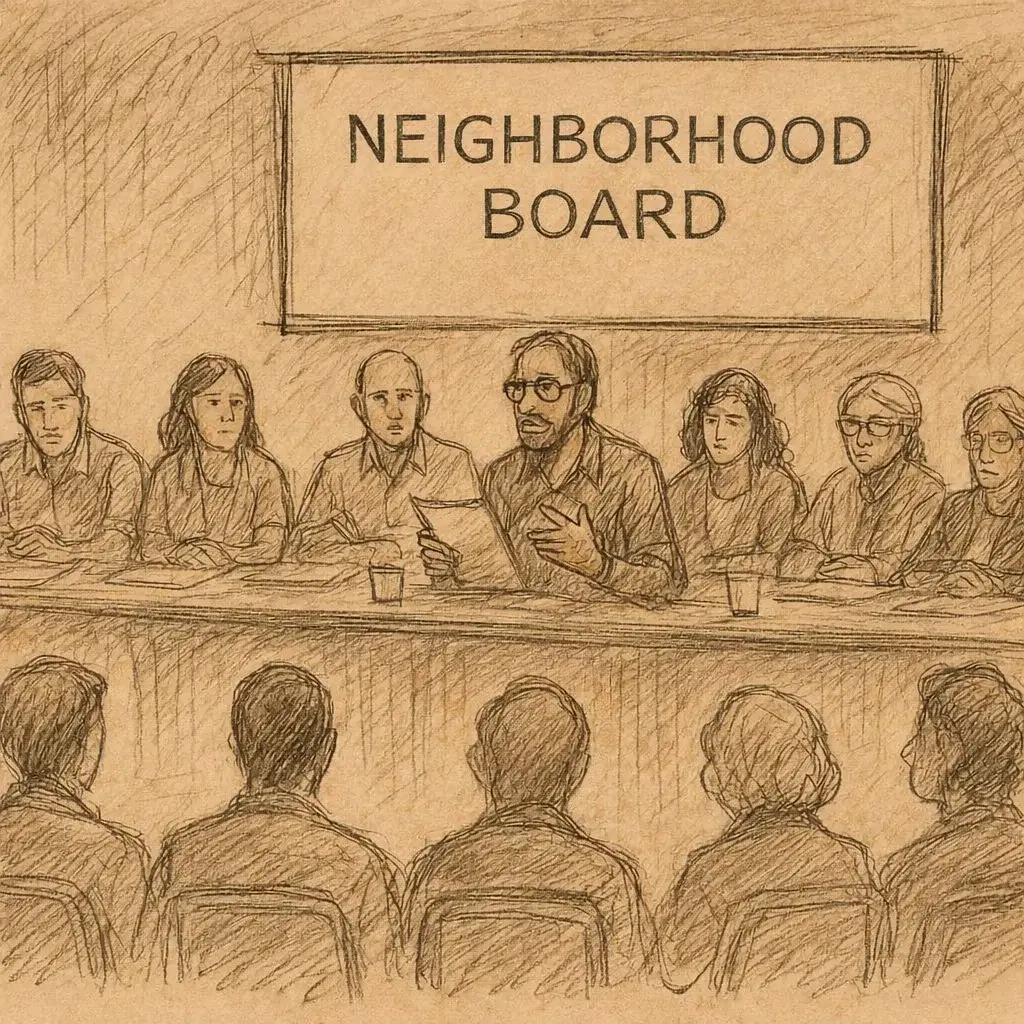
No 16 Kalihi Valley Neighborhood Board Regular Meeting October 2026
Listen to this article:
16 Kalihi Valley Neighborhood Board Meeting – October 27, 2026
Meeting Opening and Procedures
The meeting transcript identifies the gathering as the Kalihi Valley Neighborhood Board No. 16 regular meeting and records the chair calling it to order at 6:33 p.m. on Wednesday, October 14, 2026, although the supplied meeting title dates it October 27. Participants were instructed to raise their hands before speaking, identify themselves for the record, address remarks through the chair, mute microphones when not speaking, and generally limit comments to two minutes and reports to three to five minutes. Written testimony may be submitted through the Neighborhood Commission Office, while meeting handouts, reference materials, and recordings are available through the board’s Google Drive and YouTube archives. The chair also reminded attendees that the board may act only on properly noticed agenda items under the state Sunshine Law.
Fire and Emergency Response
Honolulu Fire Department Firefighter Kyle Kaleo reported three nuisance fires, 61 medical emergencies, two motor vehicle crashes, and three hazardous-material incidents within the board’s geographic area during the reporting period. Residents may review incident details and maps through the Fire Response Search Tool at fire.honolulu.gov under the “News and Info” tab or submit questions to the department’s neighborhood-board email address. HFD’s seasonal safety guidance urged residents to purchase electrical decorations and devices tested by nationally recognized laboratories, follow manufacturers’ directions, remain present and alert while cooking indoors or outdoors, keep combustible materials away from heat and flames, and exercise additional caution while walking or driving between dusk and dawn. A board member asked whether HFD would participate with fire apparatus in the Kalihi Business Association Christmas Parade, which begins at Kalihi Union Church and ends at the Kapālama shopping-center area, and also requested public education about legal and illegal fireworks before New Year’s Eve. Kaleo said the department’s social-media outreach has become more active and offered to provide the appropriate contact information, although he was not directly involved in that program.
Police Leadership, Crime Statistics, and Community Policing
New District 5 Commander Major Thomas Chang introduced himself after taking the position approximately two months earlier and said strengthening community partnerships would be one of his priorities. He described Kalihi as culturally rich and emphasized that residents take pride in their community. Sergeant Corpuz then presented September crime figures compared with August: aggravated assaults increased from zero to one, auto thefts rose from two to four, burglaries and robberies remained at zero, reported sexual assaults increased from zero to two, and one simple assault and one unauthorized entry into a motor vehicle were recorded. Theft declined from seven in August to five in September. District 5 officers responded to 562 calls for service in September, up from 548 in August. Because October is National Pedestrian Safety Month and Halloween was approaching, HPD reminded motorists to watch carefully for children, students, and kūpuna, particularly near schools. Board members also asked future HPD reports to include proactive community work such as the RAP school program, its support for DARE activities, and youth events in housing communities so that the public can see HPD’s crime-prevention and relationship-building work in addition to enforcement statistics.
Police Drones, Surveillance Trailers, and Privacy Limits
Major Chang confirmed that Districts 1 and 5 are participating in a drone pilot program in coordination with the Department of Emergency Management. Drone pods operate during specified days and hours and may be launched for priority-one incidents such as burglaries or robberies in progress. The drones are intended to provide overhead support and situational awareness for responding officers, not to conduct routine aerial patrols. Chang explained that continuous patrols would raise legal concerns involving residents’ reasonable expectations of privacy. A technical failure interrupted this discussion and caused a five-minute recess, after which the meeting resumed. Resident questions also focused on mobile surveillance trailers for crime hot spots involving gangs, theft, or stolen vehicles. Chang said HPD could consider such deployments but would need approval, public notice, and compliance with legal requirements, similar to publicly disclosed camera monitoring downtown.
Parking Complaints and Unpaid Citations
HPD identified parking complaints as the third-highest category of calls for service in District 5. Major Chang acknowledged that repeatedly sending officers to the same locations consumes time that could otherwise be used for urgent incidents involving weapons, burglaries, or threats to life. He said officers sometimes issue citations but also receive complaints when enforcement becomes aggressive, making education, public awareness, signage, and community coordination necessary parts of the response. A resident asked whether supervisors could investigate addresses generating 10 to 15 repeated calls and raised concerns that some vehicles reportedly accumulate hundreds of unpaid tickets without being towed or preventing renewal of registration or licenses. Chang said he understood that unpaid citations can result in administrative blocks on transfers or sales, but he would need to research the specific law and claims that individuals could accumulate 200 to 400 tickets without meaningful consequences. The same issue later arose in a question to Senator Donna Mercado Kim about Act 59, which was described as a well-intended law that allegedly contributed to millions of dollars in uncollected parking fines. Kim said she would investigate whether repeal legislation had been introduced or would need to be considered during the 2027 session.
Christmas Parade and Police Participation
A board member invited Major Chang to serve as grand marshal of the Kalihi Business Association Christmas Parade, noting that in-person engagement by District 5 leadership was meaningful to the community. Chang said he would be honored but wanted to notify Chief Arthur “Joe” Logan’s successor or current Chief Lazar and determine whether the chief was also available. The board suggested that both could serve because the parade had two grand marshals in the previous year. Members praised Chang for acknowledging when he needed to research an issue rather than offering an unsupported answer and expressed support for the drone pilot as a potentially useful public-safety tool. Two remaining HPD questions were to be sent to District 5 by email.
Water Main Break and Power-Outage Conservation
Board of Water Supply representative Iris Oda reported one September water-main break near 1752 Kilohe Street on September 1. She also explained how electrical outages affect the water system: well pumps require power to move water into reservoirs, so during an outage the community must rely on water already stored in those reservoirs. Residents were asked to limit use to drinking, cooking, and personal hygiene during outages and to continue conserving after power returns because reservoirs require time to refill. Prolonged outages can significantly deplete storage, and updates are available through the Board of Water Supply website and official social-media accounts.
Kilohe Street Vegetation and Firebreak Work
The Board of Water Supply followed up on overgrown vegetation on watershed land behind Kilohe Street properties. BWS communications and field-operations personnel met with board representatives and a resident and began developing a plan to trim vegetation behind the affected homes. A board member clarified for the record that the parties determined a 30-foot firebreak would satisfy Honolulu Fire Department requirements. Maintenance teams were expected to visit once or twice per month over the following six months and perform incremental work until the area meets HFD standards. Participants praised the BWS crew involved in the site visit.
Kalihi Uka Pumping Station and Water-Service Capacity
Oda also followed up on a prior concern that pumps at the Kalihi Uka pumping station might be too small to serve development farther into the valley. BWS had not understood the specific issue and requested an address for investigation. The board identified 3075 Kalihi Street, described as a large property associated with approximately 11 development units rather than a single-family residence. BWS agreed to research whether water availability, pump capacity, development configuration, or another infrastructure issue was responsible for the concern.
Flooding Near Board of Water Supply Land
The board revisited flooding affecting a home-health-care property next to BWS land. During heavy rainfall, an existing drainage gully reportedly becomes inadequate, creating a health and safety hazard severe enough to require emergency evacuation of patients. BWS personnel had met with the resident that day and were discussing possible next steps directly, although no public resolution was yet available. The chair emphasized the urgency of the issue because additional storms were expected.
Upper Kalihi Valley Storm Isolation and Emergency Access
Residents from the far end of Kalihi Street described being isolated for approximately four or five days after the storm referred to as “Lala.” A fallen tree brought down or obstructed a utility pole and disrupted electricity, internet, emergency access, and a rescue response. Residents said government personnel came to inspect and photograph the damage but left without immediately clearing it, so Hō‘oulu ‘Āina supplied equipment to lift a tree and neighbors used their own chainsaws and tools to reopen access. Speakers said similar emergencies repeatedly force the community to perform its own disaster response, including helping older residents obtain medication and making roads passable for doctors and emergency personnel. They questioned what would happen if Hō‘oulu ‘Āina or capable neighbors were unavailable during a future disaster.
Drainage, Mudslides, and Unclear Property Jurisdiction
Residents described extensive flooding and mud at Samoan church properties near the back of the valley and near Likelike Highway, with water reportedly reaching shin level and a mudslide depositing large amounts of sediment through a church. Particular concern centered on the area near Tin Roof and two Samoan churches, where no agency or landowner has clearly accepted responsibility for drainage improvements, culverts, roadside ditches, or vegetation management. Addresses discussed included 3533 or 3534 Kalihi Street and 3544 Kalihi Street. Residents and board members asked the city, state Department of Transportation, Department of Land and Natural Resources, and Board of Water Supply to determine ownership and jurisdiction. A resident also reported that a culvert failed during the latest storm; state DOT responded quickly but said the location was outside its jurisdiction, while the resident had not yet received a city response. Council Member Tyler Dos Santos-Tam’s constituent-services director, Lynn Robinson, offered to begin with city departments, identify the responsible agency, and coordinate with state offices if the matter belongs to DOT or DLNR.
Trees, Trespassing, and Burmeister Access
Residents raised concerns about trees overhanging homes near the Burmeister access or overpass area, uncertain property boundaries, and repeated disputes over which public agency or private owner is responsible for dangerous vegetation. They warned that falling trees could damage homes, block the only route into the upper valley, or injure residents. The gate leading toward Burmeister was also reported damaged after utility-company access connected with work on a 5G antenna. Residents asked for clearer communication from the Board of Water Supply and other landowners, visible boundary identification, and preventive action rather than waiting until a tree falls. Trespassing was also described as a recurring problem because boundaries between public, utility, and private land are unclear.
Disaster Resilience and Case Management
Board members proposed beginning a community resilience program in the back of Kalihi Valley and working forward toward the lower valley. Residents were encouraged to share contact information and participate in planning around emergency access, drainage, brush removal, and neighborhood self-help. The board also advised storm-affected households without a disaster case manager to call 211 and enroll in the Disaster Case Management Program, which can assist with longer-term recovery after immediate emergency operations end. Several speakers stressed that drains, bridges, culverts, trees, and eroded areas should be inspected before storms rather than only after damage occurs. Board members thanked residents for organizing their own response while acknowledging that repeated dependence on volunteer labor is not a sufficient long-term system.
Additional Flood Concern on Kilohana Street
A board member reported a similar flooding concern from a resident at 1524 Kilohana Street who had attempted to contact elected officials without receiving support. Robinson said this was likely a city matter and asked for details so her office could investigate. Board members emphasized that upper-valley residents, many of whom are kūpuna, frequently feel isolated from government services and encouraged affected residents to continue attending meetings, documenting conditions, and providing photographs and addresses.
Missing Person and Dangerous Swimming Areas
A resident reported that a former student had been missing since September after entering a privately owned pond in Kalihi with a group of young people. According to the account presented, police were called because the group was trespassing, the swimmers scattered, and one individual—identified tentatively as John Sung—was never seen leaving. His belongings were reportedly found near the pond, creating concern that he may have been injured or drowned. Speakers questioned whether the pond had been searched and why a missing-person or possible death investigation had not produced a clearer public response. One resident said a body could remain submerged for a long period and called the alleged lack of a search unacceptable. Another board member noted that the property owner had previously reported repeated trespassing and that people had died while swimming in the broader area.
Ice Ponds, Tin Roof, and Access Restrictions
The missing-person discussion expanded into the history of swimming and trespassing at Ice Ponds, Tin Roof, and nearby private or utility lands. A former board chair recalled that after a child died at Tin Roof in 2015, the community supported stricter enforcement, additional HPD patrols, removal of the sites from online tourist listings, and closure of unsafe access points. He said these areas cannot be made safe with existing resources and should be secured again in collaboration with landowners and agencies. Another member argued that community leaders need a clear decision about whether such areas can ever be safely enjoyed or must remain closed because of trespassing, drowning, and liability risks. It was clarified that the newly reported missing-person incident may involve a different private pond on the same general street rather than Ice Ponds or Tin Roof themselves.
Mayor’s Office Updates
Mayor Rick Blangiardi’s representative, Bandmaster Clark Bright, highlighted city updates involving expansion of crisis response through CORE, the selection of new HPD deputy chiefs, city assistance to Kaua‘i, progress in O‘ahu’s recovery initiatives, and upgrades to the Honolulu Zoo’s penguin and hippopotamus exhibits. Bright also reminded residents that the general election was scheduled for November 3, with active registered voters automatically receiving mail ballots beginning around October 16. Several earlier requests remained open, including Monkeypod-related work, Kamānaiki Stream cleanup, an overgrown grassy area, private vegetation blocking sidewalks, and feral-chicken capture. Relevant agencies requested extensions, and the items were expected to return in the November report.
Monster Homes and Neighborhood Parking
The Department of Planning and Permitting responded to concerns that large or “monster” homes worsen neighborhood parking congestion. DPP stated that a residential structure is lawful if it complies with the Land Use Ordinance, regardless of its overall size or building-envelope height; its approval process did not directly address the later parking impacts described by residents. Board members objected that plans may show compliance while the occupied property generates far more vehicles than surrounding streets can accommodate. They asked DPP or another responsible agency to attend a future meeting, inspect actual conditions, and discuss whether development review should better account for post-construction parking effects.
Kalihi Valley District Park Roof, Showers, and Pool Access
The city reported that repairs associated with the park showers were completed on July 31, 2026, but the showers were said to be available only during pool operating hours. Board members disputed that description, saying the showers remained barricaded and inaccessible. The meeting clarified that ordinary bathrooms were open but pool-side showers were closed. Boards around the facility were installed for safety and are expected to remain until gym-roof work is completed, although no completion date was available. The city has allocated $4.5 million in fiscal year 2027 construction funds for replacement of the Kalihi Valley District Park gym roof, with another $107,550 from the Parks Playground Fund available as supplemental funding if needed. Members requested an on-site inspection with Department of Parks and Recreation Director Laura Thielen or an authorized representative to establish an accurate scope, schedule, and explanation of what is preventing the showers from reopening. Robinson agreed to arrange the visit, with board members, the council office, and potentially District 5 police participating.
Pool Staffing and Unequal Operating Hours
Residents and board members said the Kalihi Valley pool is open only on limited hours across approximately four days per week, while pools in communities such as Mānoa reportedly operate seven days a week with longer hours. The stated explanation was a shortage of approximately two employees, leaving only a pool manager or interim manager, but members questioned why citywide staffing shortages are not shared more evenly among facilities. They also reported that posted or recorded hours were several weeks out of date and that visits often found the pool closed for lack of staff. Robinson agreed to ask DPR how employees and lifeguards are assigned, why Kalihi Valley has a disproportionate shortage, and how schedules are communicated. The board also discussed K-VIBE’s efforts to build a junior-lifeguard pathway so Kalihi youth can receive training and eventually help fill local lifeguard positions.
Cooling and Ventilation at the Park
The council office had submitted a request for four industrial fans for the Kalihi Valley District Park gym, where hotter conditions have made the existing cross-ventilation design inadequate. DPR indicated it was evaluating fans, chillers, or similar equipment, but permanent installation might need to wait until roof construction is completed. If the full expense cannot be covered in the current fiscal year, purchases could occur in phases. The board clarified that a separate request was also needed for the meeting room, where closed or ineffective louvers leave board members and residents sweating through meetings. Members suggested pedestal fans costing about $199 each as an immediate solution, while also asking DPR to consider portable air-conditioning units or split systems. Robinson agreed to preserve the approved gym request while opening a separate request for cooling the meeting room.
Traffic Signs, Crosswalks, and Street Improvements
The council office submitted a request for an additional one-way sign on Lehua Street after reports of crashes caused by drivers traveling in the wrong direction. It also requested traffic studies for a raised crosswalk near the Hele gas station at 1950 Kalihi Street and for broader traffic-calming measures along Kalihi Street. A board member sought an update on repainting or repaving the lower portion of Kalihi Street; Robinson said the project remained in the queue but had no new schedule. Additional safety reports involved two faded pedestrian-crossing signs on Camphor Road near 7-Eleven and Jack in the Box, as well as a malfunctioning pedestrian push button at the School Street and Camphor Road intersection. The council office requested precise location details for follow-up.
Hazardous Tree at Kamānaiki and Merker Streets
A board member reported a large cherry tree near the corner of Kamānaiki and Merker Streets, approximately 20 feet from a stop sign and nearly as tall as a utility pole. The tree was described as capable of striking homes on either side of the street if it fell during a storm. The adjoining household reportedly lacks funds to remove it, and previous communication with a city arborist ended without resolution. The council office asked for the nearest address and photographs to determine whether the tree is within the sidewalk or public right-of-way and whether city intervention is possible.
Emergency Preparedness Meetings and Safety Task Force
Council Member Dos Santos-Tam and Representative Amy Perruso or Representative Takenouchi were announced as hosts of an emergency preparedness and resilience meeting at Kawānanakoa Middle School at 6 p.m. on October 22. The meeting was intended to provide planning advice and practical steps for preparing before disasters. Separately, the Kalihi Safety Task Force was scheduled to meet October 22 from 11 a.m. to 12:30 p.m. in room 103 at the KPT PAC facility. Organizers said they were trying to form the nation’s first “Level 1” community-based safety task force, building on another area’s Level 2 model. Questions arose about whether the effort sufficiently represented Kalihi Valley and Camphor-area residents, and participants were encouraged to attend and continue that discussion outside the board’s limited committee-report period.
Affordable Senior Housing and Redevelopment
Governor Josh Green’s representative Jill Radke announced the opening of Hoʻokahua or Hoʻohiki Senior Living at 1002 North School Street. The development contains 249 affordable rental apartments for residents age 55 and older whose households earn up to 60 percent of area median income. It is the first phase of a larger plan for approximately 800 affordable senior units. Applications were being accepted through October 31, a housing lottery was scheduled for November 10, and move-in was expected in January 2027. Radke also reported that the first phase of the Mayor Wright Homes redevelopment at 521 North Kukui Street was scheduled to break ground October 22. That phase will provide a 306-unit affordable rental tower, with construction expected to last approximately three years and finish near the end of 2029.
Youth Basketball, Business Development, and Public Events
Radke reported that Golden State Warriors coaches conducted a free basketball clinic at Pālama Settlement on September 30 for nearly 100 children from Kalihi-Pālama. Participants learned dribbling, passing, rebounding, and shooting from coaches that included two-time NBA champion and former Warrior Zaza Pachulia. She also announced a November 13–14 workshop at the East-West Center for small businesses and nonprofits seeking to reach the visitor market. The event was scheduled from 8:30 a.m. to 5 p.m. each day and cost $80 for both days or $45 for one day, plus tax, including breakfast and lunch. The Aloha Tower Centennial celebration was also announced, with an October 15 blessing and reopening of the observation deck, a Royal Hawaiian Glee Club performance, and an October 16 evening celebration featuring entertainment, tours, and an 8 p.m. drone show. Residents were additionally reminded to participate in the Great Hawai‘i ShakeOut earthquake drill by practicing “drop, cover, and hold on.”
Proposed Port and Camp Five Recreation Center
A board member asked why the governor had recently discussed a new port, whether it related to a previously submitted community plan, and where it might be located. Radke did not have details but said she would seek an answer, suggesting sustainability could be part of the rationale. Another resident asked about long-promised demolition of the Camp Five Recreation Center, noting that officials had previously said funding was available. Radke recalled that contracting should have been underway and agreed to obtain an updated demolition and rebuilding timeline, coordinating with Representative Ikaika Hussey’s office if needed.
Homelessness and Stream Encampments
Residents asked for immediate action on homeless encampments under bridges, along streams, near Kalihi Valley Recreation Center, around the Likelike Highway forested areas, and near the Kaʻiwai or Kalihi stream system. They warned that people camping in waterways face danger during storms and that exposed or distressed individuals walking near children create additional safety concerns. A previously addressed encampment near Kilohana was cited as an example of successful intervention. State representatives asked for exact locations and agreed that homelessness requires coordination across state, city, outreach, shelter, health, and public-safety systems.
Election Information and Ballot Measures
Senator Donna Mercado Kim reported that her Capitol office was under renovation until approximately December, her assistant Kathy Nee was on medical leave after an accident, and she herself had recently recovered from illness, limiting her ability to provide a full written report. She reminded residents that ballots were being mailed and that the general-election ballot contained two constitutional amendments and 20 city charter amendments. She warned that the number and complexity of measures could cause voter fatigue and longer waits at in-person voting sites. Representative Hussey added that voter service centers would open October 20 and drew attention to Charter Amendment Question 5, which he said would authorize ranked-choice voting in Honolulu. Hussey personally described ranked-choice voting as a promising, progressive approach, while Kim encouraged voters to research every proposal carefully.
Campaign-Finance Litigation and 2027 Legislative Planning
Representative Hussey reported that the Chamber of Commerce, Grassroot Institute, and American Civil Liberties Union had filed suit challenging Hawai‘i’s Act 11 response to the U.S. Supreme Court’s Citizens United decision. He interpreted the legal challenge as evidence that the state was confronting significant questions involving political spending and corruption. With the 2027 legislative session roughly three months away, he encouraged the board to begin identifying legislative priorities, despite uncertainty over who would represent the district after the general election. When asked about a proposed 32-hour workweek, Hussey said he would support it and expressed willingness to work with the chair on the concept.
Bridge, Highway Drains, and Vegetation Debris
Representative Hussey was reminded of a request to inspect the final bridge on Kalihi Street near the route to Hō‘oulu ‘Āina and the upper valley. He acknowledged that the bridge-integrity issue had fallen off his follow-up list and promised to revisit it within a week. He had already written to state DOT Director Ed Sniffen about runoff, Likelike Highway drains, and related upper-valley concerns. Hussey said DOT sent numerous vehicles and personnel shortly before the latest storm and believed drain work had occurred, though residents requested confirmation. A resident added that maintenance crews often cut grass and blow the clippings into storm drains instead of collecting them, undermining flood-prevention work. Because roadside mowing may involve city rather than state jurisdiction, the concern was to be referred to the appropriate city department.
Neighborhood Safety and Disaster Planning Events
Hussey announced an October 19 disaster-preparedness meeting at Central Union Church Parish Hall focused on urban Honolulu. He also thanked the council office for pursuing the Kalihi Street gas-station crosswalk, Lehua Street one-way signage, and traffic-calming requests. Residents reiterated that preventive inspections of bridges, drainage systems, slopes, and vegetation need to occur before severe weather and asked elected officials to provide direct status reports rather than allowing requests to disappear between agencies.
Meeting Minutes
The board unanimously approved the September 9, 2026 regular-meeting minutes after amendments. Three references to “Makuakāne” were to be changed to “Makuahine,” and “riser” was corrected to “RISR,” an acronym associated with the city’s information or service-request system. No objections or abstentions were recorded.
Kalihi Business Association Christmas Parade
The board unanimously authorized the Kalihi Valley Neighborhood Board to register and participate in the 2026 Kalihi Business Association Christmas Parade. Participation may include both walking or riding in the parade and operating a community booth near the end point from approximately 5 to 8 p.m. The board planned to coordinate materials and activities with the Neighborhood Commission Office.
Recognition of Christopher Wong
The board unanimously approved a certificate recognizing board member Christopher Wong for advocacy, mentorship, and reminding Kalihi Valley of its value “plus 10 percent.” Wong said his service was inspired by his grandmother, Lolita Pascual, who operated the Pink Store business in Kalihi Valley for approximately 30 years, as well as longtime community figures Pascual Dobbis, James Rodriguez Sr., and Ted and Harriet Yap of KC Market. He emphasized that service should honor kūpuna, support future generations, and replace negative stereotypes about Kalihi with recognition of the neighborhood’s cultural wealth and mutual care. He also urged residents to remember the people whose past work made current community advocacy possible.
Board Meeting Time and Member Reporting
During board business, a member objected to rushing the closing agenda and argued that elected neighborhood-board members need sufficient time to explain their own work, not only question agency representatives. He suggested either beginning meetings at 6 p.m. or reconsidering the meeting venue if the current permit and closing time prevent full board discussion. The chair explained that the facility permit effectively required the meeting to conclude by 9 p.m., even though the scheduled session was generally expected to finish earlier.
Neighborhood Board Election Timeline
The chair announced the upcoming Neighborhood Board election schedule. Candidate materials were expected to become available December 18, 2026; the voter and candidate registration deadline was February 19, 2027; mailed candidate materials had a late-February deadline; voting was scheduled from April 23 through May 21; late ballots had to be received by May 28 if properly postmarked; results were to be released by June 1; challenges were due June 8; and the inauguration of new board members was planned for June 26. The chair described 2027 as a period of significant transition involving a new legislative year, new City Council leadership, and a new Honolulu police chief.
Chair’s Resignation
Chair Lea Tambaga announced that she would step down as chair upon adjournment while remaining a member of the Kalihi Valley Neighborhood Board. She requested that election of a successor be placed at the beginning of the November agenda and directed the request to Chair Pro Tem Sung. Tambaga said community service was not defined by title and that she intended to continue helping, learning, advocating, and working with residents. Wong praised her as a selfless community servant and said her departure from the chairmanship challenged the entire board to increase its commitment to Kalihi Valley.
Next Meeting and Adjournment
Because Wednesday, November 11 was a holiday, the board agreed without objection to move its next regular meeting to Thursday, November 12, 2026, at 6:30 p.m. at Kalihi Valley District Park, with online access also available. The chair also announced a televised rebroadcast on ʻŌlelo Channel 49. After final remarks recognizing the board’s dedication and Kalihi Valley’s cultural strength, the meeting adjourned at 8:50 p.m.