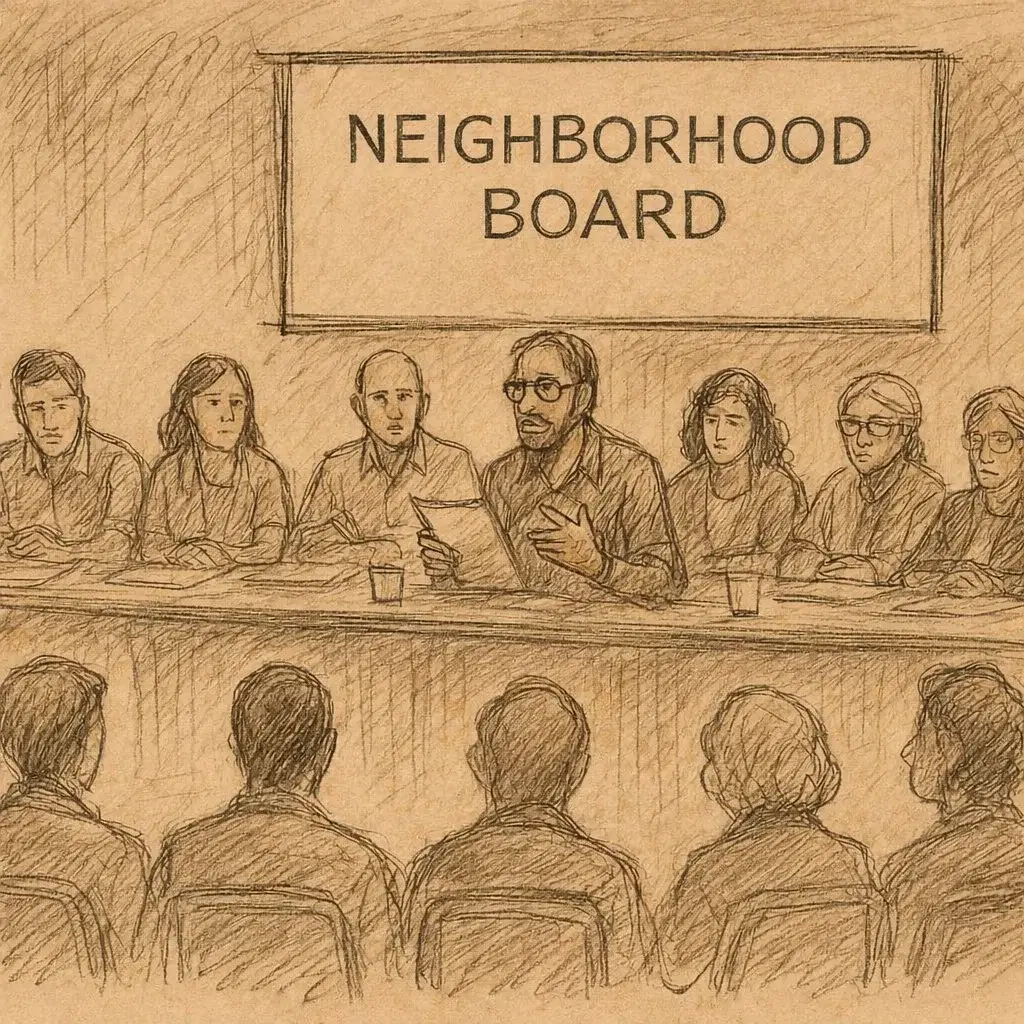
No 15 Kalihi Pālama Neighborhood Board Regular Meeting September 2026
Listen to this article:
15 Kalihi-Palama Neighborhood Board Meeting – September 17, 2026
Meeting Opening and Quorum
Vice Chair Lynn Vasquez opened the meeting, although the spoken introduction identified the date as September 16 while the meeting title lists September 17. Participants were instructed to raise their hands before speaking, state their full names, direct remarks through the chair, and limit comments to one minute and 30 seconds with one question per speaker. Written testimony could be submitted through the Neighborhood Commission Office. Vasquez explained that neighborhood boards exist to promote citizen participation in government decisions and that, under the Sunshine Law, the board generally cannot act on matters not listed on the agenda. Adding an item requires nine votes, or two-thirds of the 13-member board, and is limited to matters of major importance affecting a significant number of people. Six members were initially present, leaving the board without the seven members needed for quorum and preventing formal action on several matters.
Police Crime Statistics and Homeless Encampments
An Honolulu Police Department District 1 representative, Sergeant Lee, reported August 2026 statistics that included four motor-vehicle theft incidents, two burglaries, three thefts, no unauthorized motor-vehicle cases, three assaults, no sexual assaults, no graffiti cases, three drug cases, and a second motor-vehicle-theft figure of 13 as stated in the report; the apparent duplication was not clarified. District 1 recorded 276 calls for service. Board member Willis Moore, a resident of 888 Iwilei Road, described a growing encampment along Iwilei Road near Subway, alleging that people temporarily relocate there during weekly sweeps on Kuwili Street and return afterward. He said the encampment blocks the sidewalk and bicycle path, includes animals and accumulated belongings, leaves rubbish behind, and creates a poor and unsafe environment for residents and visitors. Moore said repeated calls had not resulted in an officer responding. Sergeant Lee said District 1 had not received complaints through its normal channel and agreed to refer the matter to his command. A community participant suggested contacting the Mayor’s complaint office so the case could be routed directly to the Police Chief and relevant city agencies.
Water Conservation Event
Board of Water Supply representative Iris Oda announced the “Imagine a Day Without Water” event scheduled for Saturday, September 26, from 9 a.m. to 1 p.m. at the Arc of Safety at Waiʻanae Mall, 86-120 Farrington Highway. The free public event was planned to include interactive exhibits, educational displays, hands-on activities, games, prize giveaways, a rain-barrel workshop, food, and refreshments. A handout provided at the prior meeting was resubmitted for posting to the board’s online records.
Rail Construction on Dillingham Boulevard
Honolulu Authority for Rapid Transportation representative Gabby Camacho reported that HART and contractor Tutor Perini were extending concrete traffic barriers from Waiakamilo Road to slightly beyond Kohou Street on Dillingham Boulevard. The change replaced cones with barriers to separate traffic from the construction zone but did not create additional lane closures. One eastbound and one westbound lane would remain on the makai side, while work continued on the mauka side. Responding to a question from the previous month, Camacho said the only property obtained through eminent domain for the Mokauea/Kalihi rail station was 1829 Dillingham Boulevard. HART had communicated with the owners since 2022 and reached a settlement considered reasonable and in the public interest. Residents were directed to HART’s project hotline at 808-566-2299 or info@honolulutransit.org.
Attempt to Fill an At-Large Board Vacancy
The board considered filling one of four at-large vacancies. A resident who identified himself as Bob Fatea expressed interest, said he lived at 1536 Pohaku Street in ZIP code 96817, and noted that he had previously run for elected office. Although he had not brought residency documentation into the meeting room, members said his residency could be verified from his identification or previous candidacy. A nomination and roll-call vote followed, but only six valid votes were recorded. One online member was muted or unresponsive, and participants were reminded that online board members must have their cameras on for their votes to count. Because the board still lacked quorum, the appointment was tabled. At the end of the meeting, members asked whether Fatea could be sworn in at the next meeting, but Neighborhood Commission Chair Patrick Smith clarified that he could not guarantee favorable commission action in advance.
Deferred Community Recognition
A planned community recognition for the Brothers Cazimero was deferred. No recognition presentation or formal action took place because of the meeting’s quorum and scheduling circumstances.
Leilani Street Traffic and Parking Safety
Jefferson Kelly, a resident of Leilani Street, renewed concerns about speeding and traffic diverted onto the residential street because of a no-right-turn restriction near School Street and Kalihi Street. He said several residents had raised the issue across multiple board terms without seeing a solution. Kelly suggested installing electronic speed-feedback signs, reducing the speed limit, or pursuing other traffic-calming measures. He also described a visibility hazard at Leilani and Lokaku Streets, where vehicles parked close to the intersection block drivers’ views of speeding traffic. He requested no-parking signs or a marked setback near the corner. Members discussed waiting for transportation officials, requesting help from the appropriate council office, and developing a board resolution. There was disagreement over whether board members should personally inspect the street, with some noting that boards are advisory and do not install signs or conduct enforcement. Two members nevertheless volunteered to observe the location and prepare an informed resolution for future consideration.
Continuing Nuisance at 901 Gulick Avenue
Kristen Liana followed up on the board’s August resolution concerning recurring nuisance activity near Hawaiian Snow at 901 Gulick Avenue. She acknowledged that conditions had become much quieter during the preceding month and a half but said public drinking, smoking, urination, and short gatherings still occurred. She also said a tree identified for removal and wooden pallets described as a fire hazard remained outside. Liana asked what practical effect the resolution had, which agencies were responsible for follow-up, and whether it created any additional enforcement process if the nuisance returned. She emphasized that repeatedly calling HPD was not a permanent solution, particularly because groups often leave within 10 to 15 minutes before officers arrive.
History of the Gulick Avenue Response
Dee Hayashida from Councilmember Radiant Cordero’s office reviewed the government response to the Gulick Avenue complaint. The matter began in January 2026, and in February the office requested DPP review property boundaries while asking HPD for added evening patrols. In March, DPP reported that irregular roadway width and the compromised sidewalk near the loading dock made it difficult to determine the precise street, sidewalk, and setback boundaries; DPP concluded that loitering, public urination, and sidewalk parking would largely require HPD enforcement. After District 5’s command changed, Councilmember Cordero arranged a May site meeting involving Liana, the neighboring property owner, Hawaiian Snow’s owner, council staff, Major Chang, Acting Captain Timmy, and Officer Galicia. Hawaiian Snow’s owner reportedly agreed to trim or remove trees and add security lighting, and patrols continued. HPD later said its officers repeatedly found no arrestable activity and had exhausted available measures, advising Liana to keep calling when incidents occurred. The August resolution came after many of these steps because earlier meetings lacked quorum. Hayashida could not confirm what further action DPP, the Mayor’s Office, or Hawaiian Snow would take.
Role and Follow-Up of Board Resolutions
Neighborhood Commission Chair Patrick Smith explained that neighborhood boards are advisory and cannot directly compel enforcement, issue fines, or change laws. Resolutions remain useful because they formally express the community’s position, document the problem, and clearly tell elected officials or agencies what action residents want. He recommended concise resolutions that explain the circumstances and state a specific requested outcome. Follow-up depends on board members repeatedly asking elected officials and agencies for status reports. Fatea and other participants urged the board to assign members to track resolutions, maintain communication with responsible offices, and report progress to affected residents rather than allowing matters to end with a paper referral.
H-1 Widening and Gulick Avenue Closure
Patrick Watson of Honua Consulting, reporting for the H-1 widening project, announced that the Gulick Avenue overpass was expected to close fully beginning Monday, September 21, at 6:30 a.m. The closure was projected to last approximately one year for bridge work. The Beckley Street intersection at Gulick Avenue would remain closed for another six weeks and then shift to a single-lane contraflow arrangement during workdays, with crews managing traffic. Full traffic access was expected to return during evenings. Project information was made available through the project hotline, email contacts, and h1widening.com. Representative Shirley Templo’s office later added that a temporary bridge would remain available for pedestrians and bicyclists and expressed concern about prolonged effects on nearby small businesses, including reduced access, parking, traffic circulation, and customer activity.
Farrington High School Noise Contact
Lisa Yasso provided follow-up information for residents concerned about noise from Farrington High School events or band activities. Complaints may be directed to Principal Laurie Luczak through the school’s main number, 808-305-5000. Yasso said she obtained the information in her role as a parent representative serving the school community councils for Kalihi Kai Elementary, Kalākaua Middle School, and Farrington High School.
Youth Violence, Theft, and Policing at Kuhio Park/Kahumanu Housing
Yasso also reported escalating youth violence at her public-housing complex, identified in the transcript as Kahumanu Homes. She described a Friday fight in the parking lot in which youths wearing dark blue or black hoodies allegedly attacked resident children with baseball bats and mace. She later learned it was the third fight in three days. As a legally blind resident, she said she and her son had to hide while taking out rubbish and saw only one police vehicle respond. She also described youths stealing and opening a neighbor’s delivered package and said outside students were using the housing complex to hide or avoid school. Elderly residents were reportedly afraid to call authorities, and Yasso said the neighborhood no longer sees the visible police presence it once had.
Police Staffing and Police Activities League Concerns
Fatea and Yasso questioned whether HPD has enough staffing to respond effectively to neighborhood safety problems. Fatea cited a citywide shortage of approximately 500 officers and urged the city to improve recruitment and retention rather than place all responsibility on patrol officers. He also disputed the usefulness of referring youth concerns to the Police Activities League, saying PAL had 14 to 16 assigned officers in the 1970s and 1980s but only about four currently. As a longtime PAL booster, he said the program once supported more than 120 basketball teams but now reaches roughly 20 across Honolulu. He called on the Mayor and city human-resources system to provide sufficient staffing and incentives before further retirements deepen the shortage.
Public-Housing Redevelopment and School Enrollment
Yasso reported that her housing complex may undergo redevelopment similar to Mayor Wright Homes, although funding had not yet been secured. Project representatives expected to apply for funding in January 2027; if approved, phase-one residents could begin relocating by the end of 2027. She warned that temporary displacement could sharply reduce enrollment at Kalihi Kai Elementary, Kalākaua Middle School, and Farrington High School. Because school budgets and Title I funding are tied partly to student counts, enrollment losses could reduce staffing and programs. She said Kalihi Kai had already missed its projected enrollment and Farrington had lost more than $1 million because enrollment fell below estimates. She asked state officials what assistance would keep the schools and their programs financially stable during redevelopment-related relocations. Representative Templo’s office agreed to seek an answer.
H-1 Cap Park Planning Study
The Hawaiʻi Department of Transportation, PBR Hawaiʻi, and AECOM presented an early feasibility study for a cap park over approximately half a mile of the H-1 Freeway between Liliha and Queen Emma Streets. A cap park is a deck built over a depressed freeway to create public open space. The team cited Klyde Warren Park in Dallas, Hance Park in Phoenix, and Boston’s Rose Kennedy Greenway as examples of projects supported through public-private partnerships, nonprofit maintenance organizations, municipal revitalization efforts, or additions to existing infrastructure projects. The Honolulu study is funded through the U.S. Department of Transportation’s Reconnecting Communities Pilot Grant Program and is intended to restore connections severed by freeway construction, improve pedestrian and bicycle mobility, strengthen mauka-to-makai movement associated with the ahupuaʻa system, acknowledge the area’s cultural and immigrant histories, reduce environmental pollution, and expand public access to open space.
Historical Context for the Cap Park
The project team outlined the area’s development from pre-contact Honolulu, when Kou was a fishing settlement linked to loʻi kalo, agricultural lands, and a major Nuʻuanu trail, through missionary settlement, Western-style construction, commercial growth, private land ownership after the Māhele, and the emergence of immigrant neighborhoods such as Chinatown. By the late 1800s, roads, bridges, electric lighting, and port development were transforming Honolulu. Early 20th-century sanitation policies, the Chinatown fire associated with efforts to control bubonic plague, automobile growth, and expressway planning further changed the district. From 1950 onward, the Mauka Arterial—later incorporated into the H-1—combined with urban-renewal policies to reshape central Honolulu. More than 500 properties were condemned, and Nuʻuanu, Liliha, and Foster Botanical Garden-area connections were divided. The cap park study is examining whether some of those disrupted neighborhood links can be restored.
Cap Park Boundaries, Maintenance, and Displacement Concerns
A board member asked why the study stops at Liliha rather than extending west into densely populated Kalihi, where open and green space is limited. Project staff said the initial area was selected because of its historic and cultural connections to downtown and Chinatown, though they could not provide all details behind the original scope. Senator Karl Rhoads explained that he initiated the concept through a legislative resolution and selected an area in his district where the freeway is depressed enough to be capped; elevated freeway segments farther west would be much more difficult to cover. Community members raised concerns about maintenance, security, houselessness, damaged or unusable existing parks and gyms, and whether a new park could increase nearby land values and worsen housing affordability. The study team said similar concerns had emerged during outreach and would be considered through programming, security planning, public-private partnerships, coordination with city and state parks agencies, and identification of reliable construction and long-term maintenance funding. The first community meeting was scheduled for Tuesday, September 29, at 5:30 p.m. at Keʻelikōlani Middle School.
School Street Senior Affordable Housing
Highridge Costa project manager Harrison Hertzberg presented an update on the School Street affordable-housing project, officially named Hoʻokīki and located at 1008 North School Street. The development will contain 250 units for residents age 55 and older: 32 studios, 208 one-bedroom units, nine two-bedroom units, and one two-bedroom manager’s unit. Of the 249 income-restricted homes, 98 will serve households earning no more than 60% of area median income, 125 will serve those at or below 50%, and 26 will serve those at or below 30%. The building will provide 247 parking spaces, which the developer expects will accommodate residents with vehicles, although more than one space per household cannot be guaranteed. First move-ins and apartment viewing were anticipated in January 2027. A housing lottery was tentatively targeted for October 26, with applications accepted through October 1 for automatic lottery entry; later applicants would be placed on a waiting list. All homes will be rentals.
Debate Over Concentrated Affordable Housing
A community member questioned whether continuing to concentrate public and subsidized rental housing in Kalihi helps residents eventually build wealth and purchase homes or instead reinforces long-term poverty and higher crime. He argued that housing was historically understood as temporary assistance while families regained stability and asked how affordability is defined for residents whose income may not support rents near $1,400. Senator Rhoads responded that older models concentrating only the lowest-income households in one place had produced social problems. He said the Mayor Wright redevelopment is intended to include a range of income levels rather than exclusively very-low-income residents, with the goal of avoiding some problems associated with traditional public-housing design.
Mayor’s Storm Preparedness Report
Mayor’s representative and Department of Information Technology Deputy Director Stephen Courtney described preparations for Tropical Storm Lala. City departments positioned equipment, cleared streams and drainage areas, secured facilities, tested emergency communication systems, coordinated with state, federal, and community partners, activated the city Emergency Operations Center and HPD Joint Operations Center, opened eight hurricane refuge areas across Oʻahu, and increased first-responder staffing. Residents were urged to maintain an evacuation bag for every household member containing sturdy shoes, identification, documents, chargers, medication, glasses, and cash. Households were also advised to store 14 days of supplies, including one gallon of water per person per day, nonperishable food, a can opener, work gloves, sanitation products, personal-care items, knives, and basic tools.
Mayor’s Follow-Up on Community Policing and Disability Issues
Courtney reported that HPD’s Community Affairs Division oversees PAL and can be reached at 808-723-3475. Regarding Yasso’s request for patrols near a park and structure between Kalihi Kai Elementary and Kalākaua Gym where drug use was alleged, HPD requested a precise address, ownership information, and clarification about whether the property is public or private. District 1’s community-policing team had also contacted area schools in response to Chair Cullen’s earlier request and was awaiting replies. The administration maintained its decision not to reestablish the Mayor’s former Americans with Disabilities Act committee, citing other forums dealing with disability rights and concerns. Residents were directed to HNL 311 for non-emergency city reports and HNL.info for city information.
Mayor’s Follow-Up on Gulick Avenue
Board members pressed Courtney to address the year-long Gulick Avenue nuisance and the unresolved pallets and tree. Courtney said he had worked with HPD to increase patrols and believed that effort contributed to quieter conditions. He had also reviewed Liana’s Ring-camera videos and previously asked DPP to consider violations, but the request had been declined roughly six or seven months earlier. He agreed to approach DPP again and coordinate a report through the Neighborhood Commission Office. Liana confirmed that smoking, drinking, and urination were still occurring intermittently and repeated that the community needed a long-term plan rather than temporary reductions in activity.
Councilmember Cordero’s District Report
Councilmember Radiant Cordero’s office urged residents recovering from recent storms to avoid downed trees, debris, utility lines, and malfunctioning traffic signals, treating failed signals as all-way stops. At Kalākaua District Park, the missing women’s restroom sink had been replaced. Because overhead fans could interfere with sports, the Department of Parks and Recreation was using air movers and floor fans to improve gym ventilation while exploring longer-term options. Farrington High School student Arabella Cruz was sworn in for a second term representing District 7 on the Honolulu Youth Commission. The report also covered Bill 41, which aligns city rules with new state regulation of e-bikes and electric mobility devices; storm-related insurance claims; emergency-repair permit fee waivers; wastewater and stormwater planning; previously announced school-zone speed reductions and driver-licensing changes; new DPP requirements effective September 1 for certain residential projects; standardized seasonal athletic-field permitting; reinstatement of the daylight-saving-related schedule referenced in the report; and the September 30 home-exemption filing deadline.
Blood Bank Building Reuse
Cordero’s office clarified that the former Blood Bank of Hawaiʻi building will be renovated for the Honolulu Emergency Services Department and Emergency Medical Services administration. Ambulance functions will also be based there, consolidating operations that are currently spread across multiple rented or leased locations.
Illegal Dumping Legislation and Downtown Night Market
Councilmember Tyler Dos Santos-Tam’s representative, Lynn Robinson, reported that the councilmember was developing legislation giving the city clearer authority to remove illegally dumped furniture, appliances, tires, construction debris, and other materials from sidewalks, streets, roadsides, and public rights-of-way. The proposal would expedite removal where dumped items create health, safety, or drainage hazards and allow cleanup costs to be charged to responsible parties. City departments were still reviewing the bill. Robinson also announced an Activate Downtown Honolulu night market at Fort Street Mall on Friday, September 18, from 4:30 to 9 p.m., featuring crafts, jewelry, clothing, music, and food as part of efforts to increase activity and safety downtown.
Election and Constitutional Amendment Information
Senator Karl Rhoads discussed the first proposed state constitutional amendment on the 2026 ballot, which originated from his legislation. The amendment would provide more time during legislative interims to confirm judges, allowing hearings to be consolidated and reducing the expense of bringing neighbor-island senators to Honolulu for separate confirmation sessions. He noted that leaving an amendment question blank counts as a “no” vote. General-election ballots were expected in mailboxes by October 16. Residents who had not received ballots by October 17 or 18 were advised to contact the county clerk at 808-768-3610. Rhoads said the U.S. Supreme Court had recently allowed states to continue mail voting despite federal efforts to impose additional restrictions. Voting another person’s ballot is a Class C felony punishable by up to five years in prison and a $10,000 fine, including when the intended voter has died; health records are used to update election rolls, though timing can result in ballots being mailed before a death is recorded.
Power Outage Claims, COVID-19, and Accessibility
Rhoads reminded residents that claims to Hawaiian Electric generally must be filed within 30 days of an outage. Compensation may cover repair costs or the depreciated value of damaged items, whichever is lower, if the loss is determined to have been within the utility’s control. He said a bill he introduced to shift more outage costs to the utility had not passed. Rhoads also warned that COVID-19 cases were increasing and said updated vaccines were available and covered by his insurance. Responding to a prior accessibility concern, he formally asked the State Highways Division to install audible countdown signals at the School Street and Liliha Street crosswalks, where freeway noise makes it difficult for blind pedestrians to determine when crossing is safe. He also reported that the Division of Vocational Rehabilitation was recruiting to fill five vacancies. Rhoads said he had approximately six weeks remaining in office but intended to continue constituent work through his final day.
Mayor Wright Naming Contest and Community Cleanup
Representative Kim Coco Iwamoto announced a public contest to choose a new name for the redeveloped Mayor Wright Homes community. The effort is being conducted through the Hawaiʻi Public Housing Authority and developer Highridge Costa, and the selected name is expected to identify the development for many years. Iwamoto also thanked volunteers who participated in the previous month’s Chinatown cleanup and said she would meet with Hawaiian Electric to discuss outage preparedness and electrical-grid improvements.
Halona Street and Auld Lane Encampment
Iwamoto reported repeated complaints about a blue bus near Halona Street and Auld Lane being used by houseless individuals. Large amounts of rubbish were accumulating and blowing into the surrounding area near the freeway entrance. Her office had coordinated with Councilmember Dos Santos-Tam’s staff and submitted multiple HNL 311 reports, but she said stronger intervention was needed as conditions continued to deteriorate.
Infrastructure Ballot Proposal
Iwamoto discussed the second state constitutional question, describing it as a proposal intended to improve infrastructure without raising property taxes. She disclosed that advertisements supporting the proposal were privately funded by developers, including Stanford Carr Development, rather than by state or other public funds. She also noted that voters would face two state constitutional questions and approximately 19 Honolulu Charter questions.
Representative Templo’s Community Report
Representative Shirley Templo’s representative, Ed Thompson, reported on her attendance at the Hawaiʻi State Association of Counties conference on Maui, where state and county officials discussed housing, infrastructure, public safety, emergency preparedness, transportation, and intergovernmental coordination. Templo also joined the second annual Lights of Lahaina march led by Lahainaluna High School students to commemorate the community’s losses and recovery. She recognized Sergeant Efren Aguilar upon his retirement after 26 years leading Farrington High School’s Junior ROTC program and helping students develop discipline, teamwork, and leadership. Farrington’s homecoming football games against Radford were scheduled for September 18, with the junior varsity game beginning at 5:30 p.m. and admission listed at approximately $12.55.
State Storm Business-Recovery Assistance
Governor Josh Green’s representative, Kathleen Lee, shared storm resources and announced that the Department of Business, Economic Development and Tourism and Chamber of Commerce had partnered to make $3.35 million available for affected businesses to recover and rebuild. Responding to an earlier concern about Costco’s proposed Dillingham Boulevard gas station near a school, the Governor’s Office said the Governor generally does not take positions on private-sector proposals but shares community concerns about environmental and traffic effects.
Proposal to Reduce Board Membership
The board discussed reducing its authorized membership from 13 seats to either 11 or nine, effective July 1, 2027, because repeated vacancies and absences had prevented quorum and delayed resolutions for months. Neighborhood Commission Chair Patrick Smith said a decision or clear consensus was needed before the commission’s September 28 meeting so election officials could prepare for the May 2027 neighborhood-board election; otherwise, a change might not take effect until 2029. Under the Neighborhood Plan, quorum is a majority of authorized seats, meaning seven for a 13-seat board, six for 11 seats, and five for nine seats. Some members favored nine because boards of that size generally avoid quorum problems, while others preferred 11 to preserve more opportunities for community participation. Members emphasized that reducing formal seats would not prevent residents from attending, testifying, or participating informally. Because the board lacked quorum, it could not formally vote, but discussion appeared to favor reducing the board, with several members expressing support for 11 seats.
Next Meeting and Broadcast Information
The announcement of the next meeting contained conflicting dates, referencing Wednesday, October 21, and Thursday, October 26, at 6 p.m. at Kapālama Hale, 925 Dillingham Boulevard, Room 153; residents would need to confirm the final date through the Neighborhood Commission Office. Recordings of Kalihi-Pālama Neighborhood Board meetings are available on ʻŌlelo Channel 49 and at olelo.org, with broadcasts stated as the first Monday of each month at 9 p.m. and the second and fourth Thursdays at 11 a.m. The meeting concluded without quorum and with the vacancy appointment and other formal actions unresolved.