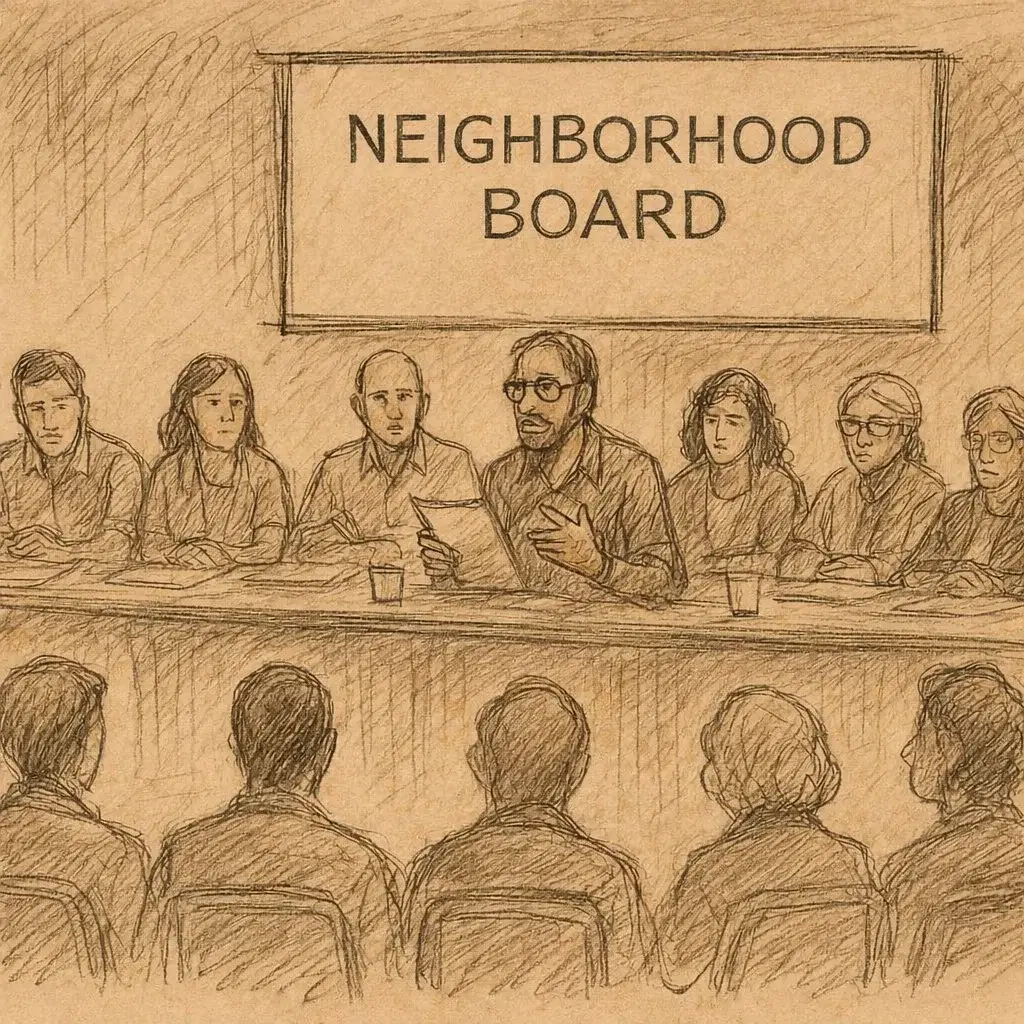
No 15 Kalihi Pālama Neighborhood Board Regular Meeting May 2026
Listen to this article:
15 Kalihi-Palama Neighborhood Board Meeting – May 21, 2026
Meeting Opening, Attendance, and Lack of Quorum
Chair Evelyn Cullen called the regular meeting to order at 6:00 p.m., reminded attendees to sign in, silence devices, and follow speaking rules for in-person and virtual testimony. Public comments were limited to one minute and 30 seconds with one question per speaker. During roll call, only five board members were confirmed present, so quorum was not met. Because of that, the board proceeded with reports and presentations but could not take formal action on agenda items, and later announced that board business would be deferred until the next meeting in July. The meeting date was stated at the opening as Wednesday, May 28, 2026, although the meeting itself was presented as the May 2026 regular meeting and later the board announced its next meeting for July 15, 2026.
Honolulu Police Department District 1 Crime Report
HPD District 1 Sergeant Cole Osato reported April crime statistics for a smaller Kalihi-Palama subarea including Liliha Library, Liliha Square, Kam IV area locations, housing, and portions of Vineyard Boulevard. He reported zero motor vehicle thefts, zero burglaries, three unauthorized entry into motor vehicles, one assault, two sex assaults, zero graffiti cases, zero drug cases, and 16 motor vehicle collisions. Total calls for service in that area were 294 for the month. Residents were directed to the HPD public website for more complete crime statistics. No questions were asked.
Board of Water Supply Main Break and Toilet Rebate Program
Board of Water Supply representative Iris Oda reported one water main break in April, near 914 Kahaʻai Place on April 25. She also emphasized a water conservation rebate program for WaterSense-labeled toilets using 1.28 gallons per flush. The rebate has been increased from $100 to up to $200 per toilet through a partnership with the City and County Department of Environmental Services. She said these toilets can reduce water waste by 20 to 60 percent, or roughly 13,000 gallons annually. The rebate cannot exceed the purchase price, applications are available online at the Board of Water Supply website, and there is a filing deadline after purchase as well as limited funding, so residents were encouraged to apply quickly. The program applies islandwide for Board of Water Supply customers.
HART Construction Updates and ADA Access Questions
HART representative Gabby Camacho provided three updates. First, a 24/7 northbound lane closure on Kalihi Street from Houghtailing/Howe Street to Kamehameha/Kamoliʻi Street began that week and is expected to continue through July 2026. After that, one southbound lane in the same corridor will close from July through September 2026. Traffic in both directions will still be maintained while contractors perform infrastructure, driveway, sidewalk, curb, and gutter improvements. Second, HART released its Spring 2026 project update newsletter with information on utility relocation, guideway and station work, and traffic updates on Dillingham Boulevard. Third, HART announced a virtual business and community meeting for May 28 at 1:00 p.m., where contractors Tutor Perini and Nan, Inc. would discuss construction in Kalihi, Iwilei, downtown, Chinatown, and Kakaʻako.
The major issue raised in discussion was ADA compliance during Dillingham construction. Community advocate Donald Sakamoto asked whether HART has a specific ADA safety protocol for sidewalks, crosswalks, and intersections, and whether contractors are required to follow formal accessibility guidelines. He referenced prior testimony that HART safety personnel could not identify where that plan was. Camacho said such a plan exists and committed to sending it to him and the board and to follow up directly the next day. This exchange framed a larger concern that construction detours and temporary routes may not be meeting legal accessibility standards.
Resident Testimony on Dillingham Accessibility Failures
Resident Lisa Jasso returned to the issue of accessible pedestrian routes on Dillingham Boulevard, saying conditions have persisted for nearly a year. She described an April 14 meeting with construction representatives and staff linked to Representative Shirley Templo’s office, where, according to her, officials admitted they did not know where the ADA walkway and crossing plans were. She said one worker suggested creating a special walkway “just for you,” which she rejected because the issue affects the entire community, not just one individual. Jasso said she was especially disappointed that after her prior testimony, nobody from the city, county, or HART followed up with her except Representative Templo’s office. She said HART has repeatedly acknowledged being in violation yet no one is being held accountable, and she warned that someone could be seriously injured or killed if conditions do not improve. Her testimony underscored the daily hardship imposed on residents who rely on walking and transit, especially those with disabilities.
Ongoing Nuisance Issues at 901 Gulick Avenue
Resident Kirsten Liana gave an update on nuisance activity at 901 Gulick Avenue, a matter she has brought before the board since January. She reported that on May 12 a meeting was held with her, Council Member Radiant Cordero and staff, HPD, the owner of Hawaiian Snow, and other stakeholders. Since then, she said, the property owner cut down a tree that had blocked visibility and changed existing exterior lighting from dim yellow to brighter white lighting. She appreciated those steps but said the main problem remains after-hours and weekend nuisance activity. She argued stronger flood lighting extending toward the wooden pallet area and trash bin area would better discourage loitering and other activity. She also noted that while some pallets were initially reduced, additional pallets later reappeared, leaving an area where activity continues to concentrate. She wants to continue pursuing a resolution focused on installing a 24/7 surveillance camera system as a more practical long-term response than overnight private security.
Affordable Housing Covenant Expirations and Displacement Warning
Community member Pia Mozingo warned of a coming affordable housing crisis tied to expiring affordability covenants on rental properties. She said those covenants have helped keep rents stable for working families and kūpuna, but once they expire, property managers may raise rents to full market levels. She handed the board a list of properties and management companies she believes should be monitored and urged immediate action rather than waiting until eviction notices are issued. She requested that the board establish an affordable housing preservation committee to pursue preservation funding, monitor timelines, work directly with landlords, and lobby the state legislature by January 18, 2027. She said the board’s June recess made it important to place the issue on the July agenda. In her remarks, she estimated that approximately 14,000 homes could be affected, using an average of four persons per household to suggest roughly 56,000 people could face impacts overall, while also saying that within the local neighborhood about 1,600 families and roughly 6,000 people could be directly affected. She described the issue as part of a nationwide problem involving more than 300,000 units. Her testimony connected housing preservation to the risk of large-scale displacement and homelessness in the community.
Gulick Avenue Sidewalk Safety Concerns
Another resident testified that Gulick Avenue still lacks sidewalks despite decades of neighborhood use. He said he had witnessed two older women fall on the street near the store across from the school on the mauka side and added that a principal from Kalihi Waena had reported three children being struck or injured on Gulick Street. He said he has lived in the area for more than 50 years and there has never been a sidewalk there. He asked how the community could pursue sidewalk construction and which government entity has jurisdiction. The concern highlighted a longstanding pedestrian safety gap on a route used by both schoolchildren and older residents.
Honolulu Police Department District 5 Crime Report
After earlier technical difficulties, HPD District 5 Sergeant Rudy Mori delivered the April report for the broader Kalihi area. He reported nine aggravated assaults, 13 auto thefts, eight burglaries, one robbery, one sex assault, 14 misdemeanor assaults, 19 thefts, and nine unauthorized entry into motor vehicle cases. Total calls for service were 2,628. No follow-up questions were asked, but the report reflected substantially heavier police activity and higher incident counts than the smaller District 1 subarea report.
Costco Fuel Station Proposal at Former Sizzler/Burger King Site
Costco and project partners presented a proposal to redevelop the former Burger King/Sizzler site at 1505 Dillingham Boulevard into a standalone Costco fuel station. Costco real estate development lead Therese Garcia said the site is about 0.8 miles from the existing Iwilei Costco and that Costco is leasing about 1.6 acres from Kamehameha Schools. Kamehameha Schools is demolishing the existing buildings and delivering the cleared site. Costco described the project as part of a new “off-site fuel” model consisting only of fuel sales, with no warehouse or other retail services.
The station would include 20 dispensers in a four-by-five layout, with 28 feet between dispensers and 32 feet between fueling islands, intended to improve circulation. The site would contain its own restroom, office, break room, employee parking, and trash enclosure. Dual ingress and egress would be provided from both Dillingham Boulevard and Colburn Street. Costco said the design also includes a protected fuel truck route and drop area so fuel deliveries would not block customer operations, plus about 200 feet of internal queuing depth intended to keep waiting vehicles off surrounding streets. The company also said the station would use a red-light/green-light system above fueling positions so drivers can identify open pumps more quickly. The property is zoned IMX, where an automobile service station is a permitted use, and Costco said permits have already been submitted. The company expects permits in hand by the second quarter of 2027, construction to begin in summer 2027, and completion by the end of 2027.
Community Opposition and Questions About Costco Traffic, Safety, and Hiring
Board members and residents raised multiple concerns about the Costco fuel station. Chair Cullen asked about the safety of underground fuel tanks close to dense residential neighborhoods and the planned replacement of Mayor Wright/Kuhio Park-type public housing in the area, noting concern for more than 1,500 new families expected in nearby redevelopment and asking how a major accident or explosion would affect residents within a half-mile radius. She also asked about pedestrian safety for nearby elderly residents. Costco responded that the tanks would meet and exceed regulatory requirements, would use double-lined technology, and staff would be extensively trained.
A community member asked whether Costco would prioritize local hiring rather than bringing in mainland workers and paying for hotels, arguing that local residents, including workers from the west side and urban Honolulu, should get the jobs and training opportunities. Donald Sakamoto asked about ADA access for drivers using wheelchair-accessible vehicles, specifically whether attendants would provide reasonable accommodation for people unable to reach standard-height pumps. Costco replied that attendants are trained to assist members who need help.
Strong neighborhood opposition also emerged. Lisa Jasso, who lives at Kūhiō/Kāhi? Kahumanu Homes near the site, said many residents and schoolchildren at Kalihi Kai Elementary across the street oppose the plan. She argued that traffic was already bad before rail construction, has become much worse during construction, and will worsen further with the nearby public housing redevelopment. She said the community had expected restaurants to return to the site after Burger King and other businesses closed, not a fuel station. Another resident asked whether a flyover, bridge, or other engineered access solution could pull traffic off Dillingham and feed directly into the station to reduce bottlenecks.
Questions also focused on why Costco chose this location instead of another part of the island and why it is pressing ahead now during intense rail-related traffic disruption. Costco said this project is part of a broader effort to add fuel capacity on Oʻahu because long gas lines are one of the company’s biggest member complaints. A Costco real estate representative compared the strategy to opening more cash registers when lines back up. Traffic engineer Matt Nakamoto of Austin Tsutsumi & Associates said the station is meant to address existing over-demand by increasing capacity, noting it would handle up to 80 cars in queue and provide 40 fueling positions compared with 24 at the existing Iwilei station. Construction impacts, according to the project team, would be limited, with only some off-peak utility work on Colburn Street. Costco confirmed that the existing Iwilei fuel station would remain open even after the new Dillingham site opens.
H-1 Widening Project Overview
Honua Consulting and project partners gave a detailed presentation on the state Department of Transportation’s eastbound H-1 improvements from the Ola Lane/Olalei Overpass to the Likelike Highway off-ramp. Public information manager Patrick Watson said the project has twin goals: improving safety and relieving congestion. The main highway improvement is to eliminate the center-lane merge from H-201 east to H-1 near Ola Lane and widen eastbound lanes and shoulders through the corridor. The project also includes work to modify the Gulick Avenue overcrossing to improve traffic flow and accommodate the widened freeway.
H-1 Closures, Detours, and Construction Timeline
The team outlined major upcoming closures and detours. Temporary H-1 lane closures are occurring during non-peak and nighttime hours, with nighttime work generally scheduled from 9:00 p.m. to 4:30 a.m. Full eastbound and westbound H-1 closures are planned twice, typically from 8:00 p.m. Saturday to 8:00 a.m. Sunday. One closure was scheduled for June 6 to support overhead electrical line work by Heco crews. Another was tentatively set for July 11 for installation of a temporary pedestrian-bicycle bridge. Detours during these closures would route eastbound traffic off at North King Street and back via Kalihi Street, while westbound traffic would be routed around Bishop Museum, School Street, and the Moanalua Freeway. Airport-bound traffic would be redirected along Nimitz Highway and Kalihi Street.
Watson said the project began in 2023, with construction expected to continue into the first quarter of 2028. Utility relocation is ongoing. Temporary pedestrian bridge construction and launch is expected in July 2026. Full closure of the Gulick overpass is anticipated from the third quarter of 2026 through the fourth quarter of 2027. Richard Lane/Kalihi Stream bridge work began in the second quarter of 2025 and is expected to continue through the fourth quarter of 2026.
Gulick Overpass Modifications and Temporary Pedestrian Bridge
Project representatives said the Gulick Avenue bridge will be lengthened and its abutments shifted approximately 15.5 feet on each end to make room for the widened H-1 below. Work also includes a new infill wall above the existing median, retaining walls on the eastbound and westbound sides, and an increase in vertical clearance of six inches. Current traffic impacts on Gulick include narrowed and shifted lanes to create a 10- to 12-foot work area while preserving 24 feet for two traffic lanes. Lane closures occur during non-peak hours from 8:30 a.m. to 3:30 p.m. and at night, with coordination through Kalihi Waena Elementary School.
When the overpass itself closes, a temporary pedestrian and bicycle bridge will provide 24-hour access. Superintendent Dylan Kawabe of Hawaiian Dredging said the interior walkway width will be about 10 feet 8 inches, with a clearance height of roughly 6 feet inside the truss and approximately 17.5 feet from roadway to bridge bottom. He said the bridge and approaches are designed to be ADA compliant. This was particularly relevant because schoolchildren and other pedestrians rely heavily on that crossing.
Resident Concerns About Pedestrian Safety, Students, and ADA Accessibility on H-1 Project
Board member Diosa, who said she lives on the affected street and now walks her son to school because of closures, asked about bridge dimensions and security. Her main concern was that children already throw objects from the existing bridge and might do the same from the temporary bridge. She asked whether netting or additional height could be added to prevent anything from being thrown onto the freeway. Project staff said they would explore the possibility, although the bridge is prefabricated with a standard railing system. She also asked whether special duty officers would be stationed there during school arrival times, particularly because homeless-related issues in the area have already concerned families. The project team said officers would be used during initial implementation and as needed, but could not commit on the spot to daily school-hour staffing.
Donald Sakamoto asked whether the temporary bridge had been reviewed for ADA compliance, including slope and accessibility for wheelchair and walker users, and whether the Disability and Communication Access Board had been involved. The team said the bridge and connecting paths are ADA compliant. He also criticized the use of color-coded maps in the presentation, explaining that as a legally blind participant he could not interpret references to blue, orange, and purple routes. He cited Department of Justice digital accessibility requirements and asked that maps and online documents be made accessible. The presenters agreed to revise future website graphics using more accessible markings rather than relying on color alone. Lisa Jasso supported that request and asked agencies to send presentation materials in advance and in large-print or otherwise accessible formats so visually impaired residents are not excluded from public process.
Questions About Neighborhood Traffic Spillover from H-1 Work
Community member Kākoua Kīaloha asked about access for Richard Lane residents while bridge work is underway. The project team said work there will mainly occur during daytime shifts with flaggers and contraflow, preserving one lane of alternating access because the area effectively has one way in and out. He also raised anecdotal reports that closure of Beckley Street has pushed significantly more traffic onto Leilani Street and Fernandez Street near Kamehameha Community Park. He asked whether ongoing outreach was being conducted in those streets and whether the team would hold additional community meetings if residents requested one. The response was that prior outreach had included meetings at Kalihi Waena Elementary, and that residents should email concerns to the project’s inquiry address; if enough people requested a meeting, the team would coordinate another one.
Mayor’s Representative Report: Storm Recovery, City Updates, and Enforcement Questions
Mayor Rick Blangiardi’s representative, Deputy Director Stephen Courtney, reported that the city is continuing cleanup and recovery after three consecutive severe weather systems, including multiple Kona lows that caused flooding across Oʻahu. He announced a centralized recovery website, oneoahu.org, for reporting home damage, accessing health and safety guidance, finding assistance, and supporting affected communities. Debris removal is ongoing, especially on the North Shore, with dump trucks, heavy equipment, and dumpsters deployed. Storm debris can be brought to city transfer stations and convenience centers open daily from 7:00 a.m. to 6:00 p.m.; H-Power is accepting commercial, municipal, and some other waste, while Waimānalo Gulch is accepting residential construction debris such as dirt, rock, and concrete. Previously planned mayor’s town halls were postponed indefinitely while departments focused on storm response.
He also highlighted citywide items from the mayor’s newsletter, including the March 18 State of the City address, accreditation for the Honolulu Zoo from the Association of Zoos and Aquariums, the city’s acquisition of 175 North Pāua? North Pauahi Street in Chinatown as part of affordable housing efforts, and release of the city’s 2026 annual sustainability report.
Courtney then followed up on prior neighborhood concerns. Regarding the nuisance activity at 901 Gulick Avenue, he said HPD District 5 met on May 12 with the owner of Hawaiian Snow, a concerned resident, and Council Member Cordero to discuss mitigation and enforcement options. HPD said it has continued directed patrols and enforcement as staffing and call priorities allow and that officers have been told to take action on observed violations such as noise, loitering, public intoxication, illegal parking, and public urination. All parties agreed to allow two to three weeks to evaluate current mitigation efforts. Courtney added that he personally met with HPD leadership that morning to discuss additional targeted patrols during late hours.
On illegal game rooms, he relayed a Department of Planning and Permitting response that civil fines are governed by Bill 57 and may not exceed $1,000 per day for each day of violation after an order is served. If fines exceed $150,000 or remain unpaid for more than five years, DPP can attach them to motor vehicle registration and transfer fees, refuse disposal fees, and certain license renewal fees. He noted that total fines may exceed $150,000 depending on continued noncompliance.
Community Frustration Over City Staffing Vacancies and Service Delays
Resident testimony during the mayor’s report focused heavily on staffing shortages. One speaker said Kalihi Valley District Park has deteriorated, with only one maintenance worker where there were once three, leaving community members and youth to sweep floors themselves. He said boxing gym space and Kalākaua District Park bleachers are in poor condition and criticized repeated explanations that the city is “waiting for parts.” He broadened the issue to citywide vacancies, saying residents face long waits to register vehicles, parks are understaffed, and HPD is reportedly around 500 officers short. He questioned why departments still receive full budgets when so many positions remain vacant and asked where those funds are going. Courtney responded that vacancies are an ongoing citywide issue and said he could raise recruitment concerns with department directors and HR, though he could not give a fuller answer on the spot.
Lisa Jasso then asked whether worker shortages explain why overgrown grass near McNeill and Kapiolani/Kaʻa? near the basketball court by Kalākaua and Kahumanu Homes has not been cut for months, saying children walk through the area daily. She also again asked when someone from the city and county would contact her directly about her accessibility concerns. Courtney said he would try to identify the responsible department for the grass issue and suggested reporting matters through Honolulu 311. Jasso replied that as a legally blind resident she has difficulty using online systems and often relies on her daughter for help, adding that she has repeatedly been passed from office to office without resolution.
Council Member Radiant Cordero’s Report and Follow-Up Items
Council Member Radiant Cordero’s office, represented by Tricia Raipel, submitted a written report and highlighted several items. The office included information on rescheduled community events delayed by the previous month’s storm, such as the Kalihi Ahupuaʻa Ride on May 30, along with sewer bill assistance resources, registration information for the Junior Lifeguard Program, and upcoming service changes for TheBus. Raipel also reported that a work order has been initiated for lighting repairs at the Kalākaua District Park tennis courts, although no timeline was yet available. A bus shelter is scheduled to be installed at bus stop 590 on Dillingham Boulevard at North King Street.
Regarding the 901 Gulick nuisance problem, she confirmed that Cordero’s office participated in the meeting with the resident, Hawaiian Snow, and HPD, and that the council office plans to help identify surrounding properties that may also be contributing to the problem and send notifications to seek additional changes. On Lisa Jasso’s Dillingham accessibility concern, Raipel said the office had alerted HART because HART has jurisdiction over the area and that they were told HART had reached out. Jasso immediately disputed that statement and said no one from HART had contacted her, again describing the loss of her independence as a transit- and walking-dependent resident with limited sight. She spoke emotionally about needing to ask her 9-year-old son to help guide her to the store because she no longer knows what route is safe amid construction.
Donald Sakamoto responded that passing the issue to HART was not enough, especially since the city council had recognized the importance of accessibility in a July 9, 2025 proclamation honoring the ADA’s 35th anniversary. He said elected officials must apply more pressure to ensure sidewalks, crossings, and transit-related access meet ADA obligations, and he repeated that systems like Honolulu 311 are not truly accessible if blind residents cannot use them independently.
Senator Donna Mercado Kim’s Report and Legislative Follow-Up
Kathy from Senator Donna Mercado Kim’s office said the senator’s written report had been sent to the board and included legislative updates following sine die on May 8. She highlighted follow-up on a previously discussed neighborhood concern involving the U-turn area on Olomea Road near Palama Settlement. According to a statement made at the senator’s town hall by state transportation director Ed Sniffen, the cost estimate for the work is about $2.5 million, and the senator is continuing to track the issue. Later, Donald Sakamoto thanked Senator Kim specifically for support of House Bill 1894 on Braille literacy for children, saying it would help blind students access reading materials and websites. The office added that another bill, HB 1891 on dyslexia, was also moving forward and should help more students.
Representative Shirley Templo’s Report and District Funding
Representative Shirley Templo’s office, represented by office manager Ed Thompson, reported that this year’s legislative session secured more than $15 million in funding for District 30 and surrounding communities. He said those investments include support for Farrington High School, Kalākaua Middle School, Kalihi Waena Elementary, the Kalihi-Pālama Public Library, and Red Hill remediation work, as well as grant-in-aid support for nonprofits serving families and vulnerable residents. He also highlighted the ongoing Kalihi Safety Task Force, created by Representative Templo to address neighborhood safety concerns and strengthen coordination among residents, agencies, and service providers. Thompson said the office has also been involved in disability and public accessibility concerns, including outreach to Donald Sakamoto and attempts to help with HART-related pedestrian access issues.
He noted that Representative Templo had hosted the mayor of Navotas, Philippines, at the state capitol to strengthen cultural and community ties and had attended May Day celebrations at Kapālama Elementary and Farrington High School. He invited residents to email legislative ideas for the next session. Multiple community members then thanked Representative Templo. Lisa Jasso said Templo has shown up at school and community events, including Leadership Day at Kalihi Kai Elementary and events at Farrington, Pohukaina/Puʻuhale, and Kalākaua, and said the community appreciates her support. Donald Sakamoto also thanked Templo for corresponding about the Dillingham issue and pushing for a future board briefing on ADA conditions, quoting Benjamin Franklin’s line that “by failing to prepare, you are preparing to fail.”
Honolulu Fire Department Report
Although the Honolulu Fire Department representative had to leave before speaking, board member Lloyd Ohana read the written report into the record. For April 2026, HFD recorded zero structure fires, four wildland or brush fires, eight nuisance fires, three cooking fires, and 11 activated alarms with no fire. Emergency responses totaled 202 medical calls, zero motor vehicle collisions involving pedestrians, five motor vehicle collisions, zero mountain rescues, two ocean rescues, and two hazardous materials incidents. The report clarified that nuisance fires include rubbish fires outside structures and vehicle fires. Safety reminders included clearing dry brush and vegetation, never parking on dry grass, avoiding activities that create sparks during hot and windy conditions, and staying aware of weather and fire risk. A brief note was also made that HFD is hiring.
Meeting Recess and Next Scheduled Session
Because the board did not achieve quorum, all board business was tabled until July. The board announced it would recess in June 2026 and that the next regular meeting is scheduled for Wednesday, July 15, 2026, at 6:00 p.m. at Kapālama Hall/Palama? Room 153. Residents were also told that recordings of board presentations are available through ʻŌlelo Channel 49 and online at olelo.org, airing the first Monday of each month at 9:00 p.m. and the second and fourth Thursdays at 11:00 a.m. The meeting was then adjourned.