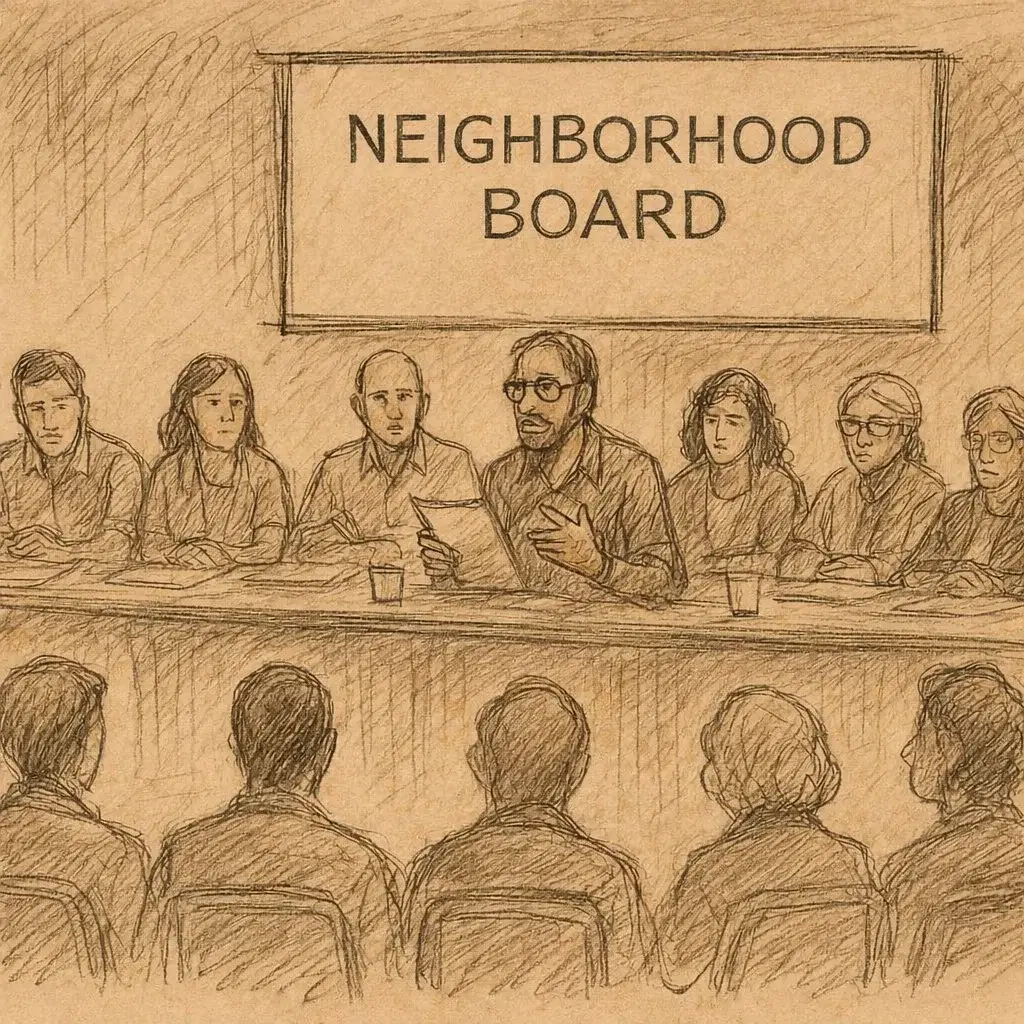
No 23 ʻEwa Neighborhood Board Regular Meeting July 2026
Listen to this article:
23 Ewa Neighborhood Board Meeting – July 10, 2026
Meeting Procedures and Board Introductions
The meeting opened with a reminder that the ʻEwa Neighborhood Board is an advisory body intended to promote fair, collaborative public participation in government decision-making. Public comments were generally limited to two minutes and one turn per speaker, reports to two minutes, and presentations to ten minutes. Remote participants were asked to remain muted unless speaking. Under the Sunshine Law, the board may act on listed agenda items, while adding a non-agenda item requires a two-thirds vote—eight members of the 11-member board—and major matters affecting many people may not be added during the meeting. Members present included Dave Morris, Shane Greenland, John Rogers, Mitchell Tynanus, Alexander Gauss, Susan Gorman Chang, Mike Plowman, and Cory Rosenlee, with additional participation online.
Honolulu Fire Department Incident Report
The Honolulu Fire Department reported June 2026 activity that included one wildland or brush fire, one nuisance fire, six activated alarms without fire, 182 medical emergencies, one motor-vehicle collision involving a pedestrian, one other motor-vehicle collision, and one ocean rescue. The department’s seasonal safety message focused on hiking: residents were advised to choose trails suited to their skill and stamina, consult official trail information at hawaiitrails.org, check rain, wind, and ocean-swell forecasts, remain on marked trails, avoid risking safety for photographs, hike with a companion, tell someone their plans, and allow enough time to return before dark.
Honolulu Police Department Crime and Traffic Statistics
Honolulu Police Department District 8 reported June crime and service data for the district and ʻEwa Beach. Motor-vehicle theft figures were reported as 24, with 13 attributed to ʻEwa; the district recorded 14 burglaries, including four in ʻEwa, and 106 thefts, including 23 in ʻEwa. Unauthorized entries into motor vehicles totaled 15 districtwide, seven of them in ʻEwa. Officers issued 151 speeding citations, 1,441 citations for moving violations, and 556 parking citations, for a total of 2,134 citations. District 8 received 8,938 calls for service, of which 2,765 were in the ʻEwa Beach area.
Feral Dog Pack Near White Plains and Kalaeloa
Board members raised an urgent public-safety concern about a pack of approximately seven to ten loose dogs seen around Tripoli Road, the end of Coral Sea Road, White Plains Beach, the park, and its parking lot. The resident who reported the dogs had called 911 and the Hawaiian Humane Society but was told there was little the Humane Society could immediately do. Concern centered on the possibility that the animals could become increasingly feral and attack cyclists, runners, surfers, or other park users, particularly given a previous pack-dog attack on a young woman along the Leeward Bikeway. HPD advised the public to call 911 and said officers would check the area and, if the dogs could be secured, coordinate with the Humane Society. Later in the meeting, board members asked city and state representatives to clarify which agency has responsibility, noting that residents are often redirected among HPD, the Humane Society, DLNR, and other entities. The issue was referred for follow-up by the mayor’s and legislative offices.
Weed and Seed Youth Culinary Program
District 8 Weed and Seed reported that its summer culinary program at James Campbell High School was concluding. Thirteen students participated in a class taught by Executive Chef Randy Bangloy of Roy’s Ko Olina. An appreciation banquet for program sponsors was scheduled for the following week. Weed and Seed also announced that additional details would be provided later about the U.S. Attorney’s Safer Communities Fair, expected at Pearlridge in September.
Filling Board Vacancies
The board filled its two open seats. Former member Charmaine Valerio asked to return after stepping away because of family circumstances, citing her experience in nonprofit leadership, outreach, volunteer coordination, and community partnership-building. Aisha Prestera, a newer Edgewater/Kapoleina resident, described work with the Aloha Spirit Foundation involving at-risk youth mentorship, arts, music, athletics, litter cleanup, homelessness, and housing affordability. Members emphasized that regular attendance and communication about absences are essential. Valerio and Prestera were separately nominated, seconded, and approved unanimously, restoring the board to full membership.
Election of Board Officers
The board elected officers for the July 2026 through June 2027 term. Mitchell Tynanus was elected chair, Alexander Gauss vice chair, John Rogers secretary, and Charmaine Valerio treasurer. Each received ten votes, with one board member absent. The June 17 regular meeting minutes were accepted without correction and filed as written.
Meeting Time and Annual Schedule
Members changed the regular meeting time from 7:00–10:00 p.m. to 6:30–9:30 p.m. The earlier schedule was favored because many members work the following day, and the library contract requires the meeting space to be vacated by 9:30 p.m. Board staff and the videographer are also limited to a three-hour meeting. Members cautioned that beginning earlier should not simply lengthen meetings, so 9:30 p.m. will remain a firm ending time. The board also agreed to schedule meetings in 11 months of the year, recessing only in December. If graduation schedules or facility conflicts affect May, that meeting may be moved rather than automatically canceled.
Kamahau Canoe Club Resolution
The board adopted a resolution supporting Kamahau Canoe Club and the preservation of cultural and community outrigger paddling at Puʻuloa. The club is a registered 501(c)(3) nonprofit with a 20-year history of cultural stewardship, youth development, and community service in ʻEwa Beach. The resolution urges Kapilina Beach Homes and Greystar Management to reconsider terminating the club’s access and to negotiate in good faith toward a memorandum of understanding that would preserve a permanent presence at Iroquois Point. It states that displacement would damage the cultural fabric of ʻEwa Beach and traditional Hawaiian outrigger canoe practices, and it calls on government representatives and the U.S. Navy to help secure a safe permanent site if an agreement with private management cannot be reached. Members amended the measure to ask government and Navy representatives to “actively intervene in this dispute,” and to identify the officials, agencies, and email recipients to whom the resolution will be sent. The resolution may also be used by the club in discussions with landowners, agencies, and other decision-makers.
Coral Creek Golf Course Antenna Proposal
A presentation concerning a proposed new antenna facility at Coral Creek Golf Course was listed on the agenda, but the presenter was not present or online. The board moved on without receiving a report or taking action.
Lithium-Ion Battery Fire Risks
Honolulu Fire Department Captain Malcolm Medrano delivered an extensive fire and life-safety presentation on lithium-ion batteries found in phones, laptops, power banks, e-cigarettes, power tools, hobby equipment, e-bikes, e-scooters, electric vehicles, and household energy-storage equipment. HFD began closely tracking the problem after 11 lithium-ion battery fires led to structure fires in 2023; that figure tripled to 34 in 2024 and rose to 37 in 2025. These incidents are categorized among electrical fires, historically the second-leading major cause of structure fires after cooking. Damaged or overheated batteries can enter “thermal runaway,” during which one cell ignites adjacent cells, releasing extreme heat, flammable and toxic gases, popping or venting sounds, smoke, and potentially explosive flames. A demonstration showed the process developing in as little as 47 seconds.
Recent ʻEwa E-Bike Structure Fires
HFD described two serious local fires involving the same model of RAEV Bullet GTX e-bike, neither of which was charging when it ignited. On March 22, an e-bike stored in a garage beside a Tesla underwent thermal runaway while the occupants were away. The resulting fire caused approximately $281,000 in property damage and $55,000 in contents loss, including damage involving three vehicles, and spread toward the upper floor. In May, another bike of the same model ignited while stored inside a bedroom. Occupants saw it begin smoking and escaped before the rapid fire developed; damage was estimated at $233,000 to the property and $10,000 to contents. No injuries were reported in either incident. HFD advised that e-bikes, e-scooters, and similar mobility devices should not be stored or charged inside homes or next to electric vehicles or other combustible materials.
Battery Charging, Extinguishing, and Disposal Guidance
Residents were advised to use only the correct manufacturer-compatible charger, because aftermarket or incompatible chargers may fail to stop charging and can create overheating. Batteries should be charged in a cool location on a hard, noncombustible surface, away from flammable materials, and charging should stop before 100 percent when possible. Loose 9-volt batteries should not be stored with their terminals touching because metal-to-metal contact can create heat. A battery or device that bulges, deforms, produces an odor, grows unusually hot, smokes, or makes venting noises should be treated as compromised; a phone that spins on a flat surface may have a swollen battery. Standard ABC extinguishers may temporarily suppress flames or prevent spread to ordinary combustibles, but they do not reliably stop the internal overheating. CO₂ extinguishers provide a better initial response, while a proposed new “Class L” extinguisher and vermiculite-based agents remain under development. HFD’s primary advice was to evacuate immediately and call 911 rather than attempt to carry a burning battery outside, because thermal runaway can escalate in less than a minute and people have been injured while trying to move devices. Used batteries should be taken to city Environmental Services drop-off locations rather than discarded in household trash. HFD provided safety sheets and listed fire.honolulu.gov and 808-723-7168 as information resources.
ʻEwa Beach Sewer Improvement District and Cesspool Conversion
Resident Rodney Reeves expressed disappointment over the cancellation of a state senator’s town hall concerning the ʻEwa Beach Sewer Improvement District. The Department of Environmental Services has decided not to pursue the project at this time, even though Hawaiʻi law requires cesspools to be upgraded or converted by 2050. Reeves asked whether postponement merely shifts future costs and responsibility onto individual homeowners, whether the city is preparing an alternative community plan, and what guidance will be offered to residents who may otherwise need to finance private conversions. He said previous presentations concentrated on a proposed monthly sewer charge of approximately $100 without adequately comparing it to an individual conversion that could cost $35,000 or more. Homeowners who had already upgraded their wastewater systems were reportedly to receive a $100-per-month waiver for 25 years, equivalent to roughly $30,000, but that long-term value had not been clearly communicated. Members noted that an earlier city concept would have installed the public sewer line and offered easements without an upfront city construction charge, although homeowners would still need to connect their properties. The board agreed that Environmental Services should be invited back to provide an updated presentation. Near the close of the meeting, it was confirmed that the July 15 meeting at Kaimiloa Elementary had been canceled because the project was placed on hold following strong community opposition.
Need for a Regulation 12U Baseball Field
Players and families from ʻEwa Beach Little League asked the city to restore or create a regulation-sized baseball field for 12-year-olds. The 12U teams lost access to Puʻuloa Neighborhood Park approximately three months earlier after a nearby resident reportedly complained that a foul ball might strike private property. Players said Puʻuloa is the only local field with the correct dimensions and a pitching mound for their age. They are now forced to use either a smaller field intended for younger children or an oversized high-school field, where temporary base placement puts sliding and running areas on uneven, weed-filled grass. Players described falls, jammed knees, and pitching on flat ground that alters form and could cause arm injuries. They asked that the city immediately restore access to Puʻuloa, retrofit another existing baseball or softball field with an appropriate mound and dimensions, or at least allow pitching and defensive practice at Puʻuloa while a permanent compromise is developed.
Youth Testimony on Park Conditions
The young speakers described baseball and neighborhood parks as places where children learn discipline, teamwork, leadership, perseverance, and respect while forming friendships and remaining physically active. They also raised broader park-maintenance concerns, including dead grass and restrooms without soap dispensers. Eight-year-old Pearl Benavente, a 10U player, said it was unfair that her division has a regulation field while her brother’s 12U team does not. Board members praised the players for presenting their case clearly and thinking about younger teams that will soon move into the 12U division. Members also noted that ʻEwa Beach Little League has expanded geographically toward the Waiʻanae Coast and that the limited number and poor condition of local fields are longstanding problems.
Parks Department Commitment on Baseball Access
Mayor’s representative and Parks and Recreation Deputy Director Kehau Lanipuʻu said she had learned of the 12U issue only the previous day, apologized, and committed to meeting with the league and DPR staff before the season begins in August. She said the goal would be to care for the children and identify a workable field solution. The board asked DPR to examine both restoration of Puʻuloa access and the possibility of designating or converting another park for 12U baseball, and requested an update at the next meeting. Members compared the situation to homes beside golf courses, where stray balls do not normally result in closing the entire course, and suggested that insurance, protective netting, or other mitigation could address the neighboring property concern. One member offered to help draft a board resolution if that would accelerate a solution.
E-Bike Law Webinar and Used Bicycle Program
The Hawaiʻi Bicycling League announced a July 14, 2026, 6:00 p.m. webinar explaining newly passed state e-bike legislation expected to be signed by the governor. Registration through a QR code was required to receive the webinar link. HBL also announced a partnership with Re-use Hawaiʻi to create an ongoing location for donated, repaired, and affordably priced bicycles and parts near Salt Lake and Aloha Stadium. Re-use Hawaiʻi already accepts reusable household construction materials and operates a tool-lending or rental service. The announced grand-opening date was July 11, with the year stated during the meeting as 2028, from 9:00 a.m. to 3:00 p.m.; workshops and bicycle sales were planned, and one board member said he would donate an electric bicycle.
Student STEM Summer Camp
James Campbell High School student Joshua Tom reported on student-led STEM classes that have been offered monthly since October. The students were recognized by Congressman Ed Case for expanding STEM education and exposing ʻEwa youth to possible high-school and college pathways. During the meeting week, the group was holding a five-day summer camp in the ʻEwa Beach Public and School Library meeting room for approximately 25 students ages six to 14. A final presentation and potluck were scheduled for the following day from noon to 4:00 p.m., and the board and public were invited to view the participants’ projects.
Oʻahu Resilience Hub Learning Community
Honu Aina invited ʻEwa organizations and residents to join the Serene Oʻahu Hub Learning Community, a partnership involving Kapiʻolani Community College, the Lāhui Foundation, Hawaiʻi Climate Commission, Vibrant Hawaiʻi, Hawaiʻi Foodbank, Haimana, and other groups. The network links existing resilience hubs, informal community networks, and regional partners to coordinate emergency preparedness, climate adaptation, and disaster response. A hub does not need to be a permanent building; it may be a group of residents with local relationships that can connect vulnerable households to larger sites such as the Kroc Center. The program offers ʻIliʻili mini-grants of $50 to $250 for community conversations or activities addressing climate change, emergency readiness, local needs, or disparities. It also provides certifications such as psychological first aid, disaster first aid, and CPR. The July Zoom meeting was announced for July 23 at 3:00 p.m., with regular meetings generally held on the third Thursday of each month.
Gentry Homes
Gentry Homes reported that it had received comments from the city Department of Transportation Services and was revising its design accordingly. Gentry still wants to meet with DTS to confirm how far the project’s traffic-signal interconnect cables must extend. No further project details or questions were raised.
ʻEwa Carnival at Wai Kai
Aseco announced that the ʻEwa Carnival will return to Wai Kai for a second year on Saturday, August 15, and Sunday, August 16, from 2:00 to 10:00 p.m. Aseco, Wai Kai, and the event promoter met separately with community members and area lawmakers after the prior year’s carnival to gather feedback and identify needed improvements. Event operations and parking logistics were still being finalized, with a fuller update expected at the August board meeting immediately before the carnival.
Wai Kai Luau Conditional Use Permit
A board member called attention to Major Conditional Use Permit 2026/CUP-38 concerning a larger, permanent luau operation at Wai Kai. A public proceeding was identified for July 24 at 10:00 a.m. at the Frank F. Fasi Municipal Building, and comments were also due by that date and time. Residents were directed to the Department of Planning and Permitting website at honolulu.gov to review the application and submit testimony. The Aseco representative said he would verify the permit details.
Marine Corps Base Hawaiʻi Leadership and Mission
Colonel Steve Detrinis introduced himself following his May 21 change of command at Marine Corps Base Hawaiʻi. He and his wife have lived on Oʻahu since 2023 and have eight children, several attending Damien Memorial School and Kailua programs. He described three principal installation responsibilities: projecting military power by preparing and deploying units, protecting Hawaiʻi and the homeland, and serving as a responsible steward of military resources, land, neighboring communities, and relationships with Hawaiʻi residents. He noted that approximately 1,500 Marines had recently returned from three months in the Philippines and that Marines were still operating at Diego Garcia. He cited homeland defense as the first priority in the National Defense Strategy and competition with the People’s Republic of China as the second, emphasizing that military and civilian households share the same communities and risks.
Puʻuloa Range Training Facility
Board members welcomed Colonel Detrinis but emphasized ongoing concerns about the Puʻuloa Range Training Facility, including lead contamination, environmental testing, range noise, and resolutions previously adopted by the board. Members invited him to participate personally in the PRTF working group, tentatively expected to meet in August, noting that prior meetings often involved representatives without authority to make decisions. Detrinis said he was aware of the issues, wanted to hear all perspectives, and intended to attend unless the meeting conflicted with major command events scheduled from August 9 through 12. The Marine Corps was also asked to provide promised information on environmental sampling locations and activities at the range.
Navy Role in the Kamahau Canoe Club Dispute
Members asked Colonel Detrinis to help bring the Navy into discussions concerning Kamahau Canoe Club, particularly because the club’s operating area appears to lie near the boundary between Kapilina-managed property and Navy-retained land and because disputes over trees and property responsibility may have contributed to the access conflict. Detrinis agreed to alert the new commanding officer at Joint Base Pearl Harbor-Hickam but cautioned that federal support to non-federal entities is governed by strict legal conditions. He said military leaders must avoid improperly providing federal resources or becoming involved in private matters outside their authority, although he would encourage discussion and determine whether the Navy has an appropriate role.
West Loch Briefing and Landing Ship Medium Proposal
The Marine Corps representative acknowledged that a requested briefing on the West Loch project was overdue and said subject-matter experts had been identified and were preparing it for a future board meeting. A member also asked about environmental-impact scoping for the proposed homeporting of nine Landing Ship Medium vessels. The question focused on whether the environmental review would examine the movement of roughly 200 vehicles, including heavy trucks and equipment associated with a Marine Littoral Regiment, along Fort Weaver Road and through ʻEwa Beach to West Loch roll-on/roll-off facilities. The Marine representative agreed to obtain an answer for a later meeting.
Red Hill Closure Task Force
The Navy Closure Task Force reported that Tank 11 was fully degassed on June 2. The U.S. Environmental Protection Agency issued its final drinking-water assessment of the Navy’s enhanced monitoring of the Joint Base Pearl Harbor-Hickam water system, allowing the Navy to return to normal regulatory compliance monitoring. Red Hill Highlights Issue No. 44 was available on the task force website and mobile application. Residents were encouraged to download the “NCTF-RH” app through Apple or Google stores and enable notifications for closure updates and events.
Mayor’s Office and City Leadership
Mayor’s representative Kehau Lanipuʻu reported that city agencies are coordinating efforts to strengthen community disaster preparedness. The city has selected a former Smithsonian National Zoo director to lead the Honolulu Zoo. Krishna Jayaram, formerly deputy managing director, was serving as managing director-designate following Mike Formby’s departure. Lanipuʻu also agreed to carry forward community concerns raised during the meeting, including the feral dogs, sewer planning, Little League field access, park maintenance, road issues, and other requests requiring city responses.
Lower School-Zone Speed Limits
The Department of Transportation Services is implementing Ordinance 24-32, which lowers posted speeds on city roads bordering schools from 25 mph when children are present to 20 mph on school days. The city will also replace missing, faded, or noncompliant school-zone signs. With more than 200 schools and thousands of signs involved, work will proceed in phases over several years, starting with public schools. Priorities will be based on enrollment, Title I status, numbers of students living within walking distance, education level, crash history, and speeding problems. For roads outside city jurisdiction, DTS will ask the appropriate owner or operator to adopt the lower limits.
Coconut Rhinoceros Beetle and Palm Preservation
DPR confirmed it is not currently treating palms in ʻEwa Beach or planting new coconut palms because the coconut rhinoceros beetle problem remains unresolved. Members cited widespread palm deaths at West Loch Golf Course, West Loch Shoreline Park, Kapapapuhi Point Park, and other locations, while asking the city to preserve remaining healthy palms at Puʻuloa and other beach parks through netting, pheromone traps, or approved treatments. They argued that Puʻuloa Beach Park may be a suitable treatment area because its approximately 25 palms are relatively isolated from other coconut stands by the 135-acre Puʻuloa Range. Lanipuʻu agreed to submit the request but cautioned that treatment is resource-intensive and typically targeted where trees have the greatest likelihood of survival. Members also noted that the University of Hawaiʻi has distributed treatment kits and suggested volunteer support if access to city lift equipment could be arranged.
Kapapapuhi Point Brush and Fire Hazard
DPR will inspect Kapapapuhi Point Park before the end of July and develop a plan for clearing brush that residents believe creates a wildfire hazard. A board member asked why maintenance that had once occurred approximately quarterly stopped around the COVID-19 period and whether the change resulted from funding or an administrative decision. A state senator asserted that the city had created an emergency crew of approximately seven workers for this kind of vegetation maintenance but that the work was not being performed, and asked the mayor’s representative to examine staffing, supervision, and possible nepotism concerns. DPR agreed to investigate.
Oneʻula Beach Park Comfort Station and Exceptional Tree
The Oneʻula Beach Park comfort-station design has reached the pre-final stage, with construction bidding targeted for January or February 2027. The project has $1.64 million in fiscal year 2026 capital-improvement funding and another $1.5 million approved for fiscal year 2027. DPR said the project remains on track. The city also responded to a request for a plaque recognizing ʻEwa Beach’s first designated exceptional tree. Because the response was not included in the written report in time, Lanipuʻu said she would email the Parks Committee chair and vice chair and provide a fuller update at the next meeting.
Tripoli–Keoneʻula Boulevard Connection
Members reminded the mayor’s and legislative representatives of the board’s prior resolution seeking a direct connection from Tripoli Road toward Keoneʻula Boulevard and Kalaeloa. The concept would improve access between ʻEwa Beach, Wai Kai, White Plains, and Kalaeloa without requiring drivers, cyclists, and other users to travel around the entire area. Members acknowledged that multiple landowners and agencies control the corridor but asked that the connection remain part of long-term Kalaeloa infrastructure and master-planning discussions. Senator Gabbard’s office said he had an upcoming meeting with the Hawaiʻi Community Development Authority and Councilmember Andria Tupola about Kalaeloa infrastructure and would accept the resolution and prior board presentation for discussion.
Kuhina and Hanakahi Road Conditions
A state senator asked the city to follow up on traffic-calming devices reportedly promised two years earlier for Kuhina Street and Hanakahi Street. He criticized the use of limited black-and-yellow markings and patchwork repairs, saying the road surface has deteriorated and has not been properly repaved for decades. The mayor’s representative was asked to identify the responsible transportation director and arrange direct follow-up.
Board of Water Supply
The Board of Water Supply reported two main breaks in June: an eight-inch break on June 21 at 91 Bryan Street and a 16-inch break on June 22 at 91-1450 Farrington Highway. The agency also invited residents to its 2026 “Unthirsty” Plant Sale at the Hālawa Xeriscape Garden, 99-1268 Iwaena Street, on Saturday, August 1, from 9:00 a.m. to 1:00 p.m. Admission and shuttle service from street parking will be free, but vendors will accept major credit cards rather than cash. The event will feature native and drought-tolerant plants, UH Master Gardener “plant doctors,” rain-barrel information, educational booths, and free soil conditioner. The representative also distributed Hawaiʻi Wildfire Management Organization materials on making homes and properties more wildfire-resilient.
Public Schools and 2026–27 Calendar
Complex Area Superintendent John Lee reported that most campuses provided free summer learning through credit-bearing summer school, enrichment and social-emotional learning hubs, or transition programs for students entering new campuses. Kolo-mua, the state’s only multi-track school, began its new year on July 8. For most other schools, teachers return July 28 and students return the following week, although some campuses have additional waiver days. James Campbell High School’s new principal is Anela Pia, formerly principal of Kaimiloa Elementary. Larissa Gedash, a vice principal at ʻEwa Makai Middle School, will serve temporarily as Kaimiloa’s principal while a permanent replacement is selected.
School Meals and Summer School Participation
The Department of Education reported substantial participation in free summer learning and meals. James Campbell High School reportedly served more than 600 summer students, including slightly over 300 incoming freshmen, with many using summer physical-education classes to preserve space for college-preparatory courses during the regular year. Keoneʻula Elementary and Campbell were among the local sites offering the Seamless Summer meal program, which serves any school-aged child regardless of whether the child attends that campus. The DOE agreed to provide exact participation numbers and to investigate whether expanded state eligibility for free breakfast and lunch has increased use during the school year.
Bicycle Education for Older Students
A member asked DOE to expand bicycle safety education beyond the Hawaiʻi Bicycling League’s current fourth-grade program to middle and high school students. The superintendent said bicycle use rose when school-bus service was reduced and city buses reached capacity, leaving many students to walk or cycle. Because middle- and high-school ages account for many bicycle crashes, he welcomed discussions with HBL and possible grant-funded instruction covering riding skills, roadway rules, and traffic safety.
College Counseling at Campbell High School
A parent whose son recently graduated from Campbell as a valedictorian said the student received little direct guidance about college-application, financial-aid, and other hard deadlines, and might have missed important opportunities without parental intervention. The concern was presented as a possible systemic issue affecting students who have less family support. Campbell has two full-time college and career counselors, additional part-time staff, and academy-level counselors, so the superintendent agreed to investigate whether outreach is reaching all students consistently.
Student Safety, Vaping, Mental Health, and Online Risks
The board asked education officials what parents should watch for as children enter elementary, middle, and high school. Superintendent Lee said students now face much earlier and wider exposure to self-harm content, mental-health pressures, vaping, substance use, and other harmful influences through both local peer groups and online networks. He described vaping as highly prevalent and said many students have experimented with it or become addicted. Principal Shane Greenland added that risks include fentanyl, sexual exploitation, trafficking, and unsafe online activity. Both emphasized knowing a child’s friends, locations, and activities; developing trusting communication; involving students in sports, clubs, academics, and other structured groups; and relying on a broader network of relatives, coaches, teachers, and community adults.
State Department of Transportation Projects
New Hawaiʻi Department of Transportation representative Mel Chung provided updates on eight transportation projects. Construction of the Fort Weaver Road shared-use path from Kilauea Street to Puʻuloa Beach Park is expected to begin around June 2027. It will be built on the makai side, eliminating on-street parking along that side. A Fort Weaver Road traffic-signal modernization project covering one of five planned intersections is expected to be advertised in fall 2027 after delays elsewhere. The intersection will be made ready for accessible pedestrian signals, and the equipment will be included if the city selects an APS standard before design completion.
Kunia Road, Farrington Highway, and Fort Weaver Improvements
The Kunia Road resurfacing project from H-1 to Lyman Gate is expected to be advertised in fall 2026. Limited right-of-way prevented inclusion of bike lanes or wider shoulders, and daytime construction is expected to last nine months to one year. Widening Farrington Highway from Kapolei Golf Course to Fort Weaver Road is projected for completion in February 2028 and will include two traffic-counting stations with bicycle-detection loops; intersections will be designed for later APS installation. The Fort Weaver shared-use path from Laulanui Street to Farrington Highway is expected to begin in early 2027 once the contractor finishes other work. The Fort Weaver project between Geiger Road and Keoneʻula Boulevard remains delayed but is targeted to begin in fiscal year 2027. HDOT is also studying ways to prevent rocks and mud from washing onto the Leeward Bikeway between Fort Weaver Road and West Loch Shoreline Park during heavy rain. Striping work near Kilauea Street is on hold until a new striping contract is awarded.
H-1 Zipper Lane Questions
The board asked HDOT why the H-1 zipper lane does not extend farther west toward Kapolei, noting that severe congestion in the two general-purpose lanes can make the zipper lane nearly as slow by the time traffic reaches Pearl City. Members also requested an updated estimate of the cost and feasibility of operating a zipper lane westbound during the afternoon commute, an idea examined and shelved in earlier years. HDOT agreed to research both questions.
Kapilina Housing, Navy Lease, and Electric Bills
The Senate District 20 report focused heavily on Kapilina Beach Homes and the underlying Navy lease. The senator said congressional and Navy actions from 2003 through 2009 changed an original 65-year arrangement to a 100-year lease, despite earlier expectations that the land might eventually transfer to the State of Hawaiʻi or Department of Hawaiian Home Lands. Hunt later sold the housing interest to Greystar or a related management entity, while the Navy retained underlying land and electrical-infrastructure interests. The senator alleged that Kapilina receives electricity from the Navy at rates below Hawaiian Electric’s but charges residents much more, citing documented monthly bills of approximately $5,000, $7,000, and $10,000 and meter readings that allegedly did not match billed usage. He also cited mold, deferred repairs, poor property maintenance, and the danger that Section 8 tenants could lose housing in a market with too little replacement inventory.
Proposed Kapilina Lease Review
The senator said an end-of-month meeting was being arranged with the Navy and Kapilina management, although attendance by Greystar or its attorneys had not yet been confirmed. He intended to request that Hawaiʻi’s congressional delegation and the Secretary of the Navy terminate or reconsider the long-term lease and transfer the land to the state. He argued that responsibility rests with both the Navy, which owns the land and electrical grid, and the private management company, which owns or controls the residential buildings. The planned discussion would also include Kamahau Canoe Club access and a possible shoreline high-water-mark determination. If the meeting does not produce cooperation, the senator said he would issue a public statement detailing the electrical billing, management, maintenance, and lease concerns.
Senator Gabbard’s Community Meeting
Senator Mike Gabbard’s office invited residents to a “Listen Story” meeting on Saturday, July 25, from 9:00 to 10:00 a.m. in the Kapolei High School teachers’ lounge, with a Zoom option available by contacting the office. Deputy Director Jennifer Walter of the Department of Emergency Management was scheduled to discuss emergency planning and provide an update on the Makakilo Interim Emergency Access Route. The office also agreed to pursue the feral-dog concern near White Plains and review the Tripoli–Keoneʻula connectivity resolution before an infrastructure meeting with HCDA and Councilmember Tupola.
Representative Reyes Oda’s Report
Representative Julie Reyes Oda’s office reported on a June 17 town hall at Puʻukea Elementary School. Speakers included James Burke of AARP on household disaster planning, Deputy Parks Director Kehau Lanipuʻu and HPD Officer Fumikazu Moroka on homeless encampments and e-bike regulations, and Sergeant Mike Lambert on illegal fireworks and reporting procedures. The event also recognized Campbell student Tracy Beasley-Wosinski for selection as a Hawaiʻi sister-state student through the Pacific and Asian Affairs Council, along with 2025 Walt Disney Legacy Award recipients Kina Nakashima, Nate Rhodes, and Lunu Bithia. The office mailed nearby residents a summary of the May 27 Puʻuloa Range Training Facility working-group meeting covering environmental testing, Marine Corps updates, and community-safety efforts. Asked about broader district priorities, staff cited the planned elementary school in Ho’opili and its role in easing overcrowding, and agreed to return with a clearer statement of the representative’s principal goals for ʻEwa Beach.
Committee Assignments
The board assigned members to standing committees for the new term. Alexander Gauss, John Rogers, and Aisha Prestera volunteered for Parks; Cory Rosenlee and Shane Greenland for Education; Rogers, Gauss, and another participating member for Transportation; Charmaine Valerio and Prestera for Public Safety, Community Outreach, and Homeless Outreach; Dave Morris for Economic Development; Morris and Susan Gorman Chang for Climate Change; Mike Plowman and Prestera for Hawaiian Affairs; and Plowman for Military Affairs. Members reminded new committee chairs that committees must actively schedule meetings, secure locations, prepare publicly posted agendas through board staff, and develop substantive work rather than exist only as names on the agenda.
Next Meeting and Broadcast Schedule
The next regular meeting was scheduled for Thursday, August 13, 2026, from 6:30 to 9:30 p.m., both in person at the ʻEwa Beach Public and School Library and online through Webex. Regular meetings are rebroadcast on ʻŌlelo Channel 49 on the first Sunday of each month at 6:00 p.m. and on the second and fourth Fridays at 10:00 a.m. The meeting adjourned after the board confirmed the new schedule and reminded residents that the July 15 cesspool-conversion meeting had been canceled.