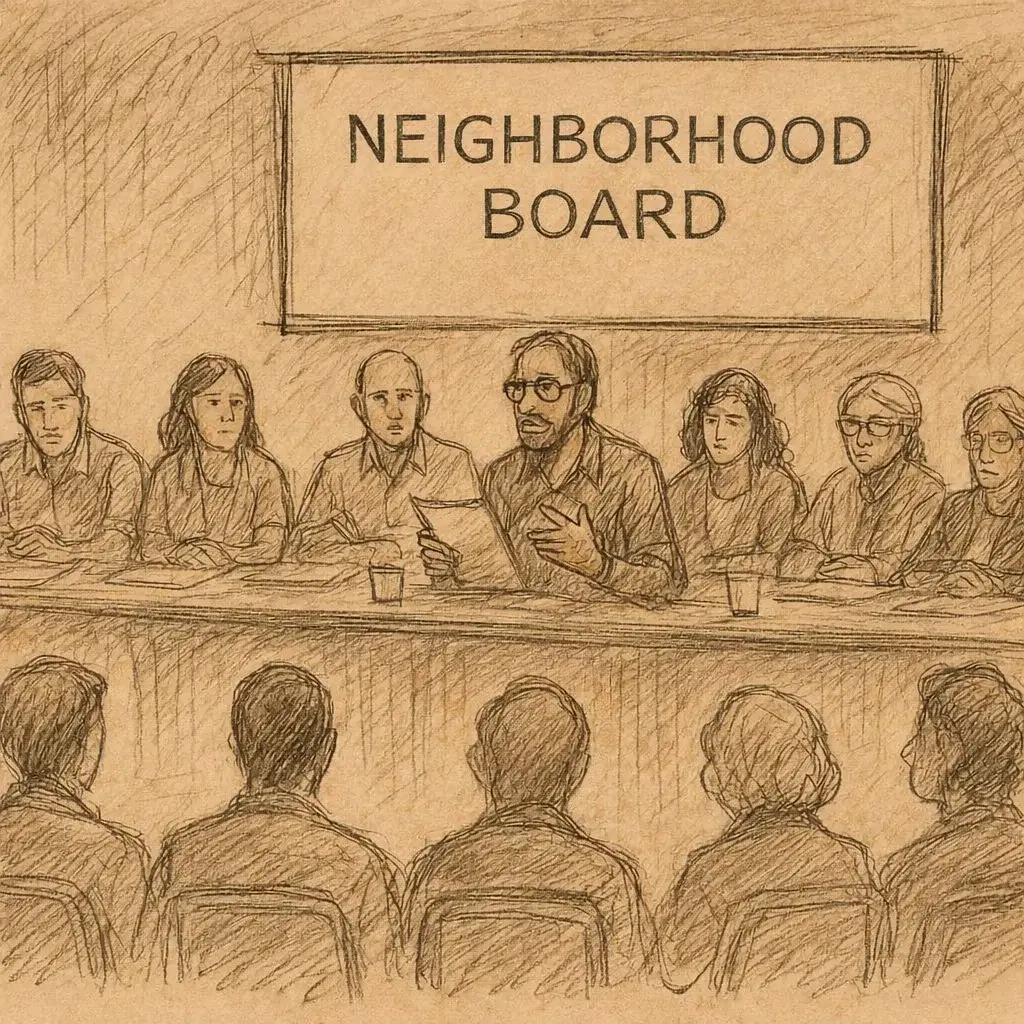
No 13 Downtown-Chinatown Neighborhood Board Regular Meeting November 2026
Listen to this article:
13 Downtown-Chinatown Neighborhood Board Meeting – November 7, 2026
Fire-Damaged Building and Rooftop Rescue
The board followed up on a fire at approximately 905 Kekaulike Street, where the affected building had been burned out. The Honolulu Fire Department had been asked whether the structure was unsafe to occupy, but no determination was available at the meeting; the question had been forwarded to the Community Relations Office, with an update anticipated the following month. Resident Ernest Carvalho also thanked the Honolulu Police and Fire departments for rescuing a disoriented man from a roof near Nuuanu Avenue and Hotel Street several weeks earlier. A ladder truck was required, and the man reportedly resisted officers during the rescue. The board was told that he was subsequently taken for an emergency mental-health evaluation under an MH-1 order. A previous request for information about possible overcrowding at nightlife venues had likewise been sent to the appropriate inspector, but no follow-up was yet available.
October Crime Statistics and Police Concerns
Honolulu Police Department Sergeant Kaleo Osaka reported October crime and service data for the district: five vehicle thefts, one burglary, 23 thefts, three unauthorized entries into motor vehicles or auto break-ins, 20 assaults, one sexual assault, no graffiti cases, three drug cases, and 89 motor-vehicle collisions. HPD recorded 1,867 calls for service during the month. Board members asked whether these monthly statistics could be submitted directly to Neighborhood Board 13 for permanent storage on its public-facing Google Drive. Sergeant Osaka said the information is available at HonoluluPD.org and that he submits an after-action report through his command, but he does not directly provide the statistics to the board. The board also recognized HPD’s recent neighborhood presence, including officers on all-terrain vehicles and several significant arrests.
Unauthorized Vehicles on Fort and Hotel Streets
Board members and residents raised repeated concerns about private vehicles using streets where access is limited. Several cars had recently been seen traveling on Fort Street between Hotel and Beretania streets even though they did not appear to be authorized vendors making deliveries. Residents requested patrols and enforcement to stop the practice from becoming normalized. Ernest Carvalho described the continuing presence of unauthorized vehicles on Hotel Street as increasingly dangerous, noting that some of the same cars travel through the corridor day and night. He cited a recent Sunday-night crash around 10 p.m. in which a vehicle skidded and struck Murphy’s Bar & Grill; he said a similar crash on a busy Friday or Saturday could have caused casualties. Residents reported personally redirecting vehicles and questioned why cars were still able to travel near police without being stopped. Later Citizen Patrol remarks confirmed that vehicle traffic on Fort Street had become a prominent concern.
Shopping Carts, Sidewalk Obstructions, and Vehicle Habitation
Board Member Ross Isokane expressed support for City Council Bill 53, which would give HPD more authority to address stolen shopping carts. He noted complaints about carts abandoned on sidewalks or dumped in streams and canals and cited Major Paul Okamoto’s testimony that existing law is difficult to enforce. Isokane rejected arguments that the proposal unfairly targets people experiencing homelessness, stating that Honolulu should continue investing in homeless services while also enforcing laws that protect shared public spaces. Board Member Laura Sturgis separately reported a new group of unhoused people on Bishop Street near the telecommunications building and Sisters Bookstore, including an individual apparently living in a pickup truck. HPD said officers regularly enforce parking restrictions and bus-stop violations on Bishop Street. Vehicle-habitation enforcement is limited to 6 p.m. through 6 a.m.; outside those hours, police may still address illegal parking, including vehicles left in no-parking zones.
New Life Church Christmas Event
Jacob Chung of New Life Church Honolulu announced that a planned family Christmas event would no longer be held outdoors at Smith-Beretania Park. Unstable weather and rising costs for tents, tables, and chairs led organizers to scale down the program, focus primarily on children, and move it inside the church’s Smith Street facility near the park. The event itself was not canceled. Chung agreed to provide an updated flyer by email so it could be placed in the board’s Google Drive and distributed to the community.
Kukui Street Pedestrian and Bicycle Safety Proposal
Doug Pyle, speaking as an individual and Kukui Plaza resident, described a dangerous crossing experience while walking to the meeting. Two drivers failed to stop while he was in a crosswalk used by children traveling to school, with the vehicles changing lanes and driving around him. Pyle suggested exploring a larger traffic redesign connected to the Beretania Complete Streets and safer-streets planning process. His concept would redirect through traffic from Kukui Street toward Vineyard Boulevard via Queen Emma Street, develop Kukui Street primarily as a pedestrian and bicycle corridor with local vehicle access, and possibly close the one-block section of Fort Street near the fire station. He had raised the concept at a transportation program the previous day but clarified that it was an individual proposal rather than an official board position.
Iwilei-Kapalama Geotechnical Work
Patrick Watson of Honua Consulting, speaking on behalf of the Hawai‘i Community Development Authority and Michaels, gave advance notice of geotechnical boring along North King Street between Kōho Street and Iwilei Road for the Iwilei-Kapalama Electrical Infrastructure Project. Although the work is just outside the board district, the project team provided notice because of its proximity. Small vertical drill rigs will collect subsurface soil and rock data needed to design the electrical project safely and determine structural conditions. Work from Iwilei Road to Pua Lane was scheduled for November 16–20, 2026, followed by work from Pua Lane to Kōho Street near the canal from November 30 to December 4, with December 7–11 reserved as weather-contingency dates. Hours will be 8:30 a.m. to 3:30 p.m. during non-peak traffic periods. Drilling will take place mainly in center medians and leftmost lanes, producing temporary noise, equipment activity, minimal dust, and minor local traffic disruption. Cones and barriers will define the work zone. Brief crosswalk effects may occur at Iwilei Road and North King Street, west of Dillingham Boulevard, and at Kokea Street south of North King. Bus service should remain available; if a stop must move, it would generally be relocated only about one bus length. Watson provided 808-230-1808 and Patrick@honuaconsulting.com for questions.
CORE Homeless Outreach Reorganization
Honolulu Emergency Medical Services Assistant Chief of Operations Jeff Zuckernick presented an extensive update on the Crisis Outreach Response and Engagement program, or CORE. Zuckernick, a paramedic with approximately 30 years of Honolulu experience, said he was assigned about nine or ten months earlier to help Dr. James Ireland restructure CORE into a more purposeful and effective organization. The effort includes expertise from a registered nurse and former paramedic who helped establish UCLA’s emergency-room outreach program for unhoused patients. CORE is focusing particularly on individuals with severe substance-use disorders, behavioral-health conditions, and recurring medical needs who are difficult to connect with lasting care. Zuckernick emphasized that hospitals, HPD, EMS, outreach groups, service providers, and community members must operate as a coordinated system rather than as isolated organizations. Joint meetings among those partners were expected over the following months to identify service gaps and prevent people from simply being transported to an emergency department, discharged shortly afterward, and returned to the street.
CORE Staffing, Medical Diversion, and Service Hours
CORE has approximately 30 to 35 employees, about half of whom are community health workers. These workers, commonly seen in red shirts, connect unhoused residents with medical care, benefits, housing resources, and other social services; Zuckernick described them as the organization’s backbone. EMS personnel support them in evaluating and transporting medically vulnerable clients. CORE emergency medical technicians also respond to selected 911 calls and can transport patients to facilities other than crowded hospital emergency departments, reducing pressure on both ambulances and emergency rooms. Zuckernick reported unusually strong staff retention, with only two recent departures, both related to family relocations. Community health workers are funded to operate Monday through Friday from 7 a.m. to 3 p.m., while CORE ambulances generally operate from 7 a.m. to 7 p.m., seven days a week. He urged residents to ask council members, legislators, and senators for more funding if they want expanded service capacity and hours.
CORE Data, Accountability, and Audit
Board members pressed CORE for measurable outcomes, key performance indicators, and a clearer return on public investment. Zuckernick acknowledged that data collection had been a significant weakness and said CORE began implementing a new HIPAA-compliant data system approximately one month before the meeting, with Department of Health support. He expected the program to provide stronger community-level statistics within several months. Board members also referenced a city audit that could not be completed in a conventional manner because CORE had changed substantially from the organization operating during the period under review. Zuckernick said CORE is being transformed into an output-oriented, data-driven operation with clearer service measures, stronger partnerships, and expanded training for community health workers and emergency medical technicians. A question about ambulances being out of service was attributed to a resolved supply-chain issue; he said there was no longer a notable number of vehicles offline.
How to Request CORE Assistance
CORE advised residents to call 911 when someone is experiencing a medical emergency, traumatic injury, or immediate crisis. For a person who appears to need social services but is not in an emergency, the preferred reporting method is the Honolulu 311 application. The app allows the public to provide a detailed description, upload photographs, identify the location, and track the report. CORE reviews those submissions every day and may follow up directly when the reporting person provides contact information; anonymous reports are more difficult to investigate. The public may also call 808-768-2673, or 768-CORE, although the hotline is staffed only during business hours and otherwise accepts messages. Responding to a complaint about a woman with numerous cats who was reportedly experiencing mental-health difficulties, Zuckernick committed to sending a crew the following day to assess her needs. If she refused assistance, CORE could request additional help, including HPD’s Crisis Intervention Team. Several Chinatown residents and business operators credited CORE with visibly improving conditions along Mauna Kea and Smith streets over the previous four years.
King and Hotel Street Concrete Repairs
The City Department of Design and Construction and its consultants presented plans for an approximately $11 million concrete roadway rehabilitation project on King and Hotel streets. He Lave Construction LLC is the contractor, WSP is the design consultant, and Becker Communications is handling public outreach. The project will replace damaged concrete rather than reconstruct every lane in full. Work will also include necessary curb and gutter repairs, restriping, restoration of vehicle-loop detectors, and related roadway features, but it will not include sidewalk reconstruction or widening. On King Street, work will extend from Dillingham Boulevard to River Street and then from Bethel Street to Alapai Street, leaving out the River-to-Bethel segment that was rehabilitated by a more recent city project. Approximately 25 percent of King Street’s concrete bus-lane area will be replaced. About 40 percent of Hotel Street’s concrete pavement will be reconstructed. The older bus-lane pavement is roughly 40 years old, and the project is intended to extend its service life for decades.
Roadwork Phasing, Closures, and Schedule
Construction is expected to begin in summer 2027. King Street will be handled first, generally one block at a time, with each work area closed for no more than one week while crews demolish and remove failed concrete, pour replacement pavement, allow it to cure, and reopen the lane. Hotel Street work will then proceed by closing an entire direction at a time, first eastbound and then westbound. Hotel Street will be closed to all traffic in the active direction, including bicycles, so bike commuters will have to follow the bus detours. The Department of Transportation Services is coordinating temporary bus routes and stop changes, with notices planned at affected stops and through public announcements. Although the overall project period may span approximately a year because of permitting, preparation, curing, and phased construction, the team said continuous roadway work will not last the entire period. Night and weekend work could accelerate completion, but the noisiest demolition activities will not be permitted at night.
Construction Noise, Access, and Cost Controls
The project has a nighttime and weekend noise variance, but presenters did not have the approved decibel limits available and agreed to provide them later. Nighttime work would be limited mainly to relatively less disruptive concrete pouring and related operations, although some noise would still occur. Concrete demolition and removal will not be allowed at night. Contractors will use standard dust and noise controls and work with affected businesses. Sidewalks and storefronts are expected to remain accessible throughout construction, and the work itself will remain between the curbs. The project team said contingencies are built into the construction budget to cover typical unforeseen conditions and that it intends to minimize change orders and stay within the $11 million contract amount and approved schedule. Board members nevertheless warned that the project will overlap with rail construction along Nimitz Highway, creating potentially severe traffic congestion if schedules are not closely coordinated.
Business, Event, and Multilingual Outreach
Becker Communications reported that approximately 200 Downtown and Chinatown businesses had already been canvassed, including those on side streets such as Mauna Kea, Smith, Nuuanu, and Bethel. The outreach is intended to provide early notice, correct misinformation about storefront access, and identify neighborhood events around which work should be scheduled. Events specifically mentioned included Murphy’s St. Patrick’s Day block party, Chinese New Year celebrations, and First Fridays. A second outreach round, mass mailings to residents and businesses, press releases, and at least 14 days’ notice to abutting properties are planned before nearby work begins. The board requested multilingual notices in Mandarin, Cantonese, Vietnamese, Tagalog, and Chuukese and suggested consulting the Office of Elections for its broader language-access list. Project information will also be available through the Department of Design and Construction website, while bus questions may be directed through city transit channels.
Lane Markings and Complete-Street Coordination
Board members asked whether the concrete work would delay long-discussed markings for bus-only or vehicle-restricted lanes, including possible red pavement on Hotel Street under city traffic law. The project itself includes permanent striping, but presenters could not say whether the Department of Transportation Services planned interim markings before construction. They agreed to seek clarification and coordinate with DTS. The board also requested that traffic planning account for rail work one block away on Nimitz Highway, the hundreds of cyclists who use Hotel Street during early-morning commuting hours, and the cumulative effects of rerouting buses, bicycles, and private vehicles.
Hawaiian Electric Infrastructure Work
Hawaiian Electric representative Ricky Honma reviewed multiple underground electrical projects in Downtown and Chinatown. Work outside Hawai‘i Dim Sum and Seafood Restaurant on King Street between Kekaulike and Mauna Kea streets had been completed the previous day. Overnight rehabilitation of a Queen Street manhole between Mililani and Richards streets began October 5 and is expected to continue into early 2027. Work at South Beretania Street manhole 426 near Alapai Street began October 12 and was expected to finish around November 12. Work at the Prince Kūhiō Federal Building was scheduled for the night of November 20 and for November 23–24, with minimal community impact anticipated. Additional November projects were planned on Bishop Street between South Beretania and Hotel streets and at the American Mutual Life Building at Alakea and South Beretania. Building-vault projects at Pioneer Plaza near Merchant Street and Fort Street Mall and at the Theo Davies Pacific Center near Bishop and Queen streets were expected to be completed by year’s end.
Nimitz and Ala Moana Electrical Work
Hawaiian Electric also intends to work along portions of Nimitz Highway and Ala Moana Boulevard. The activity had originally been scheduled for October but was postponed because of conflicts with other projects. The utility hoped to complete it by the end of 2026, although no firm start date was available. Approximately four weeks are budgeted for the effort, but roadway impacts will not be continuous because the period also includes preparatory work and activity across different segments. Most Hawaiian Electric street work is scheduled from 8:30 a.m. to 2:30 p.m., with different restrictions on major thoroughfares to avoid peak traffic. Honma committed to sending exact schedules and updated presentation materials to board leadership as projects are confirmed. Information is available at HawaiianElectric.com/downtownnetwork. Residents thanked the utility for improvements since earlier major outages, reporting that the area had not experienced similar disruptions recently.
Utility Rate Proceedings
Questions were raised about Hawaiian Electric’s pending request for higher rates. Honma said the Public Utilities Commission proceeding remained active and that additional public-comment opportunities were expected, with Neighbor Island meetings already scheduled and O‘ahu details still forthcoming. The governor’s representative later reported that the PUC held its final listed public hearing on the utility’s rebasing proposal in Hilo on November 4 and that residents could review recordings and submit comments through the PUC website. Some residents argued that the governor should present a broader plan to reduce Hawai‘i’s very high electricity costs rather than relying solely on the regulatory hearing process. The governor’s representative responded that utility rate cases are formally handled by the independent Public Utilities Commission.
Agency Reports Not Presented
No Board of Water Supply representative was available when its agenda item was called. Honolulu Authority for Rapid Transportation representative Mr. Cho had given advance notice that he could not attend, and residents were referred to HART’s project websites and invited to send questions through the board. No state Department of Transportation representative or written report was available. Downtown Honolulu Business Improvement District Executive Director Brooke Kleinow also was not present, although the board noted that the BID continued its monthly Downtown Safety Network meetings and had resumed pressure washing. The board expected fuller updates at a later meeting.
Chinatown Business and Community Association
The Chinatown Business and Community Association reported continued concerns along North King Street, Nimitz Highway, River Street, North Hotel Street, and North Pauahi Street. Issues included traffic and pedestrian safety, illegal vending, improper storage and trash disposal, public camping, open drug and alcohol use, and people experiencing significant mental-health challenges. CBACA met with community stakeholders and shared reports from the Chinatown Security Team. It also held a comprehensive meeting with Police Chief Arthur “Joe” Logan’s successor, Chief Lazar, and Deputy Chief Nakasato, followed by another meeting with Nakasato, two commanders, and a captain to map foot-patrol coverage. The association said consistent police visibility combined with private community security could address recurring problems before they escalate. During the reporting period, the Chinatown Security Team logged 1,120 patrol hours while 911 calls associated with its work fell to 30. CBACA continued coordinating with the Downtown Honolulu BID because safety conditions in the two districts are closely connected.
Chinatown Heroes and Affordable Housing Recognition
CBACA held its 17th Chinatown Heroes Banquet at Legends Seafood Restaurant, drawing more than 265 attendees. Paul Lam received the Housing Innovation Award for developing 200 affordable rental units over five years, with another 800 units reportedly in the pipeline using Chapter 7 housing provisions. Other honorees included former U.S. Attorney Ed Kubo or Eddie Hay as transcribed, representatives of the Hawai‘i Fujian United Society, and Jason Aileen Chan of Chan’s Meat and Seafood. The event recognized contributions involving housing, business investment, and community service. CBACA will not hold its regular meeting in November and plans to resume meetings in December.
Neighborhood Citizen Patrol
The Downtown-Chinatown Neighborhood Citizen Patrol referred residents to the detailed three-month report previously posted in the board’s Google Drive. Current concerns include private vehicles entering Fort Street and a rise in graffiti around the district. Patrol members welcomed the appearance of pressure-washing equipment on Fort Street and expressed interest in coordinating more closely with the Downtown Honolulu BID. The patrol meets on the second Tuesday of each month at 7 p.m. outside the Diamond Head Tower lobby of Kukui Plaza, 55 South Kukui Street. Participants walk through a selected part of the board district, photograph conditions, and submit reports to agencies and elected officials.
O‘ahu Metropolitan Planning Organization
Board Member Nikki Shintani provided the board’s first renewed report from the O‘ahu Metropolitan Planning Organization Citizen Advisory Committee. A signal-optimization study is being developed to monitor the transportation effects of major projects, simulate travel patterns, and identify improvements for transit priority, bicycle networks, and Vision Zero, the statewide goal of reducing traffic deaths to a statistical zero. The committee also heard from O‘ahu Transit Riders, a new organization led by Justin Menina of the Department of Health and University of Hawai‘i student Daylan Kam. The group aims to organize public-transit riders and supporters, promote accessible transit and walkable streets, and keep members informed about legislation, workshops, and other transit events. Shintani and Doug Pyle are participating in the organization.
Regional Transportation Studies
The OMPO committee’s latest meeting focused on the biennial Unified Planning Work Program, which establishes the schedule and budget for O‘ahu transportation studies. Planned work includes the Congestion Management Process Performance Analysis, a Safety Investment in Federal Funding Study, Phase 2 of the O‘ahu Bike Plan update, Part 2 of the Traffic Signal Strategy Plan, Phase 2 of the Vision Zero Action Plan, analysis of an eastern extension of the rail system, analysis of a western rail extension, an active-transportation monitoring program, and alternatives for a Kapolei paratransit facility. Four studies will be managed by OMPO, three by the Department of Transportation Services, and two by HART. Shintani and alternate Doug Pyle had attended two credited meetings; three are required before the board can be formally readmitted to the Citizen Advisory Committee. The committee generally meets on the first Wednesday of each month, and the board may need to submit a formal petition letter to complete reinstatement.
Governor’s Office Report
Governor’s representative Stephen Downs reported that President Donald Trump’s administration had approved two major disaster declarations related to storms Hurricane Lala and Hurricane Lowell, making FEMA public-assistance funding available under at least a 75-percent federal and 25-percent local cost share. In response to a prior question about housing and labor costs, the governor’s office clarified that its objective is not to lower wages. Rather, reducing housing costs could ease the cost-of-living pressures that force employers to offer higher compensation simply to recruit and retain workers and that cause residents to leave Hawai‘i or withdraw from the workforce. The full response was placed in the board’s Google Drive. Follow-up requests asked the state to remove commercial advertising signs from the Vineyard Boulevard median and provide a schedule and status report on the water-feature project behind the State Capitol fence, including whether leaks had delayed completion.
Governor’s Election and Tourism Questions
A member of the public asked why the governor had declined to debate his gubernatorial opponent. Downs said campaign questions must be directed to the governor’s campaign rather than handled through state staff. The governor and lieutenant governor were also congratulated on their election victory. Board Member Isokane asked whether the Hawai‘i Tourism Authority or Department of Business, Economic Development and Tourism was proactively partnering with Downtown-Chinatown event organizers through grants or marketing support. He noted that neighborhood block parties can attract tens of thousands of participants and could fit HTA’s interest in promoting meaningful community-based visitor experiences outside heavily burdened tourist areas. Downs agreed to refer the question to the appropriate agency.
State House District 28
Representative Kove Ratcliffe reported that the Honolulu Liquor Commission considered Scarlet Honolulu’s request for 74 special general licenses covering 222 late-night operating days through October 2028. Ratcliffe submitted opposition testimony. The commission offered approval only for the remainder of 2026, after which Scarlet withdrew the application because paying for the licenses under the shortened period was not economically practical. As a result, Scarlet’s existing hours remained unchanged. Ratcliffe also reported that Council Member Tyler Dos Santos-Tam had become City Council chair, that he had held a town hall at Queen Emma Gardens, and that additional district town halls were planned.
Chinatown Police Substation and Beretania Improvements
Representative Ratcliffe sent Police Chief Lazar a letter requesting prompt repair of the Chinatown police substation’s plywood-covered door, emphasizing the message the condition sends to residents, workers, businesses, and visitors. Ratcliffe described the new chief’s community engagement positively. Board Member Bob Armstrong added that Chief Lazar had confirmed the substation was among his priorities and that HPD and the city were in very early discussions about possibly leasing space in the adjacent Wo Fat building, which could increase police visibility and service capacity. Ratcliffe’s district survey identified public safety, homelessness, and cost of living as leading concerns, and he plans to include related measures in his legislative package. He also attended a Honolulu Complete Streets event focused on Beretania Street, where repaving is expected in late 2026 or early 2027. Long crossing distances at Beretania and Mauna Kea were identified as difficult for older pedestrians, and residents were encouraged to submit comments through the Complete Streets program.
Constitutional Amendments and RISE Bonds
Ratcliffe reported that both state constitutional amendments on the ballot passed, including the amendment concerning RISE bonds, and said he looked forward to working with Senator Nakamatsu and Council Chair Dos Santos-Tam on implementation. Dos Santos-Tam’s representative, Peggy, said the council office was likewise preparing to work with state counterparts on new options made possible by the amendment. Board members later asked Representative Kim Coco Iwamoto, who had opposed the amendment, what alternative state resources or infrastructure-financing approaches she would support now that voters had approved it. Her office manager said the question would be taken back to the representative for a response the following month.
City Council District 6
Council Chair Tyler Dos Santos-Tam was unable to attend, but his representative invited the board to submit both current and previously unanswered community concerns. She confirmed that a complaint regarding an earlier meeting at Zippy’s was proceeding through the Office of Information Practices process and that Dos Santos-Tam would cooperate with the review. The district office also expressed enthusiasm about coordinating with state officials following passage of the RISE bond amendment. No reports were provided by Congressman Ed Case’s office or Mayor Rick Blangiardi’s representative, and the board noted that Senator Karl Rhoads had apparently made his final report at the preceding meeting.
State House District 25
Representative Kim Coco Iwamoto’s office announced a condominium owners’ forum at the State Capitol at 9 a.m. on Saturday, November 14. Iwamoto was also co-hosting a district town hall with Council Chair Dos Santos-Tam and continued to invite condominium associations to request building-specific town halls. Her office thanked community members for engaging with her written positions on the ballot amendments. On Scarlet Honolulu, Iwamoto supported the proposed late-night hours as a harm-reduction measure, reasoning that a licensed and staffed establishment may be safer than unlicensed after-hours activity. Her office also said Scarlet’s owners had indicated they would station staff to move crowds away from nearby residential buildings.
Scarlet Honolulu Late-Night License
The board considered whether to recommend approval or opposition concerning Scarlet Honolulu’s application for special liquor licenses allowing operations from 2 a.m. to 4 a.m. for approximately 220 days. Although the application had already been withdrawn, the acting chair allowed public and board comment because the item had been publicly noticed and a similar application could return. Testimony in support argued that Scarlet has effective staff and security, handled extended hours successfully at a Waikīkī operation, serves a distinct community, and could allow patrons to leave gradually between 1 a.m. and 4 a.m. rather than all being forced onto Hotel Street at 2 a.m. Supporters described staggered closing as a way to reduce crowding, fights, impaired driving, and pressure on limited HPD staffing. Several board members said Scarlet had no substantive violations in the previous five years and that three recent warnings involved employee paperwork. They argued that the club should receive treatment equal to that given other businesses with late-night privileges.
Concerns About Scarlet’s Neighborhood Effects
Opponents and nearby residents warned that patrons already create noise while leaving for surface parking near 1171 Nuuanu Avenue between approximately 1:30 and 2:30 a.m.; extending that pattern to 4:30 a.m. could disrupt residential sleep for much longer. A representative associated with Maunakea Marketplace and the Wo Fat building objected to what he described as misleading allegations involving Board Chair Chūlan Shubert-Kwock and the Chinatown Security Team. He said the team is a self-funded community service supported by Maunakea Marketplace and has no responsibility for Fort Street Mall, and he requested fact-checking, accountability, and transparency. Board Member Kevin Lai moved for the board to oppose extending Scarlet’s hours to 4 a.m., but no member seconded the motion, so the board adopted no position.
Office of Information Practices Appeals
The board considered Board Member Lai’s request to place discussion of three active Sunshine Law appeals on the December 3 agenda. The appeals concerned the August 6 meeting notice, packet, and minutes; alleged multi-member email caucusing; and the alleged creation of a committee without proper agenda notice at the September 3 meeting. Because the matters named or concerned current officers, the presiding role shifted several times to avoid conflicts. Lai argued that the board chair had not timely distributed Office of Information Practices notices and supporting appeal documents to all members, preventing the full board from understanding and responding to the claims. Former Waikīkī Neighborhood Board member Greg Misakian urged the board to treat OIP correspondence and Sunshine Law obligations seriously and to provide complete public discussion. Other members said the complaints involved minor mistakes, consumed time better spent on neighborhood services and infrastructure, and could be handled through collaboration and the normal OIP process. Lai moved to place the appeals on the December agenda, but the motion received no second.
Proposed Censure of the Board Chair
A separate item concerned Lai’s request to place a motion on the December agenda censuring the board chair for allegedly failing to comply with OIP directives, perform required administrative duties, and distribute official communications. A resident described the proposed censure language as unnecessarily hostile and questioned whether the underlying issue was merely late paperwork. Lai responded that the matter involved compliance with state law, not punctuation or personal disagreement, and said censure would express that the chair should improve rather than remove her from office. Several board members countered that the documentation was available online, the complaints did not involve a meaningful victim or harm, and repetitive procedural disputes were interfering with discussion of transportation, safety, construction, and other public priorities. Another member urged the board to resolve minor concerns internally while remaining careful about Sunshine Law compliance. Lai’s motion to schedule the censure discussion received no second and therefore did not advance.
October Meeting Summary
The board considered the written summary of its October 1, 2026 meeting. After public comment, a motion was made and seconded to approve the summary. Lai proposed amending it to correct the official spelling of Smith-Beretania Park and remove certain colons following prepositions. An objection required a roll-call vote on the amendment, which failed by one vote in favor and seven opposed, with no abstentions. The October summary was therefore approved without those changes.
Holiday Events and Next Meeting
Board members interested in walking in the Honolulu City Lights Parade on Saturday, December 5 were asked to notify the neighborhood assistant by Friday, November 13. The Neighborhood Boards’ 2026 Toys for Tots drive will continue through Wednesday, December 9, accepting new, unwrapped toys for local children at board meetings or the Neighborhood Commission Office. The next regular Downtown-Chinatown Neighborhood Board meeting was scheduled for Thursday, December 3 at 6 p.m. at Ke‘elikōlani Middle School Library and online through Webex. Meeting rebroadcasts were scheduled for ‘Ōlelo Channel 49 on the third Thursday of each month at 9 p.m. and the fourth Saturday at 9 a.m., with archived meetings available through OleloNet. The meeting adjourned at 8:19 p.m.