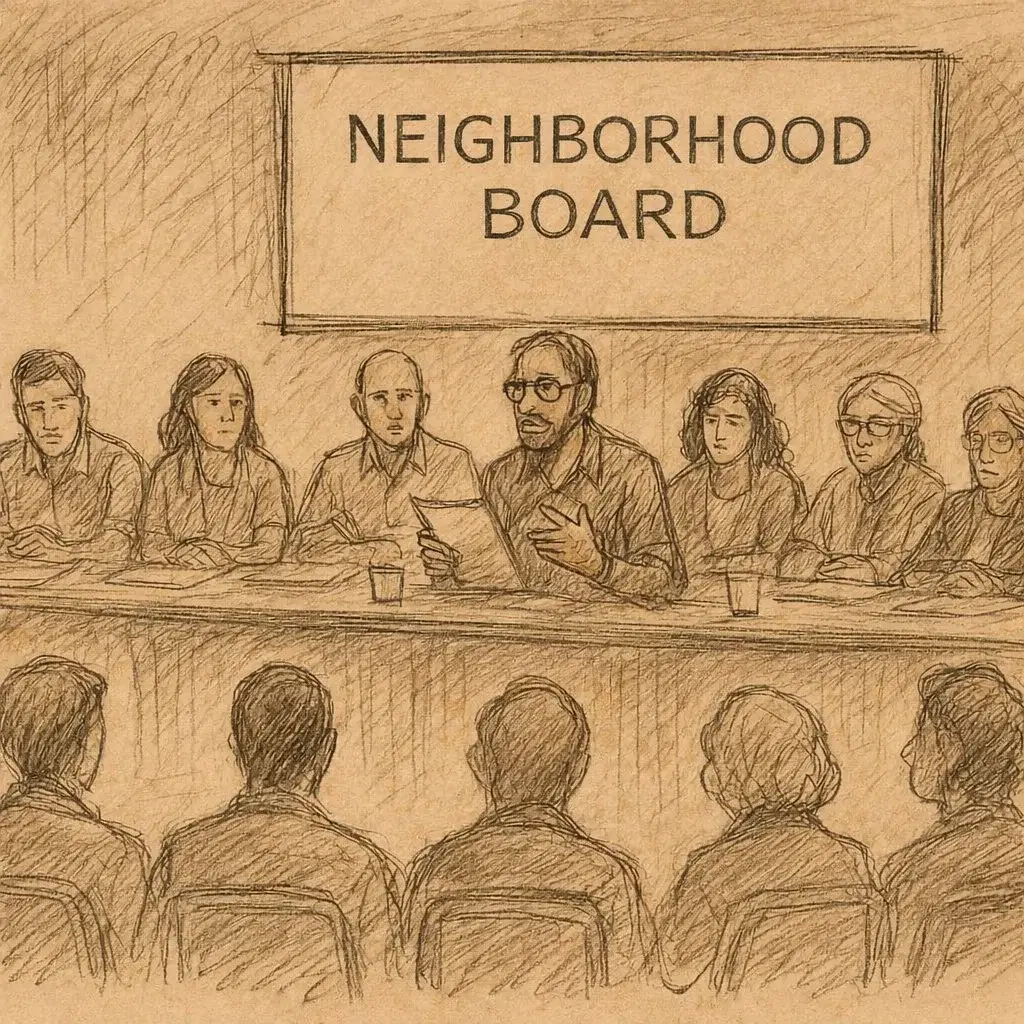
No 13 Downtown Chinatown Neighborhood Board Regular Meeting September 2026
Listen to this article:
13 Downtown-Chinatown Neighborhood Board Meeting – September 5, 2026
Meeting Opening and Attendance
The Downtown-Chinatown Neighborhood Board opened with introductions from Vice Chair Dan Mestas and members Nikki Shintani, Hei Ho, Ian Nguyen, Bob Armstrong, Kevin Lai, Laura Sturges, Ross Isokane, and others participating in person or online. Laura Sturges identified herself as treasurer. The meeting proceeded through public-safety reports, public concerns, presentations, proposed resolutions, board business, and reports from government representatives. The chair noted that the district has roughly 25,000 residents, with an even larger population in the surrounding downtown area.
Honolulu Police Department Crime Statistics
Honolulu Police Department representatives reported August 2026 statistics for the district. Motor-vehicle thefts increased from five in the preceding month to seven, burglaries rose from two to four, and unauthorized entries into motor vehicles increased from one to three. General thefts declined from 22 to 19. Assaults increased from 15 to 19, while reported sexual assaults remained at two. Reported graffiti incidents remained at zero. Drug cases rose sharply from four to 14. The district recorded 88 motor-vehicle collisions, unchanged from the previous month, and 2,054 calls for service, one fewer than the preceding month’s 2,055. With schools back in session, HPD urged motorists to slow down and watch for children emerging from between parked vehicles and around high-rise buildings.
Loud Vehicles and Motorcycle Enforcement
Captain Matsumura addressed recurring complaints about loud mufflers, motorcycles, and vehicles traveling through Chinatown, especially at night and around bars. District 1 officers increased enforcement and driver education following concerns raised at the previous meeting. Since that meeting, officers had issued three loud-muffler citations and 13 citations for various motorcycle-related offenses. HPD said nighttime enforcement would continue in response to community complaints.
Chinatown Police Substation Renovation and Temporary Closure
HPD announced that the Chinatown substation was tentatively scheduled to begin renovations during the week of September 21, subject to street-use permits, Department of Design and Construction coordination, and contractor scheduling. Because of the nature of the work, the substation would have to close temporarily. HPD had looked for an alternate Chinatown location but found no suitable space. Residents would still be able to call 911 and receive a police response or visit the main police station nearby. No firm completion date was available, although officials hoped the closure would last only one or two months. Board members emphasized that the substation has long had an unwelcoming appearance, inadequate signage, inaccessible public restrooms, and a plywood-covered door. Police Chief David Lazar committed to prioritizing repairs, restoring a welcoming public presence, and discussing the facility’s condition with his staff and the city’s facilities personnel.
Police Chief David Lazar’s Priorities
Chief David Lazar, completing his ninth week as Honolulu’s first externally selected police chief in approximately 90 years, described his early priorities. He had promoted two deputy chiefs for field operations and administration and was developing a three- to five-year strategic plan for HPD. His agenda includes modernizing technology, improving recruitment and retention, strengthening community policing, expanding visible foot and bicycle patrols, and building relationships among officers, residents, and merchants. Lazar said he planned to walk Chinatown with District 1 officers and stressed that effective community policing requires police and residents to identify and solve problems together rather than relying only on brief public engagement or patrol cars passing through an area.
Police Staffing, Recruitment, and Retention
Chief Lazar said HPD appeared to be approximately 400 officers short on paper, although the effective shortage could fall to about 275 if current recruits complete the academy and field training. The department recently began its largest academy class in 12 years with 66 recruits, of whom 63 remained, and another large class was expected in October. More than 2,000 applications had been received during the prior year, although that was approximately 700 fewer than the year before. HPD had shortened the period from application to hiring to roughly three or four months and was aiming for a 90-day process without lowering standards. Six officers were added to recruitment, bringing that unit to 12, and the background-investigation staff was expanded so investigators would handle closer to 15 files rather than 30 or 40. Lazar also proposed replacing Scantron-based testing with online systems, using remote or proctored processes where appropriate, and promoting “Aloha policing” throughout Hawaiʻi and the continental United States. A suggestion that recruits walk community beats during academy training was raised, although no commitment was made.
Foot Patrols, Open Drug Use, and School Safety
Several residents urged HPD to place more officers on foot in Chinatown, downtown, and neighboring District 5 areas such as Kalihi and Liliha. Former board chair Ernest Carvalho said officers walking regular beats would learn who belongs in the neighborhood and develop trust with residents and merchants. Residents of Kukui Plaza described people openly using drugs with foil, flames, and straws along Kukui Street and near the Princess Kaʻiulani school campus, including while students were leaving school and using the nearby Biki station. They said patrol vehicles sometimes drove past without intervening. Chief Lazar stated that HPD could not tolerate open public drug use, particularly near schools, and instructed District 1 leadership to follow up. He encouraged residents to call again and request a sergeant if officers do not adequately address a reported incident. Residents corrected an earlier reference to the applicable pedestrian-safety program, identifying it as “Safe Routes to School.”
Prostitution and Persistent Street Crime
Kukui Plaza residents also reported persistent prostitution along Kukui Street and on private residential property, alleging that some of the same individuals had operated openly during afternoon and evening hours for years. Chief Lazar said a lasting response would require cooperation between District 1 patrol officers and HPD’s narcotics and vice personnel rather than merely sending an occasional patrol car. He committed to notifying the appropriate support units and developing a longer-term plan that examines why the activity has become established at that location.
Drug Arrest and Regional Coordination
Ernest Carvalho thanked HPD for a recent drug arrest near Sun Yat Sen Park, saying officers removed a convicted felon who was allegedly selling drugs. He urged HPD to coordinate enforcement across Districts 1 and 5 because improvements in Chinatown depend on conditions in downtown, Kalihi, and Liliha as well. He also called on residents to work actively with police and elected officials, noting that law enforcement and government cannot clean up the neighborhood without sustained community participation.
Drones, Cameras, and License-Plate Readers
Chief Lazar described HPD’s use of cameras, drones, and automated license-plate-reader functions. Chinatown cameras may be used more effectively to identify stolen vehicles, and HPD’s drone-as-first-responder pilot began in District 1 with some District 5 coverage. The chief cited a recent case in which a drone followed three suspects wanted in an auto break-in and located one hiding in bushes near the freeway, allowing officers to make arrests that he believed would otherwise have been unlikely. He said technology would complement, not replace, conventional police work and community partnerships. Drawing on his previous department’s experience, Lazar said drones, plate readers, specialized undercover teams, spike strips, and public education had helped reduce auto break-ins there to a 22-year low. He also supported a “Park Smart” approach encouraging drivers not to leave valuables in vehicles.
Surveillance Safeguards and Data Privacy
Residents and Neighborhood Commission Chair Patrick Smith warned that law-enforcement technologies have been abused in other jurisdictions and requested strong privacy rules, oversight, and limits on data sharing. Chief Lazar said HPD has policies, training requirements, accountability measures, Fourth Amendment safeguards, and transparency obligations for its real-time investigation center and drone program. He offered to participate in a community meeting devoted specifically to police technology. Lazar stated that HPD does not want to share its surveillance data outside the department and said HPD would not use Flock cameras because of controversy surrounding that company and concerns about where collected information might be sent. He agreed that any technology must operate within clear guardrails to preserve public trust.
Officer-Involved Shootings and De-Escalation
A resident who had witnessed an officer-involved fatal shooting about five years earlier said police recorded his account but did not take a written sworn statement or follow up with him. He asked HPD not to defend or clear officers before investigations are complete. Chief Lazar responded that neither police nor the public should rush to judgment and that officers are entitled to a full, fact-based investigation and due process. He acknowledged that officers sometimes must make split-second life-or-death decisions but emphasized crisis-intervention training, de-escalation, creating time and distance, sound tactics, and avoiding positioning that leads officers to fire at moving vehicles. He said public trust requires both support for officers and meaningful transparency and accountability.
DUI Enforcement and Traffic Deaths
A resident contrasted limited intervention against open drug use downtown with a multi-vehicle DUI checkpoint near Diamond Head. Chief Lazar explained that sobriety checkpoints are generally supported by grant funding and are intended to reduce impaired driving, speeding, and fatal crashes. He reported that Oʻahu had recorded 26 traffic fatalities as of the day before the meeting, compared with more than 50 during the prior year, and said even 26 deaths were too many. He agreed that officers at checkpoints must remain professional while also acknowledging the need for stronger service in downtown neighborhoods.
Homelessness, Mental Health, and Encampments
Chief Lazar said HPD must enforce laws against open drug activity while connecting unhoused and mentally ill residents with services. He referenced HoNu, the city’s CORE crisis-response program, and MH-3 initiatives intended to direct people experiencing mental-health crises toward treatment. He advocated making Oʻahu an “encampment-free” island so large camps do not become established locations for drug use and related crime. Board members asked HPD to return regularly and advise the board on legislation, funding, and policies that would help police address homelessness, drug use, and associated offenses.
Honolulu Fire Department Report
The Honolulu Fire Department reported August 2026 activity in the district. There were no structure fires, brush fires, cooking fires, pedestrian-involved motor-vehicle collisions, or mountain rescues. Firefighters responded to six nuisance fires, 25 alarm activations that did not involve fires, 101 medical emergencies, three motor-vehicle collisions, three ocean rescues, and one hazardous-materials incident. A board member asked for an update on possible relocation or construction of a new downtown fire station and training center. The firefighter did not have that information and agreed to seek an answer from HFD’s community-relations office for a future meeting.
Lithium-Ion Battery Fire Safety
HFD warned that it is responding to more fires involving lithium-ion batteries in smartphones, laptops, e-bikes, scooters, toys, power tools, and vehicles. Residents were advised to use manufacturer-approved cords and chargers, charge devices on hard and flat surfaces, unplug fully charged equipment, and charge larger devices outside when possible without blocking exits. Devices should no longer be used if they become unusually hot, swell, leak, smell strange, smoke, hiss, or pop. Travelers were advised to keep charging devices visible aboard aircraft and never charge e-cigarettes or vapes on a plane. HFD invited residents to Fire Prevention Week Family Day at the Honolulu Zoo on October 3, 2026, from 10 a.m. to 2 p.m., under the theme “Charge into Fire Safety: Safe Charging Is a Superpower.”
Assistance for an Unhoused Resident and Chinatown Signage
During public concerns, Ernest Carvalho reported that an unhoused woman known locally for caring for cats wanted to return to family outside Hawaiʻi. He planned to connect her with resources to arrange that return. Carvalho also requested larger, clearer signs prohibiting vehicles from driving on Hotel Street, saying the existing signs are too small to be effective.
Bus Reliability and Hotel Street Traffic
Residents criticized persistent delays on Routes 2 and 4. Route 2 was said to have arrived 30 minutes to an hour late during rush hour over the preceding month, causing riders to miss meetings and other commitments and leading some passengers to direct frustration at drivers. Speakers rejected traffic as a sufficient explanation and asked city officials to improve service reliability. A merchant from Maunakea Marketplace separately opposed any proposal to make Hotel Street one-way, arguing that downtown needs a two-way east-west route because King Street and Beretania Street already operate in opposite directions. He said Hotel Street is a commercial lifeline for merchants and is used by tour buses dropping off and collecting visitors. The mayor’s representative later reported that the Department of Transportation Services had no current plan to change Hotel Street’s traffic pattern.
Rail Planning, Connectivity, and Board Boundaries
Doug Pyle asked the board to consider forming a committee focused on the arrival of rail and related issues such as transportation access, pedestrian connections, land use, and neighborhood integration. He warned that without a comprehensive plan, rail-related changes could become chaotic and fail to serve residents. Neighborhood Commission Chair Patrick Smith reported that a proposed boundary change affecting an area currently within the Kalihi-Pālama board could not occur before the May 2027 election and, even if adopted, would not take effect until May 2029. Because rail proposals will affect the area in the meantime, Smith offered to help the Downtown-Chinatown and Kalihi-Pālama boards develop a memorandum of understanding or coordinated resolutions expressing a shared vision without infringing on either board’s authority.
Downtown Safety Coordination and Vacant Union Plaza
A Maunakea Marketplace representative said conditions in Chinatown and the downtown Business Improvement District appeared to be improving and recommended that Chinatown organizations, the BID, merchants, and downtown groups create a shared communications platform for information about recurring offenders and safety problems. Another resident raised concerns about Union Plaza on Union Mall, describing the building as vacant but occupied by squatters, including one person who allegedly behaves aggressively toward passersby. The resident asked what the city was doing to secure and address the property.
Oʻahu Resilience Hub Learning Community
A representative of the Oʻahu Resilience Hub Learning Community described a City and County Office of Climate Change, Sustainability and Resiliency initiative coordinated by the Little HUI Foundation in Lāʻie and the Serenity Sustainability Lab at Kapiʻolani Community College. The network partners with the Department of Emergency Management, HI-EMA, the American Red Cross, Hawaiʻi Foodbank, and community nonprofits to develop local resilience hubs and regional micro-networks. It offers CPR and first-aid training, shelter operations, psychological first aid, FEMA community-resilience certification, and Community Emergency Response Team training. The network included 14 established hubs and more than 30 hubs overall, with mini-grants available. Because public-concern testimony was limited, the chair invited the organization to return for a full presentation at the next meeting.
Meeting Schedule Dispute
Members revisited whether the board needed to formally approve or reconsider its meeting date, time, and place. The chair said Neighborhood Commission guidance established the schedule for the board’s two-year term and that members had previously shown no interest in changing the first Thursday at 6 p.m. Bob Armstrong and Kevin Lai noted that a prior discussion and approved minutes indicated the issue would return to the agenda and argued that a schedule may still be reconsidered during a term. The chair declined to place the matter on the agenda, stating that the existing arrangement was workable and further discussion would be unnecessary.
Books, Brews, and Beats Community Event
Organizer Maya Maishiro requested board support for “Books, Brews, and Beats,” a daytime community event planned for Saturday, October 10, from noon to 6 p.m. at the Fort Street Mall Farmers Market location. Following an inaugural event at Drip Studio in May, the gathering will feature a curated book exchange, craft coffee, matcha, nonalcoholic beverages, and live instrumental music described as healing frequencies. The organizer clarified that “brews” refers to coffee and tea rather than alcohol. Board members welcomed additional daytime activity on Fort Street Mall and unanimously approved support without objection.
H-1 Cap Park Feasibility Study
The Hawaiʻi Department of Transportation and consultants from PBR Hawaiʻi and AECOM presented an early feasibility study for a cap park over approximately one-half mile of the H-1 freeway between Liliha Street and Queen Emma Street. A cap park is a deck built over a freeway to support public open space. Examples included Klyde Warren Park in Dallas, Hance Park in Phoenix, and the Rose Kennedy Greenway in Boston. The Dallas project uses a public-private funding and management model, Phoenix’s park reconnects communities divided by freeway construction, and Boston’s greenway was integrated into a larger transportation project. HDOT received funding through the federal Reconnecting Communities Pilot Program and is studying whether a cap could reconnect downtown and Chinatown with the residential areas of upper Liliha and Nuʻuanu, improve walking and bicycling, strengthen mauka-to-makai connections, reduce pollution, and add open space near schools, parks, businesses, and housing.
Cap Park History and Community Engagement
Historical research for the cap park study described pre-contact Honolulu as a fishing village connected to a productive mauka agricultural landscape with terraced fields, freshwater fishponds, streams, and trails reaching toward the Pali. The consultants are studying traditional place names and the ahupuaʻa system to understand historic mauka-to-makai relationships. They also reviewed the construction of the Mauka Arterial, later incorporated into H-1, and the Honolulu Redevelopment Authority’s creation of superblocks during the 1950s. Those actions displaced residents, small businesses, churches, temples, and other institutions. The study is considering whether a cap park could acknowledge or partially repair those historic divisions. Early discussions had been held with the YMCA, Hongwanji, Queen Emma Gardens, and the Chinese Chamber of Commerce, where participants raised maintenance, financing, security, and homelessness concerns. The first broad community meeting was scheduled for September 29, with additional neighborhood-board presentations planned.
Cap Park Cost, Timeline, Maintenance, and Safety
HDOT did not yet have a construction estimate because the project remained in the system-planning and concept stage. A conceptual alternative and preliminary cost information were expected at the end of the study, followed by environmental review of effects on natural resources, nearby communities, and transportation. Construction might not begin for approximately 10 years, placing any completed project well into the 2030s. Residents supported the concept but questioned whether the government could maintain another park when existing parks experience encampments and illicit activity. They also asked whether the project could restore part of Foster Botanical Garden land affected by freeway construction and how the cap would avoid creating hidden spaces similar to areas under Nimitz Highway where people had climbed into structural rafters. HDOT said programming, design, operations, maintenance, and security would all be evaluated. The deck would also have to preserve the safety and reliability of H-1 as a critical route for workers, military access, and the economy. A River Street resident asked planners to consider odors and possible biological or chemical hazards from the nearby morgue, including reported formaldehyde-like odors when filtration appears inadequate.
Syringe Exchange Program Relocation
Kabika Poʻahi, managing director and acting executive director of the Hawaiʻi Health and Harm Reduction Center, reported that the organization’s mobile syringe exchange stopped operating along Kukui Street and elsewhere in Neighborhood Board 13 around October 2025. The program had therefore been outside the neighborhood for nearly a year and had no current plan to return. It now uses two mobile vehicles on Oʻahu, including service in the Iwilei area, rural communities such as Waiʻanae, and other locations where services are needed. The organization declined to disclose every fixed stop because of stigma and safety concerns. The update contradicted previous information received by the board suggesting that the van had returned, and the chair said the clarification eased substantial concern about activity near the school and pedestrian routes.
Harm Reduction Debate and Syringe Disposal
Board members expressed sharply differing views on syringe exchange. One member called for complete defunding, arguing that free needles enable illegal drug use and contribute to neighborhood crime. Poʻahi responded that more than 200 studies support syringe exchange as an effective public-health intervention and noted that the center honored the board’s request to relocate. Other members supported the program based on experience with addiction, restaurant-industry substance use, and blood-borne disease. Poʻahi said hepatitis C remains the most prevalent infection among the population served, but no significant disease-rate change had yet been observed after the Chinatown relocation. Fewer people were accessing the service, and overall syringe exchanges were declining as more users shifted from injection to smoking. The program does not distribute foil squares. Poʻahi said returned syringes retain value as a form of exchange currency, making program participants more likely to bring them back rather than discard them. Improper disposal may still occur during police action or encampment sweeps. A proposed resolution asking the center and city and state agencies to avoid regularly locating syringe services near school routes, maintain a 300-foot setback where feasible, and provide notice and safety protocols received no second and therefore died without board action.
Residential Over-the-Air Broadcast Access
River Street resident Robert Quintero proposed a resolution supporting building-code changes to preserve free over-the-air television reception in new multi-unit housing. He said residents in high-rises do not control rooftops, exterior walls, risers, or shared wiring and may be unable to overcome interference from modern construction materials, reflective windows, surrounding towers, building orientation, and lower-floor placement. Channel Master reportedly identified as many as 87 over-the-air channels potentially available in ZIP Code 96817 as of August 24, 2026, including FOX, KHON, ABC, CBS, PBS, NBC, and digital subchannels, but only under favorable reception conditions. Quintero advocated master antenna systems or broadcast-ready infrastructure at construction, when adding the necessary pathways and rooftop equipment would be less costly. He argued that free television provides local news, election information, educational and cultural programming, and emergency alerts without requiring cable, broadband, or streaming subscriptions.
Broadcast Proposal Debate and Board Action
Some members supported Quintero’s goal but opposed imposing a statewide mandate without evidence of how many residents are affected, a cost-benefit analysis, or evaluation of effects on Hawaiʻi’s already high housing costs. Alternatives included grants for lower-income seniors, pilot studies, or requiring new buildings to be antenna-ready rather than mandating a complete installed system. Quintero said pathways and wiring already exist in most modern buildings and identified another resident, including Councilmember Tyler Dos Santos-Tam, who had experienced similar reception problems. Senator Karl Rhoads said his office had prepared draft Senate and House legislation for possible introduction in 2027 and that technical, fiscal, legal, and policy details could be resolved through the legislative process. Instead of adopting Quintero’s detailed resolution, the board approved a broad motion supporting residential public access to broadcasting by eight votes in favor, none opposed, and one abstention.
Deferred Bus Lane Presentation
The board deferred an agenda item concerning a bus lane presentation for one month at the presenter’s request.
August Meeting Minutes
The board considered the draft written summary of its August 6, 2026 meeting. Kevin Lai said his written comments identified misspellings, inaccurate attributions, extra words, and other proofreading problems and sought amendments to the draft. The chair and secretary said corrections had already been made and moved to approve the draft. Debate became contentious over whether further corrections should be considered and whether Lai had been allowed his full discussion time. A roll-call vote began, with Lai voting no, but the complete result was not preserved in the supplied transcript.
Federal Report, Affordable Housing, and the SAVE Act
A representative from Congressman Ed Case’s office appeared during a portion of the meeting that began mid-report in the transcript. The chair thanked the congressional office for news concerning approximately $8 million in rehabilitation funding, although the specific projects were not fully described in the available excerpt. Patrick Smith and Kevin McDonald offered opposing views of Congressman Case’s vote for the SAVE Act, with Smith asking why he voted for it and McDonald thanking him and raising concerns about election administration, mailed ballots sent to former or deceased residents, and long voting lines. Because the congressman was not present, staff asked residents to email Nestor Garcia at the congressional office for individual follow-up.
Chinatown Gateway Housing Conditions
A resident of Chinatown Gateway Plaza described recurring leaks, aging windows that allegedly had not been resealed since the building was constructed in the 1970s, plumbing and infrastructure concerns, and missing maintenance records from a previous management company. During Tropical Storm or Hurricane Lala, water reportedly entered through the windows and created an electrical fire risk, requiring the resident to call HFD and shut off breakers. She said she and her mother pay full rent, that she had moved through four units over roughly a year and a half, and that the conditions had harmed her mental health and ability to work. Congressional staff asked her to forward documentation by email for follow-up.
Jones Act
Ross Isokane asked Congressman Case’s office to consider alternatives to full repeal of the Jones Act. He referred to temporary waivers associated with an energy crisis involving Iran and argued that Hawaiʻi and Alaska bear disproportionate shipping costs from a federal policy justified on national-security grounds. He suggested federal financial assistance or compensation for affected noncontiguous states if outright repeal remains politically difficult.
Governor’s Report and Hawaiʻi 250
Governor Josh Green’s representative, Steve Downs, responded to questions from the previous meeting. Regarding Hawaiʻi’s absence from the national America 250 celebration on the National Mall, the administration said the event posed major logistical and staffing challenges because it was 5,000 miles away and required two weeks of 12-hour daily participation. Neither the state nor Congress appropriated funds for an official Hawaiʻi pavilion delegation, so the Hawaiʻi America 250 Commission focused on local events on each island using volunteers and donations. Kevin McDonald questioned that choice because the state had funded travel for eight legislators to a national conference in Chicago and argued that participation in the national anniversary event could have promoted Hawaiʻi tourism.
Small-Business Climate
The governor’s representative addressed CNBC’s ranking of Hawaiʻi as the worst state for starting and operating a small business. DBEDT identified infrastructure, operating costs, technology and innovation, and business friendliness as major challenges. State responses include investing in shared commercial kitchens and manufacturing facilities, acquiring land for additional production space, supporting targeted and emerging industries, building the workforce, expanding access to capital, creating diverse higher-quality jobs, and using public-private partnerships and infrastructure investment to accelerate affordable housing. Residents asked for more specific action on taxes, utility costs, labor costs, and regulation, which they said were central to the CNBC findings. The same concerns were later directed to the mayor’s office regarding Honolulu’s local business environment.
State Follow-Up on Lighting, Noise Cameras, and Illegal Signs
The Department of Accounting and General Services thanked Vice Chair Mestas for recommending prompt replacement of fluorescent Capitol lighting with LEDs rather than waiting for bulbs to fail and said rebates and cost savings would be considered. HDOT reported that all 10 cameras in its noise-detection pilot had been installed at sites selected using HPD complaint data. A proposed River Street and Beretania Street site had to be moved because HDOT could not secure the necessary right-of-way on a city pole. Data will be gathered for six months, evaluated, and then released publicly. HDOT also said highway crews continually monitor state roads and generally remove illegally placed signs during landscaping and cleaning cycles every five weeks, with additional dispatches when specific signs are reported.
Birds, Modified Mufflers, and Military Lands
Residents requested Department of Health attention to a large number of birds roosting in broken upper-floor windows of the Lai Fong building and the resulting accumulation of droppings on sidewalks. They also asked whether vehicle-safety inspections adequately detect illegally modified mufflers, gunshot-like exhaust systems, and train-style air horns on trucks. Ross Isokane requested an update on the state’s 2029 military land-lease negotiations, particularly 782 leased acres and approximately 3,400 acres of fee-simple federal land in Mākua Valley. He asked whether the governor would seek the return and complete remediation of land contaminated by unexploded ordnance and other military use, noting a broader reported request for roughly $500 million in statewide cleanup funding.
Mayor’s Report: Streets, Lighting, Parking, and Parks
Mayor Rick Blangiardi’s representative, Emergency Services Deputy Director Ian Santee, reported that a streetlight near bus stop 4787 at Nimitz Highway and Kekālike Street had been removed for HART’s City Center guideway and station construction. A temporary light was installed on the construction fence, but moving the bus stop beneath it was considered infeasible; the city was seeking HART’s permanent-lighting timeline. Recent downtown and Chinatown road rehabilitation included phase 12D and Unit 88 work, with future concrete-road projects expected to include Hotel Street and the King Street bus lane. Residents were encouraged to use Honolulu 311 for specific defects. DTS inspections found USPS vehicles standing along Richards Street; the city noted that federal postal vehicles remain subject to ordinary traffic laws. The city’s pest-control contractor was asked to investigate rooster activity and possible trapping at Kamaliʻi Mini Park. Negotiations continued with a preferred development partner over a predevelopment agreement and ground lease for that park site.
Dangerous Ramps, Damaged Buildings, and Trespassing
The Department of Design and Construction acknowledged that the curb ramp at 1027 Maunakea Street does not meet ADA standards because of its steep cross-slope but maintained that it could not be flattened and that only three previously described options were viable. The chair strongly rejected that response, saying the hazard had gone unresolved for seven years and demanding an on-site inspection, measurement, and correction before someone is seriously injured. Regarding the fire-damaged property at 901/905 Kekālike Street, HFD, the Department of Planning and Permitting, and HPD had conducted inspections; the city said a violation could be issued if the structure remained unsecured or if corrective permitting had not begun. At 1022 Bethel Street, the property manager agreed to remove litter, but HPD had been unable to contact the Seattle-based owner and would continue safety patrols and enforcement.
Streetlights, Trees, Signs, and Other Maintenance Requests
Residents reported prolonged streetlight outages outside McDonald’s on Hotel Street and throughout Union Mall, creating dark and potentially unsafe pedestrian areas near vacant buildings. They also reported storm-damaged tree stumps on Hotel Street, a fallen tree near the Bishop Street side of Kamaliʻi Park, a plywood-covered hole at South Hotel and Alakea Streets, and defaced street signs near Nuʻuanu Avenue and Vineyard Boulevard. One member suggested installing a solar-powered light near Kekālike Street and Nimitz Highway. Questions were also raised about why a syringe-exchange van had reportedly been observed traveling on Kukui Street if the operator had stopped serving the neighborhood; the mayor’s representative was asked to clarify the date and circumstances.
Honolulu Liquor Commission
A board member cited a new complaint involving Scarlett Honolulu after a reported $670,000 settlement in 2025 and noted that the City Council had authorized another $50,000 for legal representation. He asked the mayor to revisit Honolulu Liquor Commission reforms so taxpayers would not continue bearing the costs of recurring disputes and litigation.
Councilmember Report
A representative for Councilmember Tyler Dos Santos-Tam deferred a full verbal presentation because the meeting was running short on time. The office’s newsletter was placed in the online chat, and participants were invited to review it and submit questions directly.
Power-Outage Claims, COVID-19, and Voting
Senator Karl Rhoads told residents who suffered losses during power outages associated with Lala that they could file claims with Hawaiian Electric, even though consumers may not know whether utility negligence was involved. He also reported a renewed increase in COVID-19 cases and said updated vaccines had recently become available at CVS and other pharmacies. General-election ballots were expected to reach mailboxes by October 16. Rhoads warned that potential federal changes could create additional hurdles for voting by mail and urged registered voters to persist even if they had to use a voter-service center. Responding to claims of long waits during the recent primary, he said the first results were released around 7:15 p.m., indicating that voting lines had cleared relatively early. He noted that two races ended in ties but attributed that to evenly divided voters rather than vote-by-mail administration.
Affordable Housing Definitions
A resident questioned whether government definitions of “affordable housing” sometimes permit rents or sales prices above local market levels while still granting developers tax benefits or fee waivers. He argued that publicly subsidized projects should produce homes genuinely below market and asked whether the governor would support corrections to state programs where affordability thresholds could unintentionally contribute to price inflation.
Adjournment and Next Meeting
Because the meeting approached its 9 p.m. deadline, reports from Representatives Kim Coco Iwamoto and Mike Lee, as well as other monthly agency materials, were deferred to the board’s Google Drive and online chat. The chair apologized for the shortened time and asked participants to submit questions electronically. The meeting adjourned at approximately 9 p.m. The next regular meeting was announced for October 1 at the same place and time.