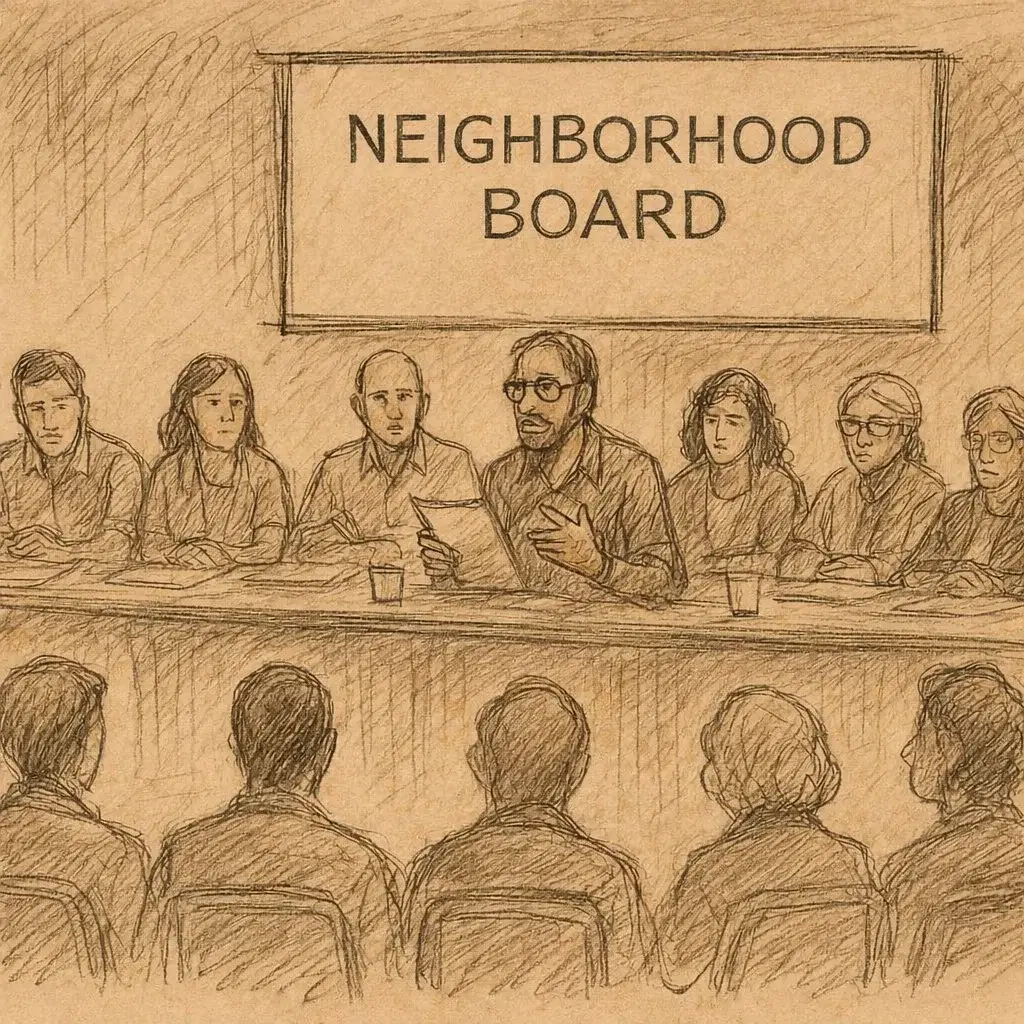
No 13 Downtown Chinatown Neighborhood Board Regular Meeting August 2026
Listen to this article:
13 Downtown-Chinatown Neighborhood Board Meeting – August 8, 2026
Opening, Attendance, and Agenda
The meeting transcript records the session being called to order at 6 p.m. on August 6, although the meeting is identified as the August 8, 2026 regular meeting. Board members and staff introduced themselves, including Chair Chūlan Kwak, Kevin Lai, Ian Nguyen, Dan Mestis, He Ho, Nicole Shintani, Laura Sturgis, Robert Armstrong, Ross Isokane, and Neighborhood Assistant Tammy. Armstrong participated remotely because he was ill, while Shintani and Isokane joined after the meeting began. The Honolulu Fire Department was not present to deliver its scheduled public-safety report. Presentation item 5.4 was deferred at the requester’s direction until September.
July Police Statistics
Honolulu Police Department Sergeant Kaleo Osaka reported that Chinatown recorded five motor-vehicle thefts, two burglaries, 22 thefts, one unlawful entry into a motor vehicle, 15 assaults, two sexual assaults, no graffiti cases, four drug-related cases, and 88 motor-vehicle collisions during July. HPD received 2,055 total calls for service in the month. Four sergeants share responsibility for supervising the Chinatown area.
Kekālike Street Parking and Loading-Zone Enforcement
Captain Matsumura reported that HPD worked with the Department of Transportation Services to install new signs on Kekālike Street near Oʻahu Market. Officers followed the installation with public education and intensive enforcement, issuing approximately 98 citations over several weeks for vehicles illegally parked in the loading zone. HPD intends to continue enforcement to establish compliance with the revised parking restrictions. The city also later reported that loading zones were being added around Kekālike Mall to reduce conflicts involving vendors, deliveries, and other vehicles.
Drug Activity and Sidewalk Conditions on Kukui Street
HPD followed up on complaints about suspected drug activity near the Longs Drugs loading area on Kukui Street, across from Princess Kaʻiulani Middle School. Marked day- and night-watch officers made numerous checks but did not directly observe drug transactions. They did issue approximately eight to ten citations for sit-lie violations, sidewalk obstruction, littering, and related offenses. Kukui Plaza resident Doug Pyle said residents observe drug use and dealing daily, sometimes while children are nearby, and explained that people hide behind parked vehicles when marked patrol cars approach. Captain Matsumura acknowledged that marked units may not see concealed activity and said the area is known to HPD’s narcotics and vice personnel and plainclothes units, although details of active investigations could not be disclosed. Residents emphasized the need to preserve a safe school route and urged continued use of both narcotics investigations and sidewalk enforcement.
Syringe-Exchange Program Near the Middle School
The mayor’s representative reported that HPD had observed more people in the Kukui Street area and suggested the increase might be connected to the syringe-exchange program returning to the side of Princess Kaʻiulani Middle School. The Chair, residents, and several board members strongly objected to the program’s return to that location, stressing that the objection concerned its placement beside a school and a route used by students and kūpuna rather than the concept of needle exchange itself. One resident reported finding approximately five discarded syringes in bushes within the prior two weeks and said discarded needles had declined when the van was absent. Participants recalled that the board and city had previously worked to relocate the van. The Chair sought authority to send an immediate protest letter, but members debated whether a new board vote or previously adopted action was required under open-meeting rules. Neighborhood Commission Chair Patrick Smith advised that the Chair could rely on a prior formal board action if one existed but that the board could not take an unagendized vote on a matter with significant community impact. Councilmember Tyler Dos Santos-Tam’s representative said the office had previously worked to move the van and would again contact the Hawaiʻi Health and Harm Reduction Center to seek a more appropriate location. Representative Kim Coco Iwamoto, whose district includes the school, also agreed to contact the program and inquire about alternatives.
Burned Building at Kekālike Street and Nimitz Highway
HPD discussed a building variously identified as 180 North Nimitz Highway and 901 Kekālike Street, near the bottom of Kekālike and Nimitz. The property had been associated with a suspected illegal game room and was under investigation by the Narcotics/Vice Division before a late-evening fire on July 24. HPD said the building had been shut down and vacated after the fire. Resident Dale Krupa, however, reported seeing three ground-floor doors open shortly before the meeting and people continuing to enter, including through a doorway leading toward the burned second floor. HPD explained that officers could not themselves board up private property but would refer the hazardous condition to the Department of Planning and Permitting and continue working with the owner. Board members corroborated that people remained on the ground floor shortly after the fire and emphasized the risk posed by unsecured access to a fire-damaged structure.
Motorcycle Noise, Late-Night Parking Lots, and Hotel Street Traffic
Residents again complained about loud motorcycles gathering on sidewalks near Momo’s and Manifest, circling Chinatown, and revving engines from around midnight until 2 or 3 a.m. The noise carries into Chinatown Gateway Plaza, where many residents sleep with open windows. HPD said it would review prior calls, provide statistics at a future meeting, and continue dispatching officers when residents report active violations. Board member Kevin Lai also described recurring noise between approximately 1:30 and 2:30 a.m. at the surface parking lot at 1171 Nuʻuanu Avenue beside The ARTS at Marks Garage, including screeching tires and amplified music from pickup trucks. HPD agreed to request increased night-watch checks and a visible police presence along Bethel Street as patrons move toward the lot. Residents also asked for clearer Hotel Street bus-only signs and more citations for unauthorized vehicles. HPD said many violators are tourists confused by inadequate markings, that tickets are issued regularly, and that DTS is working on larger signs and intersection repainting, although no completion date was available.
Homelessness, Human Waste, and Public Restrooms
Architect and Chinatown property owner Dean Sakamoto described severe sanitation problems around his building at 99 North King Street, the former bank building at King and Mauna Kea streets. Following the departure of The Pig and the Lady and other nearby businesses, vacancies and reduced foot traffic have left the area quiet, while unhoused people regularly sleep outside former ATM areas and have few restroom options. Sakamoto said sidewalks and doorways are used for urination and defecation, creating odors, health hazards, and an inhospitable environment for businesses and visitors. He thanked HPD and the Department of Facility Maintenance for responding and cleaning daily but said sanitation, public health, homelessness, and business recovery require a coordinated strategy beyond enforcement and routine cleanup. His nonprofit, SHADE Institute, offered planning and design assistance. He was advised to submit a formal resolution for placement on a future agenda so the board could debate and act on it.
Several participants supported Sakamoto’s concerns and noted that the lack of toilets has been a longstanding neighborhood problem. Ala Park’s restroom facility had been removed, the HPD substation restroom was described as frequently unavailable, and businesses such as McDonald’s no longer routinely allow public restroom use. The Chair said a public restroom on Pauahi Street was being developed under the city’s homeless-solutions office and was expected to be completed around October. She also described volunteer Chinatown Security Team efforts involving approximately 30 to 40 online and foot patrols and free cleanup of human waste. She promoted a Chinatown Improvement District that could provide stable funding for professional sanitation and security services. HPD clarified that the sit-lie prohibition is not enforceable between 11 p.m. and 5 a.m., even in Waikīkī; the Chair suggested asking the City Council to consider around-the-clock coverage now that additional shelter beds and treatment options exist.
HPD Drones as First Responders Pilot
Assistant Chief Brian Lynch presented HPD’s Drones as First Responders pilot for District 1 and neighboring District 5. Drones would be positioned at police or fire facilities but remotely flown from police stations by sworn officers certified by the Federal Aviation Administration for beyond-visual-line-of-sight operations. They would launch only in response to 911 calls, principally high-priority incidents in progress such as assaults, weapons cases, robberies, thefts, vehicle break-ins, domestic incidents, or missing children and kūpuna. By flying directly over traffic, drones may arrive before patrol cars, identify suspects, follow fleeing individuals, direct arriving officers, and provide situational awareness. Lynch said better advance information may also reduce unnecessary deployments and lower use-of-force risks because officers would better understand what they are approaching.
The drones will have blue police lights and speaker capability, which could be used for emergency warnings such as clearing a beach before a tsunami, although HPD generally intends to fly high enough to minimize danger to people below. Video is not recorded while a drone travels from its launch point to the call. Recording begins only when officers reach the reported location and determine there is relevant activity; if nothing is happening, the drone returns without recording. Captured video may be admitted as evidence in court. HPD emphasized that drones are not intended for general patrol, random surveillance, routine drug investigations, or low-priority trespass complaints, although deployment could depend on call volume and circumstances.
Members and residents asked about privacy, constitutional oversight, court use, access by federal agencies, and the relationship between drones and Chinatown’s fixed cameras. HPD said departmental policy includes constitutional guardrails and is available at HonoluluPD.org, with an online link for questions and concerns. The accompanying real-time information center can activate public-area cameras when responding to a 911 call, but officers will not continuously monitor them. Some Chinatown cameras are unavailable because of poor maintenance. Patrol officers will still respond by vehicle; cameras and drones will supplement rather than replace them. HPD expects an initial network of six to eight drone pods covering Kalihi through the urban core toward District 7. Depending on the final scale, leased equipment and replacement packages could cost approximately $600,000 to $1 million annually. The pilot will be evaluated using response times, arrests, crime prevention, and other performance data before long-term expansion. A member also asked about HPD’s previously purchased $150,000 Boston Dynamics robotic dog; Lynch said he believed HPD still possessed it but had not been involved in that project.
Other HPD and Community-Policing Matters
The board thanked HPD’s community-policing team and Officer Pratt for organizing a successful National Night Out gathering at McCoy Pavilion attended by more than 100 residents and community-patrol members. Participants conducted sign-waving on Ala Moana Boulevard and met Chief Arthur “Joe” Logan’s successor, Chief David Lazar, who reportedly greeted nearly everyone present. The Chair welcomed District 1 Commander Major Henry Roberts back from the FBI Academy and thanked HPD for ATV support at Ala Park and for work associated with the MH-3 initiative. She also reported a newer and more aggressive group of unhoused individuals causing disruptions around Mauna Kea, North King, Hotel, and Pauahi streets and requested additional attention.
Vacant Island Insurance Building and Private-Property Management
A Chinatown Gateway Plaza resident reported researching ownership and management of the former Island Insurance building because activity there was spilling into the residential complex. She said the property had previously been connected with National Mortgage and Finance Company and Hawaiian Properties, with management responsibility transferred to CBRE in November. She contacted CBRE manager Katrina Medina about trespassing, drug use, accumulated rubbish, and defecation, and was told the company would elevate the matter and was willing to work with the community. The Chair asked that the contact information be sent to the Neighborhood Assistant so it could be retained in the board’s centralized files.
Safer Streets and Transit-Oriented Development Planning
Doug Pyle and board member Nicole Shintani had attended Oʻahu Metropolitan Planning Organization discussions with out-of-state specialists on safer streets and urban design. Topics included affordable housing, pedestrian safety, bicycle access, bus and rail connections, and planning for development around the future rail corridor. Pyle said he hoped to return with a formal presentation or proposal because rail and transit-oriented development create an opportunity to redesign neighborhood streets and housing patterns. The Chair asked him to package the material and submit it for a future agenda so the board could discuss and potentially act on it.
Neighborhood Commission Guidance on Meeting Rules
Neighborhood Commission Chair Patrick Smith addressed complaints about how speaking rules and agenda procedures had been presented in the past. The Commission determined that general speaking rules belong to the board rather than solely to its chair, and that a board cannot give a chair powers beyond those authorized by the Neighborhood Plan. Smith clarified that the Chair retains authority to arrange agenda items, manage the meeting, prioritize first responders and elections, and fairly grant additional speaking time. If members believe that discretion is being abused, a majority of the board may direct the Chair to follow a different procedure. He also explained that Neighborhood Commission policy and the Neighborhood Plan can supersede Robert’s Rules of Order. Smith said the current board appeared cooperative and well run, while the Chair emphasized that public concerns had been moved earlier on the agenda and that the new board was operating with greater cooperation.
Hawaiʻi Pacific University Shark Race 5K
Hawaiʻi Pacific University cross-country coach Kevin Schwartz presented the inaugural Shark Race 5K run and walk, planned for Sunday, September 6, as an HPU fundraiser. The course will begin and end at Aloha Tower, travel along Aloha Tower Drive and Ala Moana Boulevard, turn onto Keawe Street, loop around Kakaʻako Waterfront Park, and return by the same route. Organizers hope to attract approximately 400 runners and walkers. The makai side of Ala Moana Boulevard from Alakea Street to Keawe Street would close from about 7 to 8:45 a.m., with slower participants eventually moved onto sidewalks to shorten the closure. HPU was coordinating with DTS, HPD special-duty officers, and Aloha Roadway Services, and said businesses along the course had been notified.
Some members objected that the agenda did not include enough detail about the route and impacts for the public to evaluate the proposal under Sunshine Law. The Chair advised future applicants to provide maps, affected-business notices, and road-closure details with their agenda submissions. Despite the concern, the board voted 6–0, with two abstentions, to support the event. HPU agreed to provide more complete planning information in future years.
Children and Youth Day
Retired Department of Education teacher and counselor Alan Silver requested support for the 33rd annual Hawaiʻi Children and Youth Day, founded by former Senator Suzanne Chun Oakland and former Representative Dennis Arakaki. The event is scheduled for Sunday, October 4, from 10 a.m. to 3 p.m. at the State Capitol, Frank F. Fasi Civic Grounds, and Kalanimoku Building grounds. Punchbowl Street between King and Beretania streets would temporarily close from 7 a.m. to 4 p.m. to allow setup, operation, and cleanup. Thousands of children, youth, and adults are expected for entertainment, games, literacy activities, books, creative-writing opportunities, and family programming. The event has a budget of more than $10,000, largely supported by donors. The board unanimously voted 9–0 to support it.
Downtown Honolulu Business Improvement District
Executive Director Brook Klinet reported that the Fort Street Mall Business Improvement District became the Downtown Honolulu Business Improvement District on July 1. The organization is a city-ordinance-created 501(c)(3), governed by a volunteer board and funded through special property assessments paid by district property owners and businesses. Its role is to supplement rather than replace city services. Its areas of work include sanitation, maintenance, public safety, hospitality, public-space programming, marketing, beautification, capital improvements, advocacy, and economic development.
Downtown ambassadors wear pink shirts, with markings distinguishing cleaning staff from safety staff. Cleaning services include litter and debris removal, sweeping, leaf removal, pressure washing, street-furniture cleaning, graffiti abatement, weed control, landscape watering, and special projects. Safety personnel have guard cards and additional training and conduct foot and bicycle patrols, welfare checks, outreach referrals, safety escorts, business engagement, visitor assistance, monitoring, and reporting. They do not replace HPD and will refer unhoused people or those experiencing medical or mental-health crises to outreach providers while escalating criminal or dangerous incidents to police.
Initial operations are Monday through Friday from 6 a.m. to 10:30 p.m. Cleaning and safety teams work from 6 a.m. to 2:30 p.m., while safety coverage continues from 2 to 10:30 p.m. The BID hopes to raise enough money for weekends, overnight shifts, and eventual 24-hour coverage. The ambassador service number is 808-866-3163 and is answered only during operating hours for incidents within the district. Pressure washing was expected to begin using borrowed Waikīkī BID equipment while Downtown Honolulu’s machinery awaited shipment from San Diego. The team planned to spend approximately three months, through November, establishing a cleanliness standard and then transition to maintaining it.
The BID will continue the Fort Street Mall Open Market, which has operated for more than 20 years on Tuesdays and Fridays from 7 a.m. to 1:30 p.m. It currently features eight to twelve produce, prepared-food, and craft vendors and is recruiting more small businesses. Future plans include music, games, themed activities, and partnerships to make the market a stronger destination. Board members asked the BID to audit broken streetlights, especially near Hotel Street and McDonald’s, assist with graffiti, investigate chickens on Fort Street Mall, clarify bicycle, e-bike, and smoking rules, monitor activity at the troubled Union Square building, and address First Friday and weekend noise near Hotel Street and Scarlet Honolulu. The BID agreed to provide regular reports and remain in close contact with the board.
Board Representation on the Downtown BID
The BID’s charter provides for a nonvoting neighborhood-board representative at its monthly meetings. The Chair said she intended to serve and asked that Vice Chair Dan Mestis also attend to improve continuity and information exchange. Members clarified that the representatives may listen, provide neighborhood context, convey previously authorized board positions, and report back, but may not independently commit the board to actions or resources. The BID accepted participation by both representatives, and its executive director will also report regularly at neighborhood-board meetings.
Broadcast Television Access Resolution Deferred
The board considered but deferred a resolution from resident Robert Cortero concerning reliable access to free over-the-air television signals in urban residential buildings. The attachment had initially been submitted July 2, but it did not transfer when the email was forwarded and was only uploaded on the meeting day. Members concluded that the public had not received adequate time to review it. Cortero argued that broadcast access is a public-safety and equity concern for low-income, elderly, disabled, isolated, and technologically limited residents who rely on television for emergency alerts, evacuation instructions, weather warnings, local news, public-health information, elections, education, cultural programming, and other community information. Members asked him to clarify how many people and buildings are affected, estimate costs to developers and property owners, consider grant-funded pilot options, and address Federal Communications Commission rule 47 C.F.R. §1.4000 concerning owners’ and tenants’ rights to install reception equipment. Senator Karl Rhoads said his office was researching the state, local, and federal legal issues and could help place a proposal in proper legislative form for the next session. The matter was deferred to September for a full presentation and possible action.
Hotel Street Bus-Only Markings Resolution Deferred
Robert Armstrong introduced a resolution asking the city to restore visible bus-only pavement markings and signs along Hotel Street. The proposal cited serious and potentially deadly vehicle incidents, Hotel Street’s heavy pedestrian, visitor, and bus use, the limited availability of police for constant traffic enforcement, and the success of visibly designated transit lanes elsewhere. It called for red pavement, “BUS ONLY” markings, additional signs, continued 15-mile-per-hour operation, and notice to DTS, HPD, the Sheriff Division, Oʻahu Transit Services, taxi companies, Uber, Lyft, government agencies, and news media.
Members broadly supported the objective but suggested refinements. Proposed changes included using neutral language about enforcement challenges, asking DTS to evaluate and restore markings where appropriate, avoiding a rigid color requirement unless it conforms to federal and city standards, emphasizing clearer signs, and determining whether planned transit-oriented-development changes could make Hotel Street one-way. Members noted that red methyl methacrylate pavement is recognized under federal traffic-control standards but does not replace legally required signs. Because the board packet containing the resolution was distributed too close to the meeting, Neighborhood Commission Chair Smith and several members advised against a vote. The resolution was read and discussed but deferred to September.
Approval of Meeting Summaries
The board approved the draft written summaries corresponding to the June 4 and July 2, 2026 regular-meeting video records without objection. The Neighborhood Assistant confirmed that the June summary had been posted on the Neighborhood Commission Office website on July 31.
Oʻahu Metropolitan Planning Organization Appointment
The board appointed Nicole Shintani, without objection, as its representative to the Oʻahu Metropolitan Planning Organization Citizens Advisory Committee. Members noted that a delegate could legally be a board member or a member of the public, but the board preferred an engaged member who could attend meetings and report back. Shintani cited prior work with OMPO and the Hawaiʻi State Energy Office. She was asked to learn the committee’s schedule, clarify the representative’s duties, attend upcoming meetings, report regularly, and determine why the preceding day’s meeting had been canceled.
Governor’s Office Report
Governor Josh Green’s representative Steven Downs reported that approximately 65 percent of the fluorescent lighting at the State Capitol had been replaced with LEDs, with the remainder expected to be replaced as existing lamps fail. A board member cautioned that waiting for burnout could make the project ineligible for Hawaiʻi Energy incentives because of changes involving fluorescent-lamp restrictions and recommended completing the high-return conversion in-house rather than through an energy-savings performance contract.
The Hawaiʻi Department of Transportation will remove illegally placed signs from medians along state roads and dispose of unclaimed signs after two weeks, although no fines are currently issued. Contact information for reporting illegal advertising was provided, and a member identified the Vineyard Boulevard median between Punchbowl and Nuʻuanu as an area needing attention. A noise camera was scheduled for installation on an existing pole near Pali Highway and Vineyard Boulevard in front of the YMCA. Another is planned for River Street, pending city right-of-way access. Members asked for data supporting the locations, a timeline for public results, and consideration of Nuʻuanu Avenue, where loud vehicles frequently leave nightlife areas. Downs also reported that revised flood-insurance maps affecting areas around North and South Kukui streets were based on city and FEMA hydrology studies of rainfall, runoff, and stream flow; residents may petition FEMA for map revisions using information provided in his handout.
A resident who had attended the nation’s 250th-anniversary celebration in Washington, D.C., criticized Hawaiʻi’s absence from a National Mall showcase that included other states and territories and requested an explanation of who decided not to send a delegation. He also cited a survey ranking Hawaiʻi as the worst state for starting and operating a small business and requested the Governor’s plan to address regulatory and economic barriers. The Governor’s representative agreed to research both matters.
Mayor’s Office and City Services
Mayor Rick Blangiardi’s representative, Deputy Director Ian Santee, highlighted the new design for Hawaiʻi driver’s licenses and state identification cards, transit-oriented development moving forward in Iwilei-Kapālama, the swearing-in of David Lazar as Honolulu’s 13th police chief, and the city’s participation in national 250th-anniversary activities. School-zone speed limits on city roads bordering schools are being reduced from 25 to 20 miles per hour when children are present between 6 a.m. and 6 p.m.
For bus Route 151, the city removed stop 4877 from in front of Cindy’s Lei Shop on Mauna Kea Street and relocated it to Hotel Street on July 12. Makai service on Mauna Kea will continue toward Nimitz Highway, allowing Chinatown riders to reach Iwilei and transfer to Route 7 at stop 4787 near Nimitz and Kekālike. Between July 13 and 26, District 1 officers assigned to Kukui Street issued five sit-lie warnings, with those involved leaving without incident. Residents were again told to call 911 when criminal activity is occurring.
The board requested an update on lighting at the Kekālike–Nimitz bus stop, noting that a promised temporary construction light was not evident and work order R202615221 remained open. It also renewed a seven-year request to flatten an unsafe Mauna Kea Street sidewalk used by hundreds of pedestrians, including people with disabilities. Additional city questions concerned trapping feral chickens at the former Kamaliʻi Mini Park, confirming any future one-way configuration for Hotel Street, requiring city and state workers to follow residential leaf-blower hours, and the mayor’s plan to improve Honolulu’s road conditions. Representative Iwamoto said she was considering legislation to prevent commercial properties near residences from using leaf blowers at early hours allowed in industrial or commercial districts.
City Council District I Report
Councilmember Tyler Dos Santos-Tam’s representative reported that the former restroom structure at Ala Park had been removed and that the city was working with a contractor on replacement restrooms on Pauahi Street. The bus shelter on River Street had also been removed, and additional loading zones were being established around Kekālike Mall. Several malfunctioning lights at Smith-Beretania Park were confirmed, including lights cycling on and off every five to ten minutes, and a repair work order had been submitted.
Residents asked which city office receives health complaints about feeding feral birds behind the Kukui Plaza towers and about nesting birds at the Li Fong building. The representative identified the Department of Customer Services as the contact for feral-chicken issues and agreed to follow up on broader health and property-maintenance concerns. Questions were also raised about Bank of Hawaiʻi repainting the Marks Garage building blue and whether that complied with historic-district rules; the matter was referred for follow-up with DPP.
The representative explained why Chinatown had not been included in the expanded Downtown Honolulu BID. Large downtown banks and corporate property owners possess far more assessed square footage and voting power, creating concern that Chinatown’s smaller businesses and distinct priorities would be outweighed. The Council office is instead examining a separate Chinatown improvement district, although the city owns approximately 40 percent of relevant property, making assessments and governance more complicated. It is working with the Chair on possible funding and service structures. The representative also agreed to return with details about city efforts to remove outdated regulations and improve Hawaiʻi’s poor small-business environment.
State Legislative Reports and Election Information
Senator Karl Rhoads reminded voters that primary-election ballots had to be received, not merely postmarked, by 7 p.m. on Saturday. Because of the deadline, he recommended using an official drop box rather than mail. In-person voting was available at Honolulu Hale through Saturday, and anyone in line by 7 p.m. could vote. Voters could track receipt and processing through elections.hawaii.gov and use Honolulu’s elections website to locate official drop boxes.
Representative Kim Coco Iwamoto clarified that Princess Kaʻiulani Middle School lies in House District 25 and committed to discussing the disputed syringe-exchange location with the operating organization. Representative Della Au Belatti’s or another District 26 report was not separately detailed in the transcript. Representative Adrian Tam or a district representative noted that school had resumed and that recent legislation raised the income threshold for free school breakfast and lunch: a family of four earning less than approximately $113,000 now qualifies, compared with the previous threshold of about $75,000. The representative also suggested moving Iwilei Road, including 888 Iwilei and 215 North King Street, into Neighborhood Board 13 during the Neighborhood Commission’s redistricting process because residents regularly attend this board and future transit-oriented development ties the area closely to Downtown-Chinatown.
Water Supply and Transportation Notes
A Board of Water Supply representative announced the “Imagine a Day Without Water” event for Saturday, September 26, from 9 a.m. to 1 p.m. at the Waiʻanae Mall’s Arc of Safety, 86-120 Farrington Highway, and planned to repeat the notice in September. A transportation representative remained available for questions, and the Chair requested an explanation for a prominent pillar placed near the foot of Nuʻuanu Avenue approaching the harbor, directing the question to be handled by email.
Chinatown Business and Community Association
The Chinatown Business and Community Association reported on its July 14 meeting and the third Hawaiʻi Chinatown Peace Festival, held July 18 in partnership with Weed and Seed Hawaiʻi at Mauna Kea Marketplace. After a year of planning, the event showcased Chinatown’s cultures through music, dance, food, and activities. It featured 29 food vendors, drew approximately 4,800 attendees, and opened with a blessing by Izumo Taishakyo Mission of Hawaiʻi.
The association continues to coordinate with the Chinatown Security Team, HPD, and the city’s CORE program. It reported noticeable reductions in crime and homelessness-related disruptions, with improved conditions benefiting restaurants, merchants, tour operators, and visitor activity. Planned work includes strengthening neighborhood security, conducting more cleanups, and educating merchants and shoppers not to support illegal or unlicensed vendors selling food and goods under potentially unsanitary conditions. Its next meeting was scheduled for August 12.
Neighborhood Citizen Patrol and Future Meeting Schedule
The Neighborhood Citizen Patrol deferred its July activity report until the next meeting. Kevin Lai asked that the board revisit the regular meeting day and time because the July summary had indicated that the matter would be discussed, but the Chair said a formal scheduling decision is required only at the beginning of each two-year term and maintained the current schedule. The next regular meeting was announced for September 3, 2026, at 6 p.m., after which the meeting was adjourned.