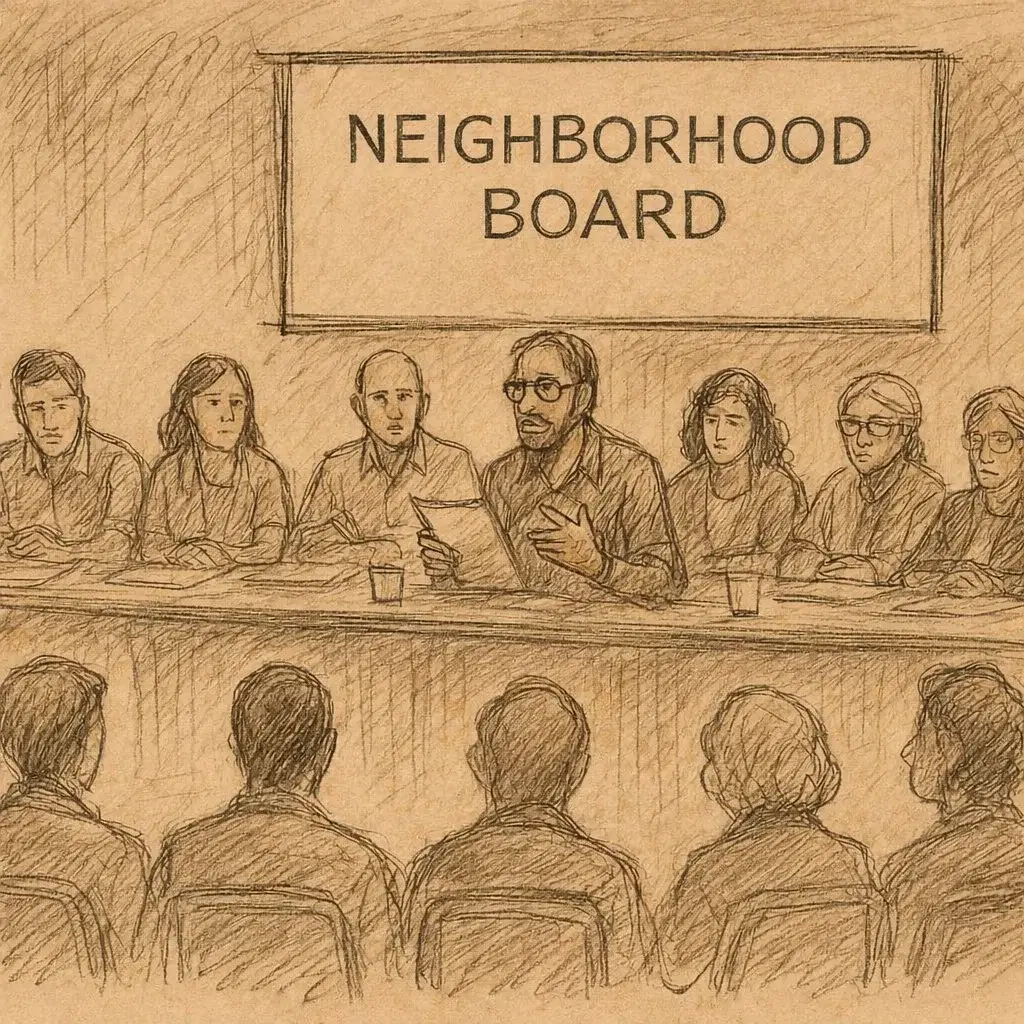
No 13 Downtown Chinatown Neighborhood Board Regular Meeting July 2026
Listen to this article:
13 Downtown-Chinatown Neighborhood Board Meeting – July 6, 2026
Call to Order and Agenda Reordering
The Downtown-Chinatown Neighborhood Board No. 13 called its regular meeting to order with members Dan Mestas, Bob Armstrong, Kevin Lai, Laura Sturges, Hei Ho, and Chair Chulan Schubert Kwok present, while Nicole Shintani participated remotely. Neighborhood assistant Cammie supported the meeting. To comply with the Neighborhood Plan, the board agreed without objection to move the public-safety reports ahead of the vacancy and officer-election items. The Honolulu Fire Department was unable to attend because personnel had been dispatched to a call, so the board proceeded directly to the Honolulu Police Department report.
Honolulu Police Department Crime Statistics
District 1 Sergeant Freeman presented June 2026 statistics. Police recorded four motor-vehicle thefts, down from 10 in May; three burglaries, down from six; 25 thefts, down from 28; six unauthorized motor-vehicle-use cases, down from nine; 28 assaults, up from 19; two sexual assaults, up from one; no graffiti cases; eight drug cases, unchanged from May; and 88 motor-vehicle collisions, up from 83. Officers also issued three loud-muffler citations. Total calls for service increased from 2,077 in May to 2,185 in June. The increase in assaults, collisions, and overall calls contrasted with declines in several property-crime categories.
Chinatown Noise, RIMPAC, Bar Inspections, and Morning Enforcement
Interim District 1 Major Paul Okamoto addressed recurring noise complaints near Chinatown Gateway, Bethel Street, and Chaplin Lane. Because RIMPAC personnel were in Honolulu, NCIS and military Shore Patrol units had joined HPD in Chinatown and Waikīkī, with additional deployment expected during the Fourth of July weekend. HPD was also working closely with the Honolulu Liquor Commission on regular bar inspections. Officers continued early-morning enforcement of vacancy and sit-lie rules, which generally end at 5 a.m., by asking people occupying sidewalks to move as Chinatown businesses begin opening. A resident of Gateway Plaza said motorcycles, rather than ordinary crowds, were the most disruptive source of noise, with engines and mufflers waking residents between approximately 1 and 3 a.m. He also described drumming and activity associated with an underground space near Fort Street and Chaplin Lane reportedly used by homeless artists and musicians. HPD said it was aware of the motorcycle problem and would continue persistent loud-muffler enforcement.
Suspected Illegal Activity at 180 North Nimitz Highway
A resident asked about the deteriorated building at 180 North Nimitz Highway, including the Little Saigon bar, an alleged illegal game room above it, and a suspected bicycle or moped chop shop on the ground floor. The location was described as immediately adjacent to a future rail-station escalator or elevator, raising concern about conditions around planned transit infrastructure. HPD indicated that it knew of the location but limited its comments, while agreeing to look into the alleged chop-shop activity.
Motorcycle Violations, Commercial Signs, and Large-Vehicle Parking
Board members asked HPD to address large trucks occupying more than one downtown parking stall, motorcycles producing excessive noise, and commercial signs placed in the median of Vineyard Boulevard near Pāli Highway. One member reported documenting a motorcycle burnout near Fête restaurant at Nuʻuanu Avenue and Hotel Street, including a license-plate number and police report. Members also asked whether visible police deterrents or automated systems could be used around Bethel Street and Chaplin Lane to discourage late-night gatherings and engine revving without requiring continuous officer staffing. Major Okamoto said persistent enforcement was the principal available tool and promised to maintain the issue as a priority. Responsibility for signs placed on state-road medians was later referred to the Hawaiʻi Department of Transportation for clarification.
Illegal Loading at Kekaulike and North King Streets
Chair Schubert Kwok described recurring illegal loading and unloading in or near the crosswalk at Kekaulike and North King Streets, particularly on Saturdays when elderly pedestrians are present. Although volunteers photographed vehicles and license plates, HPD explained that citations generally cannot be issued retroactively from photographs and advised calling 911 while violations are occurring. The chair responded that vehicles often leave before officers arrive. HPD said the Chinatown sergeant would direct weekend attention to the area. Major Okamoto also reported that the Department of Transportation Services had cut back foliage along the mauka side of North King Street and was preparing improved signage. Once the new signs are installed, HPD plans heavier enforcement intended to change the longstanding parking and loading practices of nearby vendors.
Downtown Business Improvement District and Ambassadors
HPD and council representatives discussed the newly launched Downtown Business Improvement District. Ambassadors had begun work during the week of the meeting, and people in pink shirts were already seen collecting trash in the downtown area and near Nuʻuanu Avenue. Major Okamoto compared the initiative to Waikīkī’s ambassador program, which he said had been effective, and expressed interest in coordination between the ambassadors and police. The BID had hired an administrator named Brooke, although her surname was not provided. Board members asked for an introductory presentation and updates to the BID website, which they said lacked current information. The council representative explained that the administrator was working with little budget and was developing a media plan while prioritizing the launch of street services.
Board Vacancy and Appointment of Ian Nguyen
The board initially considered two candidates for its vacant ninth seat. Ian Nguyen introduced himself as a Chinatown resident and business owner with longstanding neighborhood ties, including attendance at Central Intermediate School. Charles Johnson, making his third application for a vacancy, described his work as a state Department of Budget and Finance analyst and former legislative staff member. The first vote produced four votes for Nguyen and two for Johnson, with one abstention, which was insufficient because five votes were required. The board paused to examine a recently enacted quorum law, but Representative Della Au Belatti’s office clarified that the provision concerning a majority of filled seats would not take effect until January 1, 2027, and that five votes were still required under the applicable rules.
Later in the meeting, the board reopened the vacancy item. Doug Pyle was added as a third nominee, and candidates were asked how they would contribute to the board. Johnson emphasized his experience researching statutes, government procedures, and constituent problems. Nguyen cited his family’s approximately 37 years operating Duc’s Bistro, his residence in Chinatown, his daily contact with merchants, and his ability to remain consistently present in the neighborhood. Pyle emphasized collaborative planning that integrates affordable housing, transportation, businesses, and residents rather than treating developments as isolated buildings. In the second vote, Nguyen received five votes, Pyle one, and Johnson one. Nguyen was therefore appointed and sworn in as the board’s newest member.
Election of Board Officers
The board elected officers for the new term. Chulan Schubert Kwok was reelected chair with five votes and two abstentions. Dan Mestas was elected vice chair with five votes and two abstentions. Hei Ho was elected secretary. Laura Sturges was elected treasurer with six votes and one abstention. Members discussed whether the treasurer position remained useful because it had at times been treated as largely obsolete, but neighborhood staff confirmed that the office remains in the Neighborhood Plan and provides another officer who can preside if the chair, vice chair, and secretary are unavailable. Chair Schubert Kwok encouraged the new leadership team to work harmoniously and productively.
Future Meeting Schedule and Public Participation
The chair raised whether the board should continue meeting at the same time and location on the first Thursday of each month, whether it should move to the first Monday to avoid conflicts with other neighborhood boards, and whether it should recess in January 2027. Because the matter was not listed for action, members agreed that any schedule or location change should be placed on the August agenda so residents would have advance notice. At the end of the meeting, members informally supported moving public concerns much earlier in future agendas, likely immediately after public-safety reports, so residents would not have to wait through most of the meeting before speaking. The next meeting was announced for August 6, 2026, at the same time, with agendas, documents, and recordings available through the board’s website, Google Drive, and YouTube channel.
Mid-Autumn Festival and Lantern Parade
Leonard Kam presented plans for Chinatown 808’s Mid-Autumn Festival and Parade on Saturday, September 19, 2026. Activities at Chinatown Cultural Plaza are expected to run from approximately 9 a.m. to 10 p.m., with food or vendor booths and entertainment. A small parade is planned for about 5:30 p.m., beginning at Smith and King Streets near Hawaiian National Bank, proceeding along King Street, turning onto Mauna Kea Street, then Beretania Street, and ending around Sun Yat-sen Mall. Organizers hope to increase the number of participating groups and lantern carriers so Chinatown streets will be illuminated and more active during the celebration. Chinatown 808 will coordinate necessary street closures with DTS and HPD. A local restaurant operator praised the festival for attracting families and reconnecting visitors with Chinatown’s culture and businesses.
Lunar New Year Open House, Festivals, and Parade
Kam also outlined several January 2027 Lunar New Year events. The Chinese Chamber of Commerce’s Chinatown Open House, or Choy Cheng celebration, is scheduled for Friday, January 29, from 6 to approximately 10 p.m., although organizers historically finish before 9 p.m. Streets within the area bounded generally by North Beretania, River, and Bethel Streets will be closed for firecrackers and visits by approximately nine lion-dance groups to businesses and organizations. HPD and DTS have encouraged organizers to concentrate more business performances on that evening to reduce repeated disruptions throughout the broader holiday period.
The Chinatown Cultural Plaza celebration will take place January 29 and 30 with entertainment and food booths, continuing a tradition described as more than 70 years old. On Saturday, January 30, Chinatown 808 will hold the Chinatown Festival and Parade, formerly known as Night in Chinatown. The festival will occupy Beretania Street between Aʻala and Mauna Kea Streets and portions of Aʻala Park, with vendor booths, food trucks, and entertainment stages from 9 a.m. to 10 p.m. Street closures are expected to begin at approximately 7 a.m. The parade will start around 4:30 p.m. at the State Capitol and travel along Hotel Street through Chinatown.
Festival Space, Decorations, Bicycle Access, and Alcohol Policy
A resident suggested expanding festival activity onto River Street, Sun Yat-sen Mall, and College Walk, particularly near Chinatown Cultural Plaza, Fook Lam, and Royal Kitchen. Kam said DTS oversight had made those spaces easier to use, but organizers were trying to avoid creating more vendor space than demand could support and would reconsider expansion for the coming year. Board members encouraged more lanterns, overhead decorations, Chinese-themed costumes, and other visual elements comparable to celebrations in other historic Chinatowns. Kam said DTS height and safety restrictions, along with cost, limited some installations, but organizers were encouraging more culturally themed parade groups and costumes. The January 30 festival will again offer bicycle valet service, with participating vendors providing discounts to users. Kam also emphasized that alcohol has never been served at the events and will not be offered in the future. The Kekaulike Mall arch was expected to be completed before the end of 2026, pending resolution of remaining issues.
Governor’s Office: Elections, Geothermal Energy, and Capitol Lighting
The governor’s representative reported follow-up on prior board questions. Election administration is handled primarily by the State Office of Elections and the Honolulu Elections Division rather than directly by the governor’s office. On geothermal energy, the administration sees the resource as potentially transformative for Hawaiʻi’s economy because it can provide firm power and referred residents to Department of Hawaiian Home Lands geothermal initiatives. The State Capitol is replacing failed fluorescent fixtures with Type B LED lamps. Over the previous two years, lighting in the governor’s and lieutenant governor’s offices, public conference and entry spaces, and basement parking areas had been converted. A board member requested the remaining percentage of the retrofit and confirmation that the state is pursuing available energy-efficiency incentives.
Members also asked the governor’s office to determine who removes and fines commercial signs placed in state-road medians, whether a planned noise camera at Beretania and River Streets could be moved to a location with more motorcycle activity, and whether another camera could be installed near Pāli Highway and Vineyard Boulevard. The latter location had reportedly been suggested by Councilmember Tyler Dos Santos-Tam in 2024 without a known response. The board also sought state assistance in understanding FEMA’s revised flood maps and the data used to classify more downtown properties as flood risks.
Mayor’s Office: Leadership, Zoo, and City Updates
Mayor Rick Blangiardi’s representative, Emergency Services Deputy Director Ian Santee, highlighted the appointment of a former Smithsonian National Zoo director to lead the Honolulu Zoo and a leadership transition following Managing Director Mike Formby’s retirement, with Krishna Jayaram named managing director-designate. Other city updates included enclosed trash receptacles in Waikīkī, Kailua infrastructure improvements, and Honolulu’s favorable national ranking for public transportation.
Mauna Kea Street ADA Curb Ramp
The city provided a detailed response concerning the curb ramp in front of 1027 Mauna Kea Street near Sing Cheong Yuan Bakery. The ramp has an 11.9% running slope, exceeding the Americans with Disabilities Act maximum of 8.3%. Extending the ramp farther into the roadway is discouraged because wheelchair users and other pedestrians would wait in an active travel lane and the extension could interfere with drainage and maintenance. Adding a curb against the building would create a sharp elevation change that mobility-device users might not be able to mount. Removing the ramp would likely require eliminating a heavily used marked crosswalk and redirecting pedestrians to North King or Hotel Street. The matter remains under review. Chair Schubert Kwok asked the city to consider restoring a flatter, conventional sidewalk and crosswalk arrangement that would not place wheelchair users in danger or obstruct the Mauna Kea crossing.
Liquor-License Processing
In response to concerns about delayed liquor permits, the Honolulu Liquor Commission said every application must be reviewed for complete documentation, accurate ownership information, legal compliance, and public-safety requirements. The commission is assessing staffing, procedures, and workflow for opportunities to streamline the process while protecting the public interest. It advised applicants that complete and accurate submissions are the best way to reduce avoidable delays.
Nimitz Highway and Kekaulike Street Lighting
DTS found that a streetlight near bus stop 4787 at Nimitz Highway and Kekaulike Street had been removed during HART City Center guideway and station construction. A temporary light was mounted on a construction fence at the northwest corner. Moving the bus stop closer to the temporary light was considered but found infeasible during construction. DTS is waiting for HART to provide a schedule for permanent streetlight reinstallation. Board members welcomed the temporary improvement but requested continued follow-up until permanent lighting is restored.
Empty Homes Tax
The mayor’s administration reiterated its opposition to the proposed empty homes tax. The administration had viewed the policy primarily as a possible incentive to return vacant units to the local housing supply, not as a revenue source. Based on an Ernst & Young feasibility study, it concluded that the expected housing benefit did not justify the substantial administrative and community burden. Implementation would require a costly expansion of the Real Property Assessment Division, more complex procedures, and potentially large numbers of audits and appeals. The administration also expressed concern about effects on local residents owning multiple properties and noted that the proposed rate was much higher than the Residential A classification used for investment properties. It encouraged the City Council to convene a permitted interaction group and consider the proposal together with other pending real-property tax measures.
Late-Night Gateway Patrols and Kukui Street Drug Activity
The mayor’s office reported that District 1 night-watch officers had conducted repeated checks around Chinatown Gateway between 11 p.m. and 2 a.m. in response to noise and disturbance complaints. Officers did not observe illegal conduct during those checks and continued to advise residents to call 911 while violations are occurring. Kukui Plaza resident Doug Pyle described a separate chronic and worsening pattern of drug use and suspected distribution along Kukui Street, particularly around the rear loading area of CVS/Longs and across the street, within half a block of a school. He said many of the same people return daily and conceal drug activity under clothing or umbrellas, making direct police observation difficult. Pyle has called 911 regularly and urged a coordinated city response involving law enforcement, sit-lie enforcement, addiction treatment, and outreach services for both neighborhood safety and the welfare of people with substance-use disorders.
Route 151 on Mauna Kea Street
A community member reminded the mayor’s representative of an alleged city commitment to remove Route 151 buses from Mauna Kea Street within two weeks of the route’s start because of community objections. The representative agreed to follow up with DTS regarding the promise and the status of the route.
Council District 6: Hotel Street and River-Beretania Improvements
Councilmember Tyler Dos Santos-Tam’s representative reported that the office was following up on the removed bus shelter at the River and Beretania stop and on a work order for loading-zone signs. The office was also addressing private vehicles entering the Hotel Street transit corridor and considering clearer directional signs in addition to existing no-turn signs. Board members recommended large reflective “BUSES ONLY” pavement markings in the center of Hotel Street and stronger no-turn signage at River Street. A draft board resolution demanding that Hotel Street be painted and signed was circulated for possible consideration in August.
Kamaliʻi Mini Park and Replacement Open Space
A board member asked whether city rules require one-for-one replacement of park acreage when parkland is removed from the inventory and, if so, how that requirement applies to the former Kamaliʻi Mini Park, which was transferred to the Department of Land Management. The member emphasized that any replacement should serve the same downtown community rather than be located elsewhere on Oʻahu. Another member recalled that a proposed development presentation included more publicly accessible green space, but this was disputed because some upper-level open space appeared limited to building residents. The council office agreed to research the applicable rules and report back. Board members stressed that asking about mitigation did not constitute conceding that the former mini park should be lost.
State Senate District 13: Capital Improvement Funding
Senator Karl Rhoads reported several fiscal year 2027 capital improvement appropriations affecting the district. The largest was $40 million for the Dwelling Unit Revolving Fund, which supports affordable-housing development and related infrastructure. The Downtown Art Center received $200,000 for improvements to galleries, classrooms, and event spaces. The Hawaiʻi Theatre Center received $80,000 for modernization. The United Chinese Society of Hawaiʻi received $200,000 for general renovation and repairs, and the YMCA received $150,000 for campus renovations.
COVID-19 and Wastewater Monitoring
Senator Rhoads warned that COVID-19 activity was rising again, although influenza risk was low at the time of the meeting. He encouraged residents to consult their physicians about COVID vaccination. He also referred the public to wastewater monitoring, explaining that sewage sampling can identify circulating viruses at a neighborhood level without compromising individual privacy.
2026 Primary and General Elections
Senator Rhoads said primary-election ballots were expected to reach voters before July 21. August 1 was the deadline to request that an absentee ballot be sent somewhere other than a voter’s usual address, and the primary election was scheduled for August 8. General-election ballots were expected before October 16, with Election Day on November 3. Hawaiʻi ballots must be received—not merely postmarked—by 7 p.m. on Election Day, whether mailed or deposited in a drop box. In-person voters must vote before Election Day or be in line by 7 p.m. on Election Day. Honolulu Hale was identified as the closest drop box and voter-service center for many District 13 residents. Voters may sign up through the Office of Elections for ballot-status notifications and instructions if a ballot has not been accepted. Rhoads said current federal efforts to restrict mail voting were not expected to affect the August primary. He agreed to research whether a ballot sent overseas could be returned through a U.S. embassy diplomatic pouch.
Condominium Ballot Return Deadline
Board members raised legislation that would allow condominium associations more than 60 days to collect owner responses on costly or complex association ballots. Members said the current deadline is difficult and potentially expensive for large condominium communities and may have been added without fully anticipating its consequences. Senator Rhoads explained that changing the requirement would require a bill rather than a resolution and suggested approaching the next senator and House members with a narrowly focused proposal. Representatives Kim Coco Iwamoto and Della Au Belatti were also asked to consider legislation in the 2027 session, and their offices agreed to review the issue.
Recognition of Senator Karl Rhoads
The board presented Senator Rhoads with a certificate of appreciation from Governor Josh Green dated May 29, 2026, recognizing his long public service, advocacy for downtown and Chinatown, work on community safety and access to justice, and support for Hawaiʻi families. Rhoads said his term would end on November 3 and that he expected to attend three more board meetings. Reflecting on nine years on the neighborhood board, 10 years in the House, and his Senate service, he said he was encouraged to see the city’s CORE program—rather than police alone—responding to a person on Hotel and Smith Streets who appeared mentally ill, because it represented an effort to address underlying needs instead of simply suppressing visible problems.
House District 27: Legislative Priorities and Capitol Renovation
Representative Kim Coco Iwamoto’s office reported that she plans to reintroduce an empty homes tax proposal and a free-bus bill during the next legislative session. Beginning around July 22, State Capitol office renovations will temporarily displace her office for approximately one or two months. Telephone, email, and fax services will remain available despite the loss of physical office space. Her representative agreed to discuss the condominium 60-day ballot deadline with Iwamoto, even though the constituent raising it lives just outside her formal House district but within the same neighborhood board area.
House District 28: Local Facility Improvements
Representative Della Au Belatti’s office clarified uses of several capital improvement grants. The Downtown Art Center’s $200,000 will support renovation and modernization of galleries, classrooms, workshops, public-use spaces, exhibition areas, the kitchen, and safety systems. The United Chinese Society’s $200,000 will replace damaged or buckled main-hall flooring, reseal the roof, install a wheelchair lift, and repaint the building’s interior and exterior. The Institute for Human Services received $160,000 to remove and reinstall existing solar panels and recoat the shelter roof. The representative’s office also worked with Councilmember Dos Santos-Tam to have graffiti on a utility structure at Aʻala Park quickly painted over.
FEMA Flood Maps and Insurance Costs
Board members and Representative Belatti expressed concern about FEMA flood-map revisions that may place approximately 8,000 Oʻahu properties into flood-risk zones. In downtown, revised modeling suggests that overflow from Nuʻuanu Stream could move from North Kukui Street toward South Kukui Street, affecting multiple condominium towers and potentially triggering new or higher flood-insurance costs. Participants acknowledged that climate change and Kona low events can alter flood risk but questioned the classification of some properties. They requested information about whether FEMA used satellite data, LiDAR, or other modeling and whether owners or public officials can appeal questionable classifications. The issue was identified for coordination with Hawaiʻi’s federal delegation.
Kūpuna Aloha Program
Representative Belatti highlighted the newly effective Kūpuna Aloha Program, which provides in-home healthcare services for older adults who do not qualify for Medicaid. Her office had received numerous inquiries, and she said the program could benefit the neighborhood’s large older-adult population while easing pressure on family caregivers.
Chinatown Festivals, Security, Parking, and Business Support
The Chinatown Business and Community Association reported continued efforts to manage traffic and commerce during HART construction, which had closed approximately half of the commercial parking area outside Oʻahu Market. DTS opened a transit lane providing access to the Harbor Village garage daily from 5 a.m. to 6 p.m., and the CBCA and Chinatown Security Team are monitoring its operation. The security team’s monthly report documented patrol hours, people involved in violent incidents, and individuals needing additional assistance. The city’s MH-3 crisis-response team conducted two interventions during the month, and the CBCA hopes the pilot can expand to five days per week. New commercial parking and loading spaces are being developed on River Street, while HPD plans stronger enforcement after additional signs are installed.
The CBCA and Weed and Seed Hawaiʻi Chinatown Peace Festival was scheduled for July 18 as a free family event featuring cultural entertainment, food, and local businesses. This is the organizations’ third annual Peace Festival. On June 9, the CBCA’s Chinatown Happy Dragon received a Taoist blessing at Kekaulike Mall in a ceremony attended by city officials, business leaders, and residents. The next CBCA meeting was scheduled for July 14.
River Street Parking, Loading, and Trees
The board discussed plans to convert portions of River Street into badly needed commercial parking and loading spaces after the loss of curb access elsewhere. Several existing tree islands may be removed, but the chair said healthy trees would be relocated to the river side rather than cut down, while dead trees and empty planting spaces would be addressed. The green refuse container and an adjacent area used to consolidate pallets would remain so pallets are not left on narrow sidewalks where they create trip hazards. A board member emphasized preserving foliage and shade as parking changes move forward.
Citizen Patrol Observations and National Night Out
The Downtown-Chinatown Citizen Patrol reported continued graffiti, sidewalk sleeping, drug-related activity near Central Middle School, pallet structures encroaching on sidewalks and bicycle routes, and stickers or vandalism on cultural signs. The report also documented private vehicles illegally entering Hotel Street, including an incident in which a pedestrian signaled to a driver that the vehicle was traveling in a prohibited area. The patrol meets on the second Tuesday of each month at 7 p.m. at the Diamond Head Tower lobby. Members were invited to participate in National Night Out on August 4 at 4 p.m. at McCoy Pavilion in Ala Moana Beach Park.
A board member objected to presenting photographs of homeless or addicted people in a humorous manner, saying it could appear to trivialize serious circumstances. The patrol representative responded that the images were intended to draw attention to unmet individual needs and inadequate public responses, not to ridicule people. Chair Schubert Kwok described how photographs are sometimes shared with CORE to help outreach workers identify and locate people who repeatedly move before responders arrive, allowing the board and community members to follow up on service referrals.
H-1 Freeway Cap Park Planning Study
Hawaiʻi Department of Transportation representative Bob Stelmacher announced an upcoming planning study for an H-1 “cap park,” a deck or covering over portions of the freeway intended to reconnect communities divided by the highway while improving pedestrian mobility, access, and green space. HDOT plans a full presentation by technical staff at the board’s September meeting. Members also asked HDOT to clarify responsibility for removing commercial signs from Vineyard Boulevard medians and to report on promised noise-monitoring cameras, including proposed locations at Pāli and Vineyard and in areas where motorcycle noise is most severe.
Water Supply and HART Reports
The Honolulu Board of Water Supply representative attempted to participate remotely but experienced microphone problems. The board asked that the agency email its update for distribution to members. No live HART presentation was given, but the agency had submitted written materials to the board’s Google Drive.
Broadcast Access and Building-Code Reform
River Street senior-housing resident Robert Cortero requested that the August agenda include a proposed resolution concerning over-the-air television access and building-code reform. He said modern high-rise construction materials can block free broadcast signals, requiring low-income seniors and people with disabilities to purchase internet or cable service to receive emergency alerts, cultural programming, and local news. Reception varies sharply by unit and building orientation; he reported receiving only KHNL reliably while a neighbor on another side of the building receives approximately 52 channels. Because federal law limits mandatory retransmission requirements, Cortero proposed amending future building codes to require rooftop antennas and broadcast-signal jacks in individual units. He argued that isolation from information and community can worsen residents’ well-being. The chair confirmed receipt of his materials and agreed to place the issue on the August agenda so board members can review and discuss a possible resolution.
Public Comments and Former Chair’s Materials
Former chair Ernest Kobayashi congratulated the newly elected officers, urged the board to fill its vacancy promptly, and emphasized the continuing significance of Neighborhood Board 13. He also asked Chair Schubert Kwok to collect stored neighborhood-board banners, cleanup supplies, and related materials from his home. Members thanked him for his prior chairmanship and service. Eric Ma publicly supported Ian Nguyen’s board candidacy, describing Nguyen’s frequent runs through every Chinatown street, familiarity with local history and merchants, and practical efforts such as securing an ashtray for an area on River Street where cigarette litter had accumulated.
Closing Actions and Adjournment
Before adjournment, members requested that the August agenda include the Hotel Street bus-lane resolution, the residential broadcast-access proposal, possible changes to meeting date and location, and consideration of a January recess. The board also suggested inviting newly appointed Honolulu Police Chief Lazar to a future meeting. Chair Schubert Kwok thanked neighborhood staff, members, candidates, presenters, and residents, reiterated that the next meeting would be held August 6, and adjourned the meeting.