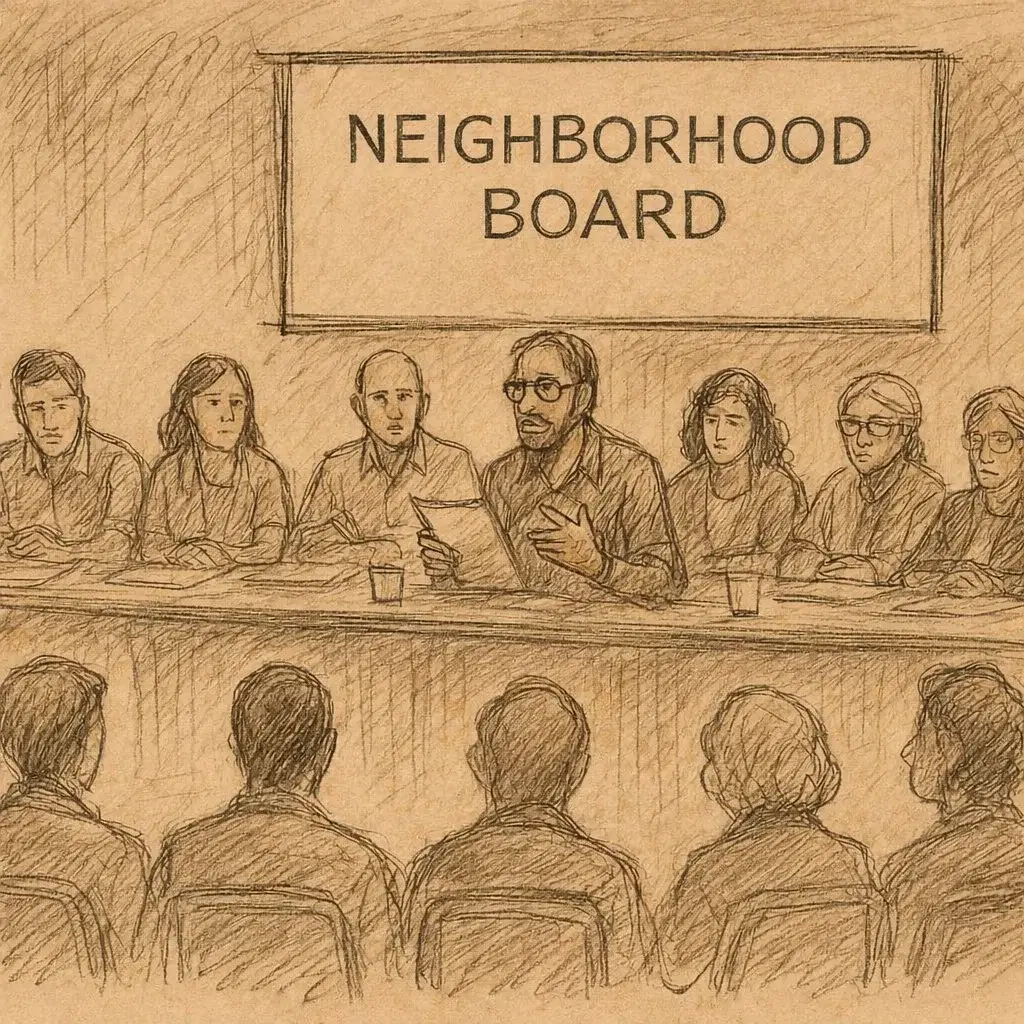
No 13 Downtown-Chinatown Neighborhood Board Regular Meeting June 2026
Listen to this article:
13 Downtown-Chinatown Neighborhood Board Meeting – June 5, 2026
Police Enforcement, Street Conditions, and Late-Night Noise
The meeting opened with follow-up discussion involving Honolulu Police Department representatives, including Major Okimoto, on several long-running concerns in Downtown-Chinatown. Board members revisited the issue of vehicles making improper turns onto Hotel Street and the related request for roadway striping or painted markings, noting that the treatment had been used before and questioning why it had taken so long to move forward again. Major Okimoto said he did not know why the process had been delayed but agreed to restart the conversation. The board indicated that the Department of Transportation Services appeared to be waiting for a clearer board position on the matter, and members suggested returning to it more formally in the coming year.
Daily Enforcement Activity in Chinatown
HPD also described recent field enforcement being carried out in the district, reportedly on a near-daily basis. Officers have been removing shopping carts belonging to businesses, addressing untaxed bicycles, and enforcing sit-lie violations where observed. Police reported that these efforts were producing visible results and that conditions were “looking a lot better.” The department said it hoped to continue the extra enforcement for several more weeks and, if funding is restored, make the work permanent in the next year. The discussion reflected continuing concern with sidewalk obstruction, public order, and the condition of commercial corridors used by residents, businesses, and visitors.
Bethel Street Noise, Motorcycle Disturbances, and Police Presence
Board members raised ongoing noise issues around Bethel Street and Chaplain Lane, especially late Friday and Saturday nights around 2 a.m. One member clarified that previous requests had not necessarily been for lighting interventions, but rather for a more visible HPD presence in an area known for recurring disturbances. Loud motorcycles racing through the downtown street grid were also highlighted as a repeated problem, with tall buildings amplifying the sound. At least one motorcycle had reportedly been identified by license plate, though members acknowledged the difficulty of intercepting a fast-moving bike in real time. Major Okimoto said loud muffler enforcement is a common issue elsewhere, including Waikiki, and committed to carrying out enforcement and reporting back the following month, including whether citations improved conditions.
Homeless Outreach and MH-3 Expansion
During the HPD discussion, a board member also thanked agencies involved in recent MH-3 operations for helping unhoused individuals leave the streets and enter treatment or services. The member said it was encouraging to hear in television coverage that Dr. Ireland had announced the program would expand to five days a week beginning in the summer. The board viewed that increase in service as a meaningful development for people needing behavioral health intervention and for street conditions in Chinatown.
Board Vacancy Following Fitzsimmons Resignation
The board then took up a membership vacancy created by the resignation of Board Member and former Vice Chair Fitzsimmons, who stepped down due to work and family commitments. The acting chair announced the vacancy and invited interested members of the public to seek appointment. Four candidates came forward, reflecting unusually high public interest in board service.
Candidate Introductions for the Open Board Seat
Ronald Sturgis introduced himself as a lifetime resident living just across the street from the meeting location. He described prior experience at the University of Hawaiʻi student caucus, where he served as chair from 2024 to 2025 and vice chair from 2023 to 2024, and said his work had included drafting and presenting testimony on behalf of roughly 50,000 university students to the Legislature and Board of Regents. Ian Nguyen identified himself as a lifetime Chinatown resident whose family operates Luke’s Bistro, a neighborhood restaurant entering its 36th year in business. He said he and his father live and work at Beretania and Maunakea and wanted to become more involved. Charles Johnson, participating online, said he lives near Chinatown Gateway Plaza and works as an analyst at the state Department of Budget and Finance, after prior work as a legislative researcher and aide in the Legislature, including in Senator Carol Fukunaga’s office. Jamie Barbosa said he is a lifelong Chinatown resident who has lived in Kukui Gardens, Honolulu Park Place, and now Honolulu Tower, and works as an account executive for Secure Parking Hawaiʻi. He described active work in downtown parking management, street environment issues, and the Biki bikeshare program, and noted that he chaired the Government Affairs Committee of BOMA in 2024 and 2025 and spent much of 2025 advocating for Bill 51 establishing the Downtown Business Improvement District.
Candidate Recruitment and Board Preparation Questions
Board members asked the candidates how they learned of the vacancy and what they had done to prepare for board service. Sturgis said he learned of the opening from his mother, Board Member Laura Armstrong, just an hour or two before the meeting. Nguyen said he had been interested in participating for about two years but had been limited by responsibilities at the family business; he was encouraged to come forward through longstanding neighborhood relationships. Barbosa said he heard of the opening through a friend of a friend and then connected through Dan, whom he knows professionally. Johnson said he heard through Diane, who had been a prior candidate.
When asked about preparation, Sturgis said he had reviewed Robert’s Rules of Order and understood parliamentary procedure to be important. Nguyen said he had not made special preparations beyond living and working in the neighborhood and reviewing the neighborhood plan as to what the board can and cannot do. Johnson described the board as a first line of representation between the community and government and said his understanding was rooted in advocacy on behalf of the neighborhood. Barbosa said his preparation was less formal but tied to daily work in the community, his professional engagement with downtown conditions, and his advocacy relationships with legislators through BOMA.
Eligibility Verification and Appointment Vote
Before the vote, a point of order was raised on the need to confirm residency and eligibility requirements under the neighborhood plan. Staff confirmed that all interested candidates had been verified. Another point of order asked whether any board members needed to recuse themselves. No recusals were taken. The board then voted by roll call. The first tally resulted in a split outcome: Charles Johnson received three votes, Ian Nguyen received three votes, Jamie Barbosa received one vote, and Ronald Sturgis received one vote. The transcript does not include a complete resolution of the vacancy after that tie, and the later closing remarks suggested the seat would remain open for another attempt at the next meeting, with the chair expressing hope that those interested would “come back and try again.”
Election of Chair for the Remainder of the Fiscal Year
The board then turned to internal leadership elections for the final month before the new fiscal year begins in July. The acting chair indicated that elections would need to be held again the next month, because the June vote would only govern the remainder of the current term. There was a suggestion to postpone the vote until July when the board would be reconstituted for a full 12-month term, but the motion was not seconded and the board proceeded.
The contest for chair featured statements from the acting chair and from Board Member Chuan Schubert-Kwok. The acting chair said he was running because he believed neighborhood boards exist to assure effective citizen participation in government decisions, both within and outside the community, and argued that meetings should be guided by that principle rather than by ego, fringe issues, or pedantic disputes. Schubert-Kwok, describing herself as the “old lady on the board,” said she had served the Downtown-Chinatown community for close to 30 years and on the board for 13 years. She emphasized teamwork, harmony, mutual respect amid disagreement, and the breadth of issues the board represents, including business, residential life, affordable housing, preservation, revival of Chinatown, help for small businesses, and support for unhoused people. In the roll call vote, Schubert-Kwok received five votes and was elected chair, with one vote cast for another member and one abstention noted.
Election of Vice Chair
Following the chair election, Schubert-Kwok nominated Dan Mestis for vice chair. No other candidates were nominated. The board still conducted a roll call vote, and Mestis was elected with six votes, one abstention, and one absence. The chair noted that both leadership positions would be up again in July for the new fiscal year.
Approval of Minutes
The board approved the meeting minutes as drafted without opposition.
Governor’s Office Report and Election Administration Concerns
A representative for Governor Josh Green’s office reported that written responses had been sent concerning several issues raised the previous month, including the Lahaina wildfire settlement, stadium construction, noise detection cameras, and an upcoming state auditor’s report on kauhale. During questions, a member of the public raised concerns about the 2024 election, describing it as a “disaster” in which some voters who arrived before the 7 p.m. cutoff reportedly had to wait until after midnight to vote in person. With 2026 being a midterm election year, he asked what had been done to prevent a recurrence of those polling problems. No substantive answer was provided during the meeting, but the question put election operations on the record as a major concern.
Energy Policy, High Utility Costs, and Geothermal Development
A board member then raised broader state energy policy, saying Hawaiʻi residents pay the highest electricity costs in the nation and that the neighborhood also experiences grid reliability concerns. After a conversation with Kauaʻi Mayor Derek Kawakami about the island’s co-op model and energy strategy, the member suggested the state should use every tool available, including transitional use of liquefied natural gas and stronger exploration of geothermal energy. He described geothermal as renewable, reliable, and potentially transformative for both utility costs and the wider economy. Another board member agreed and added that early-stage exploration costs are relatively low compared with the possible benefit, and also pointed to energy efficiency as a cheaper resource than added generation, criticizing the continued use of fluorescent lighting in the state capitol even after statewide bans took effect on January 1. The discussion highlighted frustration with energy costs and interest in more aggressive state action on supply and efficiency.
Mayor’s Office Report: Storm Response, Small Business Loans, and Prior Questions
Mayor Rick Blangiardi’s representative, Ian Santi, delivered a lengthy report that included both citywide updates and responses to issues previously raised by the board. He highlighted the release of the draft Oʻahu Food System Plan for public comment by the Office of Climate Change, Sustainability and Resiliency, and summarized mayoral newsletter items including the approaching federal aid deadline for storm response, the naming of David Lazar as Honolulu Police Chief, city homelessness initiatives, a farewell to former Managing Director Mike Formby, and the city’s small business microloan program.
He also relayed responses to prior questions on road conditions, noting that the Department of Facility Maintenance surveys roads every two years to identify candidates for rehabilitation, with projects then implemented by the Department of Design and Construction. He said higher fuel, material, and transportation costs in the islands contribute to the high projected cost of road repairs. On flags flown at half-staff, he reported that the flag at Thomas Square had not been lowered following the passing of former U.S. Representative Colleen Hanabusa because the Department of Parks and Recreation did not receive notice, and the city is now reviewing notification procedures.
Union Mall Lighting, Hotel Street Signage, and Chinatown Work Orders
The mayor’s office report also included several neighborhood-specific facility updates. At Union Mall, two of four light poles had been restored, with work continuing on the other two. For the Kekūanāōʻa-related crosswalk issue mentioned in the transcript as the “Kekalike and North End intersection crosswalks,” a work order had been initiated. On Hotel Street safety measures and signage, a work order had been issued to replace a “Do Not Turn” sign on Smith Street, while the question of pavement markings on Hotel Street remained for the Department of Transportation Services to determine. For Kamaliʻi Mini Park, there was no major change; the city and its selected preferred negotiating partner were still working on a pre-development agreement and ground lease.
Feral Chicken Control
On the issue of feral chickens, the city reported that the Department of Customer Services had already spent its appropriated funding on control efforts. Additional money for subsidized private-property removal would expand opportunities, but the city emphasized that its direct responsibility is limited to city-owned property, while state and private lands fall outside that scope. The subsidized removal program through Sandwich Isle Pest Control applies only to private property. The report added that if the governor signs Senate Bill 2892, state funds beginning in July would support receipt handling and humane disposal of feral chickens that had already been caught.
ADA Ramp and Sidewalk Hazard at 1027 Maunakea Street
One of the more pointed exchanges involved the sidewalk ramp in front of 1027 Maunakea Street near Sing Chong Yuan Bakery. The city’s written response said an investigation found no damage requiring repair, that the existing curb ramp was built in 2003 and reassessed in 2012 under the city’s ADA transition planning, and that due to adjacent entryways and limited space it was not possible to install another type of ramp that would both satisfy curb-ramp requirements and maintain accessibility. Chair Schubert-Kwok strongly challenged that response, saying the issue was not about making the area compliant for two businesses at once, but about fixing a long-standing hazard where many people had fallen. She said the area remains dangerous for both general pedestrians and people with disabilities, and that references to what had been determined in 2012 were irrelevant in 2026. She requested that the city flatten the surface and address the hazard immediately. Santi said he would return the issue to both the Department of Facility Maintenance and the Department of Design and Construction for follow-up.
Business Permitting Delays and Liquor Commission Processing Times
A member of the public who identified himself as a small business owner asked the mayor’s office to explain why city permitting can take so long, stating that some permit categories take so much time that businesses fail before opening. He specifically said that the Honolulu Liquor Commission can take up to a year to approve new liquor licenses and called that timeline “absolutely unacceptable,” especially because a new tenant cannot reasonably be expected to pay rent for a year without the ability to operate. The representative did not provide an immediate answer but committed to follow up. The exchange underscored the burden of city permitting delays on entrepreneurship, commercial vacancies, and business survival in the district.
Bus Stop Safety at Nimitz and Kekaulike
Board members and members of the public also raised concerns about the temporary westbound, mauka-side bus stop at Nimitz Highway and Kekaulike Street. A board member referenced work order R2026-15221 regarding insufficient lighting and asked for a status update beyond the notation that it was “in progress” as of May 12. Another speaker said the stop is on a curve and presents a safety risk because stopped buses or vehicles unloading passengers may be vulnerable to being rear-ended. He argued the city should move the stop farther ʻewa before an accident occurs. The mayor’s representative said he would follow up.
Empty Homes Tax and the Charter Commission
A board member used the mayor’s office question period to highlight ongoing work by the Honolulu Charter Commission. He said the commission had received 295 proposals and was down to about 20, with one surviving proposal being an empty homes tax. He framed the tax as a response to worsening housing pressures and criticized the continued ability of global speculative investors to buy housing while paying very low property taxes. Referring to Bill 46 and a Ward Research survey showing 74 percent voter support, he asked whether the administration would support the measure if it emerged from the Charter Commission and went to the public. The administration did not give a direct policy commitment during the meeting.
City Council Report: BMX Zoning, Chinatown Lighting, and BID Launch
A representative for Councilmember Tyler Dos Santos-Tam reported that proposed changes to BMX zoning downtown were moving forward at City Hall, with the aim of facilitating more housing and mixed-use development. He also said the city budget passed the previous day contained “exciting things” for Chinatown, including LED down-lighting in some long-identified problem areas. He further announced that the Downtown Business Improvement District would be fully operational beginning July 1, 2026. The update connected land use, streetscape improvements, and the new BID structure to larger efforts to reshape downtown economic conditions.
Public Frustration Over Road Conditions and Tax Burden
During public testimony to the council office, a speaker returned to a long-running complaint about Honolulu’s roads, arguing that the city is regularly ranked among the worst in the country for road conditions while residents pay some of the highest taxes and vehicle registration costs. He criticized a previous response asking which specific roads he meant, saying the problem is systemic rather than isolated. He demanded a “larger game plan” for improving road quality citywide rather than piecemeal pothole responses. The representative said he would take the issue back to the councilmember and noted that constituents can still report specific hazards for follow-up.
HPD Settlements and Accountability
Another board member cited a Civil Beat article stating that the City and County of Honolulu had spent more than $46 million over the last five years settling claims and lawsuits, with more than 75 percent of that amount involving the Honolulu Police Department. While explicitly voicing support for the “men and women in blue,” he said those settlement figures imply residents have suffered real harm in at least some incidents and asked what could be done to track the number as a performance metric, improve accountability, support the department, and reduce future payouts. The council office said the concern would be taken back and suggested that new police leadership might improve the situation.
City Budget Tensions, OER Cuts, Chinatown Funding, and Veto Questions
Chair Schubert-Kwok then questioned the council representative about the budget, which had passed 6-3 after what she described as contentious debate. She said she was disappointed by the proposed loss of 18 positions from the mayor’s Office of Economic Revitalization, especially after storm and flood impacts and in light of continuing hardships for affected farmers who still had mud on their properties and had not resumed planting. She asked for the status of $1 million for Chinatown, funding for the Chinatown police task force, and an update on Chinatown Improvement District planning. The representative said he would return with more information and noted that the mayor could still issue line-item vetoes, meaning the budget was not yet final. The board also discussed whether six votes would be enough to override a veto, with the representative confirming that a 6-3 vote would suffice under the current rules. Another board member reinforced support for the economic revitalization office, saying its role in helping local streets and small businesses is especially important in Downtown-Chinatown.
State Senate Report: Memorial Repairs and Civil Service Scholarship Idea
A representative for Senator Karl Rhoads reported one key item: the release of a $150,000 grant for repair and improvement of the Korean and Vietnam War memorials. During questions, a board member referred back to a Civil Beat article about a Hawaii medical school grant program that covers education in exchange for a five-year commitment to work in a rural community. He suggested a similar idea might be used to address public-sector staffing shortages by tying grants or scholarships to a period of civil service. The representative advised that on the Senate side, Senator Donovan Dela Cruz and the Ways and Means Committee would be the correct point of contact for funding-oriented proposals of that type.
State House District 25: Grants-in-Aid and Constituent Survey
A representative for Representative Kim Coco Iwamoto shared a constituent survey link and summarized several capital improvement and grants-in-aid awards affecting District 25 organizations. The YWCA of Oʻahu received about $700,000, the YMCA $150,000, Big Brothers Big Sisters $105,000, Boys and Girls Club $100,000, Honolulu Museum of Art $100,000, and Hawaii Theatre Center $80,000. Questions from the board again touched on the broader idea of using grant programs to build a stronger pipeline into public service.
State House District 28: Grant Awards, Cultural Plaza Uncertainty, and Crosswalk Accessibility
A staff representative for Representative Daniel Holt Ratcliff distributed materials showing his district boundaries within the board area and summarizing 2026 state budget items. The representative highlighted funding that included $2,000 for the Downtown Art Center, support for Read to Me International that appears in the transcript as “Read & Seed,” and a grant to the United Chinese Society. She also shared a letter from the Taipei Economic and Cultural Office concerning the Chinatown Cultural Plaza, which many in the neighborhood had learned might be torn down. The office’s response, as relayed, said the matter was still being worked on and that public concerns were being taken into consideration, but there was no definitive answer yet on what would happen to the property. The representative also said Ratcliff and Councilmember Dos Santos-Tam were working on adding yellow truncated dome warning pads at both sides of the Vineyard and Maunakea crosswalk after complaints from legally blind constituents that the crossing lacks visible tactile treatment and blends into the dark pavement.
Debate Over Grants-in-Aid Transparency
The grants-in-aid discussion led to disagreement over how much scrutiny the board should apply after awards are made. Chair Schubert-Kwok asked for more information about several grants, including $200,000 to the United Chinese Society, about $106,000 to the Institute for Human Services, and a larger Downtown Art Center allocation, asking what the requests were for, whether similar support had been given the previous year, and what follow-up exists. Another participant argued that the grants process is already public and that because the money has already been allocated, the board should not “keep chasing” such issues if the information can be looked up independently. In response, a board member defended the questions, saying that understanding how public funds are awarded within the district is an appropriate part of the board’s advisory role. The chair said she wanted answers the following month because the organizations and funds discussed are directly tied to the neighborhood.
HART Station Design Workshop for Downtown Station
A representative from the Honolulu Authority for Rapid Transportation announced the final station design workshop in a series covering Segment 3 stations. The upcoming meeting would focus specifically on the downtown station and was scheduled for Wednesday, June 10, 2026, from 6:00 to 8:30 p.m. at Aloha Tower Marketplace, Multipurpose Room 3. The representative noted that two workshops had already been held for each of the six Segment 3 stations and that this would be the last one.
Frustration Over Lack of Escalators at the Downtown-Chinatown Rail Station
A member of the public used the HART agenda item to sharply criticize the rail project’s cost growth and the lack of escalators planned for the Downtown-Chinatown station. He reminded the HART representative that his role is not only to relay information from the agency but also to communicate neighborhood concerns back to the HART board. He said several board members had previously expressed concern about the absence of escalators and argued that after a project sold roughly 10 years ago for $3.7 billion and now costing over $15 billion while serving only about two-thirds of the originally promised route, the public should not be told escalators are unattainable. He demanded either a stronger explanation or approval of escalators. The HART representative was not able to respond substantively before being told to return with an answer next month.
Chinatown Business and Community Association Report
The board next heard a report on the May 12 meeting of the Chinatown Business and Community Association. The report said the area’s key issues remain homeless and other individuals blocking sidewalks and access to businesses and residences, camping, alcohol and drug use, and trespassing. It was reported that the formal HPD Chinatown Task Force had not been funded, but several HPD personnel were volunteering their time to help address some of the issues. The Chinatown Security Team operated under CBCA was said to be handling much of the sit-lie enforcement, Kekūanāōʻa/Kekaulike Mall vendor enforcement, and parking-related issues. MH-3 had reportedly come out at least twice and assisted many individuals, getting some into care and some off the street. Wound care services were still active at least twice weekly. The report also noted multiple cleanup incidents involving human waste around the neighborhood and said the community was looking forward to the opening of a public restroom on Pauahi Street. The next CBCA meeting was scheduled for June 9, 2026.
Neighborhood-Level Volunteer Response to Street Disorder
In follow-up to the CBCA report, a resident from the Pauahi-Kukui area asked whether the same pattern of public drug use, including people appearing to use substances with foil and remaining visibly impaired without being helped, was also being tracked and whether neighborhoods could partner on response efforts. Chair Schubert-Kwok explained that Chinatown’s response capacity is heavily stretched and relies on volunteer labor and donated support, including a security guard supplied through Maunakea Marketplace. She said volunteers such as herself and Vice Chair Mestis go out personally and receive no pay, helping keep streets clean and trying to fill service gaps that formal systems do not meet. She added that the team also cleans up urine and feces because waiting for city response is often not practical. Residents were encouraged to call 911 to build a record of incidents even if police response is delayed. The board again emphasized the need to restore funding for the HPD Chinatown Task Force to bring back more regular foot patrol and directed activity.
Next Meeting and Future Agenda Changes
At the close of the meeting, Chair Schubert-Kwok announced that the next board meeting would be held on July 2 at the same place and time. She also noted that the board was still seeking a member to fill the vacancy and encouraged interested residents to attend and seek appointment. Before adjournment, a board member requested that the public concern period be moved earlier on future agendas so residents would not have to wait through reports from elected officials before being able to speak. The chair agreed that shifting the order from item 7 to item 6 was not a problem and said she would make that change for the next meeting. The meeting then adjourned.