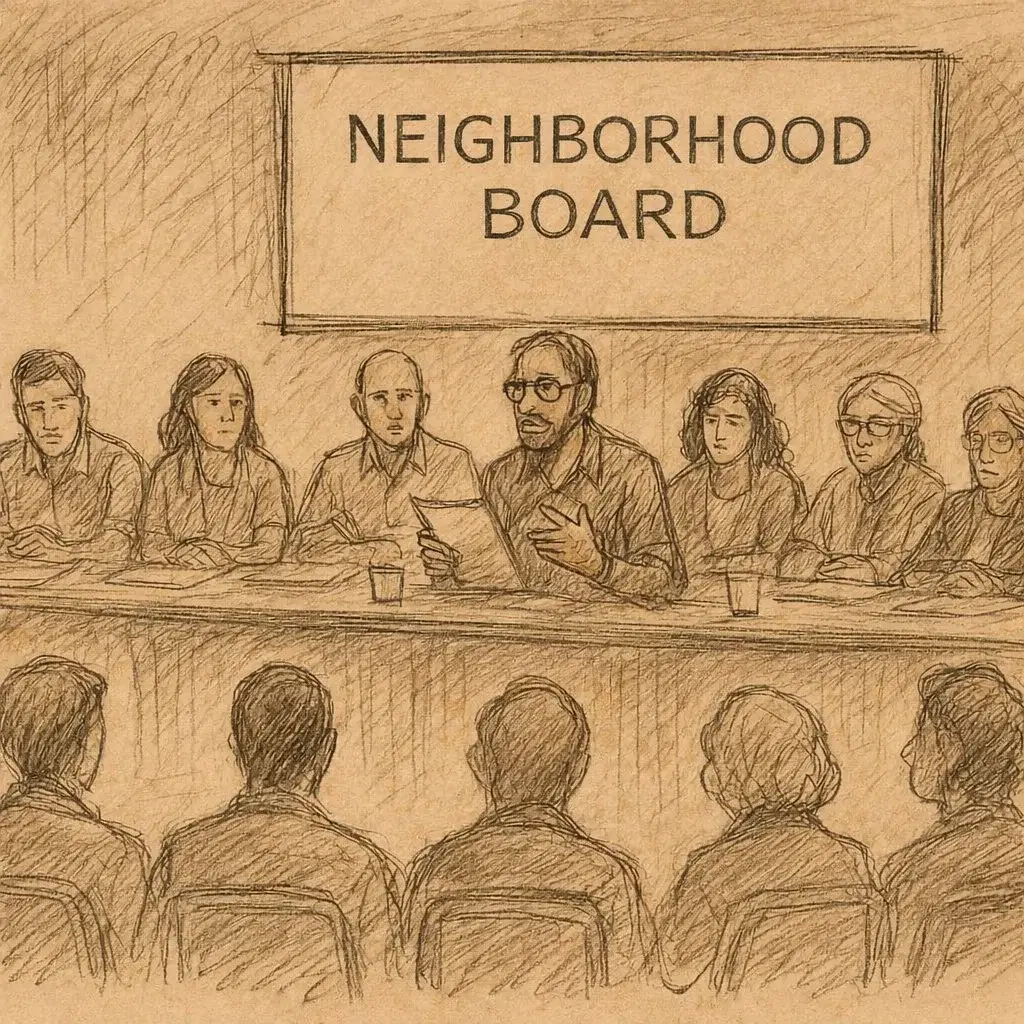
No 05 Diamond Head-Kapahulu-St. Louis Heights Neighborhood Board Regular Meeting September 2026
Listen to this article:
5 Diamond Head-Kapahulu-St. Louis Neighborhood Board Meeting – September 11, 2026
Quorum and Meeting Procedure
The meeting began after technical difficulties delayed the proceedings. Roll call found seven board members present, including several participating online, but a quorum was not established. As a result, the board could not vote, approve minutes, fill its vacancy, or take other formal action. The chair adjusted the agenda to accommodate Kalani High School students who needed to leave early for school the next day, placing their election-related food-security presentation under public event announcements. The board said action items, including the board vacancy and pending minutes, would return at a future meeting.
Fire Department Activity and Lithium-Ion Battery Safety
Captain Bellis of the Waikīkī Fire Station reported seven fires, nine activated alarms, 72 medical calls, one motor-vehicle collision, one mountain rescue, and four hazardous-material incidents for the reporting month. Because firefighters are responding to more lithium-ion battery fires involving smartphones, laptops, e-bikes, e-scooters, toys, tools, portable power stations, and similar equipment, residents were advised to use manufacturer-approved cords and chargers, charge devices on hard and flat surfaces, unplug fully charged equipment, stop using batteries that feel hot, and avoid charging where an exit could be blocked. Larger batteries for e-bikes, scooters, power tools, and emergency refrigerator backup systems should be charged outdoors when possible. Airline passengers should keep charging devices in sight and should not charge e-cigarettes or vapes aboard aircraft. HFD also announced Fire Prevention Week Family Day at the Honolulu Zoo on October 3 from 10 a.m. to 2 p.m., with the theme “Charge Into Fire Safety: Safe Charging Is a Superpower.”
Emergency Access and Ala Wai Traffic Changes
A resident asked whether plans to remove or close lanes on Ala Wai Boulevard could impede emergency vehicles, noting that Waikīkī firefighters regularly use the boulevard. Captain Bellis confirmed that the station uses Ala Wai Boulevard but did not have traffic data or details about the proposed lane changes. He expected transportation planners to account for emergency response access and suggested that the issue be directed to the Department of Transportation Services and its Complete Streets staff. Another attendee thanked HFD for its rapid response after 14 people were trapped in an elevator for approximately 30 to 40 minutes under hot and humid conditions.
District 6 Crime, Traffic, and Parking Enforcement
Lieutenant Cyrus Alona reported District 6 statistics that included two robberies, 11 burglaries, 133 thefts, six unauthorized entries into motor vehicles, 42 assaults, and two sex crimes. Officers issued no bicycle or skateboard sidewalk citations or warnings during the period. Speeding enforcement produced six citations, no warnings, and no arrests. Police issued 1,255 parking citations, 11 citations for loud mufflers or prohibited noise, and eight citations and 10 arrests related to park closures. District 6 handled approximately 4,600 calls for service and made four arrests for operating a vehicle under the influence of intoxicants.
Repeated Citations of a Bus in Waikīkī
District 6 continued citing a bus that had been raised as a recurring problem at the previous meeting. Police spoke with the owner, who reportedly said he intended to continue the conduct despite the citations and claimed that most of the tickets had been dismissed in court. The bus was also being cited for an expired safety inspection. Towing remains difficult because the city needs a tow truck capable of moving a bus and a location large enough to store it. A participant advised HPD that the disposition of vehicle citations can be checked through eCourt Kōkua by searching the license plate, allowing officers to verify whether the owner’s claims of dismissal are accurate.
Dole Street Pedestrian and Bicycle Safety
A St. Louis Heights resident described Dole Street near Kanewai Park, Frank Street, and the East-West Center as extremely dangerous for pedestrians, including his four-year-old daughter. He estimated that 15 to 20 vehicles are regularly parked illegally in tow-away areas, within 20 feet of a crosswalk, or directly on the crosswalk, obstructing visibility. He also reported drivers proceeding through red lights, speeding at approximately 50 miles per hour to catch signals, and failing to yield even when pedestrians have the right of way. After previously being struck while riding in a marked bicycle lane, he no longer feels safe bicycling and said it took three days to reach the non-emergency police line to report violations. HPD agreed to conduct additional morning checks when schools and the University of Hawaiʻi are in session.
Proposed Dole Street Traffic-Calming Measures
Residents and board members proposed several approaches to the Dole Street safety problems. Suggestions included highly visible flashing pedestrian beacons, raised crosswalks, four-way stop controls, rumble strips, speed humps, and traffic-enforcement cameras between University Avenue and the surrounding streets. One participant suggested installing approximately eight raised crosswalks along Dole Street to force drivers to slow down, while another favored cameras over physical humps. Additional concerns were raised about speeding on Waiaka Road, Kuliʻouʻou-area streets referenced during the discussion, and routes near Kapiʻolani Boulevard. The board concluded that these were primarily Department of Transportation Services matters and proposed consolidating the various requests for a future Traffic and Transportation Committee meeting with DTS.
Kapiʻolani Boulevard and Kūʻilei Place Traffic Risks
Residents reiterated concerns about the large Kūʻilei Place development and the possibility that vehicles will be allowed to make left turns into and out of the project from Kapiʻolani Boulevard. They cited an earlier fatal motorcycle collision involving a driver making a U-turn and argued that left turns and U-turns in the area create serious risks because of traffic speed, multiple lanes, and vehicles entering from freeway ramps. Community speakers favored prohibiting left turns in both directions, even if residents and visitors would need to circle the block. They also called for stronger measures at freeway off-ramps where vehicles accelerate and then attempt to cross several lanes. City representatives clarified that interstate and freeway facilities are generally under state jurisdiction.
Complaint About Police Reporting and Accountability
A resident described an incident near Kūʻilei Place in which an officer allegedly activated emergency lights, made a U-turn, and stopped to assist a former board member with a disabled vehicle but did not log the encounter. According to the speaker, the lack of a record prevented later officers from understanding what had happened, contributed to a blocked driveway, required additional police responses, and delayed resolution until approximately 2:40 a.m. The chair determined that the matter was too case-specific and detailed to resolve during the general report. A District 7 lieutenant agreed to contact the complainant at approximately 10 a.m. the following morning and also mentioned a “Meet the Major” event at 9 a.m. at a Starbucks in ʻĀina Haina.
Board of Water Supply Operations and Dole Street Main Break
Board of Water Supply representative Kathleen Pahinui reported no main breaks during the prior reporting period but acknowledged the more recent Dole Street break, which occurred as the island was preparing for a storm. A board member thanked BWS field crews for responding quickly and maintaining water access with water tanks. A resident asked whether the latest break occurred only about 10 feet from a previous failure and whether the entire aging pipe segment should be evaluated instead of repeatedly attaching new pipe to old infrastructure. Pahinui said the location is known to be problematic, noted that BWS has assessed its broader system, and agreed to check whether a more specific evaluation of that section is underway.
Water-System Improvements and Diamond Head Vegetation
The Monsarrat water-system improvement project has reached the stage where the new mains are installed and crews are waiting for materials needed to complete service connections. At Diamond Head, native nīpaka planted around the perimeter is reportedly doing well and has reached approximately four to six feet in height. Recent rainfall is expected to help the vegetation establish stronger roots. Pahinui offered to arrange a tour for interested board members to inspect the fencing and foliage. The board also received an update on an earlier suggestion to provide water-bill credits for planting trees; BWS is not pursuing that proposal at present but is examining other forms of water-bill assistance that may be announced in the near future.
Water Seepage on Bertram Street
A board member continued to report water or sludge flowing from behind a Bertram Street property, saying the condition had caused two slip-and-fall incidents. The concern had previously been referred to BWS staff, including employees identified as Ernie, Derek, or Jenny, and the speaker believed there may have been an earlier break in the area. Pahinui said BWS had investigated and sent a response but was not certain the source was part of the BWS system. She agreed to review the records and follow up.
“Imagine a Day Without Water” Event
BWS announced its “Imagine a Day Without Water” event at the Arc of Safety at Waiʻanae Mall, 86-120 Farrington Highway, near the end of the month. More than 30 city, state, and nonprofit agencies were expected to participate. Although the event was being held outside the neighborhood, BWS was considering a town location, potentially the current meeting venue, for the following year.
Food Security Charter Amendment
Three members of Kalani High School’s Environmental Club, joined by the Food Security Coalition, urged voters to support City Charter Question 1, also identified as Proposal 119, in the November election. The proposed Food Security Fund would dedicate 0.5% of Honolulu’s existing real-property-tax revenue to food-security initiatives without creating a new tax or fee. The students said the allocation would amount to approximately $8 million annually and could support local farmers, nonprofit groups, food distributors, and organizations addressing hunger. They also stated that more than $1 billion in property-tax revenue had gone unspent in the previous year, presenting the food-security allocation as a small portion of existing resources.
Hunger, School Impacts, and Disaster Resilience
The students said approximately one-third of Hawaiʻi households experience food insecurity, representing about 250,000 people on Oʻahu, not including unsheltered residents who may be undercounted. They estimated that groceries for a Hawaiʻi family of four cost approximately $1,500 per month and explained that power outages following tropical storms and Kona lows can force households to discard an entire month’s food. Families able to replace spoiled groceries may recover quickly, but lower-income households can face an immediate crisis. The students described food insecurity as affecting physical health, emotional well-being, and students’ ability to concentrate in school. They emphasized that recent storms and the tracking of another tropical system exposed the need for food-relief organizations to have reliable resources when thousands of households are affected at once.
School Enrollment, Poverty, and Community Inequality
One student compared experiences at Jefferson Elementary, a Title I school that directs substantial resources toward poverty-related needs such as additional meals, with Kalani High School, which consistently ranks among the state’s stronger public high schools. The student explained that many neighborhood families seek geographic exceptions for their children to attend Kalani rather than Kaimukī High School. Because public-school funding is tied to enrollment, the movement of students can reduce resources available to schools serving higher-need populations and deepen existing inequalities. The students stressed that the food-security question affects children throughout the island regardless of whether individual voters have personally experienced hunger.
Administration and Timing of the Food Security Fund
When asked which city department would manage the fund, the students said they did not know the exact administrative arrangement but understood that eligible food, agricultural, and distribution organizations could apply for support. Mayor’s representative Anton Krucky later said the responsibility would likely fall to either the Office of Climate Change, Sustainability and Resiliency or the Department of Community Services, particularly after the closure of the Office of Economic Revitalization. The students emphasized that the Charter Commission convenes only once every 10 years, making the 2026 ballot a rare opportunity to establish a permanent funding mechanism. Board members praised their civic involvement and offered to remain in contact. One attendee raised questions about causes of homelessness and possible SNAP fraud, but the chair ruled those comments outside the scope of the students’ proposal.
City Storm Response and Hurricane Preparedness
Mayor’s representative Anton Krucky described how the city organized its emergency response during the recent tropical-weather threats. An operations center logged downed trees, blocked roads, accidents, and other non-911 incidents and tracked each report through resolution. A joint activity center placed police, fire, ocean safety, emergency medical personnel, and other responders together so agencies could coordinate assignments. A mass-care operation managed shelters, transportation for residents unable to leave their homes independently, and outreach to unsheltered people encouraged to enter shelters. Krucky said city crews still had a long list of downed trees requiring removal or processing and reminded residents that approximately two months remained in hurricane season.
Need for Hardened Emergency Shelters
The board discussed the lack of strategically located, hurricane-rated shelters in and around Waikīkī, Diamond Head, Kapahulu, and St. Louis Heights. Roosevelt High School was identified as the nearest facility capable of withstanding a major hurricane during the recent threat. However, the city cannot routinely use schools until the state closes them, while many park gyms and recreation buildings are not hurricane-rated. Building a network of hardened shelters around Oʻahu would require substantial funding, design work, and coordination among federal, state, and county governments. The chair emphasized the vulnerability of single-wall homes and low-lying communities to a direct Category 4 or 5 strike, while officials noted that Waikīkī itself may not be an ideal shelter location because of elevation and flooding hazards.
Parks Projects and Archaeological Review
The Department of Parks and Recreation’s proposed improvements involving a garden pathway, bocce court, expanded fitness stations, and related park work remain on hold pending archaeological surveys. The board had requested community meetings before decisions are finalized, and Krucky said that request had been sent to DPR’s director and deputy director, although no response had yet been received. The timing of archaeological review will determine when the proposals can move forward.
Diamond Head Tennis and Pickleball Courts
DPR is not opposed to converting Diamond Head courts 8 and 9 into permanent pickleball courts. Two existing tennis courts are already striped to accommodate pickleball through temporary nets, allowing shared use. Residents asked whether a permanent conversion would include bleachers or support tournaments, warning that organized events could increase parking demand, extend activity into evening hours, affect nearby homes, and limit ordinary recreational access. The board requested a clearer process for community input and a formal decision, including whether the site would remain neighborhood-oriented rather than becoming a tournament venue.
Deferred Public Works Questions and Honolulu 311
Four earlier questions concerning Kūhiō Cliffs, the beach park, Barefoot Beach Cafe, and a storm drain had not received responses from the Department of Facility Maintenance. Krucky said the questions would be resubmitted and acknowledged that storm response had placed heavy demands on the department. He also noted that none of the concerns had been entered through Honolulu 311. Residents were encouraged to use the app for non-emergency matters such as downed trees, homelessness-related service requests, damaged facilities, and maintenance problems because submissions are routed directly to the responsible department and require a response. Dangerous situations should still be reported through 911.
Diamond Head Community Garden Loading and Parking
HPD confirmed that the area near the Diamond Head Community Garden is posted as no parking and has no designated loading zone. Because a no-parking sign is more restrictive than a sign permitting temporary loading, an officer had probable cause to cite a vehicle that stopped there to unload materials. Enforcement is often complaint-driven, meaning officers may respond after a member of the public reports a vehicle. DPR said that if land becomes available for future garden expansion, a loading and unloading area could be incorporated into the design. The need has been referred to the community garden coordinator for future planning.
Parking on Ahi Avenue and Kūle Circle
DTS contacted a board member regarding parking on Ahi Avenue and Kūle Circle. Parking on the unimproved shoulder of Ahi Avenue is not permitted where no-parking signs and white delineators are installed. Officials cited utility poles, driveways, inconsistent shoulder widths, and the need to preserve crosswalk and pedestrian space near schools. DTS also determined that a restricted residential parking zone on Kūle Circle is not legally allowable because of its distance from the shoreline, even though residents may experience parking pressure from events at nearby facilities or Kapiʻolani Park.
Kapahulu Mobility Hub Study
DTS and the Oʻahu Metropolitan Planning Organization continue to work on the Urban Honolulu Mobility Hub Study. No substantial new material has been prepared since the project team’s May 14 presentation to Neighborhood Board 5. DTS plans to return when information is ready for public review and may contact the board chair and Traffic and Transportation Committee chair to determine whether they want another presentation on previously released material.
Dog Access Around Major Parks
A board member reported receiving information about possible dog-access changes around Kapiʻolani Park. One concept would formalize leashed dog walking around the park perimeter, reflecting a use already common among residents. Similar perimeter access was suggested for Ala Moana Regional Park after Howard Hughes properties reportedly stopped allowing dogs, upsetting some pet owners. No formal proposal or implementation timeline was announced.
Park Exercise Equipment
A resident reported damaged and deteriorating calisthenics equipment at Kapiʻolani Park and similar problems near Kapiʻolani Community College. A Honolulu 311 response dated around August 6 indicated that DPR was aware of the condition, but no repair schedule had been provided. The resident explained that broken public equipment undermines community exercise groups and pushes users toward private homes rather than shared outdoor spaces. Krucky advised submitting another 311 report and agreed to track the matter, while noting that DPR maintenance crews and tree trimmers remain heavily backlogged following storm emergencies and are limited by safety rules governing long workdays with saws and other hazardous equipment.
Underground Utility Lines
A resident asked whether above-ground residential power lines could be moved underground to reduce outages caused by falling trees and branches during storms. Krucky said utility undergrounding is primarily a Hawaiian Electric matter rather than a city program. Previous arrangements have included utility projects and privately financed underground connections. He agreed to log the question for follow-up.
Kūʻilei Place Permitting and Developer Responsibilities
Residents questioned statements attributed to a Kobayashi Group representative suggesting that city civil engineers were drafting or directing the developer’s traffic and engineering plans for Kūʻilei Place. Krucky clarified that the city establishes permitting standards and requires developers to submit traffic-impact, civil-engineering, and other necessary studies, but it does not draft private development plans. He agreed to review video of the earlier McCully-Mōʻiliʻili Neighborhood Board discussion. Residents also noted that the project had received exemptions or variances involving setbacks, parking, or other requirements and raised similar concerns about a proposed approximately 40-story building on Atkinson Drive near the Hawaiʻi Convention Center, where the narrow and congested street could face additional traffic, view, and airflow impacts.
Ocean Safety Facility
A board member asked about property on the North Shore formerly occupied by food trucks that may be used for Ocean Safety operations. Krucky said the matter was moving forward and that the mayor was committed to securing suitable sites for Ocean Safety because of the agency’s operational needs. No final acquisition or opening date was provided.
City Council Action on Illegal Peddling
Council Chair Tommy Waters reported that Bill 52 passed second reading. The bill responds to repeated illegal peddling in Waikīkī, including mobile tour kiosks and people in costumes charging tourists for photographs. Existing $100 citations were described as merely a cost of doing business. Bill 52 would increase the first-offense fine from $100 to $500, the second from $250 to $750, and the third from $500 to $1,000. HPD supported the proposal. Waters distinguished illegal peddling from street performance and said he was separately developing legislation to establish designated performance areas, permits, and general-excise-tax requirements. Performing or soliciting money outside authorized areas could then be more readily enforced.
Red Curb Authority
Bill 54 also passed second reading and would authorize DTS to paint curbs red where needed. The measure is intended to deter parking in front of driveways, trail entrances, and other locations where vehicles obstruct access or create safety problems. DTS would determine which curbs qualify for the treatment.
Visitor Fees at City Parks
The council passed Bill 33 on third reading, allowing DPR to charge parking or entrance fees at selected parks for nonresidents while preserving free access for local residents. The model would resemble Diamond Head and Hanauma Bay, where Hawaiʻi residents can receive free or reduced access by showing identification. Ho‘omaluhia Botanical Garden was cited as a possible location because of its very high visitor volume. Revenue could support maintenance at heavily used park facilities.
Lifeguard Compensation
The council approved pay raises and back pay for city lifeguards, who had been working without a contract. Waters characterized the compensation as well deserved given Ocean Safety’s responsibilities and recent emergency demands.
Council Chair Waters’ Election Status
Waters reported that the Hawaiʻi Supreme Court, in a 3-2 decision, ruled that he was ineligible to seek reelection. Although the court found error in allowing one declaratory action, it ruled against his eligibility in a separate lawsuit brought by 40 voters. Waters said he accepted the decision and expected to remain active in community advocacy related to housing, cost of living, parks, and preserving Hawaiʻi’s quality of life. The board thanked him for years of accessibility, regular attendance, responsiveness, and representation of the district.
Property-Tax Assessments and Appeals
Residents argued that the city’s property-tax assessment system unfairly compares older, smaller homes with recently sold or newly constructed properties. One board member said the annual tax bill on a parcel under 5,000 square feet rose from approximately $2,500 to $5,000 in three years. Others said longtime homeowners and seniors may be taxed based on neighborhood sales even when their houses are 50 to 60 years old and have not been substantially upgraded. Waters said he had repeatedly raised the issue with the Department of Budget and Fiscal Services and encouraged owners to appeal assessments, noting that hundreds of appeals are considered and many result in reductions. Residents responded that decreases of only tens of thousands of dollars in assessed value may produce little practical tax relief when overall valuations have risen by hundreds of thousands of dollars.
Homeowner Tax Credit and Property-Tax Committee Meeting
Waters reminded residents that September 30 is the deadline to apply for the homeowner property-tax credit available to qualifying households earning $80,000 or less. Applications are available through the Department of Budget and Fiscal Services, and his office could mail forms upon request. Board member Bruce Wong was planning a dedicated property-tax meeting, likely on October 15, after also reserving October 1 and October 22 at the library. The special meeting would allow more detailed discussion of assessment methodology, senior homeowners, exemptions, appeals, capital gains, and possible reforms.
Community Park Cleanups
Council Member Scott Nishimoto’s office announced two volunteer cleanups. The first was scheduled for Ala Wai Neighborhood Park on September 27 from 2 to 4 p.m., meeting on the University Avenue side near the playground and Ala Wai Elementary School. The second was scheduled for Ala Moana Beach Park on October 10 from 9 to 11 a.m., meeting near the tennis courts. Residents were invited to participate and contact the council office for further details.
Governor’s Office and Election Questions
Governor Josh Green’s representative, Ryan Aguilar, shared the governor’s September newsletter, which focused heavily on recovery from recent storms. A resident asked how court challenges to federal mail requirements could affect out-of-state ballots scheduled to be mailed the following week and in-state ballots expected in mid-October. Aguilar agreed to seek guidance from the governor’s communications team. The board also urged the governor to consider a statewide initiative for hurricane-rated shelters and other hardened public structures.
State Office Renovations and Ala Wai Watershed Planning
Representative Jackson Sayama said renovations at the State Capitol would leave him without a physical office until approximately late December, although constituents could continue contacting him by email and telephone. His House email would remain active until November, after which he expected to receive a Senate address. Sayama had met with the board chair and community leaders about the Ala Wai watershed, emergency preparedness, and the lack of adequate local shelters. He supported beginning a coordinated federal, state, and county effort to identify facilities, secure funding, and develop hurricane-rated public shelters, while acknowledging that planning and construction would take time.
Keiki Caucus and Youth Legislation
Representative Kaʻiawe “Kaika” Olds reported that the Legislature’s Keiki Caucus had convened during the interim with nonprofits serving children, young people, and families. The meeting reviewed how organizations propose legislation, how bills are matched with legislative champions, and how the caucus selects its priorities. The caucus may formally choose only five bills for the next session, although individual legislators can introduce additional proposals. Olds cited a prior bill intended to stabilize vulnerable young people leaving foster care, homelessness, or similar circumstances, even though it had not been selected among the caucus’s five official measures.
Household Disaster Preparedness
Representative Olds urged residents not to rely solely on government during emergencies. He recommended maintaining at least one week of food, drinking water, batteries, medication, and other essential supplies; identifying the nearest shelter; monitoring official announcements and elected officials’ communications; and developing a household plan in advance. He said recent storms left some communities without power for five days and that Oʻahu was fortunate to avoid more severe impacts. He also promoted residential rain barrels, noting that a 50-gallon barrel costs approximately $90 at a home-improvement store and that BWS offers a $50 rebate. Collected rainwater can be used for gardens and car washing, with covers or other measures to prevent mosquitoes.
Shelter Safety and Aging School Facilities
A resident questioned whether older schools designated as shelters have received adequate concrete and structural maintenance. The speaker cited deteriorating concrete at other buildings and asked how the public can know that evacuation facilities are safe. Olds agreed that the Department of Education must maintain its properties and noted that Roosevelt High School’s designated evacuation space was its newer gym, which should reflect more current building codes. The board suggested that its Disaster Planning, Preparedness, and Public Safety Committee examine school maintenance records and shelter suitability.
Big Island Highway Failure
A resident asked state officials to investigate why a highway in northern Hawaiʻi Island reportedly collapsed after being affected by Category 1-level weather, leaving nearby communities cut off. Olds said the location was outside his district and suggested directing the issue to the governor’s office, although he was willing to make inquiries if necessary. The concern was framed as a way to understand infrastructure vulnerabilities that may also exist on Oʻahu.
Homeless Encampment Near Market City
A board member again raised concerns about people sheltering beneath the freeway near Market City and a stream channel. Reported issues included noise, erratic behavior, waste, possible water contamination, public-health risks, and the safety of children playing near neighboring apartments. Olds said the area may be state property, which could explain why it was not being handled as a city sidewalk matter. He agreed to inspect the location and report back if the situation remained unresolved by the next meeting.
Ala Wai Watershed Flood Mitigation
Community advocate Laura Ruby described a developing Ala Wai Watershed collaboration involving residents from areas draining through Mānoa, Pālolo, Makiki, Kanewai, and lower Ala Wai neighborhoods. The group is focusing on preventing or reducing flooding before it reaches the canal rather than only preparing for disasters after they occur. Proposed work includes walking stream corridors, documenting where channels have overtopped, speaking with neighbors, identifying surface-runoff patterns, and developing community-generated mitigation proposals. Areas mentioned included Mānoa District Park, Noelani School, Hokulani School, Kanewai, Kaimukī High School, Ala Wai Park, and parts of the golf course. Parks and other open spaces could temporarily hold two or three inches of stormwater that would drain over several days, slowing the force of runoff and reducing sediment and debris movement.
Upstream Water Retention and Pālolo Stream
Representative Olds said recent watershed planning has emphasized slowing and retaining water upstream in Mānoa and other valleys rather than constructing one large basin near the Ala Wai Canal. Ruby agreed that widespread concrete surfaces intensify runoff and said mitigation should allow water to spread safely into open areas. The board asked whether the collaboration also includes the Pālolo branch of the watershed, since Pālolo has flooded during the same events that affected Hokulani and Noelani. Ruby said the junction with the Mānoa system is within the group’s current area, but additional Pālolo-specific knowledge is needed because sections of that channel have extensive concrete walls. Residents familiar with those locations were invited to assist.
Watershed Funding and Proposed Committee Work
Ruby said Council Member Nishimoto, Representative Andrew Garrett, and Council Member Carol Fukunaga had obtained watershed-related funding, but she believed too much was designated for planning rather than immediate infrastructure. She urged the board to form or activate a committee focused specifically on flood mitigation and riverine overtopping, distinct from general disaster preparedness. The board indicated that Chair Angie Knight’s Disaster Planning, Preparedness, and Public Safety Committee could help coordinate future work, possibly with other neighborhood boards that share the watershed.
Ala Wai Pedestrian Bridge Review
The chair updated the board on the proposed pedestrian bridge over the Ala Wai Canal, an issue on which the board had previously expressed concern. Federal review had advanced, and state and city environmental or historic-preservation reviews remained. Ruby cautioned that the project was not final and said the public would have an opportunity to comment after the environmental notice and anticipated finding of no significant impact are formally published. She criticized DTS for not returning to the board with updates since earlier versions in 2021 and 2023 and said the current environmental assessment had not meaningfully incorporated extensive community comments. Residents were encouraged to monitor the Environmental Notice for the formal review and comment period.
St. Louis Heights Board Boundaries and Vacancy
The possibility of moving St. Louis Heights into the Kaimukī Neighborhood Board area remains under discussion. Commissioner Larry Veray had responded to some inquiries, but the board still had unresolved questions. Board member Arlene Velasco was identified as the lead on that matter. Separately, a St. Louis Heights resident asserted that the open subdistrict seat should be filled immediately and suggested that other neighborhoods should not decide representation for St. Louis Heights. Board members responded that appointments must follow the procedures established in the Neighborhood Plan and that the vacancy would return when a quorum was present.
Online Participation and Points of Order
The same resident suggested that only members physically present should be permitted to raise points of order, arguing that online technology was being misused. The chair clarified that a board member attending through Webex remains a full participating member and may raise procedural objections. No rule change was considered because the board lacked a quorum and because the existing participation rules already recognize remote attendance.
Meeting Minutes and Artificial-Intelligence Tools
The chair and secretary are revising prior meeting minutes to make them more complete and substantive. Artificial-intelligence transcription has improved the process but still requires careful human review, especially for Hawaiian names and local place names. The board asked the Neighborhood Commission Office to explain what funding is allocated to each neighborhood board and whether it can be used for transcription software, subscriptions, newsletters, community fairs, or other public-engagement purposes. Otter AI was mentioned as a relatively affordable transcription option used by another organization. The board emphasized the need for a consistent, dependable protocol rather than relying only on free tools.
Neighborhood Board Guidebook
The Neighborhood Commission Office released a new 2026 Neighborhood Board System Guidebook. The chair requested printed copies for every board member and suggested that the guidebook be routinely provided to all newly appointed or elected members.
St. Louis Heights Community Association
The St. Louis Heights Community Association was expected to meet on Monday, September 14, at 7 p.m. It was not yet clear whether the meeting would be held in person or online, so residents were advised to contact the association president for confirmation.
Charter Amendment Ballot Questions
A board member reported on proposals reviewed by the Honolulu Charter Commission, including changes concerning board and commission eligibility, vacancies and term limits, penalties for recalled or impeached council members, affordable housing, clean water and natural lands, climate resilience, food security, property transactions serving the public interest, council election methods, immigration enforcement, fire chief qualifications, an Oʻahu resources and cultural stewardship office, housing policy implementation, and Department of Human Resources administration. Neighborhood Commission staff clarified that the commission had already narrowed the proposals to 20 City Charter questions for the November ballot and advised using the final question numbers rather than earlier proposal numbers. The questions are available through the city’s election and charter-information website.
State Constitutional Amendments and Voter Education
Members also noted that voters would see state constitutional amendments in addition to the 20 City Charter questions. One member had seen advertising urging a “yes” vote on Question 2 but was unsure whether the advertisement referred to a state constitutional amendment or a city question. The discussion underscored confusion created by similarly numbered measures on the same ballot. Residents were encouraged to review the official election materials and conduct their own research before voting.
Deferred Presentation and Adjournment
A planned presentation by Hawaiʻi Green Growth on the “Follow the Drop” water-conservation campaign and rain barrels did not occur because the presenters were absent. The topic was expected to return at a later meeting. With no quorum available for formal business, the chair concluded the informational agenda, thanked residents, officials, and board members for participating despite the technical problems, and adjourned the meeting.