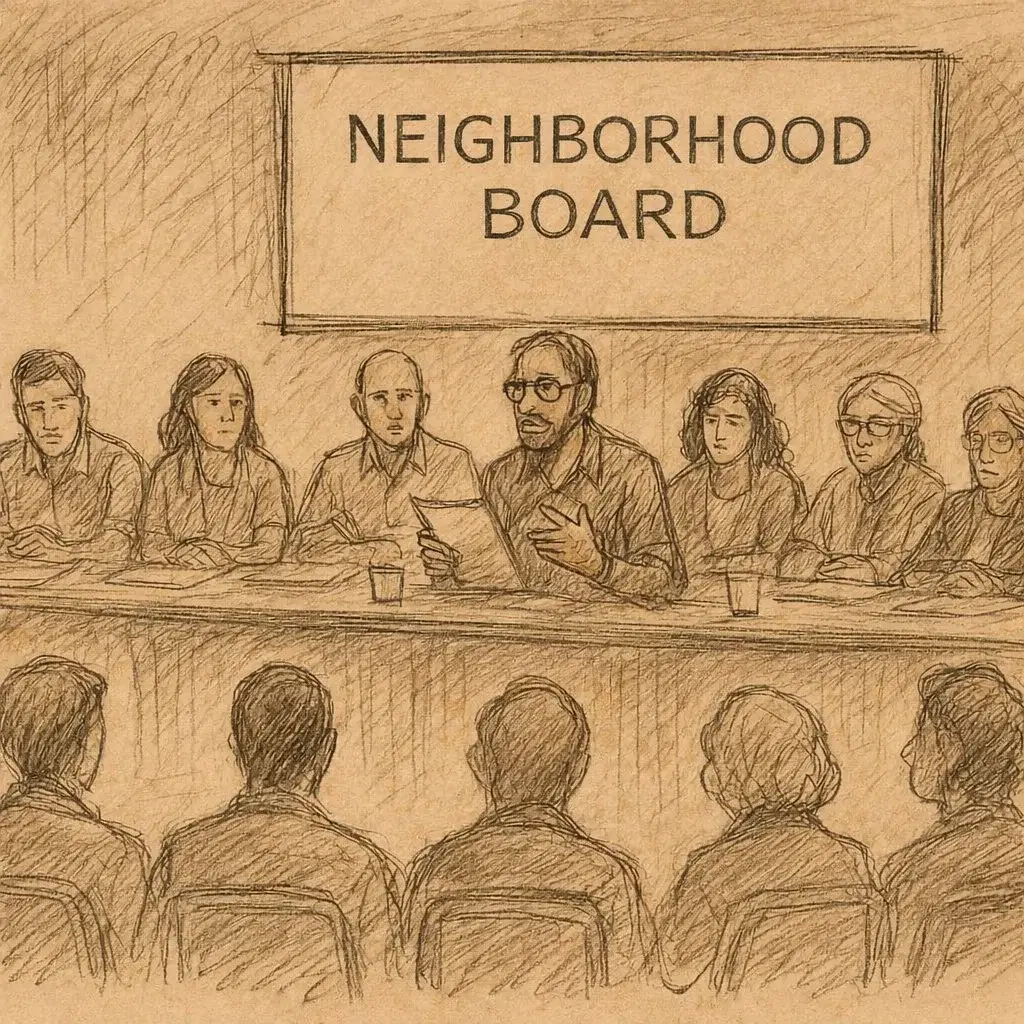
No 18 Āliamanu-Salt Lake-Foster Village-Airport Neighborhood Board Meeting July 2026
Listen to this article:
18 Aliamanu-Salt Lake Neighborhood Board Meeting – July 10, 2026
Election of Board Officers
The board elected officers to serve from July 9, 2026, through June 30, 2027. Clarence was initially nominated for chair but declined, explaining that he wanted more experience and traction on the board before assuming that responsibility, while remaining interested in another leadership position and continuing to support the community. Then-Vice Chair James Gower was nominated and accepted the chair nomination, winning the election by a 5-1-0 vote. Doug Fujikura was elected vice chair, and Chandra Kanemaru was elected secretary. The board considered whether it needed additional positions such as parliamentarian, sergeant-at-arms, or timekeeper but did not establish any. Although the discussion stated that four roles had been filled, the transcript did not record a separate election for treasurer.
Warrior of the Month: Senator Glenn Wakai
The board presented its July 2026 Warrior of the Month Award to State Senator Glenn Wakai. The award program, established on August 8, 2024, recognizes individuals and groups that provide exceptional, unselfish service to Āliamanu, Salt Lake, Foster Village, and the airport area. A nomination submitted by former Chair David Yomes highlighted Wakai’s nearly 25 years of public service, including service in the State House from 2002 to 2010 and in the State Senate since 2010, where he represents District 15 and serves as majority floor leader. The board credited him with advancing electric-grid reliability and affordability, supporting geothermal, solar, and hydropower options, digitizing state agricultural forms at the airport, and promoting remote legislative testimony before the COVID-19 pandemic, helping establish the now-common practice of streaming and archiving hearings. He was also recognized for arranging an Amazon partnership that uses otherwise empty return cargo flights to move Hawaiʻi products to the mainland faster and more cheaply, helping local businesses bypass slower and more expensive ocean freight.
Wakai’s Stadium, School, Cultural, and Community Work
The award citation described Senator Wakai as a principal advocate for the New Aloha Stadium Entertainment District, or NASED, alongside developer Stanford Carr, with the goal of returning University of Hawaiʻi football to a new stadium in 2029. It also praised his work securing resources for District 15 schools, participating directly in community projects, and supporting Operation Clean Sweep and Genki-ball work in the Salt Lake Waterway. Other cited initiatives included recognizing the shaka as the state gesture, promoting shaka and Duke Kahanamoku license plates, supporting a surf museum, and advancing projects that connect Hawaiʻi’s culture with tourism and economic activity. The citation also highlighted his effort to introduce animals into a state correctional facility as a rehabilitation tool, beginning with cats at the women’s prison—the first program of its kind in a Hawaiʻi prison. When Wakai arrived later in the meeting, the board formally presented the certificate and lei. He said it was his first Warrior of the Month recognition in 24 years in office and credited collaboration among area legislators and Councilmember Radiant Cordero. He emphasized his work holding the military accountable for the release of 27,000 gallons of jet fuel into the aquifer and defending plans for a mixed-use stadium district rather than replacing the stadium concept with approximately 40,000 housing units alone.
Salt Lake Waterway Operation Clean Sweep
Operation Clean Sweep will hold its next Salt Lake Waterway project on August 15, 2026, from 11 a.m. to 3 p.m. at the waterway entrance near Honolulu Country Club. The five-year cleanup commitment is now in its third year, although the 2026 schedule was delayed by Kona lows and subsequent bad weather that also caused neighborhood board meeting cancellations across the state. Organizers reported that Honolulu Country Club, which owns the Salt Lake Waterway, has joined the collaboration and agreed to help address cleanup needs. Participants will make 2,000 Genki balls, with the country club paying for 1,000 and Operation Clean Sweep funding the other half. The work area, tents, and tables will be set up in the country club parking area closest to the entrance. Upper and lower parking at nearby Ala Puʻumalu Park has been reserved for volunteers. Participants were asked to wear comfortable clothes, sun protection, work gloves, and closed-toe shoes rather than slippers. Organizers hope Army, Navy, Air Force, and other community organizations that have supported previous cleanups will participate again.
Hūāloa Solar Construction
Ameresco representative Josh Strickler thanked the board for its letter supporting the Hūāloa Solar project before the Public Utilities Commission and announced that the PUC approved the project’s power purchase agreement application in June 2026. Grading and installation of foundations for the solar-panel racking had begun, and a Hawaiian blessing was held during the week of the meeting, including discussion of the area’s ahupuaʻa and the history of shark racing in Pearl Harbor. The Navy approved demolition of warehouses and telephone poles within the site. Power was scheduled to be disconnected on the Saturday following the meeting, with pole and building removal beginning the following Monday. Equipment orders were already underway, and construction activity was expected to increase. The project remained on schedule for completion by November 2027.
Solar Project Construction Impacts and Community Benefits
Project representatives said construction-worker parking and material laydown areas will remain on-site, avoiding spillover onto neighborhood streets. Work will occur Monday through Friday from 7 a.m. to 5 p.m. under an approved noise permit. Once the project goes online in late 2027, the developer plans to offer a formal community-benefits package lasting throughout the 25-year contract and invited residents to provide ideas about how those benefits should be structured. Questions, concerns, or complaints may be submitted through HualoaSolar.com or by email at info@HualoaSolar.com. No audience or board questions were raised.
Pearl Harbor-Hickam-Kalaeloa Restoration Advisory Board
Community Co-Chair Francie Whitfield announced that the next Pearl Harbor-Hickam-Kalaeloa Restoration Advisory Board meeting will be held Wednesday, September 9, 2026. The board is recruiting members and expects approximately 14 openings within its maximum community membership of 20 because several current appointments are due for renewal. Applications are due three weeks before the meeting, on August 19. Application information is available through the Red Hill Environmental Remediation Navy website, RedHillERN.com. Whitfield also provided her phone number, 808-221-4933, and email, flow828@gmail.com, for questions. No questions about the advisory board were raised.
Red Hill Registry Enrollment and Health Resources
Red Hill Registry Community Engagement Director Tara Sutton reported that 478 people had fully enrolled during the registry’s first year, while approximately 2,700 had begun the pre-enrollment or enrollment process. Anyone unsure whether all enrollment steps have been completed was encouraged to contact the registry at info@redhillregistry.org or 808-427-8260. The community-designed registry tracks health outcomes, supports future research and clinical guidance concerning jet-fuel exposure, and provides resources to affected people. A new fillable letter is available for patients to take to health care providers, explaining the Red Hill exposure and requesting that it be documented in their medical record. The document contains QR codes linking clinicians to relevant research. Seven fact sheets had also been published on RedHillRegistry.org.
Red Hill Clinical Education and Community Documentation
The registry is expanding education for health professionals through an accredited one-hour continuing-education course for clinicians ranging from nurses to physicians. Presentations had already been delivered during grand rounds at Pali Momi and at medical conferences, and Sutton was scheduled to join health providers the following day for a national presentation to doctors about the exposure, known health effects, and patient referrals to the registry. She also referenced a roughly 300-page National Academies of Sciences, Engineering, and Medicine report on clinical guidance and care for affected residents. The registry asked community members to submit photographs or videos documenting their experiences during the water contamination period, including activities such as washing with bottled water, to preserve lived experiences and provide human-centered footage for future public communications.
Bus Fare Increases
Board member Joe Omura announced that TheBus fares had increased across fare categories and warned riders to carry exact change. The adult cash fare rose from $3 to $3.25; without exact change, a rider may need to pay $4 because operators do not provide change. Monthly pass prices also increased, with the financial effect varying among riders. Omura said the change surprised him because fare increases had been discussed in prior meetings but he did not recall a clear follow-up before implementation. Residents were directed to city information, bus notices, the Middle Street transit office, or TheBus customer service, believed to be 808-848-5000, for the full revised fare schedule.
Mayor’s Office Updates
Jennifer Santos, executive director of the Mayor’s Office of Culture and the Arts, delivered Mayor Rick Blangiardi’s report. The July 2026 mayoral newsletter covered coordinated disaster-preparedness efforts, the hiring of a former Smithsonian National Zoo director to lead the Honolulu Zoo, a leadership change in the managing director’s office, new enclosed trash receptacles intended to improve Waikīkī cleanliness, major Kailua infrastructure improvements, and Honolulu’s placement by Travel + Leisure among the leading U.S. public transportation systems. The newsletter is available through the mayor’s page on Honolulu.gov.
Lower School-Zone Speed Limits
The Department of Transportation Services is lowering speed limits on City and County roadways bordering schools under Ordinance 24-32. The prior standard of 25 miles per hour “when children are present” will be replaced by a 20-mile-per-hour limit from 6 a.m. to 6 p.m. on school days. The city will also install or replace school-zone signs within 1,000 feet of schools where signs are missing, faded, or inconsistent with current federal standards. The change creates a uniform daytime school-zone rule rather than tying enforcement only to the visible presence of children.
Summer Bash and Salt Lake Boulevard Construction
Councilmember Radiant Cordero’s office announced a free Summer Bash 2026 at Māʻili? [Note: transcript identifies Makalapa Neighborhood Park] on Friday, July 31, from noon to 4 p.m. at Makalapa Neighborhood Park. Organized by Parents and Children Together and partner organizations, the event will offer family activities, refreshments, and practical school resources; questions may be directed to 808-488-6705. The office also addressed speeding on Likini Street during detours associated with the Salt Lake Boulevard Widening Project. The concern was forwarded to the Department of Design and Construction and the contractor. The detours had ended, and the contractor’s current portion of work was expected to finish by the end of August, although additional phases are planned.
District Funding, Trees, and DPP Scams
Councilmember Cordero secured $150,000 for a dog park at Keʻehi Lagoon, a priority previously identified by the neighborhood board. Her report also included District 7 project and program appropriations. Trees for Honolulu’s Future is accepting requests for free trees in planter strips and other appropriate locations as part of efforts to reduce urban heat during increasingly hot conditions. The office also warned residents about fake inspections, violation notices, emails, and other phishing attempts by people posing as Department of Planning and Permitting employees. Anyone contacted should request a city-issued identification badge, record the person’s name, ask for the person’s or supervisor’s telephone number, and verify the contact directly through DPP at 808-768-8000 before sharing information.
Senator Wakai’s University of Hawaiʻi Athletics Strategy
In his legislative report, Senator Wakai discussed a plan to improve the University of Hawaiʻi’s competitiveness in the era of direct athlete compensation without using $5 million in state tax funds to pay recruits who may later transfer to mainland programs. He said he had persuaded UH to pursue an Asia-focused strategy unlike that of the roughly 360 other Division I programs. Following state-business travel to Japan and Taiwan, he plans outreach in Korea, Australia, and the broader Oceania region. The concept is to recruit Asian athletes, stream their UH games live and free to audiences in their home communities, build international fan bases, and secure corporate support from those markets. Baseball, volleyball, soccer, golf, and football were identified as potential recruiting areas. Wakai argued that the approach could generate outside funding while strengthening UH athletics over the long term.
Representative Linda Ichiyama’s Legislative Report
Representative Linda Ichiyama distributed a post-session newsletter summarizing legislation passed during the 2026 session. She reported that Governor Josh Green was in the middle of bill-signing season and had approved an expansion of Hawaiʻi’s film tax credit intended to attract productions, employ local workers, and create jobs. He also signed several measures from the Women’s Legislative Caucus package addressing domestic violence and human trafficking. Additional bill signings were expected during the following week.
Feral Chickens and Street Parking
Representative Garner Shimizu reported on constituent concerns he observed while walking through Foster Village and Āliamanu. Feral chickens and roosters remain a significant problem, with residents reporting crowing at 1, 2, 3, 4, and 5 a.m. Although the city has an existing control program, Shimizu said many constituents consider it ineffective and that he is pressing the city to expand or improve its response. He also discussed street-parking conflicts associated with multifamily households, renters, and large numbers of vehicles. Residents were encouraged to balance neighborly understanding with reporting genuine abuses through the Honolulu 311 application.
Aloha Stadium Swap Meet and Interim Events
Stadium Authority representative Samantha Spain reported that July is the busiest month for the Aloha Stadium Swap Meet and that response to its first season in the new location has been positive, particularly regarding the expanded food court during hot weather. Stadium officials continue to monitor rubbish and vendor and visitor conduct and asked the community to report problems so Sodexo, the swap meet operator, can respond. The upper and lower Hālawa parking lots are reopening for events, including a concert planned for August. Officials are evaluating resurfacing, leveling, and temporary court improvements to support basketball, volleyball, wrestling, festivals, and potentially high school graduations. The June 19 Juneteenth celebration attracted more than 6,000 people. Expanded sporting uses are being targeted for early 2027 to keep the property active during redevelopment.
Stadium Demolition and Design
Aloha Hālawa District Partners reported that the major “tripping” operations used to bring down stadium sections were complete and much of the dismantled material had been removed. The north and south end-zone structures remained and will be taken apart carefully by crane over the coming months, while the concrete structures below will be retained. Interior demolition is also continuing. Overall demolition remains scheduled for completion by November 2026. The state has accepted the stadium’s schematic design, and the development team will now refine it before soliciting construction bids.
Stadium Electrical Infrastructure Challenge
The stadium development team identified electrical capacity as a major obstacle. Existing Hawaiian Electric infrastructure is not sufficient to power both the new stadium and the surrounding mixed-use district. The developer and state are working with HECO and other government agencies to identify a solution. Other utility relocations and infrastructure work were continuing. This issue emerged as one of the principal hurdles to maintaining the planned redevelopment schedule.
Army Job Fairs and Training Advisory
The Army announced public job fairs at the Āliamanu Military Reservation gym on July 21 and at the Helemano Military Reservation training room on August 24, both from 8:30 a.m. to 2 p.m. Some applicants may receive job offers or provisional hiring decisions during the events. Available positions include work in bowling facilities, food services, child and youth services, and child development centers across Army installations. The July Army training advisory for Oʻahu was also released, with most scheduled activity concentrated around Schofield Barracks and little expected impact in the board district.
Communication With the Army and Richardson Field
Representative Shimizu expressed frustration with the difficulty of obtaining timely answers from Army contacts concerning constituent issues near Tripler Army Medical Center and Fort Shafter. The Army representative provided the garrison community-relations address, usag.hawaii.comrel@army.mil, for public inquiries. Senator Wakai added that Richardson Field is currently being used to stage equipment for the approximately $3 billion Pearl Harbor Naval Shipyard repair and modernization project, described as the state’s largest capital-improvement undertaking. After that work is expected to be pau in or after 2027, officials are discussing a possible land exchange, memorandum of agreement, or memorandum of understanding with the military. One concept is a pedestrian connection between the USS Arizona Memorial area and NASED, encouraging some of the memorial’s approximately 1.8 million annual visitors to dine, shop, and visit attractions in the stadium district.
Joint Base Leadership Change
Joint Base Pearl Harbor-Hickam reported a change of command held the day before the meeting. Captain John Fry assumed command from Captain Samuel “Smokey” White and is expected to lead the installation for the next several years. The military representative noted that planned reports on the Restoration Advisory Board and RIMPAC had already been addressed by other speakers.
Board of Water Supply Report and Plant Sale
The Board of Water Supply recorded one main break in the district during June: a 24-inch-diameter pipe break on Arizona Road on June 21. The agency also announced its 2026 Annual Unthirsty Plant Sale at the three-acre Hālawa Xeriscape Garden, 99-1268 Iwaʻena Street, on Saturday, August 1, from 9 a.m. to 1 p.m. The free, family-friendly event will feature drought-tolerant and native plants, University of Hawaiʻi Master Gardener “plant doctors,” information about rain-barrel catchment, and free soil conditioner. Payment for purchases will be by credit card only. Visitors may park on Iwaʻena Street and use a free shuttle to the garden.
Stadium Marketplace Residential Proposal
McNaughton and Munekiyo Hiraga presented plans to redevelop the former Kmart and Sack N Save portions of Stadium Marketplace into approximately 520 to 525 rental apartments. The site is about half a mile from the transit station, lies within the transit-oriented development zone, and is zoned BMX-3 for residential and commercial use. The project would replace largely dormant retail space, currently including a temporary Re-use Hawaiʻi operation, while retaining McDonald’s, Texaco, Starbucks, Domino’s, O’Reilly Auto Parts, and AutoZone. The development would contain studios and one-, two-, and three-bedroom units in four-story buildings approximately 52 to 57 feet tall. Existing Kmart and Sack N Save tower elements are about 40 feet tall, and the developer said the project is designed to fit into the area rather than become a high-rise tower.
Marketplace Affordability and Amenities
The Stadium Marketplace development will be entirely rental housing, with 60 percent of units restricted for 30 years to households earning below 140 percent of area median income. The developer is seeking approval through the state’s Hawaiʻi Revised Statutes Chapter 201H process but is not requesting state financing or low-income housing tax credits. The process may provide relief from certain city fees, including building and potentially water-related fees. Proposed amenities include a clubhouse, fitness center, dog park, barbecue spaces, children’s play areas, and gathering areas intended to help residents build community. Elevators will serve the four-story buildings.
Marketplace Site Layout, Stream Edge, and Parking
The concept includes a large building near Hālawa Stream, two horseshoe-shaped buildings around central courtyards, and another building near the Texaco station. All parking would be at surface level, with approximately one space per bedroom, meaning a three-bedroom unit would generally be supported by about three stalls. The existing Salt Lake Boulevard entrances would remain unchanged. The project would also reverse the property’s historic orientation away from Hālawa Stream by creating landscaping, a pedestrian path, and a buffer along an existing Hawaiian Electric easement. That path could help provide the connection toward Salt Lake Boulevard envisioned in the area’s transit-oriented development plan.
Marketplace Traffic and Construction Schedule
A commissioned traffic study projected approximately 172 additional vehicle trips during the morning peak hour and 211 during the evening peak hour. The developer characterized this as only a few additional cars per minute and said it would add seconds rather than major delays at nearby signals. No changes to Salt Lake Boulevard lanes, signals, or project entrances are proposed. The team plans to complete design and submit building-permit applications by the end of 2026. Permits are anticipated around summer or fall 2027, followed by demolition and approximately two years of construction. Initial occupancy is targeted for 2029. Although phased move-ins were considered, the current plan is to open the development as a whole because central leasing and amenity functions would be difficult to operate safely while adjacent buildings remain under construction. The developer has begun outreach to residents within 500 feet and to city and state officials and plans a website and newsletter; questions may be sent to project@mcnaughton.com.
Marketplace Sewer, Water, and Flood Requirements
In response to board questions, the developer said the project already has water-service confirmation and an approved sewer-connection application allocating capacity for the proposed number of homes. Because the site is in a flood zone, new buildings will be raised approximately one foot to meet applicable standards. Hālawa Valley resident Lynn Wong raised broader concerns about erosion, land movement, overgrowth, insufficient stream dredging, and flood risk along Hālawa Stream. She said her neighborhood was placed in a flood zone in 2014, after residents had already reported that the stream had gone without maintenance for approximately 25 years. She reported paying about $4,000 annually for flood insurance and feared that continued bank deterioration could leave homeowners without stable land on which to rebuild after a flood. She asked whether the redevelopment would reinforce the stream bank and urged government agencies to address conditions along the full waterway toward Pearl Harbor. The board said it would identify the appropriate agency and revisit the issue at a future meeting.
Keʻehi Lagoon Beach Park Improvements
PBR Hawaiʻi presented a City and County Department of Design and Construction project to improve Keʻehi Lagoon Beach Park, which is distinct from the neighboring state-operated Keʻehi Lagoon Memorial Park. The roughly 72-acre public beach park is in the Special Management Area, the State Urban District, a preservation designation under the Primary Urban Center Development Plan, and P-2 General Preservation zoning. Proposed work includes rebuilding Comfort Station 1 near the tennis courts, replacing Comfort Station 2 with a new facility approximately 500 feet west near the pickleball courts, demolishing the existing second comfort station, and constructing a new park-maintenance facility serving Keʻehi Lagoon and other nearby parks. One of the park’s original three comfort stations had burned down, leaving only two in operation despite heavy use by paddlers, tennis and pickleball players, softball teams, and other park visitors.
Keʻehi Costs, Sea-Level Rise, and Schedule
The two comfort stations are estimated to cost approximately $4 million, while the maintenance facility is estimated at about $8 million. Comfort-station construction is expected to begin after permits are approved and take about nine months. The maintenance facility, dependent on funding availability, would take approximately 18 months. All new buildings have been located outside both the projected 3.2-foot and six-foot sea-level-rise exposure areas. The new restrooms will connect to the county sewer system rather than cesspools and will be on the mauka side of the park, away from the primary canoe-paddling area. They will not be close enough to function conveniently as restrooms for Skyline riders.
Keʻehi Environmental Review and Public Comment
Because the park is within the Special Management Area, the city must complete a Hawaiʻi Revised Statutes Chapter 343 environmental assessment before applying for a major SMA use permit. Pre-assessment consultation ran from December 2025 through the end of January 2026. The draft environmental assessment was published the day before the meeting, beginning a 30-day public-comment period ending August 7, 2026. After environmental approval, the SMA application will go to the Department of Planning and Permitting for agency review and a public hearing, followed by at least two City Council hearings. The presenter said the process provides at least four opportunities for public input. Questions were also raised about unsheltered residents and the effect of separate temporary-housing projects on families using the park. The consultant confirmed that homelessness is present but said those operational and security concerns would need to be relayed to the responsible city agencies.
Helicopter Noise Resolution
The board considered a resolution responding to recurring low-flying and hovering helicopters over Salt Lake, Āliamanu, Foster Village, and the Honolulu Country Club area. The resolution asks the Federal Aviation Administration, City and County of Honolulu, Hawaiʻi Legislature, State Department of Transportation, Joint Base Pearl Harbor-Hickam, Daniel K. Inouye International Airport management, and other appropriate agencies to review helicopter operations affecting the community. It requests that military, commercial, private, sightseeing, news, and law-enforcement operators avoid unnecessary low-altitude flights and prolonged hovering over residential neighborhoods whenever feasible and safe. It also seeks reduced nighttime activity except for emergencies, military necessity, law enforcement, medical transport, airport operations, or other essential government functions. Agencies are asked to consider flight-path changes, minimum-altitude standards, operational limits, laws, regulations, and other community protections, while improving communication among aviation authorities, operators, military officials, and residents.
Resident Complaints About Helicopters and Country Club Noise
A Joint Base representative requested an electronic copy of the helicopter resolution. Resident Danny Ha, who lives in a condominium beside Honolulu Country Club, said helicopter noise had become severe since approximately April, sometimes continuing from 9:30 a.m. until 6 or 6:30 p.m. He said calls to a helicopter-tour organization and Congressman Ed Case’s office had not produced a response. Board members noted that former Chair Yomes had contacted several organizations and was reportedly told that helicopters are directed to hover above the golf course because it is not officially considered residential land, even though many homes directly border it. Ha also complained about amplified “boombox” music during golf tournaments, sometimes lasting nearly six hours, and said a 911 operator told him police could do little because it was associated with a tournament. The board agreed to place the issue on the next agenda and question military and government representatives directly about the health, mental well-being, pet, and quality-of-life effects of repeated aircraft noise. The helicopter resolution passed unanimously, 6-0-0.
Administrative Actions and Next Meeting
The board approved the May 14 meeting minutes without corrections, and committee chairs had no additional reports. The next Āliamanu-Salt Lake-Foster Village-Airport Neighborhood Board meeting was scheduled for Thursday, August 13, 2026, at 6:30 p.m. at the National Guard Association building. Recordings are shown on ʻŌlelo Channel 49 on the fourth Saturday of the month. The meeting adjourned at 8:36 p.m.