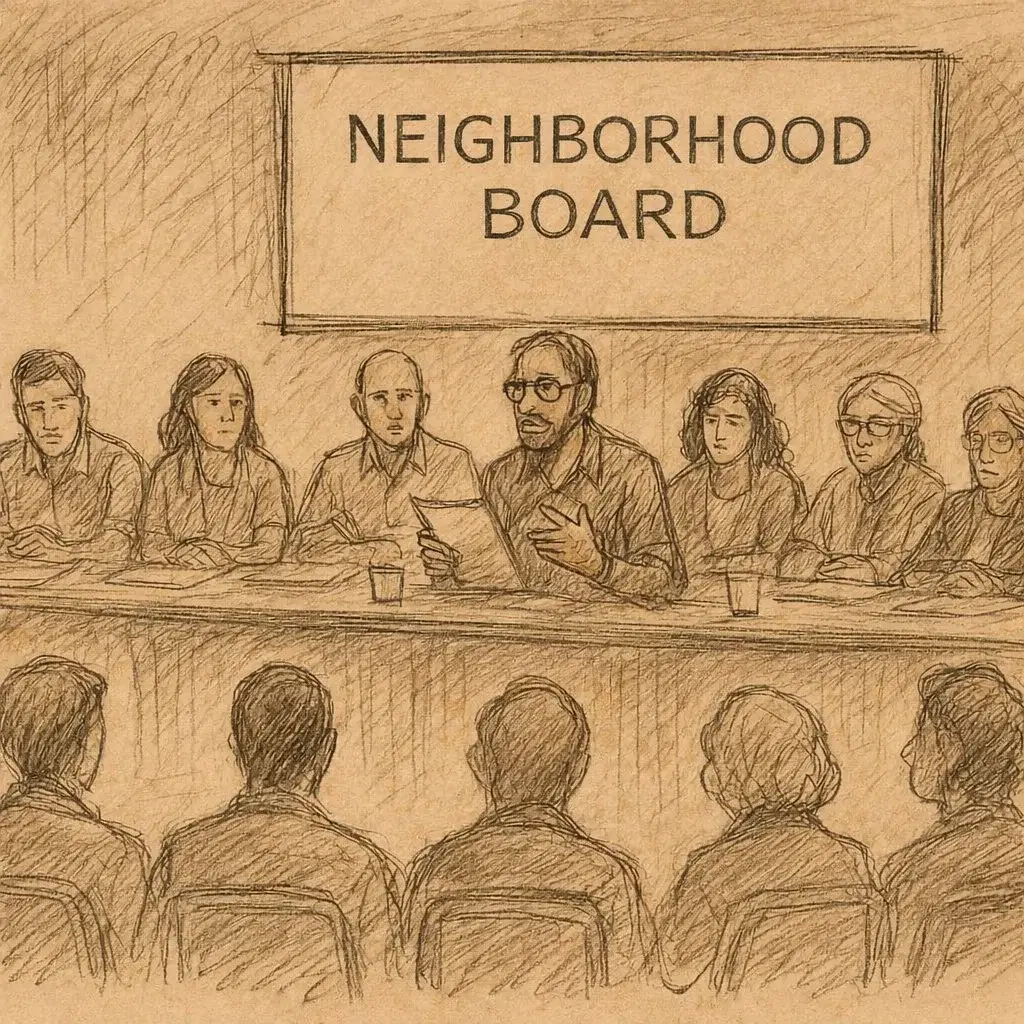
No 11 Ala Moana Kaka'ako Neighborhood Board Regular Meeting September 2026
Listen to this article:
11 Ala Moana-Kakaako Neighborhood Board Meeting – October 8, 2026
Call to Order and Quorum
The regular meeting was called to order with a reminder that the Neighborhood Board exists to promote civic engagement and improve the community. Six members were initially present, establishing quorum, with some participating online. The board then proceeded to public-safety reports, a lengthy discussion of homelessness and related services, community concerns, government and agency updates, and formal board business.
Honolulu Fire Department Activity and Lithium-Ion Battery Safety
Captain Gibo of Honolulu Fire Department Engine 2 at the Pawaa Fire Station reported August 2026 activity consisting of seven nuisance fires, 44 activated alarms, 149 medical calls, one motor-vehicle collision, and three hazardous-material incidents. Because HFD is responding to a growing number of lithium-ion battery fires, the department advised residents to use only manufacturer-approved cords and chargers, charge devices on hard and flat surfaces, unplug them when fully charged, and charge larger devices such as e-bikes, scooters, and power tools outdoors whenever possible without blocking exits. Residents should immediately stop using a device if it becomes unusually hot, swells, leaks, smells strange, smokes, or makes popping or hissing sounds. Airline passengers were advised to keep charging devices visible and never charge e-cigarettes or vaping devices aboard aircraft. HFD also announced a Fire Prevention Week Family Day at the Honolulu Zoo on October 3, 2026, from 10 a.m. to 2 p.m., under the theme “Charging to Fire Safety: Safe Charging Is a Superpower.”
Nuisance Fires and Public Trash Receptacles
In response to a board question, Captain Gibo said he did not have a comparison with July but explained that nuisance fires often involve dumpsters, rubbish containers, and public trash cans at bus stops. Some incidents are deliberate, while others begin when someone discards a cigarette that smolders for hours before igniting surrounding material. He agreed that businesses and condominiums should secure or lock dumpsters when feasible, although many fires occur in open public receptacles that cannot easily be secured.
Honolulu Police Department Crime Statistics
Sergeant Kendrick of HPD District 1 reported August statistics of 33 auto thefts, one burglary, 113 thefts, 11 unauthorized entries into motor vehicles, 29 assaults, three sexual assaults, three graffiti cases, four reported drug cases, and 165 motor-vehicle collisions. With school back in session, HPD urged motorists to watch carefully for children, pedestrians, e-bike riders, and other vulnerable road users. The department associated the increased volume of pedestrians and micromobility devices with the high number of traffic collisions.
Late-Night Bars and Police Coverage
The board asked whether HPD was coordinating with the Honolulu Liquor Commission in anticipation of certain establishments being allowed to remain open until 4 a.m., including Velvet and potentially other bars in the district. Sergeant Kendrick said plans were being developed to station officers near known problem establishments and nightlife areas to address disorderly conduct, fights, impaired driving, and related incidents. Areas identified for attention included Kona Street, Hopaka Street, and Chinatown.
Construction Traffic and Special-Duty Officers
Secretary Farinas raised ongoing safety problems around the Straub parking-structure construction on South King Street, where five lanes sometimes narrow to three, delivery and construction vehicles occupy posted no-parking and tow-away areas, and parked vehicles obstruct visibility for residents exiting a shared driveway near HECO. Sergeant Kendrick explained that special-duty officers remain on-duty police officers and can issue citations or arrange towing, although their primary assignment is controlling traffic around the construction site. If a violation is outside their immediate work area, residents may notify the officer, who can request an on-duty patrol response. Police presence varies because it depends on the contractor’s permit requirements and daily work, including lane closures, heavy-equipment movement, and operations on South King, Kealamakai, Hotel, or adjacent streets. HPD often does not receive the contractor’s detailed plan until the day or week of the work. Farinas noted that residents feel safer when officers are present and asked for greater attention to recurring visibility and access problems.
Police Chief Community Meeting
Board members asked whether the new police chief would hold a “Meet the Chief” event in Ala Moana-Kakaako similar to events in Kalihi and Waikiki. HPD representatives believed a local appearance or community event would occur before the end of 2026, possibly in November, but could not confirm the format. Councilmember Scott Nishimoto later reported that his office was working with the chief to schedule an Ala Moana-area meeting in November.
HPD Drone Pilot Program
HPD confirmed that its drone program had been operating for several weeks in District 1 and the Kalihi-Palama area. Its regular hours were approximately 2 p.m. to 8 p.m., although crews might occasionally begin earlier. Member Rand questioned whether those hours could address late-night problems in Kakaako, including street-racing caravans that often appear between 10 p.m. and 2 a.m. HPD explained that the pilot schedule was based on the period when the largest number of calls appeared suitable for drone support and that current equipment was not believed to include full nighttime or night-vision capability. The long-term goal is a 24-hour operation, but expansion would require more aircraft, FAA-certified pilots, equipment, and funding. The board requested future updates on whether the program’s hours and nighttime capabilities will expand.
Sit-Lie Enforcement and Homelessness-Related Police Work
HPD said officers enforce sit-lie ordinances in Ala Moana and Kakaako as well as Chinatown, with daily statistics collected across the district. Chinatown produces higher numbers because its unhoused population is larger, but the department said enforcement standards are intended to be consistent. Sit-lie was described as a useful tool for preventing sidewalks and business entrances from being blocked and for supporting commercial activity. HPD does not currently track whether people involved in crimes or contacts have a permanent residence, so its standard crime statistics cannot show how many incidents involve unhoused individuals. The department does work with CORE outreach personnel during both daytime and nighttime hours, although representatives emphasized that the unhoused population is diverse and no single intervention works for everyone. Improvements at Kakaako Waterfront Park were attributed to years of collaboration among HPD, state law-enforcement officers, sheriffs, and other agencies rather than one specific action.
Homelessness in Ala Moana and Kakaako
The board convened an extended panel in response to concerns raised at the prior meeting about growing encampments in Ala Moana Beach Park, along Kapiolani Boulevard near H&R Block, on Keeaumoku and Makaloa Streets, near Jack in the Box on Kalakaua Avenue, and around drainage channels. Participants included Roy Miyahira, the city’s Director of Homeless Solutions; Castro Masani, Director of Outreach for the Institute for Human Services; Jeff Zirkonick, Assistant Chief of Operations assigned to CORE; and representatives of HPD District 1. The city receives reports through Honolulu 311, email, community meetings, outreach providers, and other channels. Officials said enforcement is usually preceded by repeated outreach and service offers rather than simply displacing people. Shelter capacity was estimated at roughly 90 percent occupied, leaving limited but still available space. Outreach workers may contact someone 10 or 20 times before that person agrees to enter shelter or treatment.
Ala Moana Beach Park Enforcement
HPD reported that Ala Moana Beach Park receives regular attention from patrol officers and an ATV bicycle detail, with a scheduled operation every Thursday in coordination with the Department of Facility Maintenance and additional visits by other units on other days. Since September 1, police reported 24 park-closure citations, two shopping-cart citations, 11 citations for other park violations, seven park-closure arrests, eight contempt-of-court or warrant arrests, one disorderly-conduct arrest, two criminal-property-damage arrests, one dangerous-drug arrest, one arrest for harassment of a police officer, and approximately six to eight additional arrests tied to outstanding warrants or pending felony cases. Police said contacts are generally documented through warnings, citations, arrests, or miscellaneous public reports. Repeat violations can progress from warning to citation and then arrest, depending on the circumstances.
Shopping Carts and Personal Property
The board asked whether people can avoid shopping-cart enforcement by covering carts with tarps. HPD explained that officers cannot simply search covered personal property without legal justification. Unattended carts containing belongings also create legal and practical difficulties because the contents may include valuables. During coordinated operations, officers can recover carts when the person is present, identifies the belongings, removes personal property, and permits the cart to be returned to the owner or retailer. The Thursday Ala Moana operation is only one component of enforcement, and other police units conduct activity on different days to reduce predictability.
Outreach Referrals and Service Acceptance
IHS encouraged residents to use Honolulu 311 or an outreach QR-code referral form distributed at the meeting. Outreach staff said they generally respond within about a day and attempt contact before and after scheduled cleanups. From July through the meeting date, IHS recorded approximately 334 District 1 encounters involving 247 unduplicated people; about 95 were willing to work with outreach staff to improve their situation. Encounters with people who accept services are generally entered into the homeless-management information system. Officials said common reasons for refusing help include shelter rules, a desire to remain with a partner or pet, fear of theft or infestation, mental illness, substance use, lack of decision-making capacity, and simple familiarity with street life. Some chronically unhoused people have developed survival networks and prefer their existing arrangements until sustained trust-building changes their willingness to accept assistance.
Shelter Availability
The city described its Kukulu Command Center as both a navigation hub and a real-time data platform that allows first responders and CORE to see current shelter vacancies. At the time of the meeting, the HONU site in Kapolei reportedly had six openings in the men’s tent, one in the women’s tent, two spaces in the couples area, and capacity for as many as 30 people in the family tents. Officials emphasized that real-time vacancy information helps outreach workers and first responders transport willing individuals directly to available placements.
CORE Medical and Behavioral-Health Services
CORE was described as a team of approximately 30 to 34 people with three major components. Community health workers conduct street outreach and build trust; EMTs operating ambulances with red striping transport non-ambulatory clients to hospitals or more appropriate facilities; and advanced-practice registered nurses provide clinical assessment and prescribing capacity. One objective is to reduce pressure on 911 ambulances and emergency departments by directing non-emergency patients to behavioral-health centers, shelters, or other appropriate services. CORE also works with HPD crisis-intervention officers under the MH-3 process, which allows a qualified clinician to determine that a severely mentally ill person lacks capacity and needs involuntary transport for care. Officials said MH-3 activity had been temporarily stopped during the meeting week because treatment facilities were full, illustrating the shortage of placements for people with the most serious psychiatric and substance-use conditions.
Emergency Medical System Capacity
CORE representatives described serious congestion in Honolulu emergency departments. To avoid ambulances waiting two or three hours for beds, the system may limit arrivals in a given hour to two ambulances at Queen’s and one each at Kuakini, Kaiser, and Straub. As a result, a patient may not be taken to the hospital associated with the patient’s insurer and could be sent much farther away. Officials said many transports involve low-acuity conditions and that insurance and regulatory changes are needed so ambulances can transport suitable patients to urgent-care centers, behavioral-health facilities, shelters, and other alternatives rather than only emergency rooms. Board members connected this congestion to delayed ambulance responses for other residents, including kupuna suffering falls and serious injuries.
Resources Requested for Homelessness Response
Panelists identified affordable housing, affordable rents, case management, eviction prevention, social workers, outreach staff, specialized shelters, psychiatric care, and long-term substance-use treatment as priority needs. IHS said only three or four full-time outreach employees cover the area from the airport to Punahou Street, including the airport, Chinatown, Kalihi, Ala Moana Beach Park, Makiki District Park, and major encampments. More specialized facilities are also needed for aging and medically fragile people who are inappropriate for standard emergency shelters but cannot obtain higher-level care. CORE advocated substantial investment in treatment for chronic methamphetamine, fentanyl, alcohol, and mental-health disorders, along with stronger efforts to intercept illegal drugs entering through harbors, airlines, mail, and shipping containers. HPD acknowledged its own officer shortage but stressed that additional police alone cannot resolve homelessness; housing, treatment, rehabilitation, outreach, and coordinated follow-up are all required.
Street Medicine and Grant Applications
The board discussed Waikiki Health’s model of sending a doctor directly into encampments to offer medication, injections, and treatment rather than requiring unwilling or unstable individuals to travel to a clinic. Officials said street medicine could be effective in Ala Moana-Kakaako but requires patient trust and often weeks or months of engagement before medication is accepted. CORE had applied for an approximately $3.5 million federal SAMHSA grant focused on chronic illness and street-based treatment and an approximately $2 million Bureau of Justice Assistance grant. The second proposal would also support service workers in District Court and the HPD cellblock so people entering the criminal-justice system can be connected immediately with care. CORE expected a decision on the justice grant within about two weeks. The board also discussed directing future community-benefit packages from major developments toward street medicine and homelessness services rather than relying primarily on streetscape improvements.
Development Benefits and Possible Local Service Sites
Vice Chair Vandenbrink cited planned or proposed development at 1588 Ala Moana Boulevard, the Muse on Kapiolani Boulevard, and property acquired by Nan near Century Center. He argued that community-benefit packages should respond more directly to neighborhood priorities. The 1588 Ala Moana proposal, for example, was associated with approximately $6 million for complete-streets work and trees along Ala Moana Boulevard and Atkinson Drive, while homelessness providers described a $2 million grant as potentially transformative. He suggested that the board and elected officials explore whether the Department of Planning and Permitting could direct future benefits toward outreach, street doctors, and local services. He also raised the possibility of reusing vacant buildings, including an abandoned property beside H&R Block, as neighborhood-based service sites so clients would not need to travel outside the area.
Safe Parking Proposal
The board asked whether Honolulu could establish safe-parking areas for people living in vehicles, drawing on programs in Maui, Santa Barbara, San Diego, Seattle, and other cities. Members noted that vehicles are often a person’s last shelter after losing housing and that many people already sleep discreetly in cars throughout the district. Panelists saw potential advantages because a designated location would improve safety, make residents easier for outreach teams to find, and allow services to be concentrated in one place. They cautioned that poorly managed sites can become unsafe if they lack security, rules, and access to services. San Francisco’s reported high per-space costs were cited as a warning that any Honolulu program would need a cost-effective design and strong operations.
Coordinated Homelessness Strategy
In response to a question about whether agencies follow a unified plan, the city said it continues to implement a homelessness strategy adopted in 2023, although the plan needs updating to reflect CORE’s newer emphasis on severe mental illness. Officials described stronger collaboration among the mayor, governor, city departments, state agencies, HPD, CORE, IHS, Kealahou West Oahu, hospitals, shelters, and grassroots organizations. Coordination includes planning for people who cross jurisdictional boundaries among city, state, and private property and sharing information to avoid duplicate outreach. HPD said it hopes eventually to train all officers in crisis intervention. Panelists emphasized that homelessness is a community problem requiring coordinated action rather than isolated agency responses.
CORE Audit and Accountability Improvements
Assistant Chief Zirkonick addressed a question about an unfavorable audit of CORE. He said the program historically developed a culture of performing work without adequately documenting its actions, making it difficult for auditors to verify results or justify public spending. CORE had already recognized the problem and began restructuring about nine months before the meeting under Dr. James Ireland. The program is revising its mission, adopting a documentation system in cooperation with the State Department of Health, and obtaining a new computer-aided dispatch system. Because CORE is a covered health-care entity, it cannot simply use all traditional documentation systems. Zirkonick said improved records and clearer performance measures should make the program more accountable and effective.
Community Role and Emergency Alerts
At the close of the homelessness discussion, agencies urged residents to report concerns through Honolulu 311, emergency incidents through 911, and service needs through IHS’s referral form. Officials said consistent but humane enforcement, outreach, documentation, and public participation can help move people toward treatment and shelter while keeping public spaces usable. HPD also asked residents to enroll in HNL Alert because the 2026 storm season remained active and another weather event was possible.
Ulana Ward Village HVAC Vibrations
Resident Todd Adams again raised persistent wall vibrations and noise allegedly caused by the HVAC system at Ulana Ward Village. He said documents uncovered by residents indicate that the project’s engineers anticipated the possibility of HVAC noise and vibration inside residences. A 2020 “Appendix G” reportedly required careful evaluation in residential units and other noise-sensitive locations, while a May 5, 2021 condition required Victoria Ward Limited to implement mitigation measures identified in the noise-impact analysis. Adams said residents had to obtain these records themselves after months of requesting assistance from the developer and HCDA. He filed a Uniform Information Practices Act request on August 12, confronted HCDA Executive Director Nakamoto at an August 26 public forum, and received records on August 28. Nakamoto reportedly offered to ask the developer to conduct engineering tests inside Adams’s unit. Later, during the HCDA report, Adams asked whether HCDA ever received the vibration-test protocols and verification results it requested from Howard Hughes on January 23. HCDA agreed to take the question back to the agency.
Ala Wai Watershed, Flood Debris, and Ferry Idea
Laura Ruby briefly referenced her proposal for a low-cost pedestrian-and-bicycle ferry across the Ala Wai Canal, operating similarly to a bus. She focused primarily on flooding and debris washing from upland portions of the Ala Wai watershed through Manoa, Palolo, and Makiki streams into the canal and yacht harbor area. She urged the Ala Moana-Kakaako community to collaborate with upstream landowners and watershed groups to control vegetation and discarded material before it reaches the lower canal. She argued that debris seen downstream originates largely from neglected upland areas and called for a watershed-wide response.
Community Running Events
Steve Davidson of the Mid-Pacific Road Runners Club announced two events at Ala Moana Magic Island. The Lea Lea 5K was scheduled for October 11 at 7 a.m., with bentos and food after the race. The annual Santa Hat 5K and one-mile keiki run was scheduled for December 6 at 4 p.m. as a holiday-themed community event.
Kapiolani Boulevard Rehabilitation Project
The Department of Design and Construction and consultant WSP USA presented the Rehabilitation of Streets, Unit 89B project for Kapiolani Boulevard between Ward Avenue and Atkinson Drive. The project includes tree-root pruning, canopy pruning, limited tree removal, reconstruction of most curbs and gutters, limited sidewalk reconstruction, asphalt paving throughout the corridor, and permanent striping. The notice to proceed was issued in April 2026, the contract duration is 545 calendar days, and construction was expected to begin in October or November. Work is planned to proceed eastbound from Ward to Atkinson with tree work followed by concrete and paving, then reverse westbound before final striping.
Construction Closures and Accessibility Concerns
Concrete curb-and-gutter work will generally require one lane to remain closed for 24 hours so crews can remove existing concrete, trim roots, pour replacements, and allow proper curing. Asphalt paving will close two lanes while keeping one lane open, and striping may occur at night under an existing city noise variance. Board members stressed that sidewalks, particularly on the makai side of Kapiolani, are severely uneven and difficult or impossible to use safely with wheelchairs and strollers. They asked the city to examine conditions beyond the project’s Ward Avenue boundary, including areas near Yanagi Sushi, and questioned whether current conditions create ADA concerns. The presenters said the project is a rehabilitation rather than a complete-streets redesign and agreed to seek further information about work outside the stated limits and to provide updates if the schedule is extended by utility conflicts or other unforeseen conditions.
Exceptional Monkeypod Trees
The project corridor contains 152 designated exceptional monkeypod trees. A certified city arborist reviewed each tree, although formal confirmation from the Division of Urban Forestry remained pending. Three trees were recommended for removal and replacement with the same species: one near McKinley High School between Kamakee and Pensacola because it leans into the bus lane and has been struck; one at Piikoi because required root cutting would undermine structural stability; and one near Keeaumoku because it leans into the roadway and has sustained collision damage. Laura Ruby urged the city to transplant rather than destroy mature trees and to use them to extend the Kapiolani green canopy farther toward Diamond Head and Waialae.
Councilmember Scott Nishimoto
Councilmember Nishimoto announced another Ala Moana Beach Park cleanup for October 10 following a successful prior event. He also said his office was arranging a community meeting with the new police chief in Ala Moana, likely during November. In response to questions about development benefits, Nishimoto said he was open to proposals or a board resolution seeking a more consistent method for directing community-benefit packages toward homelessness services and other neighborhood priorities. He noted that developers themselves have complained that the current process can appear arbitrary.
Senator Sharon Moriwaki and Ala Wai Improvements
Senator Moriwaki reported that Capitol offices would operate remotely during October while they were painted and renovated. She described ongoing work with the University of Hawaii College of Engineering, including two civil-engineering faculty members, graduate students, and a design class studying technologies for continuously removing debris from the Ala Wai watershed. The Department of Transportation used approximately $9 million in federal funding to clear vegetation and debris from Manoa Stream, the most overgrown of the three principal streams entering the canal; Palolo and Makiki are the others. The state also allocated approximately $1 million to the College of Engineering and $2.5 million to DOT for pilot projects and more proactive debris-control systems. Possible measures include upstream catchments near locations such as Kapahulu Library so mattresses, couches, shopping carts, vegetation, and other debris can be intercepted before reaching the canal. Moriwaki noted that post-storm cleanup by DLNR can cost about $20,000 per day.
Makiki Stream and Citizen Patrols
Board members specifically highlighted the Makiki Stream near Jack in the Box on Kalakaua, where encampments, couches, cardboard, and other debris create flooding, sanitation, and safety concerns. Senator Moriwaki said the stream had required major clearing in the past, including assistance from the Army Corps of Engineers, and that adjacent landowners also need to stop treating the channel as a dumping site. She promoted District 1 citizen patrols and mentioned a planned training associated with organizer Sarah Kim. Moriwaki said community patrols create a visible deterrent, strengthen communication with police, and help residents and businesses participate in neighborhood safety without directly confronting suspects.
Kakaako Makai Planning and 1588 Ala Moana
Senator Moriwaki urged residents to comment on HCDA’s Kakaako Makai Area plan update, being prepared with consultant SSFM. She also encouraged public review of the 1588 Ala Moana proposal before the City Council, describing the building as very large and questioning its orientation. Residents were directed to links in her written report for the Kakaako Makai scenarios and the development proposal.
City Council and State Legislative Updates
A representative for Councilmember Tyler Dos Santos-Tam announced an informational briefing on the Department of Planning and Permitting’s permitting software during City Council committee week. Representative Adrian Tam’s office said Capitol renovations had temporarily closed its physical office, but staff remained fully operational remotely. Representative Tam was holding district office hours at the Waikiki Business Improvement District on Tuesdays and Thursdays and invited residents to submit ideas for the 2027 legislative session. Representative Kim Coco Iwamoto’s office similarly reported temporary displacement during renovations and said she intended to reintroduce an empty-homes tax bill and a free-bus-fare bill in 2027.
Governor’s Office, Storm Recovery, and Elevators
The governor’s representative shared a September newsletter covering storm recovery, debris removal, food distribution, mental-health support, restoration of essential resources, and preparation for additional storms during the El Niño season. The state had secured approximately $18.5 million in federal funding for electric-grid resilience and hazard mitigation on Oahu and the other islands. The board raised concerns about elevators failing in older high-rise buildings during storms, power outages, and water intrusion, leaving kupuna and residents with disabilities stranded. The representative agreed to include the issue in her report to the governor and consider whether emergency or resilience funding could help older buildings.
HCDA Kakaako Makai Plan
HCDA representative Francine Murray said the agency’s newsletter and online materials include scenarios for updating the Kakaako Makai Area plan and rules. A public workshop had drawn approximately 135 participants, and the online comment period was to remain open until October 19, 30 days after the workshop. An update was scheduled for the October 7 HCDA board meeting, with the agenda to be posted October 1. HCDA did not anticipate another large workshop like those held in March and September, but all workshop materials and comment opportunities were available through the agency’s website under “What is your vision for Kakaako Makai?”
HART Route Beyond Civic Center
HART representative Harry Cho explained that currently budgeted construction reaches the Civic Center station near Keauhou Place, with guideway columns extending to Cooke Street. HART does not yet have funding to continue from Cooke Street to Ala Moana. If future funding is secured, the elevated route would continue along Halekauwila Street, pass Ward Avenue with a station near a new condominium, shift to Queen Street past Whole Foods and TJ Maxx, connect through Waimanu and Kona Streets, and terminate at Ala Moana Center. Longer-term concepts include extensions toward Waikiki, the University of Hawaii at Manoa, and farther into Kapolei.
Blaisdell Access and Grade Separation
The closest planned rail station to the Neal S. Blaisdell Center would be the proposed Kakaako station near Ward Avenue, approximately a block away, but that station is not currently funded. A resident asked HART to reconsider an elevated structure and use street-level rail after the route crosses Nuuanu Stream, arguing that at-grade service would be cheaper, less visually intrusive, and potentially easier to extend through special districts, Waikiki, Moiliili, and beyond. HART responded that the route through Ala Moana is planned as grade-separated and will not change, although at-grade options could potentially be considered for future extensions beyond Ala Moana.
Approval of Meeting Minutes
The board reconsidered the July 28, 2026 minutes because online votes from the earlier attempt were invalid when members’ cameras were not on. The July 28 minutes were approved without opposition. The August 25, 2026 regular-meeting minutes were also approved without opposition.
AIDS Memorial at Kakaako Waterfront Park
The board unanimously approved support for an AIDS memorial and community site at Kakaako Waterfront Park. The proposal had been introduced at the previous meeting, and the vote formally placed the board on record in favor of the memorial.
Ala Moana-Kakaako Business Improvement District
The board considered and approved a resolution supporting the general establishment of a business improvement district in Ala Moana-Kakaako. The proposed district could support public safety, homelessness outreach, cleaner sidewalks and public spaces, better pedestrian conditions and walkability, and improvements to the neighborhood’s appearance and vitality. The resolution intentionally did not endorse specific boundaries, assessment rates, governance arrangements, or programs, leaving those details for future community and stakeholder discussions. Members cited successful business improvement districts in Waikiki and Downtown Honolulu, while noting that sustained business-community support will be necessary because property owners and businesses typically finance much of the work. The recorded vote was eight in favor, none opposed, and no abstentions.
Business Improvement District Permitted Interaction Group
To allow multiple board members to meet with businesses and stakeholders without violating the Sunshine Law, the board unanimously established a permitted interaction group to explore a potential business improvement district. The group consists of Vice Chair Vandenbrink, Member Egged, Member Rand, Chair Lee, and First Vice Chair Rice. Its role is to support the board’s general endorsement, gather stakeholder views and concerns, and examine possible district structures without committing the board to specific assessments, boundaries, or governance terms.
Action Committee and Oahu MPO Updates
The Action Committee reported on a previous discussion with Councilmember Dos Santos-Tam concerning the business improvement district and HPD’s community-policing team. Its next discussion with Representative Adrian Tam was announced for October 27, with residents encouraged to bring legislative proposals for the 2027 session. Member Rand, serving as the board’s representative to the Oahu Metropolitan Planning Organization, reported on the HNL Connect mobile application, which provides transportation-efficiency information and includes a rewards-point feature. She also noted transportation-related social-media resources and the planned reintroduction of shared vanpool programs that could connect commuters to work and rail stations.
Additional Events and Announcements
The board announced the Aloha Festivals Floral Parade, the Make-A-Wish Hawaii Jingle Rock Run, and Pride-related events. A 5K benefiting Spill the Tea Cafe was scheduled at Magic Island on October 10 from 7 to 10 a.m., and the Honolulu Pride Parade was scheduled for October 17. The board also noted that the Department of Business, Economic Development and Tourism and the Chamber of Commerce had partnered to make approximately $3.5 million in recovery grants available to businesses. As stated during the meeting, the next Action Committee meeting was listed for October 8 and the next regular board meeting for Tuesday, October 27. The meeting adjourned at 8:44 p.m.