Honolulu Permits Improve, Condo Bottlenecks Remain
Listen to this article:
Honolulu's permitting story is finally getting better - but only in the part of the market that matters least for solving O'ahu's condo shortage. The city's new HNL Build platform and workflow changes appear to be helping smaller residential jobs move faster through early review. That is real progress. But the condo market depends far more on projects that are still difficult to push across the finish line: tower rehabs, fire/life-safety retrofits, mixed-use infill, and larger multifamily development.
That distinction matters because paper pipeline is not inventory. A permit application, a zoning approval, or even a building under construction does not automatically translate into a unit a buyer can actually close on or a renter can move into. In Honolulu, the friction often shifts from plan check to engineering review, utility coordination, repeated comment cycles, inspections, and final certificate-of-occupancy sign-off.
The data supports that split. Civil Beat reported residential code review averaging about 9 days, versus roughly 2 months for commercial jobs. But UHERO still found pre-HNL Build median processing times in the first half of 2025 at 394 days for single-family permits and 585 days for multifamily. That tells us the front end may be improving while total delivery remains slow, especially for the exact project types that produce meaningful condo supply.
For buyers and sellers, this is more than a bureaucracy story. It is a pricing story. Neighborhoods with the most visible development pipeline may still remain undersupplied if complex projects stall, while older condo districts can look "affordable" but carry hidden renovation and compliance risk.
What's actually improving in Honolulu's permit system
Honolulu's Department of Planning and Permitting has spent years trying to unwind a backlog that long predates the current headlines. The old POSSE system dated back to 1998, and the city spent about $7.3 million to replace it with HNL Build, launched on August 4, 2025, according to reporting by Civil Beat. Mayor Rick Blangiardi called the transition a "Herculean effort," and to be fair, there are signs of real operational progress.
The biggest gains appear to be in simpler residential reviews and the early code-check phase. That is why homeowners doing smaller additions, alterations, or rebuilds are the most likely to feel the difference first. These jobs usually involve fewer agencies, less specialized engineering, and cleaner plan sets than large multifamily or mixed-use work.
But faster review is not the same as faster permit issuance. Civil Beat's earlier reporting noted that one stage of review got faster without meaningfully reducing total issuance time in 2024. DPP has also acknowledged that repeated correction cycles remain a problem, with an ideal target of no more than one or two rounds of comments.
The staffing issue is still the key risk. Honolulu officials were considering loan forgiveness and higher pay to recruit engineers in March 2026, according to Hawaii News Now. That is a crucial detail, because condo-relevant projects are disproportionately dependent on engineering review. If the city gets better at processing basic residential plans but remains thin on engineering capacity, the market will keep seeing a two-track system: homes move, while bigger condo supply lags.
Which projects are likely to keep clearing - and which may stay trapped
The best way to read Honolulu's current permit environment is by project type, not by headline.
The projects most likely to keep clearing are:
- Single-family homes and modest residential alterations
- Smaller low-rise infill in already-zoned urban neighborhoods
- Projects already under construction, especially in established master-planned districts
These categories benefit from simpler reviews, fewer infrastructure dependencies, and less exposure to commercial-level engineering bottlenecks.
The projects most likely to stay trapped are a different group entirely:
- Tower rehabs and major condo renovations
- Fire/life-safety retrofits in older high-rises
- Mixed-use infill that requires more utility and interagency coordination
- Large multifamily developments with heavy commercial review and infrastructure demands
This split helps explain why Honolulu can show permitting improvement without seeing a dramatic increase in deliverable condo inventory. Civil Beat found permits were moving faster for homes but slower for businesses and commercial work. UHERO found multifamily timelines remained much longer than single-family even before the HNL Build launch.
In my view, buyers should pay close attention to where complexity begins. A project that sounds housing-friendly on paper can still get stuck in electrical review, agency comments, utility coordination, or final occupancy. That is especially true for projects that are not just "buildings," but systems: elevators, fire alarms, sprinklers, transformers, drainage, parking, loading, accessibility, and life-safety all have to work together.
That is why announced units should never be treated the same as permitted units, and permitted units should never be treated the same as delivered units.
Why tower rehabs and fire retrofits are the hardest condo story on O'ahu
If the goal is understanding future condo scarcity, older tower rehabs may be the most underappreciated bottleneck in Honolulu real estate.
After the 2017 Marco Polo fire, Honolulu adopted a high-rise fire/life-safety ordinance requiring existing high-rise residential buildings to comply with Ordinance 19-04. That changed the economics of older condos overnight. Buildings now have to confront not just normal aging issues like spalling, cast-iron pipe replacement, elevators, and roofing, but also the cost and disruption of life-safety compliance.
The numbers are not small. The Marco Polo sprinkler retrofit cost more than $6 million. At the same time, Hawaii Business has reported severe insurance pressure, including one building's hurricane premium jumping from $51,555 in 2023 to $247,824 in 2024. Maintenance fees in older buildings commonly run around $1.25 to $1.75 per square foot, and that can move much higher once insurance and reserves are stressed.
From a permitting standpoint, these projects are difficult because they are non-revenue-producing. A new tower can sell units to cover costs. A sprinkler retrofit or electrical upgrade mostly preserves habitability and insurability. Owners still have to pay, but they do not get a shiny new product to monetize.
That is one reason older condo districts like Waikiki, Makiki, and the Kapi'olani corridor may stay functionally constrained even if there are lots of listings. Some inventory is effectively impaired by fear of assessments, financing limitations, or unresolved building work. I often tell buyers that a lower purchase price in an older building can be perfectly reasonable - but only if the association has already dealt with the expensive unknowns.
Kaka'ako, Ala Moana, and Makiki: where the pipeline can mislead
No part of O'ahu better illustrates the gap between pipeline and deliverable inventory than the urban core.
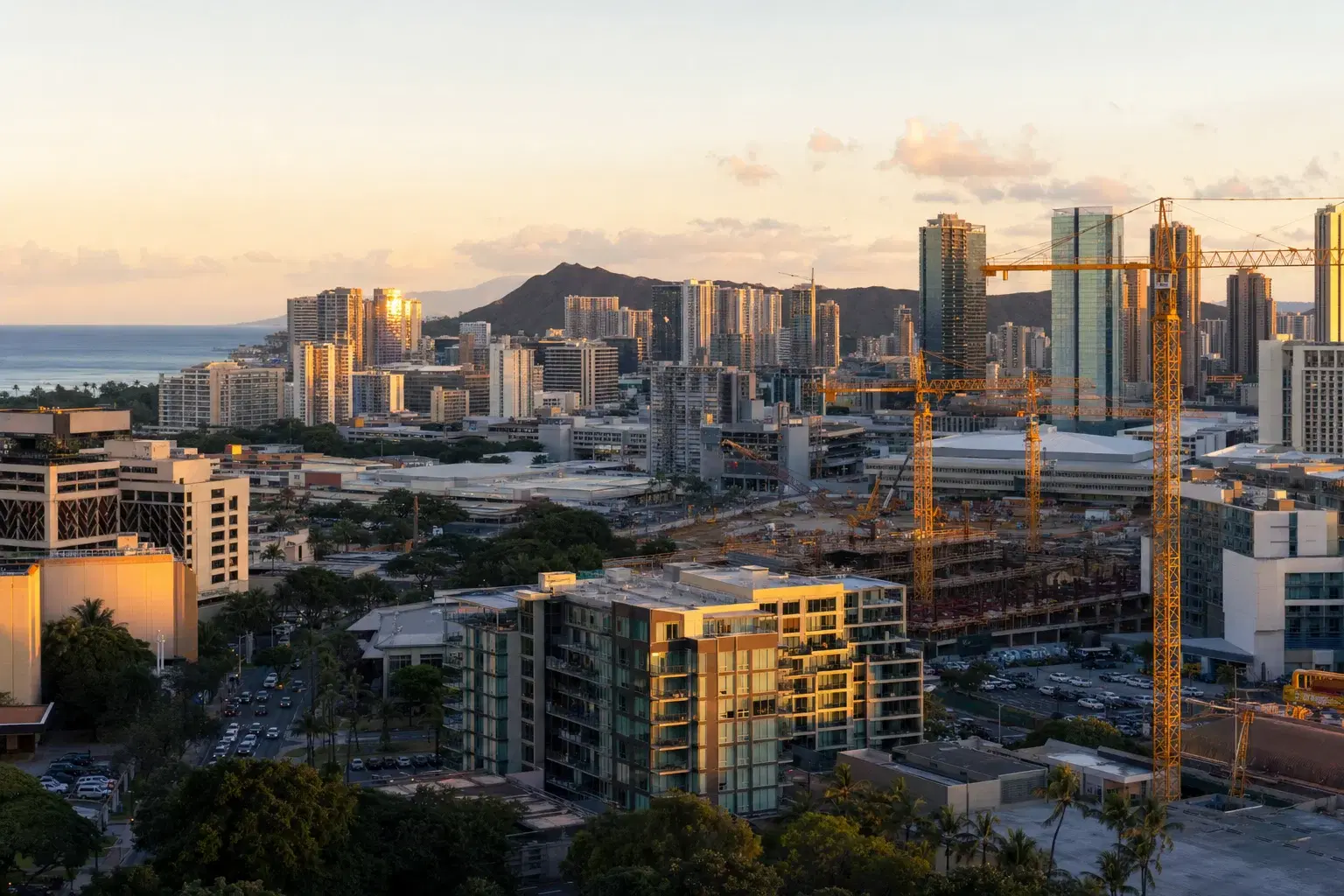
Kaka'ako and Ala Moana remain the island's most credible long-term condo supply engine. There are real successes here. Ulana Ward Village delivered 697 reserved-housing homes in 2025, and projects already under construction deserve more weight than conceptual announcements. A tower that has financing, permits, and cranes on site is fundamentally different from one still moving through review.
But even Kaka'ako has warning signs. HCDA proposed cutting allowable density in part of Central Kaka'ako from FAR 3.5 to 1.5 until infrastructure is adequate, according to the agency's rule update. That is a reminder that permitting speed alone cannot solve infrastructure limits.
The Makiki example is even more revealing. The 29-unit PenseMetro project sat empty for nearly 10 months awaiting final sign-off, as reported by Civil Beat. That is exactly the kind of project people assume should be easy to deliver: small, urban infill, affordable-housing aligned, and already built. Yet it still stalled at the finish line.
Bill 7 tells the same story at scale. The city created the program in 2019 with a 90-day approval target for affordable rental housing. Yet by early 2026, DPP reported 59 Bill 7 projects representing 1,752 potential units, while only 189 units had actually been added to O'ahu's housing stock, according to DPP figures cited here. That is the clearest evidence that announced or even active projects should not automatically be counted as future competition.
What this means for resale values by neighborhood
This permitting split is likely to shape resale performance more than many sellers realize.
On paper, O'ahu's condo market is not starved for listings. HiCentral reported the O'ahu condo median sale price at $520,000 in May 2026, up 4.0% year over year, while active condo inventory in April was 2,353 units, according to HiCentral's April report. But inventory is unevenly distributed, and much of it is concentrated in Waikiki and Ala Moana-Kaka'ako, where Locations Hawaii said about half of all available resale condos were located by late 2025 and early 2026.
That does not mean those neighborhoods are oversupplied in a practical sense.
Waikiki may have abundant resale listings, but older buildings face the heaviest retrofit, insurance, and maintenance pressure. That tends to split the market between:
- buildings where major work is already done, and
- buildings where buyers fear becoming the funding source for deferred maintenance
The first group can hold value better than many people expect. The second group can look cheap but trade at a discount for good reason.
Kaka'ako and Ala Moana are different. These areas have the strongest real pipeline, but future competition depends on how much of it gets delivered rather than merely announced. If infrastructure or commercial review continues to slow the next wave, nearby resale towers - especially well-located ones near employment and transit - may retain pricing support.
The most interesting "middle zone," in my opinion, is Mo'ili'ili, Keeaumoku, and the Ala Moana fringe. When projects in this band actually deliver, they can ease pressure downmarket through chain migration, a dynamic UHERO researchers cited through Hawaii Business have linked to new supply like The Central Ala Moana. If that supply gets delayed, adjacent resale product may stay firmer than buyers assume.
Practical advice for buyers and sellers right now
For buyers, the lesson is simple: do not confuse a lower asking price with lower cost of ownership, and do not confuse development headlines with future supply.
A smart condo buyer should ask:
- Is the building sprinkler-compliant, or what is its compliance path? See the Honolulu Fire Department guidance.
- What major projects are scheduled in the next 3 to 5 years?
- How strong are reserves, and how is major work being funded?
- Has master insurance spiked recently?
- Are nearby projects announced, permitted, under construction, or close to certificate of occupancy?
That last question matters more than ever. The hierarchy is important:
- Near CO or completed
- Under construction
- Fully permitted
- In review
- Announced concept only
For sellers, the market is increasingly rewarding certainty. Owners in well-run buildings that have already addressed sprinklers, pipes, elevators, or other major capital items are often in a better position than raw neighborhood averages suggest. Conversely, sellers in aging buildings with unresolved assessments, unclear reserve plans, or insurance instability may face a shrinking buyer pool even if the unit itself shows well.
Honolulu's permit system is improving, and that is good news. But the condo market does not run on easy permits. It runs on the projects that are hardest to finish. Until those projects move more reliably from review to occupancy, some of O'ahu's most important condo neighborhoods are likely to remain more undersupplied than the paper pipeline suggests.
Sources: Primary reporting and data were drawn from Civil Beat on DPP backlog and HNL Build, UHERO's Hawaii Housing Factbook 2026, Hawaii News Now on staffing and Bill 7 project counts, HiCentral market reports, Locations Hawaii neighborhood data, Hawaii Business reporting on condo retrofit and insurance economics, Honolulu Fire Department guidance on high-rise life-safety compliance, and HCDA materials on Kakaako infrastructure and density limits.
Disclaimer: This article is provided for general informational purposes only and does not constitute legal, financial, or real estate advice. Market conditions change frequently; readers should conduct their own due diligence and consult qualified professionals before making decisions.