2026 Condo Bills Could Reshape Oahu Pricing
Listen to this article:
Why Condo Governance Is Suddenly a Pricing Issue
At first glance, Hawaii's 2026 condominium bills look like technical housekeeping. They deal with collections, dispute resolution, and manager qualifications-topics that sound more like board-meeting material than real estate valuation. But on Oahu, that distinction is fading fast. In today's condo market, governance problems are increasingly showing up in the numbers buyers care about most: maintenance fees, special assessments, financing risk, days on market, and ultimately sale price.
The market backdrop matters. Oahu condo resales started 2026 on softer footing than single-family homes. According to the Honolulu Board of REALTORS®, January condo sales totaled 297 with a median price of $529,000, down 1.9% year over year. By March, condo sales were down 3.6% year-to-date, and the March median was $510,000. Just as important, only 7% of January condo sales closed above asking price, down from 10% a year earlier, while most sales closed below original asking. That gives buyers more room to discount risk that might have been overlooked in a hotter market.
In practice, buyers are no longer evaluating condos only by view, floor plan, or amenities. They are asking a deeper question: Can this building actually govern itself well enough to protect value? Hawaii's Department of Commerce and Consumer Affairs has been clear that sufficient reserves support both project health and unit value. I think that point is now central to how informed buyers price condos, especially in older towers where insurance, deferred maintenance, and board conflict can quickly turn into cash-flow problems for owners.
The 2026 Bills: Technical Changes With Real-World Impact
Three areas at the Legislature deserve close attention because they touch the core mechanics of how associations function.
HB1897 would modernize Hawaii's condo dispute process by replacing the older mediation-then-arbitration framework with a broader alternative dispute resolution model. The bill allows for facilitative mediation, evaluative mediation, or binding arbitration, while continuing support through the Condominium Education Trust Fund, including a $1.50 per-unit annual ADR component. That may sound procedural, but unresolved disputes over leaks, elections, rules, access to records, or maintenance responsibility often delay repair work and increase legal costs. A more flexible ADR system could reduce that governance drag.
SB147 goes to collections and enforcement. It lays out procedures for fines against owners, tenants, and guests, reinforces that owners generally cannot withhold common expense assessments, and preserves tools for dealing with unpaid obligations. It also limits certain post-foreclosure special assessment exposure to six months of unpaid regular monthly assessments. For buyers, the underlying question is simple: How reliably can this building collect the money it budgets?
SB801 and SB2297 focus on management standards. The carried version of SB801 points toward credential requirements for managing agents in larger residential condominium properties on Oahu, while SB2297 clarifies the role of community association managers and managing agents. I see this as especially important in larger towers, where operations are closer to running a commercial asset than a small apartment building. Elevators, fire systems, staffing, insurance claims, and major capital projects all require a higher level of execution than many buyers assume.
Which Buildings Are Most Exposed on Oahu
Not every condo project will feel these changes the same way. Some Oahu neighborhoods are far more exposed because of building age, ownership mix, and the scale of deferred maintenance.
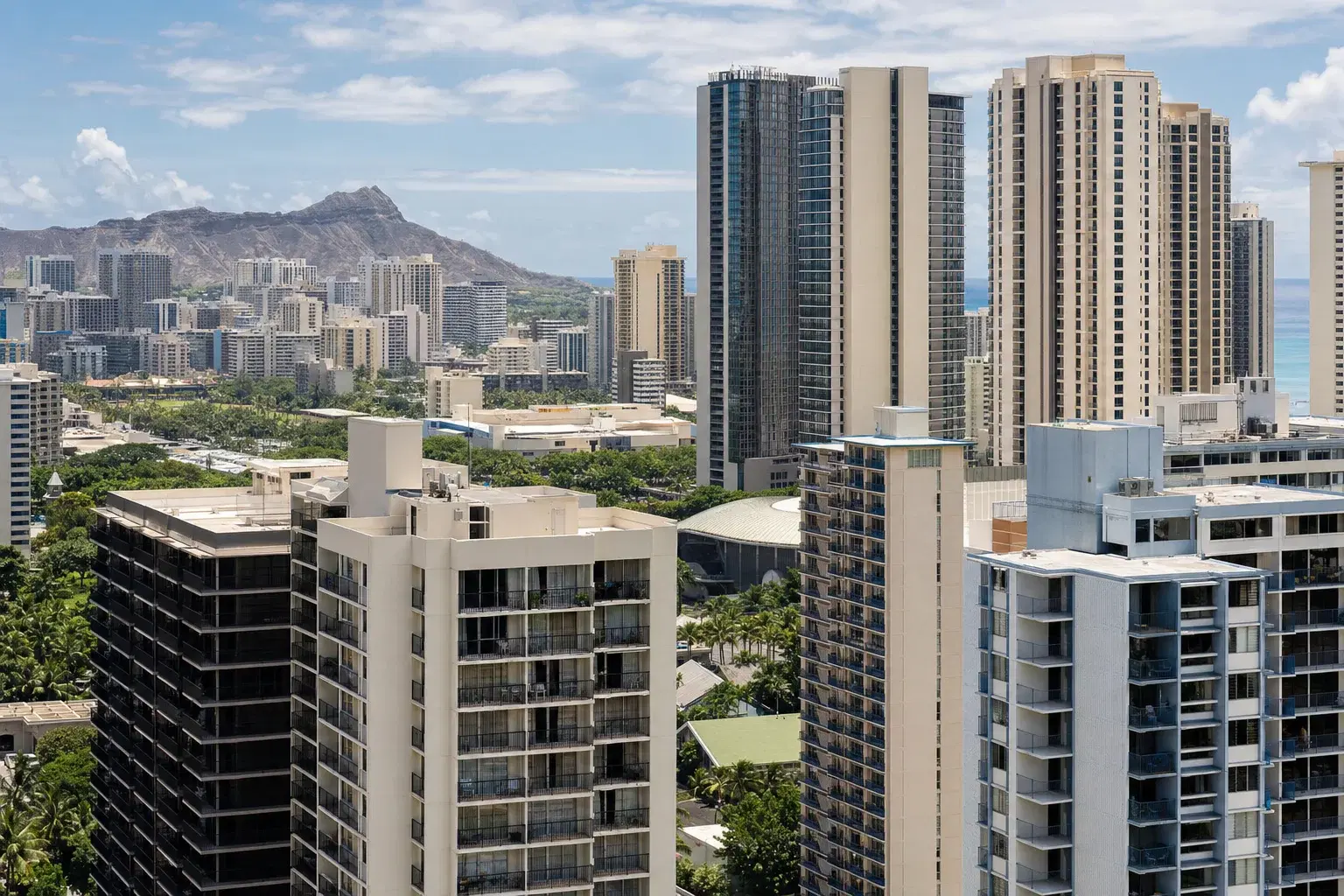
Waikiki is the obvious starting point. Many towers are older, dense, investor-heavy, and highly sensitive to insurance costs. Civil Beat reported that Waikiki Landmark experienced a 300% increase in insurance premiums in 2024, with owners paying an added $200 per month for 10 months through a special assessment. That is one building, not the whole neighborhood, but it captures the pressure points well. In Waikiki, weak collections can become a serious issue because a building may already be juggling insurance spikes, aging systems, use restrictions, leasehold complications, and turnover among non-owner occupants.
Kakaako and the Ala Moana urban core are different. Many of these towers are newer and trade at higher price points, but they also depend on sophisticated management. Here, buyers are often paying not just for finishes and amenities, but for the expectation of institutional-grade operations. If stronger manager credential standards pass, that could actually strengthen the competitive position of well-run towers while exposing buildings that have been coasting on appearance.
Salt Lake, Moanalua, and older mid-century stock may be the most vulnerable to collection risk in practical terms. These buildings are often more affordable on entry price, but many face plumbing replacement, spalling, elevator upgrades, or fire/life-safety work. In a lower-price building, even a modest delinquency rate can disrupt project timing because there is less financial cushion. That is why a bill like SB147 matters more than its title suggests.
How Governance Changes Translate Into Buyer Discounts or Premiums
The deeper story here is that condo law affects pricing by changing confidence. Buyers do not assign a line-item dollar amount to "ADR modernization" or "manager credential reform," but they absolutely price the outcomes those systems produce.
A building with chronic owner-board conflict, poor document access, and unresolved repair disputes tends to create hidden uncertainty. That uncertainty can show up as longer marketing times, lower offers, tougher lender scrutiny, or simply a narrower buyer pool. On the other hand, a building with current registration, transparent budgets, a recent reserve study, and a credible management team can defend its pricing better even if fees are high. In my experience, buyers will often tolerate high maintenance fees more readily than they will tolerate unexplained fees.
DCCA has noted that lenders recognize sufficient reserves as increasing both unit and project value. That matters because reserve strength is one of the clearest signals that governance is functioning. Hawaii has also tightened reserve study expectations in recent years, requiring independent review at least every three years in certain cases. Pair that with insurance stress-lawmakers cited a DCCA interim report showing residential high-rise property insurance premiums rising roughly 116% from 2020 to 2023 for affected properties-and the market has become much more sensitive to whether boards can execute under pressure.
I would put it this way: a "cheap" condo is often not cheap at all if the discount simply reflects weak governance and delayed liabilities. Buyers who focus only on the purchase price can miss the more important question, which is whether the building has the systems and leadership to manage the next five years without blowing up the ownership budget.
What Buyers and Sellers Should Be Asking Right Now
For buyers, the practical takeaway is to treat governance review as part of valuation, not as a legal afterthought. Ask whether the association is registered with DCCA and in good standing. DCCA says unregistered associations may lose standing in court and access to subsidized ADR, which can matter when disputes or collections become serious. Ask when the last reserve study was completed and whether it was independently prepared or reviewed. Ask about delinquency levels, recent insurance renewals, pending claims, active disputes, and the status of major capital projects.
For high-rises, ask who the managing agent is, what credentials they hold, and how much experience they have with similar buildings. That is especially important in larger Oahu towers where operations are complex and management quality can materially affect owner costs. Also review meeting minutes carefully for repeated references to deferred maintenance, insurance shortfalls, special assessment planning, or unresolved leaks and rule disputes.
Sellers should understand that in a softer condo market, a well-run building can become part of the value proposition. Strong records, current reserve studies, clear insurance summaries, and a straightforward explanation of repair timelines can reduce buyer fear. The market often punishes uncertainty more than bad news that comes with a credible plan.
Readers who want to verify project status should use official public resources. Association registration and condo-law guidance are available through Hawaii's Real Estate Branch at cca.hawaii.gov/reb. Bill language and current legislative status can be checked on the Hawaii Legislature's website at data.capitol.hawaii.gov. Buyers should also verify building and hazard information through Honolulu county resources and other official public databases rather than relying only on marketing materials. Building data online is helpful, but it always needs personal verification during due diligence.
The Bigger Outlook for Oahu Condo Values in 2026
There is a fair debate about whether more regulation will help or hurt. Supporters of these bills would argue that better-trained managers, more flexible dispute resolution, and clearer collection rules should improve governance and support values over time. Critics will say added standards can increase operating costs, shrink the manager pool, and create another compliance layer in a market already under pressure from insurance and maintenance inflation. Both arguments have merit.
But from a resale perspective, I think the more important point is this: the market is already separating buildings based on governance quality, whether legislators act or not. The 2026 bills simply make that separation more explicit. In Oahu's current condo market, strong management and transparent finances are becoming competitive advantages, while poor collections, unresolved disputes, and weak operational oversight are becoming visible pricing penalties.
This matters most in the neighborhoods where buyers have options. In Waikiki, stronger governance may help distinguish true residential buildings from towers weighed down by complexity. In Kakaako, management quality may increasingly justify premium pricing. In older, more affordable stock, collection discipline and reserve planning may determine whether a building stays financeable and livable for middle-class owners.
So yes, these are "back-office" bills. But back-office issues are now front-end pricing issues. When buyers ask me what makes one condo building safer than another, the answer is increasingly not just location or amenities. It is whether the association can collect, communicate, plan, and execute. That is governance. And in 2026, governance may be one of the most important value drivers in Oahu's condo market.
Sources: Primary sources include Honolulu Board of REALTORS® monthly Oahu market reports, Hawaii DCCA Real Estate Branch condo FAQs and commission materials, Hawaii Legislature bill text and status pages for HB1897, SB147, SB801, SB2297, and SB2295, plus Civil Beat reporting on insurance and condo governance pressures.
Disclaimer: This article is provided for general informational purposes only and does not constitute legal, financial, or real estate advice. Market conditions change frequently; readers should conduct their own due diligence and consult qualified professionals before making decisions.