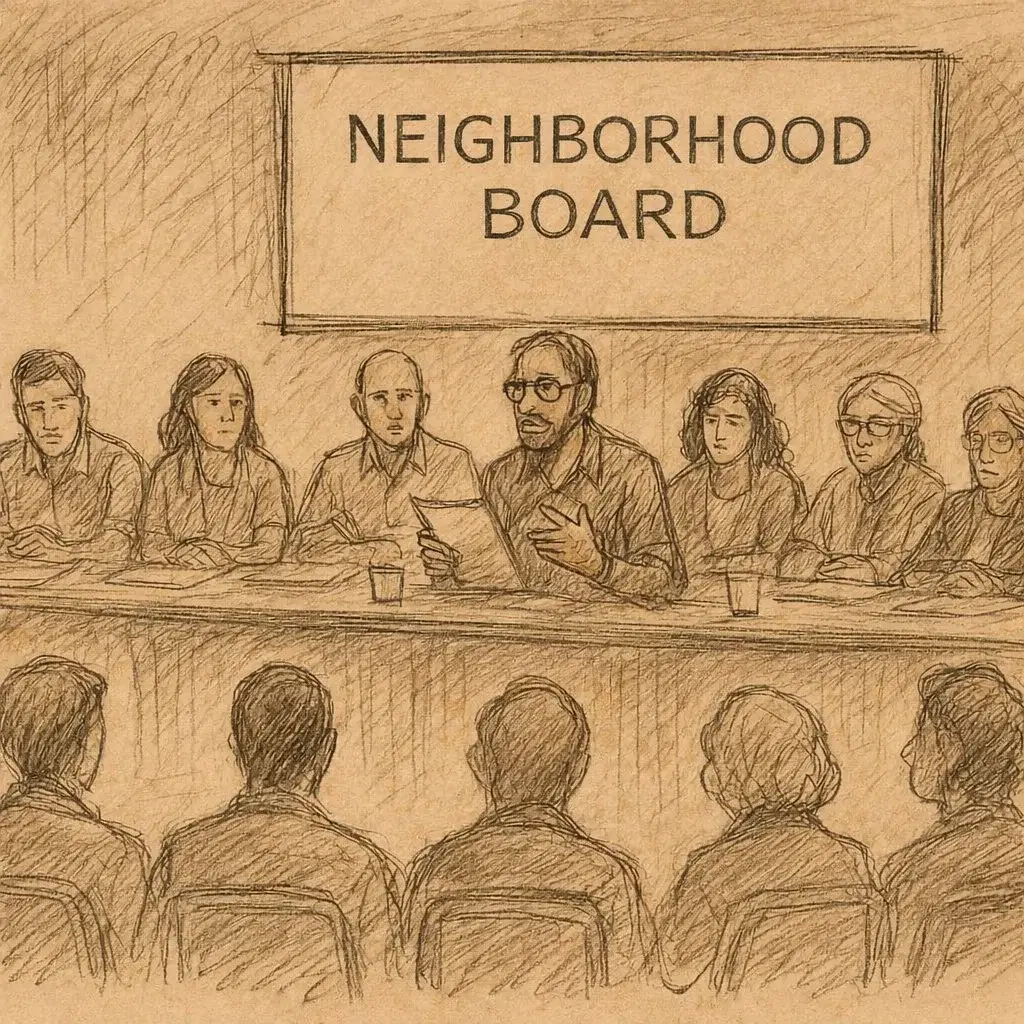
No 07 Mānoa Neighborhood Board Regular Meeting May 2026
Listen to this article:
7 Manoa Neighborhood Board Meeting – May 7, 2026
Meeting Opening, Quorum, and Agenda Change
The meeting opened shortly after 6:00 p.m. with roll call, and the board confirmed quorum with 13 members present. Early in the meeting, the chair announced that a scheduled presentation by Tom Eisen on Hawaiʻi’s environmental review process had been postponed because of time constraints. The chair also repeatedly noted that the board was under significant time pressure because a major resolution was expected to require lengthy discussion, and this shaped the pace of the meeting, with stricter time enforcement than usual and several later agenda items either shortened or deferred.
Honolulu Fire Department Report
The Honolulu Fire Department, represented by Chris Edwards of Manoa Fire Station 22, reported April response statistics for the neighborhood: one nuisance fire, five activated alarms with no fire, 38 medical incidents, one mountain rescue, and one hazardous materials incident. HFD directed residents seeking more detailed incident information to the department’s online fire response search tool. The month’s fire safety message focused on wildfire prevention as the area enters a higher-risk period marked by dry conditions, tall grass, and shifting winds. Residents were advised to clear dry brush around homes, avoid parking on dry grass because hot exhaust can ignite it, avoid spark-producing activities during hot, dry, windy conditions, and monitor weather and fire conditions through HFD and Hawaiʻi Wildfire Management resources.
Honolulu Police Department Report and Public Safety Concerns
Honolulu Police Department District 7, represented by Lieutenant Nakamura, compared April crime figures with the prior month. Motor vehicle thefts decreased from 19 to 14, burglaries rose from 3 to 4, general thefts increased from 12 to 16, and unauthorized entry into motor vehicles dropped from 4 to 2. HPD also reported 5,614 total calls for service. The police safety tip for the month was an emergency alerts subscription system accessible by QR code, although the lieutenant noted it requires residents to subscribe.
Public testimony and board discussion centered heavily on mopeds and small motorized vehicles. Board Member Harry Fox again pressed HPD to track moped thefts, especially around the University of Hawaiʻi at Mānoa and lower Mānoa, describing repeated complaints from students who purchase mopeds and lose them within days. He described a method previously used in Long Beach that mapped theft locations to identify “chop shop” centers. Another resident and board member described groups of riders in black clothing and face coverings operating loudly on two-wheelers around Seaview Place and nearby streets, allegedly setting off car alarms and running red lights. HPD encouraged immediate 911 reporting when the riders are actively present, noting the difficulty is catching them in the moment.
Additional concerns included a malfunctioning pedestrian push-button and crosswalk signal on University Avenue near the university bookstore during rush hour. HPD said traffic signal maintenance falls under city traffic authorities, but an officer would check and notify the appropriate city staff. A member of the public also raised concern that many moped riders are not wearing helmets despite the recently passed helmet law. HPD confirmed helmets are now required for mopeds and motorized bicycles and said enforcement is underway alongside public education. Another board member asked whether carrying two people on a moped is legal; HPD responded that it is not and described it as dangerous because it overloads brakes, suspension, and engine components and would result in a citation if observed.
At the end of HPD’s report, the lieutenant also responded to an issue raised in a prior written letter about green waste in the stream, explaining that enforcement and investigation of stream dumping and related maintenance issues fall under the Department of Facility Maintenance rather than HPD.
Board of Water Supply Report
Board of Water Supply representative Dominic Diaz reported that there were no water main breaks in Mānoa during April and no active BWS construction projects in the neighborhood. Even with recent rains, BWS emphasized continued water conservation heading into summer and reminded residents to monitor for leaks, shorten showers, and water yards during morning or evening hours. The report was brief but underscored the ongoing seasonal concern that heavy rainfall does not eliminate later summer water-use pressures.
Mayor’s Office Report: Flood Recovery, City Follow-Up, and Ala Wai Bridge Questions
Deputy Director Gavin Thornton, representing Mayor Rick Blangiardi, reported that the City and County of Honolulu continues cleanup and recovery work with community, state, and federal partners following three consecutive weather systems that caused major flooding. Residents were directed to oneoahu.org for information on reporting home damage, health and safety guidance, assistance programs, and ways to support affected communities, and to use HNL311 to report specific needs such as potholes and other damage.
Thornton said he had followed up on concerns raised at the previous board meeting by preparing a memo for the Department of Facility Maintenance and the Department of Emergency Management. He also reported that Board Member Fox’s request for a meeting with the Department of Facility Maintenance director had been accepted and that broader participation by others might be useful because of the range of flood-related concerns raised.
However, the Department of Facility Maintenance had not yet responded substantively to several flood-related questions, and the city deferred those answers until the next month. The unanswered subjects included a post-disaster analysis, a flood warning system for Mānoa Stream, more proactive drainage clearing near the Chinese Cemetery, stronger enforcement of stream maintenance rules, regular inspections and walkthroughs of Mānoa Stream, and targeted stream cleaning or dredging. Thornton did note that after the prior meeting DFM sent crews to clean the stream in advance of a later storm that ultimately was not severe.
The mayor’s report also addressed a resident question about why the city’s Department of Transportation Services appeared to be moving quickly to seek contractors for the Ala Wai bridge project before receiving a finding of no significant impact. DTS’s response was that it had decided to use a design-build process to allow alternative bridge configurations in response to community feedback, and that the early request for qualifications was intended to maximize time for contractors to develop options before final request-for-proposals release. Federal consulting parties would also be invited to evaluate alternatives. Community members strongly objected to the characterization that the bridge design was “sought by the community,” stating that the community had not requested any design and that the process was being pushed forward before environmental review was complete. Thornton acknowledged unfamiliarity with the details and offered to relay concerns more accurately or help connect residents directly with DTS.
A final issue raised to the mayor’s office involved pigeon populations near the transit stop by the World War II Memorial at Punchbowl and South King Street. The city responded that pigeon control is not under county jurisdiction and referred residents to the Hawaiʻi Department of Agriculture.
City Councilmember Scott Nishimoto’s Office
Keith Williams from Councilmember Scott Nishimoto’s office reported that after the prior meeting the office met with Department of Facility Maintenance Director Roger Babcock Albano and presented Scott Snyder’s flood-related letter along with community complaints. DFM asked staff to prepare a formal response to the letter, which Williams said was expected by May 12 and should be available for the board by the next meeting. During public questions, residents asked about spray-painted utility or wastewater markings on Lahaina/Lowrey-area infrastructure, but neither the council office nor the mayor’s representative had an immediate answer and both offered to inquire. A board member also criticized a pilot program involving food waste in green bins, arguing it would attract flies, maggots, rats, and improper disposal of mixed trash because green waste is only collected every other week. Williams said he would pass that feedback to the councilmember.
State Senate Report: Budget, Storm Damage, and Neighborhood Board Legislation
Senator Carol Fukunaga said the state budget includes additional funding for emergency response agencies in reaction to the flooding and associated damage concerns previously raised by the community. She emphasized that residents should continue reporting all storm-related damage, even minor damage, because a complete record helps support repairs to sewer systems, storm drains, and other infrastructure overwhelmed during the March 23 storm event.
A separate line of questioning focused on Senate Bill 2397, legislation affecting neighborhood board operations. A board member said he had heard that part of the measure intended to help neighborhood boards had effectively been “cut in half.” Senator Fukunaga explained that the bill had been amended in conference committee in response to testimony expressing concern that allowing a majority of a quorum to act could result in very small numbers of members making decisions for a board. She indicated she did not necessarily think the solution adopted was the best one, but parts of the bill remained beneficial and parts would still need improvement. She also noted the effective date is the beginning of 2027, leaving time for boards to review and understand the final language.
State House Report: Legislative Session End, Capital Projects, and Stream Dredging Request
Representative Andrew Takuya Garrett joined by Zoom and said the legislature was nearing adjournment, with roughly 215 bills voted on that day and only two days remaining in the session before sine die. He said a newsletter would be distributed within one or two weeks summarizing bills of interest to the district and detailing capital improvement projects and grant-in-aid funding secured for the area’s nonprofit community.
A board member asked about a statement by Department of Transportation Director Ed Sniffen after the floods that the state needed about $15 million to dredge streams and rivers more thoroughly, including upstream and downstream areas rather than just around bridges, because silt from unmanaged reaches had flowed into problem areas. Garrett said he did not have the answer at hand because of the size of the state budget bill but would look into whether that request was funded and send information to the chair for distribution.
Another board member asked whether there was any update on reopening Mānoa Pool. Garrett said pools are a city rather than state matter and that his last information from the city had pointed to late March, then late April, but that Kona storm impacts had likely caused delay. He suggested the mayor’s office or council office seek a definitive answer from Parks and Recreation.
University of Hawaiʻi at Mānoa Report
University representative Elmer Kai reported that May 7 was the last day of instruction for the semester and final examinations would begin the following week. Commencement season was also beginning, with West Oʻahu ceremonies at Stan Sheriff Center, community college commencements the following week, and UH Mānoa’s graduation split into morning and afternoon ceremonies on Saturday because of the event’s size.
Kai also announced that the university had begun the search for a new Mānoa chancellor and is shifting back from a provost model to a chancellor structure, meaning the role will oversee the entire campus rather than just academic affairs. Three candidates were identified, including the current interim provost and two others.
He followed up on two prior requests from board members. First, regarding lights and alarms at the Shidler College area, he said the university had checked the issue and would make sure nightly procedures are reviewed, though some alarms may still be triggered by campus activity. Second, regarding flood mitigation around Hamilton Library, he noted the major Hamilton flood occurred in 2004 and that drainage improvements had since been made, with campus water flow patterns now very different.
The discussion then shifted to mopeds and the neighborhood impact of student and worker parking. Board Member Fox complained that mopeds are regularly parked on front yards and adjacent streets around University Avenue and Maile Way, spilling several blocks into the neighborhood, and said calls to HPD had not solved the problem. He asked UH to communicate more forcefully with students not to burden neighboring streets. Kai said the university already sends monthly reminders encouraging students to be good neighbors and has designated moped parking areas, but noted that not all moped users are students. He also said UH public safety lacks authority to ticket or tow outside campus jurisdiction. Another resident praised recent redesign work on Dole Street crosswalks but asked whether additional lighting or warning signage could be added because students crossing unexpectedly from behind parked cars had contributed to a rear-end collision involving a driver with infant children in the car. Kai said he would check on whether additional improvements could be made.
The meeting also briefly touched on future use of the former College of Education property. A resident asked whether further development proposals for the large grassy area had been abandoned or put on hold, and Kai replied that most such plans had indeed been put on hold and that a fuller update could be provided later.
Governor’s Office Report
Governor Josh Green’s representative, Lisa Goshi, gave a concise disaster-recovery update. She said the state continues repairing roads and infrastructure and connecting flood-impacted residents with case managers who can help navigate housing support and financial assistance. Residents needing help were encouraged to call 211 for disaster recovery services. She also highlighted a post-disaster insurance claims guide and instructional video developed by the Department of Commerce and Consumer Affairs and provided DCCA’s contact information, including the 1-844-808-DCCA number and its website for claims assistance and insurance-related concerns. Hard copies of the governor’s newsletter were distributed.
Flooding in Mānoa and Oʻahu: Community Discussion and Correspondence
The board moved the flooding discussion ahead of some later agenda items because of strong community interest. The chair summarized follow-up actions since the April meeting. Scott Snyder’s letter calling for stronger enforcement of existing stream laws had been forwarded to city officials. Resident Amy Grace and others had sent a letter to the governor and mayor recommending multiple flood-mitigation strategies, including policy changes and new infrastructure. The chair had also sent a letter to the state legislature and city council budget committees requesting funding for flood relief and mitigation while those budgets were still under consideration. A board member raised a procedural concern that the chair had sent that letter on behalf of the board without prior board approval, though he acknowledged the time-sensitive budget schedule and said he likely would have done the same in that situation. The chair said he would try to use an emergency meeting process in the future when needed.
Residents then described repeated flood damage. One resident from Palolo/Pamora/Pamola Road said his home had flooded three times, including in 2004 and again recently, and that after the 2004 event residents had asked for the area to be designated as a flood zone but were refused. He said the repeated flooding is now damaging structures to the point they can barely withstand more events.
Later in the meeting, another longtime resident discussed stream maintenance responsibilities, saying that in many places property owners on opposite banks each own to the middle of the stream and are responsible for clearing vegetation, while acknowledging that homeowners cannot reasonably deal with large logs and major debris washed down during flash floods. He cautioned that dredging proposals need to consider impacts on stream life, including native species such as ʻoʻopu, ʻōpae, and hīhīwai, while recognizing that human safety and property protection remain the immediate concern. Another resident connected flood concerns to storm drain ownership confusion near lower Mānoa Road and the Chinese Cemetery, describing a patchwork in which runoff reportedly passes from state land into private ditches, then city structures, then back into private and state systems. He said family members had been trying unsuccessfully to get city attention to a clogged drainage situation for years and raised concern that graveyard runoff and debris could worsen in severe storm conditions.
Vacancy in Subdistrict 4
The chair briefly paused to ask whether any resident from Subdistrict 4 was present and prepared to fill the board’s one existing vacancy for that subdistrict. After explanation that proof of residence would be required, no one came forward to fill the seat.
Reconsideration and Defeat of the Sidewalk Resolution
The most extensive and contentious discussion of the evening concerned the board’s April 2026 resolution urging sidewalk construction in Mānoa. The chair explained that after the April vote, a board member said she had misunderstood the issue and wanted her vote changed from yes to no. The chair also noted that 14 written testimonies had been received from community members and all 14 opposed the resolution. Because the board had already passed the measure in April, it first had to decide whether to rescind the previous action and reopen the issue.
The original resolution cited the Oʻahu Pedestrian Plan, complete streets policy, safe routes to school, and the lack of sidewalks on major connector streets such as Lowrey Avenue, Cooper Road, Hale Lani Place, Kahawai Street, Hualālai/Hualapai/Huelapala route segments, and others between the valley’s major arterials. It also referred to federal infrastructure funding under the Infrastructure Investment and Jobs Act. As amended in April, it urged the city to devote more resources to sidewalk installations, ensure existing Tier 1 projects move forward, and add sidewalks on cross streets in Mānoa, especially Lowrey Avenue, while limiting the requested Lowrey sidewalks to one side of the street and avoiding tree removal.
Board members discussed whether rescinding the prior vote was procedurally proper under Robert’s Rules. It was explained that with sufficient advance notice and a motion by someone on the prevailing side, rescission was allowed. Several members supported rescission because the mistaken vote had been decisive; the April resolution had received the required nine affirmative votes only because that member had voted yes. Others argued that reopening a vote should be rare and questioned whether this would set a bad precedent. After roll call, the motion to rescind passed 10-2 with 2 abstentions.
Once the matter was reopened, the board debated the substance intensely. Supporters of the resolution argued that the issue was public safety and accessibility, not aesthetics. They cited people in wheelchairs, people using walkers, parents pushing strollers, and schoolchildren needing safe routes, particularly on Lowrey Avenue, which was described as a heavily used east-west connector across the valley. One member said she had photographs of wheelchair users and parents with strollers forced into the roadway because no sidewalks exist. Another invoked the city’s complete streets and school safety policies and argued that opposition from vocal residents should not erase the needs of pedestrians who may be less likely to attend meetings or submit testimony.
Opponents said the community had clearly rejected sidewalks and that the board’s role is to reflect neighborhood wishes, not impose projects developed by a small committee without broad resident input. They argued that grassy shoulders and tree-lined lanes are a defining part of Mānoa’s historic and residential character and warned that sidewalks could alter neighborhood ambience, increase heat, remove mature trees, and open the door to more traffic and development. Some said sidewalk proponents were overstating safety concerns and that walking on grass is not inherently dangerous. One member went further and argued that wheelchairs and strollers in the street create a traffic hazard and should not be used as justification for forcing neighborhood changes, suggesting alternatives such as TheHandi-Van or driving to destinations. That position drew a forceful response from a resident on Zoom, who called the remarks shocking, described the practical burden of loading twins into a car just to travel a short distance within the neighborhood, and argued that failing to improve pedestrian conditions would amount to negligence.
During the debate, an amendment was proposed to broaden the “one side only, no tree cutting” limitation so that it would apply to any new sidewalks referenced in the resolution, not just Lowrey Avenue. The amendment was accepted into the discussion, but confusion over procedure and ongoing objections continued. Ultimately, after further debate and calls to close discussion, the board voted by roll call on the resolution itself. The result was 7 yes, 8 no, with no abstentions. Because neighborhood board resolutions require nine affirmative votes to pass, the resolution failed. The board therefore reversed its April action and ended the evening without an active board resolution supporting new sidewalk construction in Mānoa.
Other Community Update Items Deferred or Without New Information
After the sidewalk vote, the board quickly returned to several deferred community update items. No one offered updates on Manoa Banyan Court, Aria Lane, Ala Wai flood mitigation, or the UH Ewa property feasibility study concerning the UH Lab School land. The previously scheduled presentation on Hawaiʻi’s environmental review process was officially postponed to a future meeting because there was no time left to hear it.
Approval of March and April Meeting Minutes
The board approved the March 4, 2026 meeting minutes and the April 1, 2026 meeting minutes by acclamation, allowing minor non-substantive and technical corrections. One such correction noted during discussion was that “Heath Williams” should include the final “s.” A board member complimented staff on the unusually detailed minutes.
Late Community Concerns: Ala Wai Ferry Idea, Stream Ecology, and Sidewalk Tradeoffs
In the final public comment period, resident Laura Ruby attempted to share materials for a future idea related to the Ala Wai crossing issue. Unable to screen-share, she described the concept verbally: a small ferry, roughly bus-sized, crossing the canal using Holo card-style boarding, with one operator, ADA-accessible ramps, and small docks on each side. She said it would allow pedestrians and bicyclists to cross without the larger impacts of a major bridge and would avoid opening the route to mopeds, a concern raised elsewhere in the meeting.
Another resident returned to the flood discussion and emphasized that while clearing and flood safety are necessary, major dredging could damage native stream species and should be approached carefully. A separate speaker, longtime resident Linda LeGrand, urged balancing safety, aesthetics, and environmental concerns in the sidewalk debate. She noted that much of Mānoa already has sidewalks in some areas, while other places retain broad green verges. She also said she did not trust assurances that trees would be preserved, arguing that once a city project begins, practical construction pressures can overtake promises made in a resolution.
Next Meeting and Closing
The chair announced that the next regular meeting will be held on Wednesday, June 3, 2026, at 6:03 p.m. at Noelani Elementary School cafeteria and online via Webex. Residents were reminded that board meetings can also be viewed on ʻŌlelo Channel 49 on the fourth Saturday of each month at 3:00 p.m. or on YouTube through the links provided on the agenda. With no further announcements, the meeting adjourned.