West Oahu Rail Condos: The Next Affordability Map
Listen to this article:
From Drive-Til-You-Qualify to Rail-Til-You-Qualify
For decades, O'ahu's housing story pushed buyers west with a simple logic: if you couldn't afford town, you drove until you qualified. 'Ewa, Kapolei, Waipahu, and Pearl City were defined by car commutes, shopping centers, and single-family/townhouse product. Condos existed, but the investment spotlight stayed on urban Honolulu - Waikiki, Ala Moana-Kaka'ako, Makiki, and older Metro walk-ups.
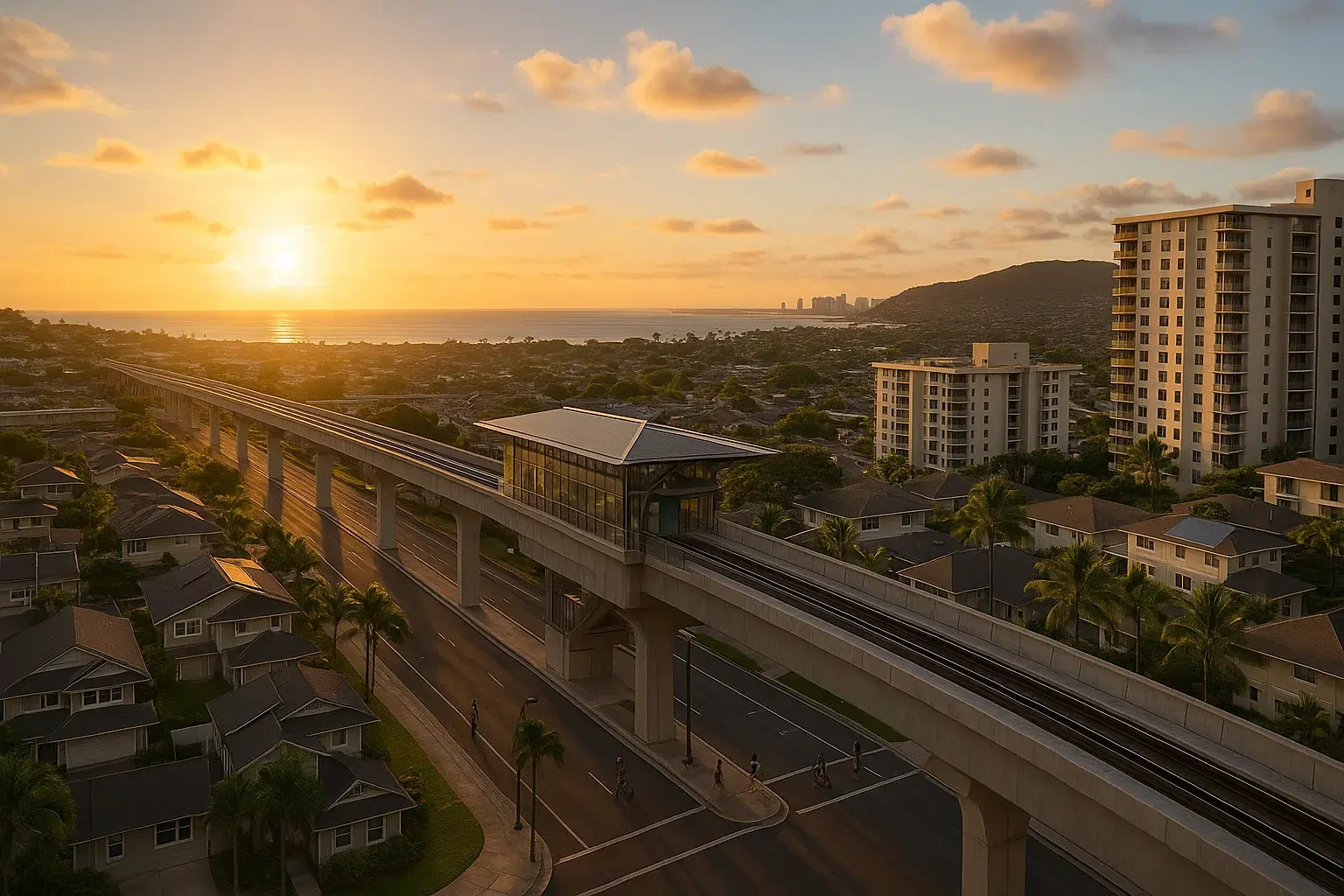
Skyline and Transit-Oriented Development (TOD) are quietly rewriting that map. The elevated, driverless rail line now operates from East Kapolei to Aloha Stadium, with 19 stations ultimately planned from East Kapolei to Civic Center. Around key stations - Hoaeae (West Loch), Pouhala (Waipahu Transit Center), Halaulani (Leeward CC), Waiawa (Pearl Highlands), Kalauao (Pearlridge), and Halawa (Aloha Stadium) - the State and City have drawn TOD special districts within roughly a ½‑mile radius, with higher heights, more mixed-use, and lower effective parking requirements.
At the same time, island-wide multifamily occupancy sits above 90%, effective rents are near $2,900 per unit, and new rental supply is modest. Condo medians have flattened around $500,000 island-wide, but the pattern is important: in-town Metro medians slipped 2-4% in 2024, while West O'ahu condo markets from Makakilo through Pearl City-'Aiea nudged up only 1-2%. That means West O'ahu remains cheaper than in-town, but the discount is compressing slowly - exactly the kind of environment where transit and zoning can start to move cap rates.
Instead of debating rail politics, it's more useful to ask: along Skyline's West O'ahu spine, where are today's condo cap rates still meaningfully higher than in Waikiki or Kaka'ako, and how will TOD zoning, parking policies, and amenity growth reshape that spread over the next decade?
Today's Discount Map: Where West O'ahu Still Out-Yields Town
To build a "future cap-rate map," you first need today's yield baseline. In-town, investors often trade yield for brand and liquidity. Waikiki's median condo price has hovered in the mid-$400,000s (about $435,000-$447,000 in 2024-2025), Ala Moana-Kaka'ako posted ~5% gains in 2024, and many newer towers carry high maintenance fees. Effective gross yields on long‑term rentable studios and one‑bedrooms in these areas often land in the 3-4% range before AOAO fees and taxes, and net yields can dip notably lower once expenses are accounted for.
By contrast, core Metro neighborhoods like Makiki-Mo'ili'ili or Moanalua-Salt Lake, with 2024-2025 condo medians around $375,000-$440,000, tend to offer slightly better yields but face aging infrastructure, rising insurance, and special assessment risk. Investors here are balancing higher rent-to-price ratios against building‑level risk and regulatory uncertainty.
West O'ahu's rail corridor still trades at a discount to both of these. Pearl City-'Aiea's condo median has run roughly $470,000-$482,000, with modest 1-2% annual gains. Waipahu and the broader 'Ewa/Leeward condo stock isn't split out cleanly in public medians, but sales and brokerage reports show prices meaningfully below in‑town luxury and a bit below or near Metro medians, even as rents are supported by tight island‑wide occupancy.
When you blend lower acquisition prices with comparable or slightly lower rents, you typically get a gross yield bump of 50-150 basis points versus Waikiki or Kaka'ako entry‑level units. That spread is widest in older 1980s-1990s mid‑rise buildings within a 10-15 minute walk of Skyline stations in Waipahu and Pearl City-'Aiea. Those projects are not branded as "transit‑oriented," but the math already reflects a quiet, rail‑adjacent cap-rate advantage.
How TOD Zoning and Parking Rules Push Cap Rates in West O'ahu
The crucial driver behind a future cap‑rate map isn't just the train; it's the zoning and parking math baked into TOD plans. Around West Loch, Waipahu Transit Center, Leeward CC, Pearl Highlands, Pearlridge, and Halawa, the City's TOD special district ordinances typically allow greater height and floor area ratios, encourage mixed-use (residential over retail), and support more walkable street grids. The Halawa/Aloha Stadium TOD Plan goes further, calling for a new entertainment district, high‑density mixed‑use around the station, and a "district‑wide parking strategy to reduce total parking required."
Why this matters for investors is straightforward: every stall of structured parking in Hawai'i often adds tens of thousands of dollars in hard costs per unit. If TOD allows developers to build at 0.7-1.0 stalls per unit instead of 2.0+, they can deliver more units per acre at a lower cost basis. Combine that with mid‑rise, efficient building forms, and you have a recipe for new condos priced below Kaka'ako's luxury towers but serving similar commuting needs once Skyline reaches Downtown and Civic Center.
That competition puts a ceiling on in‑town cap rates and a floor under West O'ahu values. If a 2028 Pearl Highlands mid‑rise can offer a 2BR unit at 15-25% less per square foot than an older Makiki or Kalihi walk‑up, but with faster rail access, predictable parking, and modern systems, renters will pay a slight premium for the rail‑served location. Over time, that pushes up rents relative to prices, compressing cap rates toward in‑town levels while still giving early buyers a yield edge.
From a long‑term standpoint, TOD zoning also embeds "land lift" potential into older low‑rise condos within the district. Even if the buildings remain rentals for years, their dirt is governed by a much more generous envelope than when they were built - a latent value many current prices do not fully reflect.
Station-by-Station: Where the Future Cap-Rate Map Is Forming
Not all Skyline stations are equal from an investment standpoint. Along West O'ahu, several clusters stand out as emerging cap‑rate corridors.
- East Kapolei / Honouliuli (Ho'opili): New townhomes and low‑rise condos near the Honouliuli station benefit from modern construction and walkable or short‑shuttle access to rail. Prices are higher than older Waipahu stock but below Kaka'ako; 2-3 bedroom units with 1-2 stalls and moderate AOAO fees can offer stable, family‑oriented rents. Here the thesis is long runway: as employment nodes build out along the line, rail‑served Ho'opili product should see cap‑rate compression versus non‑rail Leeward areas.
- Waipahu corridor (West Loch and Waipahu Transit Center): These TOD districts surround mostly 1980s-1990s concrete mid‑rises with surface parking. Today they trade at a discount due to age, past flooding concerns, and perception of crime, yet they now sit within up‑zoned envelopes. Yield‑oriented investors can still find higher gross cap rates here, especially in 2BR units, while quietly gaining future redevelopment optionality as land values respond to TOD zoning.
- Pearl City-'Aiea (Pearl Highlands and Pearlridge): With condo medians around $470,000-$480,000 and strong sales volume growth, this is the sweet spot where accessibility, price, and TOD align. Many mid‑rise buildings within a 10-15 minute walk of the stations already command better rent‑to‑price ratios than Waikiki, and as Skyline extends east, expected commute‑time improvements should justify gradual rent premiums.
- Halawa / Aloha Stadium: Inventory is thinner, but the TOD plan envisions a dense entertainment and residential district. Nearby condos priced like typical 'Aiea stock today could see a two‑stage upside: first from added amenities and jobs, then from possible redevelopment bids if AOAO boards decide their low‑rise sites are worth more as land under the new zoning.
Across these clusters, the best future cap‑rate candidates share three traits: within a verified 10-15 minute walk of a station, inside a TOD special district, and offering functional parking ratios (around one stall per unit) without resort‑style AOAO overhead.
How a Savvy 2026 Buyer Can Front-Run TOD-Driven Cap Rates
By 2026, Skyline service should be more familiar, but much of the TOD‑driven vertical product will still be on paper or in early construction. That creates a window where investors can buy existing buildings at today's pricing while underwriting tomorrow's accessibility and zoning.
Geographically, the most compelling balance of risk and return sits in Pearl City-'Aiea and Waipahu's TOD zones, with a secondary, longer‑horizon play around Halawa. In Pearl City-'Aiea, concentrate on 1970s-1990s mid‑rise condos within a documented 10-15 minute walk of Pearl Highlands or Pearlridge stations, and verify they are inside the TOD district boundaries on City and State maps. In Waipahu, target 2BR units in rail‑adjacent projects that appeal to local working households; here you're seeking above‑average gross yields today plus future rent lift as station areas gain streetscape, retail, and services.
Unit selection matters. For West O'ahu TOD locations, 2BR/1-2BA layouts usually offer better rent per purchase dollar than studios, because the tenant base is more family‑oriented than resort‑oriented. Mid‑stack units avoid some of the noise and security issues of ground floors and the roof/elevator exposure of top floors. One deeded parking stall is typically the sweet spot - you want to serve car‑owning households in the near term without overpaying for stalls that may not command equivalent rent as transit usage grows.
Equally important are governance and rentability rules. Focus on buildings that allow 6-12 month leases, are not dependent on sub‑30‑day vacation rentals, and have transparent AOAO reserves and insurance strategies. Read minutes for signs of looming special assessments or potential en‑bloc sale discussions. The best 2026 buys will look boring on paper - solid, rentable units in older buildings with no headlines - but they sit on TOD‑enhanced dirt that rail, zoning, and time are working in your favor.
Risks, Reality Checks, and How to Stress-Test Your Assumptions
No cap‑rate map is guaranteed, and rail doesn't magically fix every sub‑market. Construction delays, cost overruns, or policy changes can push back the date when full Downtown and Civic Center connectivity is realized. Some station areas face legitimate concerns about flooding, crime, or infrastructure; if those aren't addressed, rent growth could lag expectations and leave yields closer to today's levels than hoped.
Older buildings carry their own set of risks: rising insurance costs, aging plumbing and electrical systems, and potential special assessments that can wipe out years of cash flow. AOAO governance can make or break an investment; a board that under‑reserves for future repairs may keep fees artificially low now but set up painful assessments later, particularly in a climate‑exposed, high‑cost market like O'ahu.
To stress‑test a future cap‑rate play, underwrite conservatively. Use modest rent growth assumptions (in line with CBRE's expectations for muted near‑term growth), build in higher AOAO and insurance costs, and ask whether the deal still works if cap‑rate compression takes an extra five years or never fully converges with in‑town levels. Pay attention to neighborhood‑level trends - planned parks, schools, drainage, and crime stats - not just the station name.
Finally, be clear about your time horizon. TOD‑driven value shifts tend to be slow and uneven. If you need a quick flip, these corridors may frustrate you. If you can hold through a full rail build‑out cycle into the early 2030s, and you're disciplined about building selection, West O'ahu's condo corridors offer a rare combination on O'ahu: relatively attainable entry prices today with a credible path to in‑town‑adjacent rents tomorrow.
Sources: Analysis based on Honolulu rail/Skyline project documentation, State and City TOD maps and plans, Honolulu Board of REALTORS regional condo median and volume data, CBRE Honolulu multifamily reports, and brokerage market summaries for 2023–2025. Building-level yield examples are inferred from regional pricing and rent patterns and should be verified with current MLS data and official public resources.
Disclaimer: This article is provided for general informational purposes only and does not constitute legal, financial, or real estate advice. Market conditions change frequently; readers should conduct their own due diligence and consult qualified professionals before making decisions.