Ulana's New Resale Rules and Condo Liquidity
Listen to this article:
Ulana Is Really a Liquidity Story, Not Just a Rule-Change Story
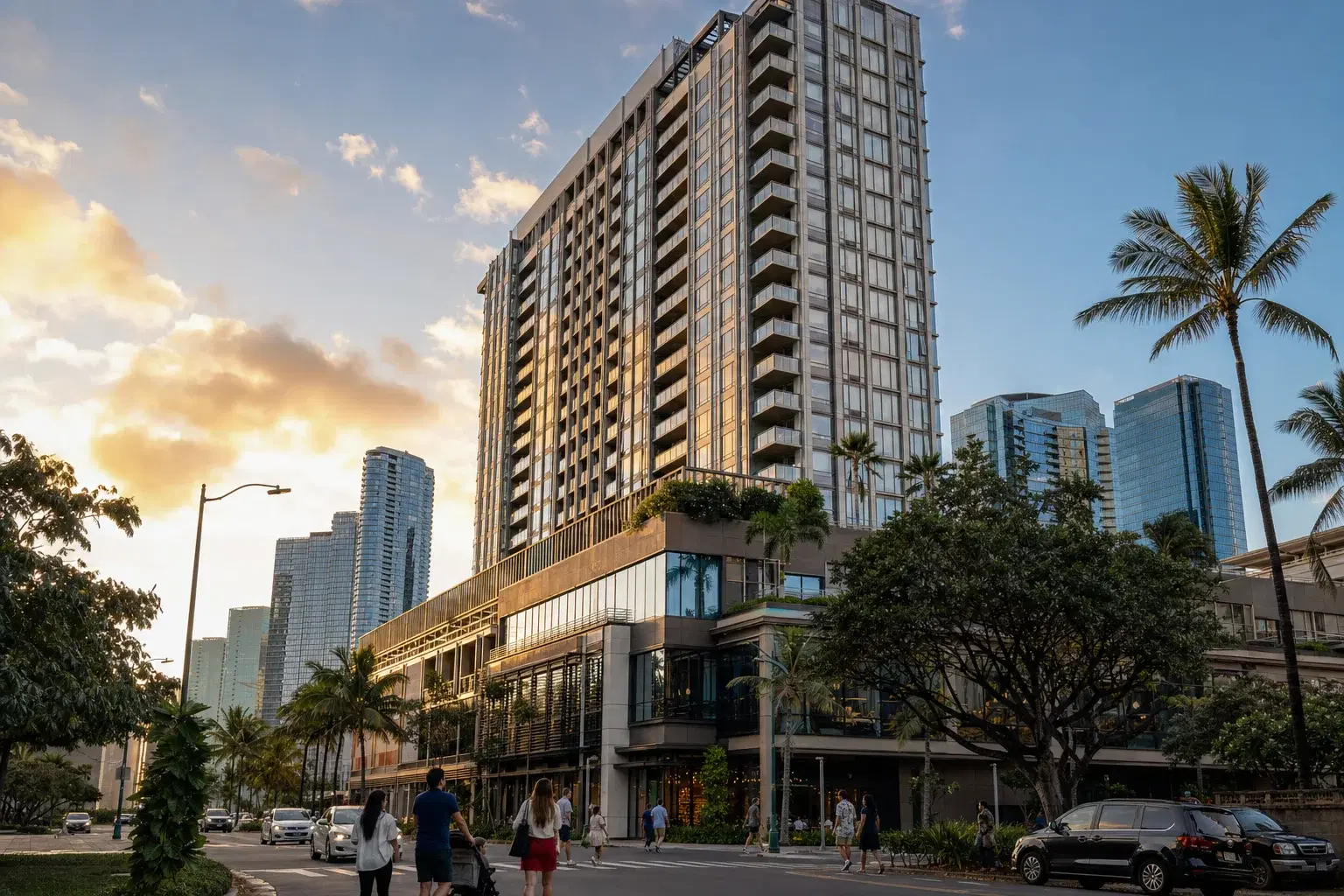
Ulana Ward Village's resale-rule change matters for a simple reason: it shifts the discussion from affordability at purchase to liquidity at resale. On HCDA's May 6, 2026 Kaka'ako agenda, the agency approved an additional pathway allowing Ulana owners to use their own brokers to sell during the regulated term to HCDA-qualified buyers, subject to HCDA approval. That does not remove the reserved-housing framework. It does, however, acknowledge that resale friction had become too important to ignore.
Ulana is the right project to watch because it is not a niche building. It has 697 reserved-housing units, making it the largest reserved-housing tower in Kaka'ako and nearly double Ke Kilohana's 375 reserved units. Its mix includes 123 studios, 205 one-bedrooms, 246 two-bedrooms, and 123 three-bedrooms. Regulated owner-occupancy terms range from 2 to 10 years, with 52 units under 2-year terms, 501 units under 5-year terms, and 144 units under 10-year terms.
That scale is what makes Ulana more than a project-specific story. HCDA estimated in 2025 that historical experience suggested roughly 10% to 14% of Ulana owners-about 69 to 97 units-could seek resale during the regulated term. In a softer O'ahu condo market, that is not a theoretical issue. It is a stress test for whether reserved-housing condos can trade efficiently enough to preserve buyer confidence.
In my view, Ulana is becoming the clearest local case study of whether a condo can be affordable on entry but still carry an exit penalty substantial enough for buyers to price in a discount.
Why Reserved-Housing Units Likely Trade With More Friction
The best way to analyze Ulana is not to ask whether reserved housing is "good" or "bad." The better question is whether reserved units behave like a distinct asset class within Honolulu's condo market. Increasingly, the answer appears to be yes.
During the regulated term, Ulana owners face several layers of resale friction that unrestricted condo owners do not. The buyer pool is narrower because purchasers must satisfy HCDA qualification standards. Owner occupancy is required during the regulated term, which removes investor demand and limits flexibility for owners whose life circumstances change. HCDA also retains a first option to purchase, and the buyback structure is formula-based rather than fully market-driven. Even after the regulated term, shared-equity obligations and release requirements do not simply disappear from the closing process.
That combination matters because liquidity is not just about price. It is about how many willing buyers exist, how quickly a deal can close, how much uncertainty sits in the approval process, and how many brokers are motivated to participate.
- Narrower buyer pool: qualified buyers only during the regulated term
- Occupancy restrictions: limits investor and second-home demand
- Administrative approvals: HCDA review can affect timing and certainty
- Pricing structure: buyback formulas can constrain market response
- Shared equity: affects seller proceeds and buyer understanding
That does not necessarily mean reserved units are poor values. For qualified local buyers shut out of unrestricted Kaka'ako, they can offer a genuine path into a neighborhood that would otherwise be difficult to access. But from a resale standpoint, these units almost certainly carry more friction during the regulated term than comparable unrestricted units nearby in Kaka'ako, Ala Moana, or Waikiki.
The Case for a 'Liquidity Discount'-and the Limits of That Theory
Based on the public record, a regulated-term liquidity discount is the most plausible working theory for Ulana and similar reserved-housing condos. I would define that discount not simply as a lower sale price, but as the combined effect of longer marketing time, more uncertainty, thinner demand, and less pricing freedom relative to unrestricted condos.
The broader market backdrop supports that concern. The Honolulu Board of Realtors reported that O'ahu condo median days on market rose from 30 days in 2024 to 44 days in 2025, while sellers received a median 96.6% of original asking price, down from 98% the year before. Locations reported that in April 2026, resale condos had a median market time of 41 days, and only 16% sold above asking, compared with 32.6% of single-family homes. In other words, Ulana's resale mechanics are being tested in an already slower condo environment.
There is also an early anecdotal signal from Ulana itself. Unit #810 reportedly sold on March 4, 2026 for $523,800, then was relisted the next day at $565,000 and went contingent later that month. One listing does not establish a trend, but it does show immediate turnover activity after initial closings-exactly the scenario HCDA had been worried about.
Still, the discount theory has limits. Reserved units may also carry a micro-premium to the right buyer: a qualified local owner-occupant who wants Ward Village access at a below-market entry price. So the cleaner analysis is this:
- To the general market: likely a liquidity discount
- To eligible owner-occupants: potentially a value premium on entry
Both can be true at the same time. The issue is not whether Ulana has value. The issue is whether that value comes with materially higher exit friction.
Why Letting Owners Use Their Own Brokers Is a Bigger Deal Than It Sounds
The May 2026 rule change looks modest on paper, but it may be the strongest sign yet that HCDA recognized a distribution problem inside the original resale structure. Under the earlier framework, resale control leaned heavily on HCDA's buyback machinery-an approach that may be manageable in a smaller project but becomes more fragile when the building has 697 reserved units.
HCDA had already acknowledged capacity concerns. Its July 2025 staff report outlined buyback price ranges from roughly $271,000 to $355,400 for studios, $400,500 to $556,300 for one-bedrooms, $504,100 to $650,300 for two-bedrooms, and $550,000 to $717,400 for three-bedrooms. It also noted that buyback decisions would depend on factors such as unit type, marketability, waitlist size, and available financing. HHFDC even committed up to $3 million over two years from its Dwelling Unit Revolving Fund to help finance Ulana buybacks.
When a public agency starts building financing support and then expands the process to allow owner-selected brokers, that usually means the bottleneck is not just capital. It is also matchmaking, marketing reach, and transaction flow.
Allowing owners to use their own brokers could improve liquidity in practical ways:
- Broader exposure to qualified local buyers
- Faster pricing feedback from the market
- More unit-specific matching for studios versus family-size units
- Less dependence on a single agency pipeline
But I would not overstate it. Brokers can widen access, yet they do not remove the core restrictions. If eligibility, pricing structure, and HCDA approval still shape the deal, then the new rule reduces friction without fully normalizing resale. It is a meaningful improvement, not a full conversion to open-market liquidity.
Could Ulana Become the Template for Future O'ahu Affordability Towers?
Ulana matters beyond Ward Village because it may be the project that forces Honolulu to redesign how reserved-housing resale works at scale. Historically, one criticism of Kaka'ako reserved housing was that affordability often faded after the first resale. Ulana appears to push in a different direction. HCDA's 2025 plan contemplated not only buying back units and reselling them to qualified buyers, but also restarting the regulated term and recording a new declaration when a qualified buyer acquired a buyback unit. That moves the system closer to a renewable affordability model rather than a one-time discount.
HCDA's menu of options was unusually broad:
- Buy and resell to another qualified buyer
- Require resale to a new qualified buyer at the buyback price
- Buy and rent as an affordable unit
- Waive buyback and allow market sale or rental after collecting shared equity
That is not just a rule set. It is an asset-management strategy. And because Ulana completes Ward Village's reserved-housing obligation-bringing the master plan total to 1,222 reserved units-what HCDA learns here will likely influence future policy well beyond this tower.
I think the likely template for future projects, if Ulana works reasonably well, will include a standing qualified-buyer pool, broker participation from the outset, dedicated revolving financing, and clearly defined resale pathways before first closings. If Ulana struggles despite those adjustments, the opposite lesson may emerge: that policymakers need simpler restrictions, shorter approval timelines, or a different balance between preserving affordability and preserving tradability.
That is the central policy question. A reserved-housing condo has to do more than start affordable. It has to remain functional when life forces an owner to sell.
What Buyers and Sellers Should Take Away Right Now
The practical lesson from Ulana is straightforward: reserved housing lowers the barrier to entry, but it raises the complexity of exit. Buyers should treat that as a feature of the product, not a surprise.
For buyers considering Ulana or another HCDA reserved unit, the most important question is not whether the purchase price looks attractive relative to nearby unrestricted condos. The more important question is whether there is a realistic chance of needing to sell within your regulated term. Job relocation, family changes, divorce, caregiving, financing stress, or a mainland move can turn a good entry price into a difficult transaction if you have not planned for the restrictions. Before buying, owners should personally verify the recorded declaration, deed restrictions, and regulated term, and review HCDA's public reserved-housing FAQs and rules rather than relying on marketing shorthand.
For sellers, the new broker pathway is clearly helpful, but it does not eliminate the need to engage HCDA early. Owners should understand whether their likely path is agency buyback, qualified-buyer resale, or a waiver scenario. They should also document improvements carefully, because allowable improvements can affect pricing under the rule-based formula.
- Buyers: compare total monthly cost, not just purchase price
- Buyers: model a forced sale in years 1, 3, and 5
- Sellers: contact HCDA early and verify process requirements
- Sellers: work with a broker who understands reserved-housing compliance
- Everyone: verify current rules directly with HCDA public documents
My bottom line is that Ulana may teach us that condo affordability in urban Honolulu is no longer just about who can buy. It is about who can resell, how quickly, and at what cost in friction. If that friction remains manageable, Ulana could become a model. If not, the market will likely begin assigning a real liquidity discount to regulated condos in Kaka'ako.
Sources: Primary sources include HCDA board agenda materials, staff reports, meeting minutes, HCDA reserved-housing FAQs and program pages, HHFDC financing materials, Hawaii administrative rules on buyback pricing, Honolulu Board of Realtors market data, Locations market research, Redfin listing history for Ulana #810, and historical reporting from Civil Beat and Hawaii Business.
Disclaimer: This article is provided for general informational purposes only and does not constitute legal, financial, or real estate advice. Market conditions change frequently; readers should conduct their own due diligence and consult qualified professionals before making decisions.