How State Insurance Is Repricing Oahu Condos
Listen to this article:
From Insurance Crisis to State-Backed Competition
Oahu's condo insurance story over the last few years has been brutal. Starting around 2023, many associations of apartment owners (AOAOs) saw master policy premiums jump 50% to well over 100% in a single renewal cycle. Some Honolulu buildings reportedly went from roughly $75,000 to $500,000 per year; a Waikiki project spiked from about $235,000 to $1.2 million; and the Peninsula at Hawai'i Kai saw a near tenfold jump from under $400,000 to $3.3 million. For owners, that translated into hundreds of dollars more per month in maintenance fees and, in some cases, $5,000-plus special assessments.
Behind the scenes, the causes were global: reinsurance costs rising after catastrophic losses in other states, climate-driven hurricane risk, and the realization that many older towers were underinsured relative to true 100% replacement cost. Hawaii's Insurance Division and local experts described it as a classic "hard market" arriving late but hard in the islands.
By August 2024, Gov. Josh Green declared an emergency, opening the door for the Hawaii Hurricane Relief Fund (HHRF) and Hawaii Property Insurance Association (HPIA) to step back into condo coverage. In 2025, Act 296 (formerly SB 1044) formalized that role, turning HHRF into a state-backed excess hurricane carrier for AOAOs over $10 million in total insured value that couldn't secure adequate private coverage, and authorizing HPIA to write all-other-perils for hard-to-insure projects. The mandate is temporary-roughly 2025-2030-but it's already reshaping who pays what.
The key shift in 2026: state-backed capacity doesn't just rescue desperate buildings; it also gives good-risk projects more leverage with private carriers, while pushing problem properties to finally address deferred maintenance.
Case 1: The Mo'ili'ili/Makiki "Good Risk" That Wins on Competition
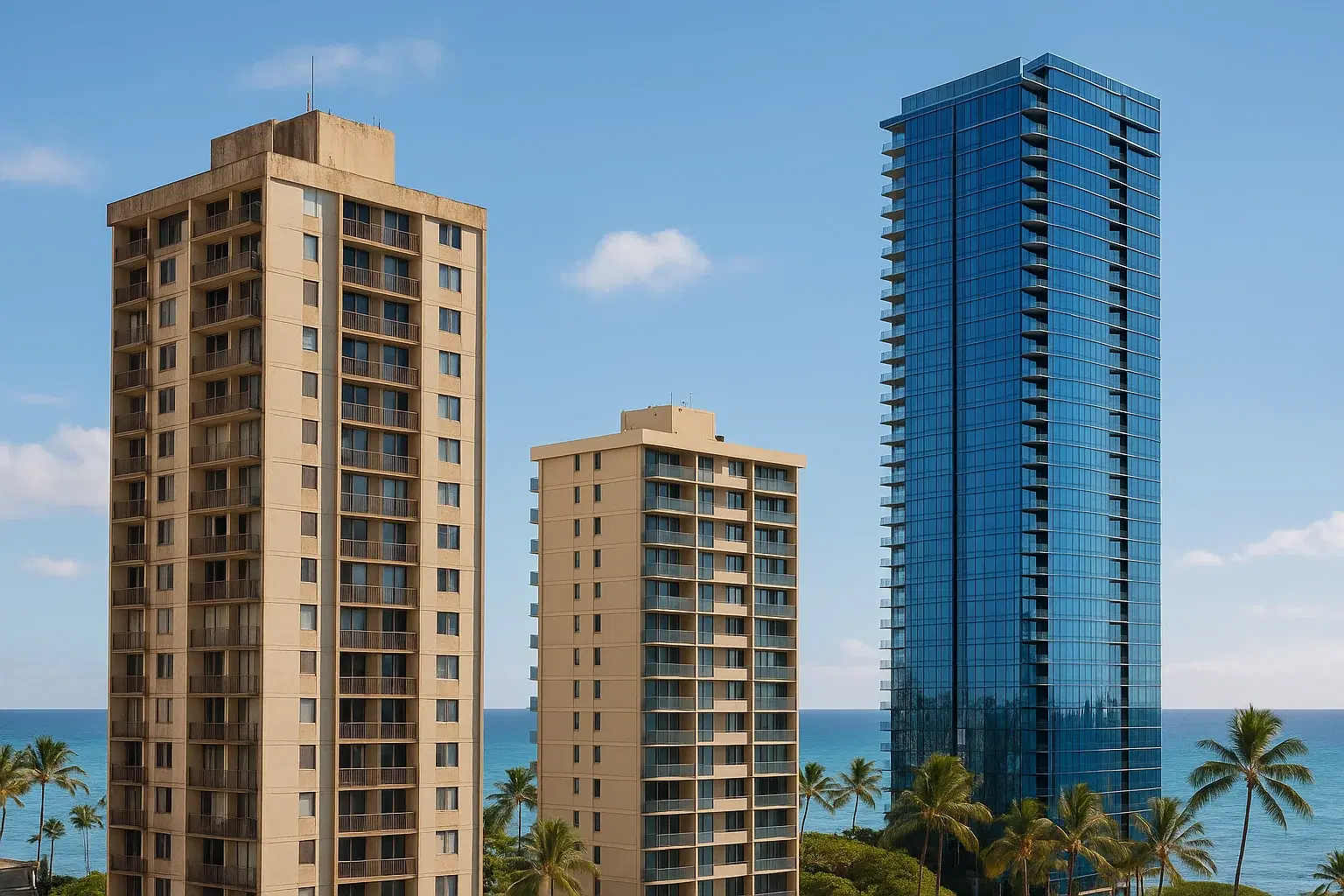
Consider a realistic composite: a 12-story, 150-unit concrete mid-rise in Mo'ili'ili or Makiki, built in the 1980s but well cared for. The AOAO has done the hard work-re-piped risers a decade ago, repaired concrete spalling, replaced the roof, and completed a full sprinkler retrofit with updated alarms. Claims history is clean for major water or fire losses over the last 5-10 years.
In 2022, this building's combined all-risk and hurricane master policy might have run around $180,000 per year on a $70 million total insured value (TIV). In the 2023-2024 hard market, that premium doubles to roughly $360,000. For 150 owners, that's about $2,400 per unit annually, or $200 per month just for building insurance. Many boards covered it by raising maintenance by $100-$120 per month or layering in temporary assessments.
Post-Act 296, the AOAO's broker can structure the risk differently. Private carriers quote the primary all-perils and lower hurricane layer, while HHRF offers an excess hurricane layer-say $50-$70 million above the primary-up to its current per-AOAO cap. With state-backed capacity in the mix, at least two private carriers compete seriously. One offers $260,000; another pairs with HHRF at about $240,000; the incumbent wants $285,000.
If the AOAO picks the $240,000 structure, insurance cost falls by a third from the peak. Per unit, the line item drops from roughly $200 to $133 per month, a $67 savings. On a $600,000 purchase with typical financing, that can trim total monthly PITI+HOA from around $4,100 to about $4,033. It's not life-changing on its own, but in lender debt-to-income (DTI) calculations, shaving $50-$100 off the HOA can move a borderline buyer from "denied" to "approved." Over time, that extra buyer pool supports resale values for older but well-run urban buildings.
Case 2: The 1970s "Problem Child" Forced Into Tough Love
Contrast that with a 25-story, 250-unit 1970s tower in Ala Moana or lower Makiki-the kind most agents quietly call a "problem child." Original cast-iron plumbing has been leaking for years; balconies show spalling; alarms are outdated and sprinklers only partially retrofitted, if at all. Reserve studies have flagged major work, but owners have repeatedly voted it down to avoid big fee hikes.
In 2022, this building might have paid around $220,000 per year on a $120 million TIV-roughly $73 per unit per month. Then a string of large water-damage claims and a minor balcony incident hit the loss record. By 2024, most mainstream carriers walk away or demand $800,000-plus with steep hurricane deductibles and tighter water exclusions. At that point the AOAO qualifies as "unable to obtain adequate coverage" under Act 296 and turns to the state-backed options.
A plausible 2026 structure: HPIA writes all-perils at about $500,000 per year with high water deductibles; a smaller private carrier provides a low hurricane layer; HHRF supplies excess hurricane up to the TIV for roughly another $250,000. Total cost lands near $750,000 per year. Spread over 250 units, that's $3,000 annually per unit-or around $250 per month-just for insurance, versus about $73 per month before the crisis. The incremental $177 per month is only part of the story.
This same AOAO now needs to fund $10 million or more in structural, plumbing, and life-safety upgrades to remain insurable as state support winds down toward 2030. That could mean a $40,000-per-unit assessment or another $300-$400 per month in ongoing fees, depending on how work is financed. A $600,000 unit that once carried an $800 HOA could now see $1,350 or more. Using a 43% DTI guideline, the income required to qualify jumps by over $1,000 in gross monthly income compared to the earlier insurance environment. Many local buyers simply can't get a mortgage there.
How High Insurance Reshapes Financing and Prices
When a building's insurance story looks like that 1970s tower, the pain goes beyond monthly sticker shock. Lenders are keenly focused on three things: whether the AOAO carries full replacement-cost coverage, whether deductibles fit Fannie Mae and Freddie Mac guidelines, and whether any exclusions (especially for water or hurricane) would prevent them from treating the collateral as adequately protected.
If an AOAO ends up relying heavily on HPIA/HHRF and accepts high deductibles or unusual exclusions, some banks back away. That's how buildings slide into "cash only" territory in Honolulu-either because coverage is inadequate, or because underwriters aren't comfortable with the structure or claims history. Once conventional, VA, and many jumbo lenders say no, the buyer pool shrinks to investors and higher-net-worth cash buyers, which inevitably pressures resale prices.
On Oahu, we're already seeing price gaps open up between two superficially similar condos-same neighborhood, same square footage, similar views-purely based on insurance and maintenance posture. A well-insured Mo'ili'ili building with healthy reserves and moderate deductibles may trade near full market value. A nearby tower wrestling with HPIA coverage, large past claims, and looming assessments may need to discount 10-20% or more to move units.
For owners, that's a harsh wake-up call: underfunding reserves and deferring maintenance no longer only risks future repairs; it can directly erode equity today. Act 296 doesn't rescue these buildings; it gives them a limited runway. Insurers are asking for engineering reports, capital plans, and documented progress. AOAOs that respond decisively can stabilize premiums and financing options; those that stall may find themselves with soaring fees, shrinking buyer pools, and softening values.
Case 3: Kaka'ako's Post-Crisis Towers as Insurance "Winners"
Now look at the other end of the spectrum: a new 40-story, 300-unit Kaka'ako tower delivered around 2026. Unlike pre-crisis projects, this one is designed with insurers in mind. It's fully sprinklered with modern voice-evacuation alarms and hardened stairwells. Mechanical rooms sit on protected floors with flood curbs, floor drains, and sump systems. Plumbing uses PEX or copper risers with smart leak detection at the stack and unit level, plus auto-shutoff valves. The roof and envelope are engineered for current wind and water-intrusion standards. From day one, the AOAO adopts a robust reserve schedule.
Even in a harder market, this tower presents a textbook "good risk." Insurers see reduced probability and severity of catastrophic loss-especially water damage, which has quietly driven a huge share of condo claims in Honolulu. A national carrier might price combined all-perils and hurricane at roughly $300,000 per year up to $100 million, with the option to add an HHRF excess hurricane layer from $100 million to $200 million for another $100,000. Total annual premium: about $400,000 on a TIV well above that of most older towers.
On a per-unit basis, that's around $1,333 per year-about $111 per month-for building coverage. That's lower than the Mo'ili'ili "good risk" mid-rise (~$133) and dramatically below the problem tower (~$250) despite much higher replacement value. Buyers are paying $900,000 to $1.1 million or more for a two-bedroom here, but their monthly HOA is less exposed to sudden insurance spikes and surprise assessments.
Lenders like these projects: coverage is comprehensive, deductibles are reasonable, and there are multiple private bids without relying heavily on state backstops. That makes financing straightforward and resale velocity strong. In practice, some buyers are choosing newer Kaka'ako product over cheaper older buildings precisely because the long-term "monthly nut"-including insurance-driven HOA risk-feels more predictable.
What Buyers Should Ask AOAOs About Insurance in 2026
By 2026, condo shoppers on Oahu can't treat insurance as background noise. It sits at the intersection of monthly affordability, loan approval, and future resale. Whether you're buying in Waikiki, Kaka'ako, Hawai'i Kai, or the urban core, you should be asking pointed questions about your AOAO's insurance strategy-especially with Act 296's temporary window closing around 2030.
First, request the AOAO's master policy declarations page. Who are the carriers? What are the total limits and deductibles? Is hurricane coverage layered with HHRF on top, and is HPIA involved for all-perils? The presence of HHRF isn't bad; in many cases, it signals that the building qualifies as a good-enough risk to attract both state-backed and private partners. But if the project is heavily reliant on HPIA because private carriers won't quote, that's a yellow flag you need to understand.
Second, look at trend lines. Ask for 3-5 years of AOAO budgets and minutes to see how rapidly premiums have risen and what assumptions the board is making for the next decade. Are there recent reserve studies, engineering reports, or completed projects for re-piping, concrete repair, or sprinkler upgrades? A building that has leaned into risk mitigation is more likely to keep insurance manageable when state support tapers off.
Third, run a DTI "shock test" with your lender: How would your qualification change if the HOA's insurance component rose 20-40% or if a special assessment added $200-$300 per month? In some "problem child" buildings, that's not a hypothetical-it's the logical next step. When you're comparing two condos, don't just line up list prices; compare their insurance structures, maintenance histories, and reliance on HHRF/HPIA. In this new landscape, those details can be the difference between steady appreciation and owning in a building that lenders and future buyers quietly try to avoid.
Sources: Analysis is based on public information from the Hawaii Insurance Division (HHRF materials), Hawaii News Now reporting on Act 296 and condo premiums, Civil Beat coverage of the hard insurance market and examples like Peninsula at Hawaiʻi Kai, Hawaii News Now and Star-Advertiser reports on the 2024 emergency proclamation and task force recommendations, industry commentary from association consultant Richard Emery, and local real estate/insurance blogs describing premium spikes, underinsurance, and financing impacts on Oahu condos.
Disclaimer: This article is provided for general informational purposes only and does not constitute legal, financial, or real estate advice. Market conditions change frequently; readers should conduct their own due diligence and consult qualified professionals before making decisions.