Skyline 2.0: Betting on O'ahu's Future Rail Premium
Listen to this article:
Skyline 2.0: Why UH & Waikiki Matter for Condo Investors
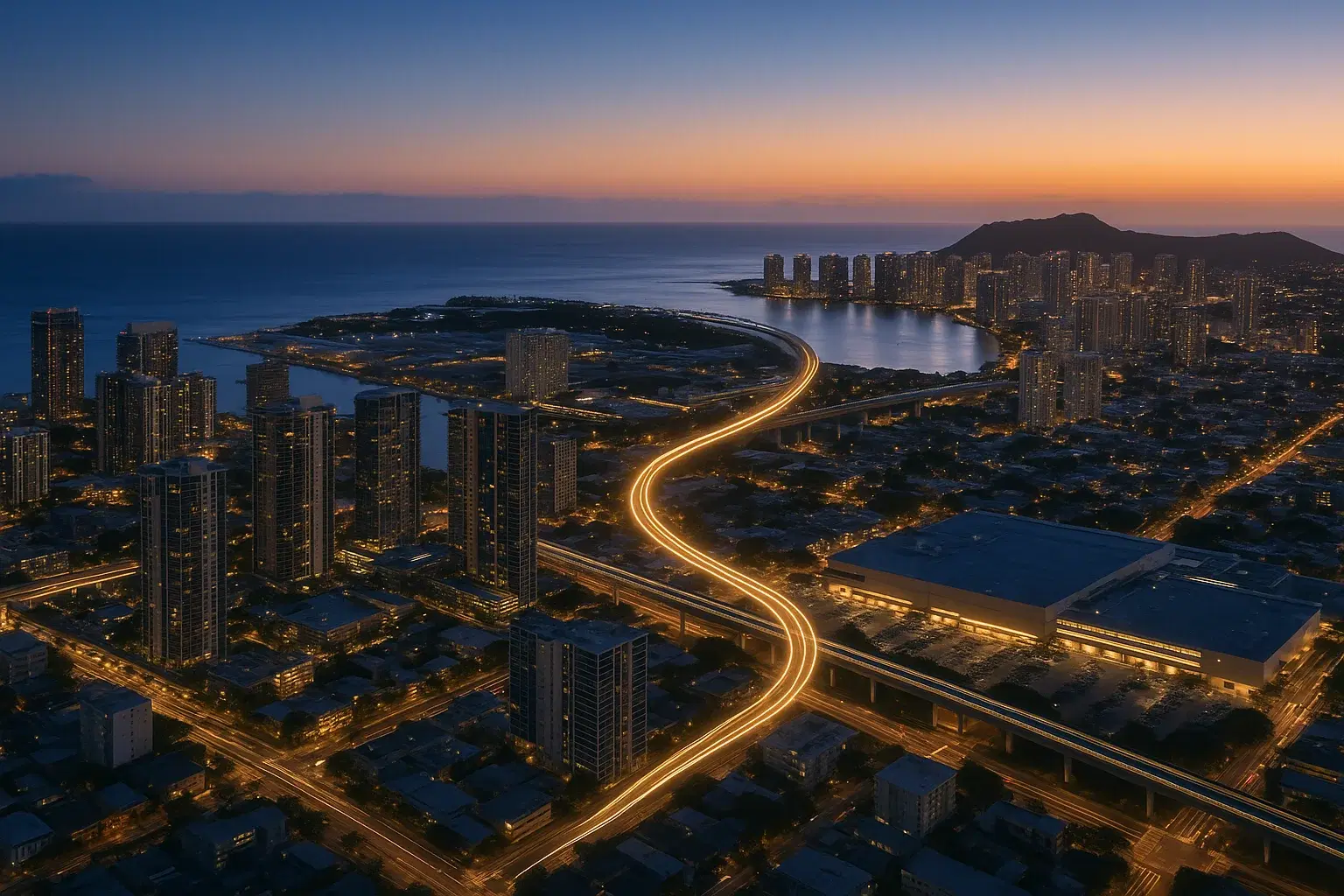
O'ahu's Skyline rail is no longer just a West Side commute line. With Segment 2 open to the airport and Kalihi, and the City pushing toward Civic Center in Kaka'ako by the early 2030s, Honolulu finally has the backbone of a rail system. The real inflection point, though, is political: in March 2026, Bill 60 authorized HART to start planning extensions to UH Manoa, Waikiki, and West Kapolei. No funding, no final routes yet-but for investors, this is when "option value" becomes real enough to underwrite.
Historically, every serious rail concept on O'ahu has treated UH and Waikiki as the missing middle mile-the pieces that turn Skyline from a peripheral spine into an everyday tool for students, hospitality workers, and visitors. The current line skirts the highest-value urban neighborhoods and relies on TheBus for the last mile. If you believe that gap will eventually be closed, certain condo buildings stand to benefit disproportionately.
From an investment perspective, this isn't about guessing the exact pier location of a future station. It's about combining likely alignment concepts (Kapi'olani Boulevard, University Avenue, the Ala Moana/Waikiki gateway) with hard numbers on today's price per square foot and rents. When you do that, you can start to see which condos are quietly carrying "free" rail option value-positioned within a quarter- to half-mile of probable stations but still priced like ordinary urban stock.
My focus here is practical: how a buyer, owner, or long-term investor can think like an infrastructure investor, discount the political risk, and make disciplined decisions about where it might actually be rational to "overpay" today for a unit that could be radically better positioned 10-15 years from now.
Mapping Skyline 2.0: Likely Stations and Walksheds
There is no approved alignment yet, but the technical and political conversation points in a fairly consistent direction. Picture Civic Center (Ka'akaukukui) as the junction: Skyline arrives from the west, and two future branches peel off east-one toward UH Manoa, one toward Waikiki. Most serious sketches put those branches on existing high-demand, high-ridership corridors:
- Kapi'olani Boulevard → University Avenue → UH Manoa(serving Ala Moana, Keeaumoku, Mo'ili'ili, campus)
- Kapi'olani / Ala Moana → Kalakaua / Ala Wai → central Waikiki → Kapahulu
From an investor's standpoint, the key is not the precise corner, but the station zones that keep showing up in plans and transit-planner discussions. Conceptually, those are:
- Civic Center / South St (funded terminus, future transfer hub)
- Kapi'olani near Ward/Pensacola(bridge between Ward Village and older Kaka'ako)
- Ala Moana Center / Atkinson (regional super-node and junction)
- Kapi'olani / Kalakaua (Mo'ili'ili) (split for UH vs Waikiki)
- UH Manoa upper campus (Dole or Maile Way vicinity)
- Waikiki Gateway (Kalakaua / Ala Moana or Kalakaua / Ena)
- Central Waikiki (Seaside-Royal Hawaiian-Kuhio area)
- Waikiki East / Kapahulu (zoo/Kapahulu terminus)
Now apply standard transit real estate logic: a ¼-mile radius (about a 5-minute walk) is the core premium zone; ½-mile(10 minutes) is extended benefit. In Honolulu's climate and street grid, both are realistically walkable for most residents and workers. If you drop those circles on a map using Google My Maps or a GIS tool and overlay condo towers, you'll see three big clusters emerge: Civic Center-Kaka'ako, Ala Moana-Kapi'olani, and Waikiki-UH.
That mapping step is where option value becomes concrete. Buildings inside a ¼-mile circle of a plausible station are "high exposure"; those in the ¼-½-mile ring are "medium exposure." Everything else is "macro Skyline beneficiary" but not a direct rail premium play.
Today's Numbers: Where Pricing Leaves Room for a Rail Premium
Before layering rail on top, you have to understand today's pricing gradient across the urban core. As of late 2025, O'ahu's median condo price is around $540,000, but the urban submarkets look very different in $/sf terms:
- Ward Village / prime Kaka'ako: roughly $1,000-$1,500+/sfin the newest towers; older Kaka'ako high-rises in the $600-$1,000/sf range.
- Ala Moana-Kaka'ako (overall): median list near $1,075/sf, median closed around $995/sf.
- Waikiki: neighborhood-wide around $740/sf, with many mid-tier condos in the $650-$900/sf band.
- McCully-Mo'ili'ili / UH fringe: often $500-$700/sf for older mid-rises with strong student demand.
- Makiki, Punchbowl, older urban stock: typically $500-$650/sf.
Right away, you can see that location and walkability are already priced in. Kaka'ako and Ala Moana trade at a 30-60% premium to Makiki-type stock because of ocean proximity, newer product, and amenity-rich streets-not because of rail. Skyline's current stations are in West O'ahu and the airport-Kalihi corridor; the market has not priced in UH/ Waikiki access because routes and funding are still speculative.
Where I see the most room for a future rail premium is in buildings that are:
- Within a plausible ¼-½-mile walkshedof Ala Moana, Kapi'olani, UH, or Waikiki stations; and
- Currently priced closer to older urban averages than to Ward Village luxury levels.
Think of mid- and upper-mid condo towers around Ala Moana Center and the Keeaumoku corridor in the $900-$1,100/sf range, or gateway Waikiki towers along Ala Moana Blvd and the Ala Wai that still trade more like ordinary high-rises than future multi-modal hubs. That pricing gap is where hidden option value can live.
Submarket Deep Dive: Where the Rail Option Is Strongest
Once you overlay likely walksheds on top of today's pricing, several opportunity zones stand out. Each has a different balance of certainty, upside, and risk.
1. Civic Center & Kaka'ako spine (high certainty, modest upside)
Buildings like The Collection, Keauhou Place, Keola La'i, 801 South, and nearby Ward Village towers are effectively guaranteed proximity to a Skyline terminus at Civic Center. Even if extensions never get built, they still enjoy direct rail access westward. Here, the incremental UH/Waikiki effect is about being at or one stop away from the main transfer hub. In other cities, core downtown transfer nodes trade 10-20% above comparable CBD stock; in Kaka'ako, much of that is arguably already baked in. I'd underwrite only a 5-10% additional future premium versus a no-rail-extension world, mostly through stronger rent resilience and liquidity rather than dramatic $/sf jumps.
2. Ala Moana-Kapi'olani (the "option sweet spot")
This is where the math gets compelling. Towers like One Ala Moana, Ala Moana Hotel Condo, Atkinson Plaza, Kapiolani Residence, The Central Ala Moana, Sky Ala Moana, The Park on Keeaumoku, and Azure sit in what is almost certainly a future station super-node: Skyline + buses + potential branch junctions. Many of these are priced below Ward Village but above older walk-ups, in the $900-$1,100/sf range. In constrained, transit-oriented mainland markets, similar locations have outperformed by 5-15% around opening, with some reaching 20%+ in hot cycles. After discounting for uncertainty and time, I see a plausible 10-20% long-term uplift versus a no-extension baseline here.
3. Waikiki Gateway & Central Waikiki (higher upside, more path risk)
Gateway buildings-Discovery Bay, Wailana at Waikiki, The Windsor, Waikiki Landmark, Allure Waikiki, plus Ala Wai corridor towers-could land in ¼-½-mile of a station that finally ties Waikiki directly to the airport and West O'ahu. Those units often trade in the $650-$900/sf band despite their strategic location. A well-executed rail spur could support a 10-25% premium over comparable non-rail resort condos long term, although immediate adjacency to an elevated structure could be a negative for a handful of stacks.
4. Mo'ili'ili / UH fringe (steady upside, redevelopment risk)
Older mid-rises along University Avenue, Kapi'olani and Date Street currently sell in the $500-$700/sfrange and rent primarily to students. University-station experience elsewhere suggests slightly faster rent growth (car-free demand) and, in the long run, upzoning and redevelopment. I'd model 0.5-1.0% annual rent outperformance and a 10-20% terminal value premium over a no-rail case-but also recognize that some existing buildings may eventually be more valuable as land than as condos.
Thinking Like an Infrastructure Investor: Pricing the Option
Global transit studies generally find that being within ~¼ mile of a rail station can add 5-15%to residential values, sometimes more in tight, high-income markets. But that's once the line is certain and operating. O'ahu is earlier in the curve: Bill 60 unlocks planning, not shovels in the ground. To make that investable, you have to think in scenarios.
One way to do it is to define a set of 2040 outcomes:
- S0: No extension beyond Civic Center.
- S1: Ala Moana built; UH and Waikiki deferred.
- S2: Ala Moana + Waikiki built; UH deferred.
- S3: Ala Moana + UH built; Waikiki deferred.
- S4: Full Ala Moana + UH + Waikiki built.
Then you assign rough probabilities and uplifts. For example, take an Ala Moana condo in the walkshed of a likely station. If you believe there is about a 70% chance that some form of Ala Moana rail opens by 2040, and that this would make that unit worth roughly 15% morethan in a no-extension world, the expected terminal uplift is about 10.5%. Discounted back 15 years at a 3% real rate, that's roughly a 6-7% present-value "rail option" embedded in the condo.
If the market is not yet charging that 6-7% premium-because most buyers are focused on view planes and maintenance fees, not rail policy-you may be getting that option value for free. If, on the other hand, the condo is already priced 20% above comparable non-walkshed stock of similar age and quality, you are probably pre-paying for more rail upside than is justified by the risk.
This framework also forces discipline: I would never buy a unit that only makes sense ifUH and Waikiki rail are built. Base your underwriting on a conservative "no-extension" case where the investment still pencils on current rents and broader O'ahu appreciation. Treat Skyline 2.0 as upside, not a requirement.
Practical Moves for Buyers and Sellers in the Rail Option Zone
For buyers and investors, the first step is to identify "no-regrets" buildings inside plausible ¼-½-mile walksheds-places you'd be happy to own even if Skyline never went beyond Civic Center.
- In Kaka'ako: Civic Center-proximate towers (The Collection, Keauhou Place, 801 South) and Ward Village buildings already have strong fundamentals: walkability, job access, and existing/funded Skyline service.
- Around Ala Moana:Focus on solid mid- and upper-mid towers near the mall and Kapi'olani corridor (One Ala Moana, Kapiolani Residence, The Central Ala Moana, Sky Ala Moana, The Park on Keeaumoku) that are not yet priced like ultra-luxury.
- Gateway Waikiki: Look closely at Discovery Bay, Wailana at Waikiki, Allure, and Ala Wai-fronting buildings that could realistically sit between Ala Moana Center and a future Waikiki station.
- Mo'ili'ili / UH:Target well-managed older condos along University and Kapi'olani where student demand provides a solid cash-flow base today.
Compare each option's $/sf to a similar building outside any future walkshed-say, a Makiki or Punchbowl high-rise of similar age and amenity level. If you're paying only a 0-5% premiumto get plausible station proximity, that's a reasonable "rail option" bet. If the premium is 15-25% with no other explanation (views, finishes, newer construction), be cautious.
For sellers in these zones, the opportunity is narrative, not hype. It's fair to mention Bill 60, the city's stated interest in UH and Waikiki extensions, and your building's relative position to Ala Moana, Civic Center, or Kapi'olani. It's not fair-or smart-to market rail as guaranteed. Sophisticated buyers will discount exaggeration, especially given Honolulu's history of cost overruns and delays.
My own approach with clients is straightforward: buy buildings that work on today's numbers, in locations that would also elegantly plug into a future Skyline 2.0 map. If O'ahu eventually finishes that map-connecting UH, Waikiki, and Ala Moana into a true urban rail network-you're positioned to benefit. If it doesn't, you still own a well-located condo in one of the tightest housing markets in the country.
Sources: Analysis based on Honolulu rail reporting (Bill 60 and Skyline build-out), neighborhood pricing data from brokerage and market reports for Kakaʻako, Ala Moana, Waikīkī, and UH-adjacent areas, and national studies on transit-oriented development value premiums from NAR/APTA and academic literature reviews on rail impacts.
Disclaimer: This article is provided for general informational purposes only and does not constitute legal, financial, or real estate advice. Market conditions change frequently; readers should conduct their own due diligence and consult qualified professionals before making decisions.