Kuilei Place and Honolulu Condo Competition
Listen to this article:
Kuilei Place's groundbreaking matters, but the resale impact matters more
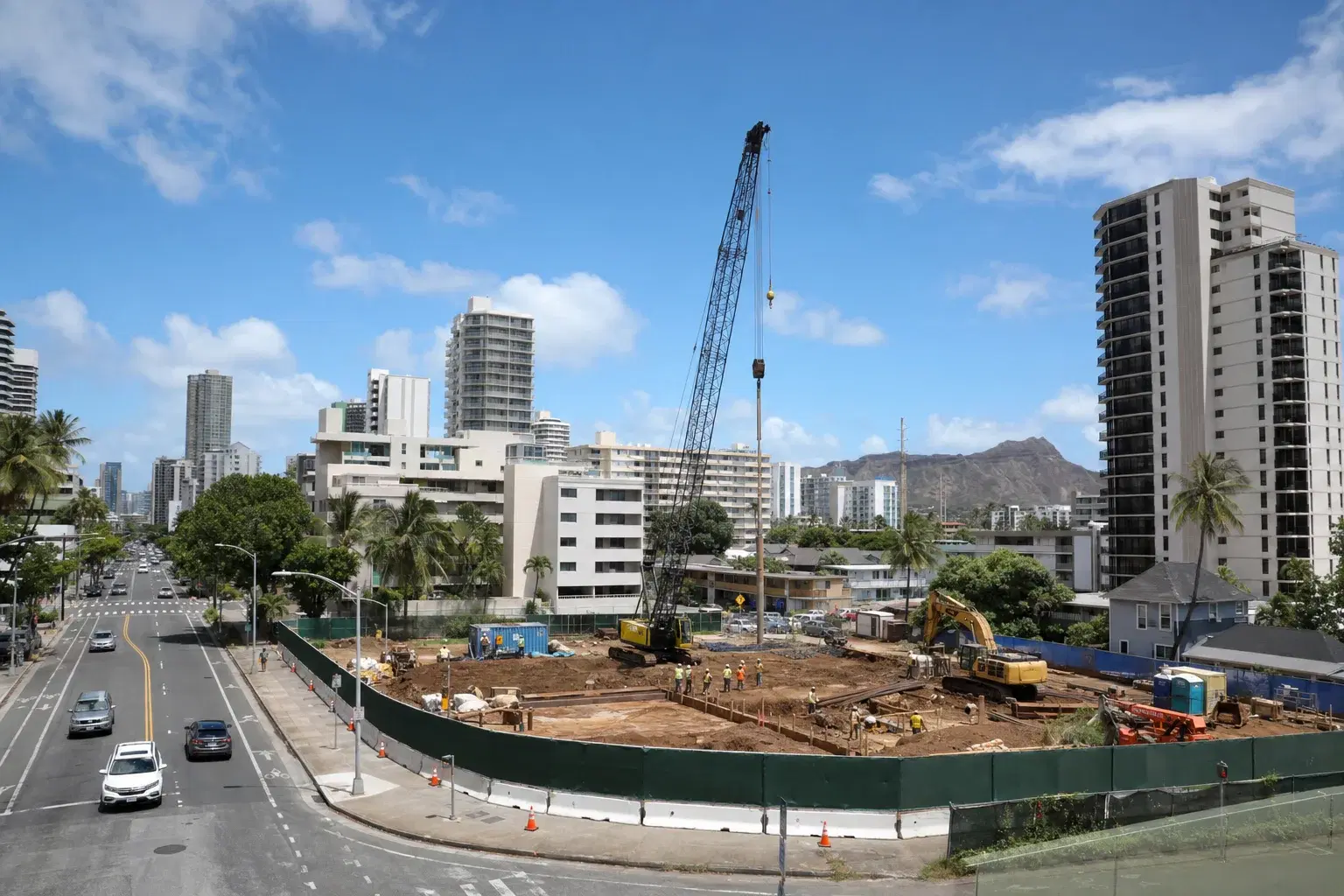
Kuilei Place breaking ground in Mo'ili'ili is easy to frame as a straightforward housing story: a big project, a central location, and hundreds of units reserved for local buyers. The more important market story, however, is what happens to the existing condo inventory around it. According to the Hawai'i Housing Finance and Development Corporation, Kuilei Place will bring 1,005 total units to roughly 3.15 acres at 2599 Kapi'olani Boulevard, including 603 affordable units and 402 market units. The state also said more than 85% of the project had already sold, with completion expected in 2027.
That scale is large enough to do more than add supply. It can redirect demand. In practical terms, that means Kuilei Place is not mainly competing with luxury towers in Ward Village. It is more likely to pull from older resale condos in Mo'ili'ili, McCully, Ala Wai, Makiki, Kapahulu, and parts of Waikiki where buyers have historically accepted aging buildings in exchange for a central commute and a lower purchase price.
In today's market, that tradeoff is less automatic. Buyers are more sensitive to maintenance fees, insurance shocks, deferred maintenance, parking quality, and the risk of future assessments. A new project in an urban core can change the comparison set overnight. That is why the real question is not whether Kuilei Place is "affordable" in a policy sense. It is whether nearby resale condos still look like compelling value once a buyer compares total monthly cost, parking, commute convenience, and building-condition risk side by side.
What 'affordable for-sale' really means in urban Honolulu
The word affordable does a lot of work in Honolulu real estate, and buyers should be careful with it. In policy terms, Kuilei Place clearly qualifies: HHFDC says 60% of the project is reserved for households at 140% of area median income or below. A 2023 HHFDC document outlined affordable-unit maximum prices that included two-bedrooms from $523,100 to $732,300 depending on AMI category, and three-bedrooms from $697,100 to $813,300. Those numbers were based on 2022 pricing assumptions and mortgage rates, but they remain useful because they show the intended buyer band.
That is the policy definition. The consumer definition is different. A household does not live inside an AMI chart; it lives inside a monthly budget. Kuilei Place's affordable information packet showed estimated maintenance fees roughly in the $333 to $629 range, with sample total monthly carrying costs reaching from around $2,500 to more than $5,300 depending on financing assumptions. For many local households, that is still a stretch.
This is not unique to Kuilei Place. Honolulu has a long history of projects being affordable relative to other new construction, not necessarily affordable in the plain-language sense. I think that distinction needs to be said clearly. Buyers should treat "affordable for-sale" as a legal and programmatic category, not as proof that the monthly payment will feel easy. The real test is whether the all-in ownership cost beats the practical alternatives in older resale buildings nearby.
- Policy affordability: price-restricted units for specific income bands
- Consumer affordability: whether the total monthly payment works in real life
- Market effect: whether buyers now prefer new construction over older resale stock
Which price bands and building types are most exposed
The most exposed resale condos are not every condo near town. The biggest pressure point appears to be the $450,000 to $750,000 range, particularly older fee-simple one- and two-bedroom buildings in Mo'ili'ili, McCully, Kapahulu, and along the Ala Wai/University corridor. That is where many local owner-occupants shop, and it overlaps closely with the affordable pricing bands outlined for Kuilei Place's two- and three-bedroom units.
There is also indirect pressure in the $300,000 to $500,000 segment. Kuilei Place is not a direct price substitute for many of those units, but it can remove the buyer who might otherwise have stretched into an aging resale condo. When that marginal buyer steps back, older stock becomes harder to sell unless it has a clear advantage on size, fees, or condition.
The $800,000 to $1 million range is selectively exposed as well. Kuilei Place's public pricing has shown some market units around $985,000 to $1.1 million, which creates a meaningful comparison for buyers choosing between a larger but dated resale and a smaller but brand-new product.
The buildings that look most vulnerable generally share a few traits:
- Older systems with visible deferred maintenance risk
- High maintenance fees without clear lifestyle advantages
- Weak or awkward parking, especially tandem or compact stalls
- Small floor plans that no longer feel cheap enough to justify the compromises
By contrast, older condos that still have a defensible position are the ones with unusually large interiors, lower fees per square foot, stable associations, and straightforward parking. Those buildings can still compete. The ones relying on "close to town" as the whole pitch may have a harder time.
Why maintenance fees, parking, and commute patterns now matter more than ever
If there is one lesson from the last several years of Honolulu condo buying, it is that buyers are no longer looking at sticker price alone. They are looking at the full monthly burn rate. That includes mortgage, maintenance fees, insurance exposure, utilities, and the possibility of a special assessment. In that comparison, newer projects can have a real advantage even when the purchase price is higher.
That is where Kuilei Place becomes a serious substitute for nearby resale stock. A buyer may compare an older condo priced at $525,000 with a maintenance fee approaching $900 or more, uncertain reserves, and looming plumbing or spalling work against a new unit that costs more upfront but offers lower projected initial fees and fewer near-term repair concerns. Even if the monthly payment is close, many buyers will pay for predictability.
Parking is another underrated factor. In urban Honolulu, one good parking stall can still swing a decision. Kuilei Place's amenity materials describe a substantial parking structure and bike storage for more than 600 bicycles. That matters for households commuting to UH Manoa, Kapi'olani Medical Center, Waikiki, Ala Moana, and Downtown. Many older buildings still have parking that is compact, tandem, uncovered, or inconveniently located. Once buyers can compare those details directly, some resale units lose one of their old advantages.
Commute patterns also broaden the substitution effect. Kuilei Place is not just a Mo'ili'ili project; it sits in a corridor useful to healthcare workers, university staff, hospitality workers, and office commuters. That means a condo in Makiki or Waikiki is no longer competing only against nearby listings. It may be competing against a new central hub product that serves several urban job centers at once.
Neighborhood-by-neighborhood: where the pressure likely shows up first
Mo'ili'ili and McCully are the clearest ground zero. This is where older condos have long sold on practical urban convenience rather than building novelty. Market data already suggest softer conditions in the area, with neighborhood-level reports showing slower sales pace and buyer leverage. That does not mean values collapse. It does mean sellers may need to sharpen pricing and prove their value much more clearly than before.
Waikiki is a more selective case. Kuilei Place is not a substitute for condotels or investor-focused resort product. But it can absolutely compete for owner-occupant buyers who previously tolerated older Waikiki buildings because they wanted centrality. If they can instead buy a newer unit outside the resort core with cleaner parking and a more residential feel, some resale Waikiki inventory becomes less compelling.
Ala Moana and lower-tier Kaka'ako resale face narrower but real overlap. Kuilei Place is not a Ward Village competitor. It is, however, a plausible alternative for buyers priced out of luxury Kaka'ako who still want a modern urban building and who care more about ownership practicality than prestige branding.
In my view, older nearby condos now need to compete on one of three fronts:
- Price advantage: clearly cheaper than new construction
- Monthly-cost advantage: lower fees and lower risk
- Lifestyle advantage: larger layouts, better parking, or proven management
If a building offers none of those, it is exposed. Location alone is no longer enough, especially when the competing location is also near town, near UH, and tied to a brand-new ownership product with strong early absorption.
What buyers and sellers should do now
For buyers, the practical takeaway is simple: compare monthly reality, not marketing language. A new condo may look expensive until the resale alternative reveals much higher fees, older systems, and assessment risk. On the other hand, a well-run older building with larger square footage and moderate fees can still be the smarter buy. There is no shortcut; each building has to be underwritten on its own merits.
Buyers looking at Kuilei Place should verify current public disclosures, projected maintenance fees, parking assignments, owner-occupancy rules, and any resale restrictions through the project's official materials and the developer's published documents. Buyers looking at older nearby condos should review the association budget, reserve study, recent board minutes, insurance trends, and any evidence of upcoming major work. Public and private listing data can be incomplete, so maintenance-fee figures shown online should always be checked against current condo documents.
For sellers in nearby buildings, this is a market that rewards honesty and preparation. The old strategy of listing an older unit and simply leaning on "great location near town" is weaker than it used to be. Sellers need to show why their unit wins despite the age of the building.
- Explain the true monthly cost, including what fees cover
- Document reserve strength and recent completed repairs
- Highlight parking quality and commute convenience
- Price for the competition, not for last year's expectations
Kuilei Place may be a housing-policy success, but its more immediate market impact could be forcing older urban Honolulu condos to justify themselves on value, not just geography. That is the real story, and it is one both buyers and sellers should be paying attention to now.
Sources: Main sources include HHFDC and DBEDT project materials on Kuilei Place, public pricing and information packets from Kuilei Place, Honolulu Board of REALTORS market reports, Oʻahu condo market statistics compiled from HBR MLS data, and reporting from Civil Beat and the Honolulu Star-Advertiser for historical affordability and fee-risk context.
Disclaimer: This article is provided for general informational purposes only and does not constitute legal, financial, or real estate advice. Market conditions change frequently; readers should conduct their own due diligence and consult qualified professionals before making decisions.