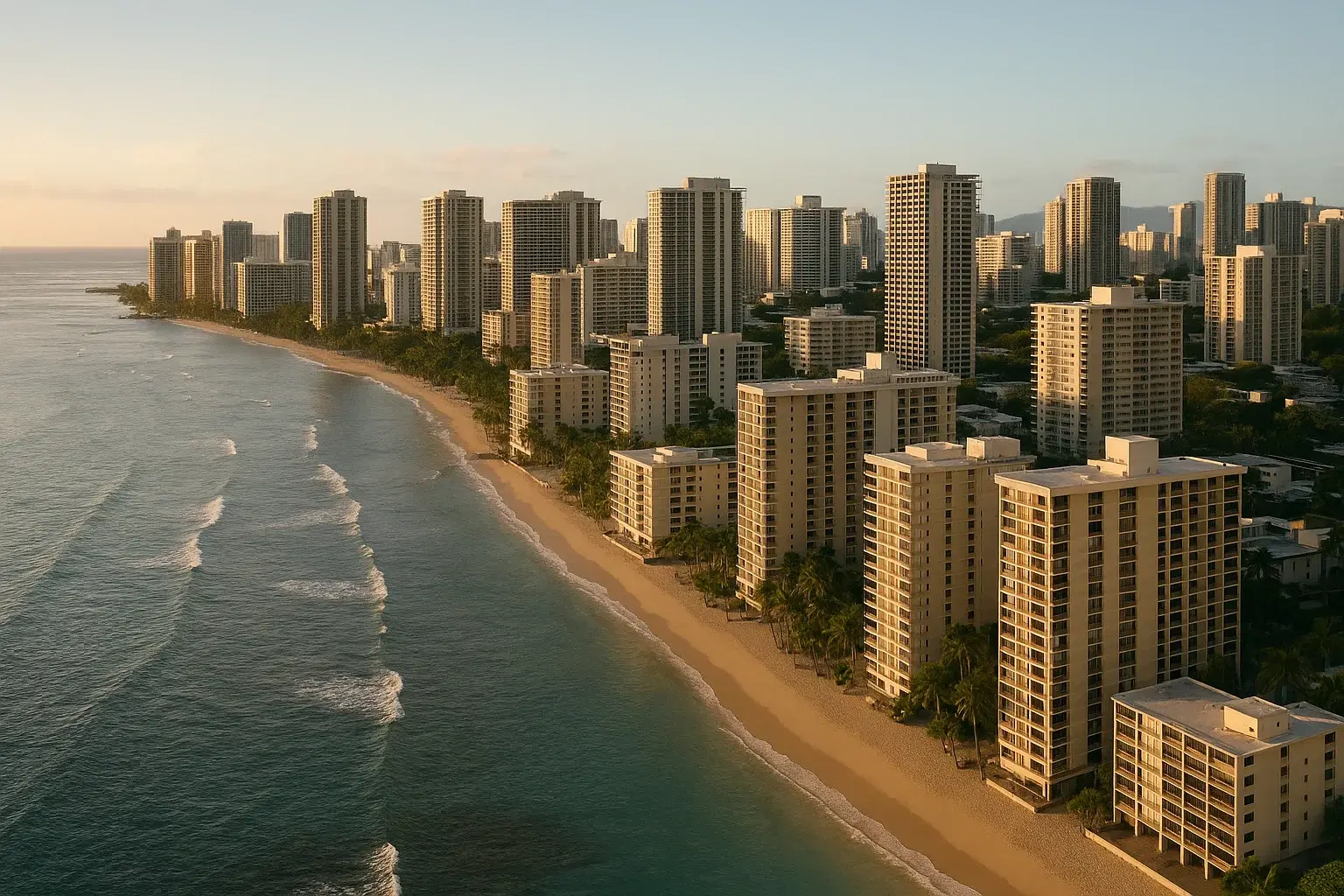
Honolulu Shoreline Rules: Why 2nd-Row Condos Win
Listen to this article:
The Regulatory Shift
Honolulu's Ordinance 23-3 (Bill 41) replaced the old 40 ft shoreline setback with a stricter framework effective July 1, 2024:
- Primary Urban Center (Waikiki, Kaka'ako): Fixed 60 ft setback from the certified shoreline.
- Outside urban Honolulu: 60 ft + 70 × the annual erosion rate, capped at 130 ft, or 60 ft where no erosion is documented.
Any structure that now sits inside this expanded line becomes non-conforming, subject to strict repair limits over each rolling 10-year period:
- ≤ 50% of replacement cost for the portion within 40 ft of the shoreline.
- ≤ 75% of replacement cost for the portion between 40 ft and the setback line.
If more than 50% of a non-conforming structure is destroyed, it generally cannot be rebuilt in place without a shoreline setback variance. And because Honolulu and the State have moved toward a practical "no new armoring" posture, relying on new seawalls or heavy hardening is increasingly unrealistic.
The result is a growing regulatory wedge between true oceanfront buildings and those set back just one block. That wedge is starting to show up in lending standards, AOAO reserves, and cap rates—long before any owner sees water at the lobby doors.
Who's Actually Affected? The Honest Inventory
In central Waikiki, Kalakaua Avenue sits roughly 225 feet from the shoreline at its narrowest point. With a 60 ft setback, the buildings directly affected are those on the oceanside of Kalakaua—the narrow strip between the road and the beach.
Here's the reality that the typical analysis glosses over: that strip is almost entirely hotels. The Sheraton Waikiki, Halekulani, Royal Hawaiian, Outrigger Reef, Moana Surfrider—these are the buildings sitting on top of Waikiki's aging seawalls. For condo investors, the actual inventory of affected residential buildings is narrower than you might expect.
The Buildings Inside the Setback Zone
Waikiki Shore (2161 Kalia Road) — This is the only true oceanfront condominium directly on Waikiki Beach. Built in the 1960s, 15 stories, 167 units, fee simple. It sits between Fort DeRussy Beach Park and the Outrigger Reef resort with no road or sidewalk between the building and the sand. With its structural footprint right on the beach, significant portions of the building fall within both the 0–40 ft and 40–60 ft non-conforming bands. Its AOAO will face the most direct pressure from repair caps over the coming decades.
The Gold Coast Condos (Kalakaua Avenue at Diamond Head) — This is where the setback rules hit the residential market hardest. Sixteen oceanfront condo buildings were constructed between 1953 and 1970, right up on the water's edge, before zoning laws would have prevented it. They line Kalakaua Avenue from roughly the Outrigger Canoe Club to the base of Diamond Head. The major buildings include:
- Colony Surf (2895 Kalakaua)
- Sans Souci (2877 Kalakaua)
- Diamond Head Apartments (2969 Kalakaua) — designed by Vladimir Ossipoff
- Diamond Head Ambassador A and C (2957 Kalakaua)
- Diamond Head Beach Hotel (2947 Kalakaua) — the only Gold Coast building allowing short-term vacation rentals
- Coral Strand (2979 Kalakaua)
- Tropic Seas (2943 Kalakaua)
- Castle Surf (2937 Kalakaua)
- Tahitienne
- Kainalu (2801 Coconut Avenue — the only one not on Kalakaua)
- Oceanside Manor (3015 Kalakaua)
- 2987 Kalakaua, 3003 Kalakaua, 3019 Kalakaua
These buildings are perched directly above the water, many with seawalls as their only buffer. They represent a mix of fee simple, leasehold, and co-op ownership structures. Every one of them has structural elements within the 60 ft setback, and many extend well into the more restrictive 0–40 ft band. Under the new rules, none of these could be built today—and the critical question is whether they can be meaningfully rebuilt when the time comes.
The Seawall Problem
Waikiki's shoreline infrastructure is extensive and old. By 1950, more than 80 structures—seawalls, groins, piers, and storm drains—occupied the Waikiki shoreline. The most prominent seawalls run along the oceanfront hotel strip, particularly fronting the Halekulani and Sheraton Waikiki, with a public walkway running on top that averages about 5½ feet high. Portions have been closed for years due to deterioration.
For buildings like the Gold Coast condos and Waikiki Shore, existing seawalls provide a critical benefit: the certified shoreline is measured from the wall face, not from where the natural beach would be. But this advantage is fragile. State and city policy momentum is clearly against permitting new armoring, repairs, or extensions. If an existing seawall fails and can't be replaced, the next shoreline certification could move significantly mauka—and the setback line ratchets with it.
Where the Hidden Value Sits: Buildings That Benefit
The flip side of this regulatory squeeze is that buildings outside the 60 ft setback have a cleaner investment story. They retain full teardown-and-rebuild rights, face no repair caps, and clear lender underwriting more easily. Here's where to look:
Waikiki — Mauka of Kalakaua and Along Kuhio Avenue
Anything on the mauka (inland) side of Kalakaua Avenue or further inland toward the Ala Wai Canal is completely outside the shoreline setback. These buildings share the same Waikiki demand drivers—visitor traffic, walkability, rental income potential—without the regulatory constraints.
Notable buildings in this category include:
- Ritz-Carlton Residences Waikiki (383 Kalaimoku / 2139 Kuhio) — Two luxury condo-hotel towers, built behind Kalakaua's "Luxury Row." High-end product with full rebuild optionality.
- Trump Tower Waikiki (223 Saratoga Road) — Condo-hotel with ocean views over Fort DeRussy Park, fully outside the setback.
- Waikiki Beach Tower (2470 Kalakaua) — Sits on the mauka side of Kalakaua directly across from the beach. Often marketed as "oceanfront" but legally in a far cleaner regulatory position than buildings actually on the sand.
- Foster Tower (2500 Kalakaua) — Similar position to Waikiki Beach Tower, across Kalakaua from the beach.
- Ilikai (1777 Ala Moana Blvd) and Ilikai Marina (1765 Ala Moana Blvd) — Iconic 1960s towers at the Ewa end of Waikiki. Road, parking, and the marina separate them from the shoreline.
- Waikiki Banyan (201 Ohua Avenue) — Over 800 units in two towers on Ohua and Kuhio, a few blocks from the beach. One of Waikiki's largest condotel operations.
- Waikiki Sunset (229 Paoakalani Avenue) — Similar inland position, legal vacation rentals.
- Royal Kuhio (2240 Kuhio Avenue) — 38 stories, 385 units in the heart of Waikiki, two blocks from the beach. Leasehold with 2041 expiration, so a different risk profile—but setback is not one of its concerns.
These buildings don't touch the sand, and that's increasingly the point. As lending standards tighten for non-conforming oceanfront product and AOAO reserves strain under repair caps, the "second row" becomes the more underwritable, more liquid investment.
Kaka'ako / Ala Moana — The New "First Row" Is Already Set Back
In Kaka'ako, the dynamics are different. The newer luxury towers along Ala Moana Boulevard are technically "first row" from a marketing perspective, but most are set back from the shoreline by Ala Moana Boulevard itself plus Ala Moana Beach Park. Their structural footprints are generally well outside the 60 ft setback, even though some ground-level improvements—landscaping, driveways, commercial podiums—may encroach.
- Park Lane Ala Moana (1450 Ala Moana Blvd) — Low-rise luxury, 6 stories on 7 oceanfront acres. Some ground-level elements may fall within the setback zone, but the residential structure sits largely mauka of the line.
- Hokua (1288 Ala Moana Blvd) — 41-story ultra-luxury tower, oceanfront adjacent to Ala Moana Beach Park. Built 2006 by the Kobayashi Group.
- Waiea and Victoria Place — Ward Village's "first row" luxury towers, also fronting Ala Moana Boulevard. Built within the last decade with modern setback awareness.
- One Ala Moana (1555 Ala Moana Blvd) — Sits directly above Ala Moana Center with beach park access.
Behind this first row, the newer "second row" Ward Village towers—Ko'ula, Ae'o, Aalii, Anaha—are even further from the shoreline. These buildings enjoy ocean views over the first-row product and carry zero setback risk.
The Gold Coast Alternative: Pualei Circle
For investors attracted to the Diamond Head lifestyle but wary of Gold Coast setback exposure, the Pualei Circle condos sit just across Kapiolani Park from the Gold Coast—same neighborhood character, similar views, a fraction of the price, and completely outside the setback zone. They're walk-up style buildings without the luxury finishes, but the regulatory position is clean.
How the Wedge Shows Up in Practice
Lending and Insurance
For non-conforming oceanfront buildings—particularly the Gold Coast condos and Waikiki Shore—expect tightening loan terms: lower LTV ratios, shorter terms, and more conservative appraisals as lenders factor in repair-cap constraints and rebuild uncertainty. Insurance carriers may impose higher deductibles, ground-floor exclusions, or require engineering reports tied to sea-level-rise projections.
Buildings fully outside the setback—the Kuhio Avenue towers, the Ritz-Carlton, the Ward Village portfolio—clear underwriting at standard terms.
AOAO Reserves and Special Assessments
Oceanfront AOAOs managing aging concrete, seawall interfaces, and salt-air corrosion are being pushed to fund 2–3% of replacement cost annually into reserves, while staying below the 50–75% repair caps. Mauka buildings typically operate around 1–1.5%. Over a 20-year hold, that difference compounds into hundreds of thousands of dollars per unit.
Cap Rates
Investors are beginning to add 25–75 basis points to target cap rates for non-conforming oceanfront buildings with significant structure inside the 0–60 ft band. Well-located second-row towers may trade 10–30 bps tighter than older oceanfront peers in the same submarket. On a building producing $5M in stabilized NOI, a 50 bps cap-rate gap represents roughly a 9% difference in property value.
Outside Urban Honolulu: Where Setbacks Get Extreme
Outside the Primary Urban Center, the math changes dramatically. The erosion-based formula—60 ft plus 70 times the annual erosion rate, capped at 130 ft—can swallow entire shallow lots on sandy segments.
In Hawai'i Kai, Kailua, and the North Shore, low-rise oceanfront condos and small apartment buildings face the most acute risk. When you combine erosion-based setbacks that can push past 100 ft with repair caps and armoring restrictions, some of these buildings face a real possibility of functional obsolescence within a planning horizon that today's buyers should be thinking about.
The Bottom Line
The emotional premium for direct oceanfront in Honolulu is real and deeply ingrained. But Ordinance 23-3 has created a regulatory framework that systematically disadvantages the buildings closest to the water—particularly older concrete structures with seawall dependencies and structural elements inside the 60 ft line.
For condo investors, the actionable insight is specific: in Waikiki, the affected residential inventory is Waikiki Shore and the 16 Gold Coast buildings. The beneficiaries are the towers along Kuhio Avenue, the Ritz-Carlton, Trump, and the mauka-side Kalakaua buildings. In Kaka'ako, the modern luxury towers are already built with enough setback to avoid the worst constraints, and the second-row Ward Village product may be the cleanest long-term story of all.
The market still pays a significant premium for direct oceanfront. The question is whether that premium adequately compensates for the regulatory ceiling that now limits what those buildings can do when they need to rebuild—and increasingly, the answer is no.
Sources: Key legal and policy details are drawn from Honolulu Ordinance 23-3 and related shoreline setback and non-conforming structure provisions in the Revised Ordinances of Honolulu; commentary on implementation and variance standards from Honolulu land-use law firm alerts; Hawaiʻi Climate Commission materials and state sea-level-rise tools; and Hawaiʻi legislative findings on shoreline armoring and nuisance-per-se proposals.
Disclaimer: This article is provided for general informational purposes only and does not constitute legal, financial, or real estate advice. Market conditions change frequently; readers should conduct their own due diligence and consult qualified professionals before making decisions.