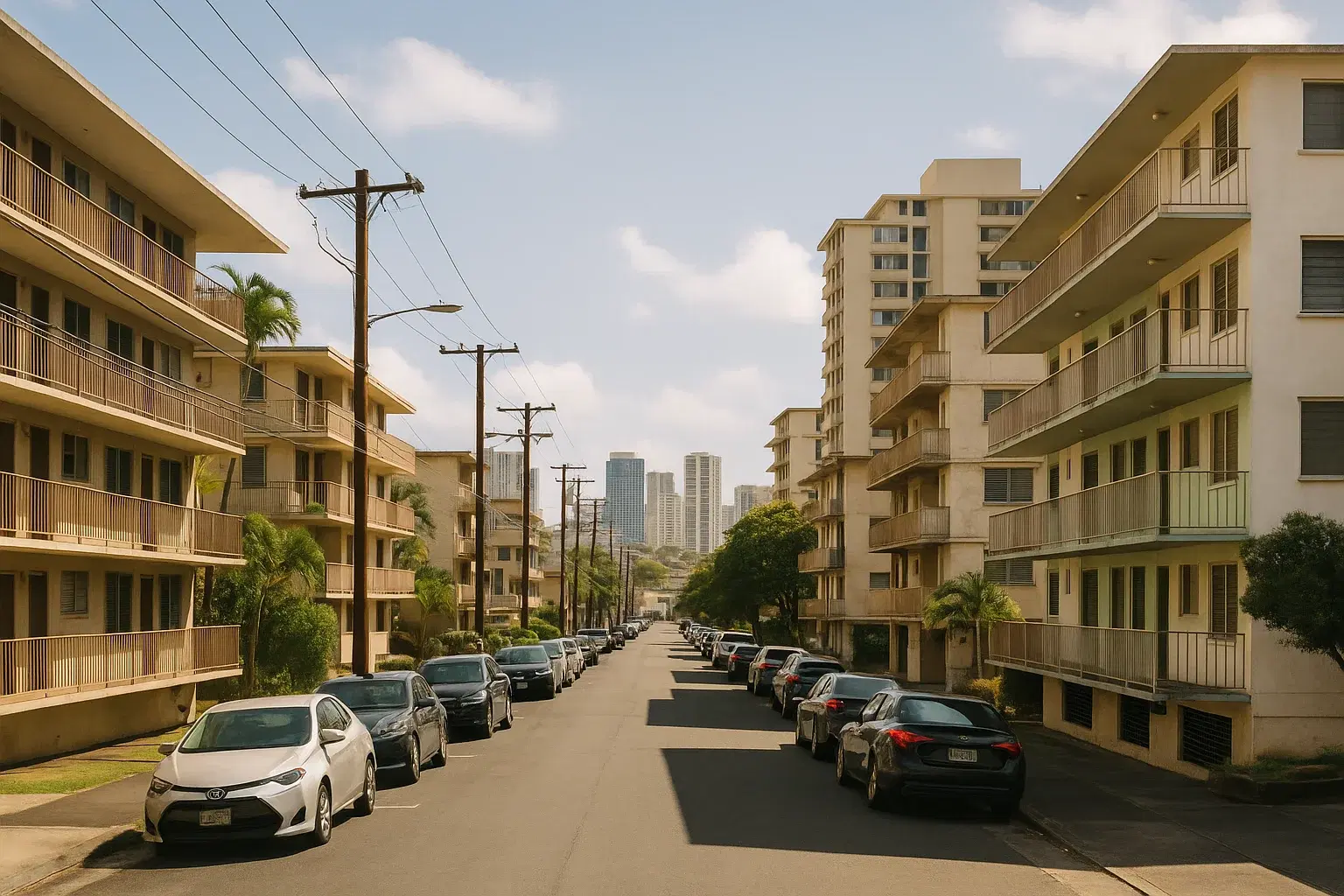
How Honolulu's Bill 6 Supercharges Older Condo Land
Listen to this article:
Bill 6 in Plain English: Why Older Apartment Land Just Got More Valuable
Bill 6 (2026), CD1, is a proposed overhaul of Honolulu's Land Use Ordinance standards for Apartment (A) and Apartment Mixed-Use (AMX) zones. It doesn't redraw the zoning map; instead, it quietly changes the rules inside existing apartment districts where many of O'ahu's older condos and walk-ups already sit.
As drafted, Bill 6 does three big things for A and AMX parcels: it shrinks minimum lot size, it relaxes minimum width/depth, and it raises allowed floor area ratio (FAR). Current rules generally require 7,500-15,000 square feet of land and 70-foot width and depth, with FAR caps from 0.9 to 2.8 depending on the district. Under Bill 6, the minimum lot size standardizes at 5,000 square feet, minimum width/depth drops to 60 feet, and FAR jumps to roughly 2.0, 3.0, and 4.0 (A‑1/AMX‑1, A‑2/AMX‑2, A‑3/AMX‑3). Public testimony from the Department of Planning and Permitting (DPP) and Grassroot Institute describes this as a deliberate attempt to unlock more housing in existing urban apartment corridors, especially on smaller, underbuilt lots.
In practical terms, that means a lot of older condo and walk-up parcels in Mo'ili'ili, Makiki, Kapahulu, parts of Salt Lake, and Pearl City are suddenly allowed 50-200% more buildable floor area on the same dirt, and many undersized lots become conforming. As a Realtor, I see this as a classic "paper upzoning": the zoning label A or AMX doesn't change, but the economic value of the land and the redevelopment leverage for associations can increase sharply if Bill 6 passes in its current form.
Mo'ili'ili, Makiki, Kapahulu: Where Bill 6 Supercharges Condo Corridors
Honolulu's apartment zoning clusters in a few familiar in-town corridors, and Bill 6 hits each a bit differently. Without live GIS in front of us, we can't list every TMK, but we can describe the parcel profiles that gain the most.
Mo'ili'ili / University is full of 1960s-70s walk-ups and small condos on 5,000-8,000 square-foot A‑2 and AMX‑2 lots. Today, those smaller parcels either don't meet minimum lot size or barely clear it, so you're stuck with low-rise buildings and awkward parking. Under Bill 6, a 5,000 square-foot AMX‑2 lot that once supported about 9,500 square feet of floor area (FAR 1.9) could support up to 15,000 square feet (FAR 3.0) - a realistic 5-6 story mixed-use building with better unit count and ground-floor commercial.
Makiki / Punchbowl has a more complicated fabric: older towers that already stretched past earlier FAR rules sit next to 5,000-10,000 square-foot A‑1 and A‑2 parcels with tired low-rises and high deferred maintenance. Those smaller lots gain the most leverage: they become legitimate mid-rise candidates without assembling to 10,000+ square feet, because the minimum lot and width standards relax while FAR rises. Associations on these underbuilt parcels suddenly have a plausible "highest and best use" as land rather than as old concrete.
Kapahulu / McCully / Waikiki fringe has pockets of AMX along Date and Kapahulu where 5,000-7,500 square-foot lots already front good traffic. With FAR 3.0-4.0 and 60-foot minimum width, corner parcels that today hold three-story walk-ups can pencil as slender 5-7 story mixed-use stacks. That means more value for owners- and more disruption risk for neighbors-if redevelopment takes off.
Salt Lake and Pearl City: Smaller AMX Lots Become Real Projects
Outside the urban core, Bill 6 reshapes a quieter but important slice of the condo market: the older apartment corridors in Salt Lake and near rail in Pearl City/Aiea. These areas already have A and AMX zoning sprinkled among towers and walk-ups, but many parcels are stuck in a gray zone-too small or too shallow to justify more than a basic low-rise building under current rules.
In Salt Lake, think of 1960s-70s low-rise condos on 5,000-12,000 square-foot lots along streets like Ala Napunani. Many of these projects have no amenities, outdated systems, and looming repair needs. Today, the economics often favor limping along with patchwork assessments because the next project doesn't pencil. Under Bill 6, those same lots can capture higher FAR without needing to assemble neighboring parcels. A tired three-story condo with covered parking on a 7,500 square-foot A‑2 lot could see its theoretical envelope go from roughly 14,250 square feet to 22,500 square feet. That kind of uplift is what gets developer spreadsheets-and unsolicited AOAO letters-going.
Around Pearl City and Aiea rail stations, A/AMX parcels already benefit from TOD attention. Bill 6 simply makes them more efficient: smaller lots in walking distance of rail no longer need to hit 10,000-15,000 square feet to support meaningful density. A 6,000 square-foot AMX‑2 parcel a block off Kamehameha Highway could move from serving eight older units to supporting a few dozen in a new mid-rise. The combination of increased FAR, transit proximity, and smaller minimum lot size is exactly the recipe that attracts land bankers and joint ventures between local operators and mainland capital. That's good news for owners looking to exit at a premium, but it also means Pearl City AOAOs should be ready for more phone calls and door knocks.
A Simple Before-After Pro-Forma: How Bill 6 Changes a Mo'ili'ili Block
To see Bill 6's mechanics in real numbers, imagine a typical Mo'ili'ili side street near UH on a 10,000 square-foot AMX‑2 parcel. Today there's a 1970s three-story walk-up: 24 units averaging 600 square feet (about 14,400 rentable square feet) and 24 parking stalls. The built FAR is around 1.44. Under current standards, AMX‑2 is capped at FAR 1.9, so the theoretical maximum floor area is 19,000 square feet-maybe 17,500 rentable. That might add only a handful of units over what's already there, so scraping and rebuilding often doesn't pay versus renovating.
Under Bill 6, the same lot jumps to FAR 3.0. Now you can theoretically build 30,000 square feet. After circulation and common areas, call it 25,500 rentable square feet. At 650 square feet per unit, that's roughly 39 units; at 550-600 square feet, you're in the low 40s. Let's assume 42 new units at $2,400/month (a new-building premium near UH). That's about $1.21 million in annual rent. With 30% operating expenses, net operating income lands around $847,000. At a 4.5% cap rate, stabilized value is roughly $18.8 million.
Now compare that to the existing building: 24 units at $2,000/month = $576,000/year, net maybe $403,000. Capitalized at the same 4.5% cap, that's just under $9 million. If new construction costs roughly $420 per square-foot for 30,000 gross square feet (about $12.6 million plus soft costs-round to $14 million all-in), a developer could still pay materially more for the land than its current income value and make the deal pencil. That spread between what the building is worth today and what the land is worth "as if redeveloped" is exactly what creates buy-out pressure on AOAOs once Bill 6 sets the new rules.
Who Gains, Who Gets Pressured: AOAOs, Small Owners, and Disruption Risk
Bill 6 doesn't affect all buildings evenly. The clearest "winners" are: (1) AOAOs on 5,000-15,000 square-foot A‑2 or AMX‑2 lots with older, underbuilt improvements, and (2) fee simple rental walk-ups on similar parcels. For these owners, the land's value as a future mid-rise or mixed-use project rises materially. In Mo'ili'ili and Makiki, that includes many 12-30 unit walk-up condos with aging plumbing and limited parking; in Salt Lake and Pearl City, smaller one-off condos and rental buildings near transit or main arterials fit the same pattern.
The pressure points show up in three ways. First, AOAOs with serious deferred maintenance may suddenly receive bulk-buy offers that look generous versus recent unit resales. Owners facing six-figure assessment risk often become very receptive to these approaches. Second, individual condo owners in small complexes may experience what I'd call "soft coercion": repeated letters, door-to-door visits, and informal "vote counts" long before any formal AOAO process. Third, neighbors-especially in Makiki, McCully, and Kapahulu-face construction disruption as more small sites pencil for infill mid-rise: dust, noise, crane operations, and street parking loss for 18-36 months at a time.
From a legal and governance standpoint, land-use attorneys in Honolulu have consistently warned AOAOs in similar situations (like Bill 7 projects) to get ahead of these pressures. That means clarifying condo termination thresholds, understanding how proceeds would be allocated by percentage interest or square footage, and adopting policies to make sure any developer approach is disclosed to all owners-not just quietly managed by a couple of board members. As a Realtor working these corridors, I strongly advise owners to treat any unsolicited offer as a signal to get independent planning and valuation advice, not as a one-time opportunity to accept on faith.
What Owners and Buyers Should Do Now in A/AMX Corridors
For condo owners and boards in A and AMX zones, Bill 6 is a prompt to do some homework before the market does it for you. First, confirm your zoning and lot details using the City and County zoning map and Real Property Assessment site: verify whether your project is A‑1, A‑2, A‑3, or AMX‑1/2/3, and note your lot area, width, and depth. Next, have your AOAO's professionals map your current built FAR versus what Bill 6 would allow. If you're sitting on a 5,000-12,000 square-foot lot in Mo'ili'ili, Makiki, Kapahulu, Salt Lake, or Pearl City with a 1960s-70s building, there's a good chance your land is more valuable under the new rules than your CC&Rs or insurance values suggest.
For boards, I recommend three concrete steps: (1) adopt a written policy that any developer or broker approach must be disclosed to the full board and then to all owners within a set timeline; (2) engage a land-use attorney to explain how Hawai'i's condo termination statutes and your governing documents interact if a bulk sale is proposed; and (3) commission a neutral appraisal that specifically models your property's value "as is" and "as if redeveloped" under Bill 6 FAR, so owners can debate options from the same set of numbers.
For buyers, especially investors and first-time buyers targeting affordable units, the key is to underwrite both housing and land stories. A cheap walk-up in A‑2 or AMX‑2 might be a great short-term home but also a candidate for redevelopment within 5-10 years. Ask the AOAO if they've been approached by developers, whether they've discussed Bill 6, and how they view long-term capital projects. Understand that your exit might be a conventional sale-or a bulk buy-out at a negotiated premium. In these older condo corridors, Bill 6 is turning quiet, stable apartment streets into active land plays. Knowing which side of that equation you're on is now part of smart due diligence.
Sources: Analysis based on Honolulu Land Use Ordinance standards, public reporting and testimony on Bill 6 (2026) from Yahoo News and Grassroot Institute, TOD and zoning materials from Honolulu DPP, and historical context from the Hawaiʻi Housing Planning Study. All quantitative examples are illustrative and not tied to specific TMKs.
Disclaimer: This article is provided for general informational purposes only and does not constitute legal, financial, or real estate advice. Market conditions change frequently; readers should conduct their own due diligence and consult qualified professionals before making decisions.