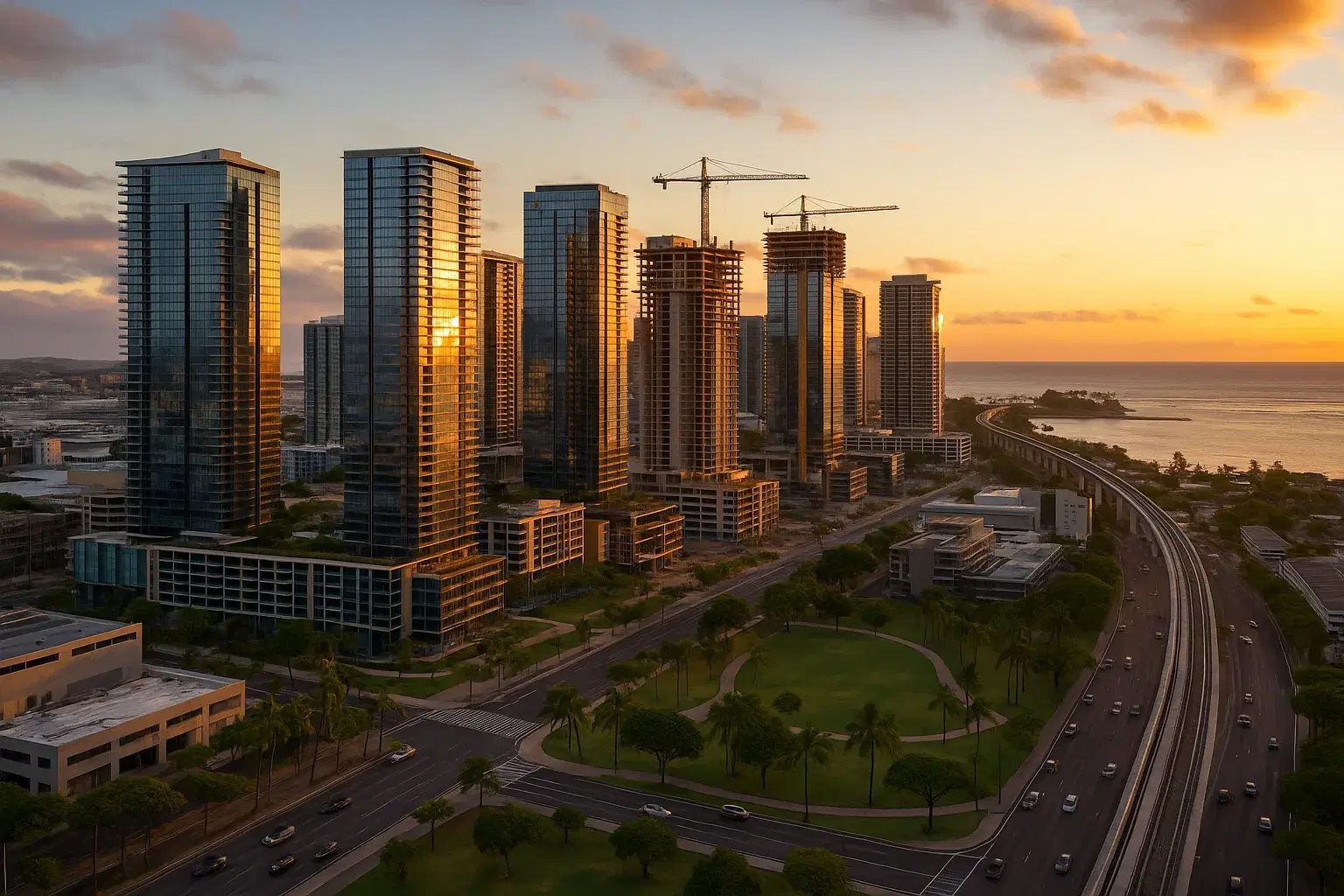
HCDA 2025: Kaka'ako & Aloha Stadium Condo Pipeline
Listen to this article:
What HCDA's 2025 filings really signal for 2026-2028
HCDA's 2025 legislative reports sharpen the near-term housing picture in Kaka'ako and set realistic expectations for the Aloha Stadium district. The headline: next-cycle production is firmly concentrated in Ward Village and Our Kaka'ako, while state-led affordable projects advance through procurement-meaning most brand-new, move-in inventory inside the urban core arrives before the Stadium district's homes ever hit the market.
Key signals include Ulana's completion in 2025 (697 reserved homes), an RFQ for a kupuna supportive rental at 586 South St. with a developer selection target in April 2026, and EAH's affordable rental at Block P (Queen/Kawaiaha'o) positioned for a 2028 construction start. Importantly, HCDA finalized rules for a 99-year leasehold, for-sale pilot on state land-potentially the most consequential affordability lever for would-be buyers over the next 36 months if site selection and entitlements move on schedule.
In parallel, Ward Village's next three towers are locked in by schedule: The Park (2026), Kalae (2027), and Launiu (2028), with luxury launches ('Ilima and Melia) demonstrating outsized demand even as resale MRI has risen islandwide. Our Kaka'ako adds depth via Alia (2027) and a large workforce share in Kahu'ina (now drifting to 2028-2029).
Finally, the Aloha Stadium Entertainment District is a long game. Recent legislative references to a 2028 first phase conflict with NASED's official March 2029 stadium opening; either way, vertical housing there is unlikely to influence condo inventory before 2029. The practical takeaway: focus your 2026-2028 strategy on Kaka'ako-Ala Moana-Mo'ili'ili, where the supply is real, dated, and measurable.
Ward Village: the core Kaka'ako pipeline and when it hits
Ward Village remains the center of gravity for near-term supply. Construction milestones and SEC disclosures give a clear staggered delivery path, while pre-sale velocity suggests limited primary-market pricing softness at the top end. Expect three major handover waves between 2026 and 2028.
- The Park Ward Village (2026): 545 homes, studio-3BR, fronting Victoria Ward Park. As of spring 2025, ~97% presold-closings will be orderly, with limited new-developer inventory left by delivery. Price band: market/luxury.
- Kalae (2027):329 luxury 1-3BR residences on the makai edge. >90% presold by early 2025. Anticipate a tight closing window and immediate resale comps tested against newer amenity packages.
- Launiu (2028): ~485 1-3BR units along Ala Moana Blvd. Construction underway by late 2025, with delivery guided to 2028. Sales momentum has been strong; buyer mix has skewed toward end-users and long-term holders.
Two luxury towers-'Ilima and Melia-entered sales in 2025 with record launch results. While unit counts and starts are not publicly fixed, their performance confirms a bifurcated market: well-amenitized, ocean-adjacent product continues to clear at premiums, even as mid-market resales see longer DOM.
Local implication: adjacent legacy towers (Pacifica Honolulu, Moana Pacific, 909 Kapi'olani, One Archer Lane) will compete on HOA value, finishes, and views. I expect more seller concessions in those buildings during Ward handovers, particularly when Launiu approaches and early buyers at The Park test the resale market.
Our Kaka'ako and the urban core: affordable depth and spillovers
South and west of Ward, the next 36 months are defined by one firm delivery, one large workforce anchor trending later, and two major Ala Moana-Mo'ili'ili projects that will shape pricing across the mid-market.
- Alia (2027): ~457 homes (417 market + 40 reserved), 1-3BR, sustainability-forward. Delivery guided to early 2027. Expect premium-per-square-foot positioning versus older neighbors, but with an efficiency story that resonates with end-users watching HOA costs.
- Kahu'ina (2028-2029 trajectory): Two towers plus live/work, 60% workforce/affordable, total units reported at ~737-861 across sources. Sales activity ramped in 2025; marketing suggests later delivery than initially planned. Its size and price controls will stabilize absorption in regulated bands and temper pressure on older mid-market stock near SALT and Cooke/Auahi.
- The Park on Ke'eaumoku (2025-2026 closings): 972 units (826 market, 146 affordable) continue to close through 2026, injecting substantial move-in options on the Ala Moana axis.
- Kuilei Place (late 2027): 1,005 homes with 603 HHFDC affordable/workforce units. This is the largest affordability tranche in the window, pulling significant demand to the Mo'ili'ili corridor and reshaping comps as it delivers.
Waikiki contributes mainly through resales-no major new towers are slated to deliver by 2028. With neighborhood condo medians hovering in the mid-$400Ks in 2025 snapshots, investor sensitivity to visitor demand and STR rules remains high. Practically, the combined Ala Moana-Mo'ili'ili pipeline creates a competitive halo that will reach older Waikiki buildings with higher HOAs and dated finishes.
Pricing under stress: absorption math and who feels it
O'ahu's condo market is absorbing fewer resales at higher inventory levels: November 2025 logged 316 condo closings (-7.3% YoY), a median of $487,450 (-8% YoY), and MRI near 6.6 months. Against that backdrop, 2026-2028 brings roughly 3,793 new units delivering or closing across Kaka'ako-Ala Moana-Mo'ili'ili: The Park (545) and remaining Park on Ke'eaumoku closings (972) in 2026; Kalae (329), Alia (~457), and Kuilei Place (1,005) in 2027; and Launiu (~485) in 2028.
Two realities soften the headline number: most towers are heavily presold, and closings spread over 4-9 months per building. Even so, the second-order effect-early resales and rent-up competition-matters. If just 10-15% of 2026-2028 deliveries recycle into resale within 12 months, that adds ~380-570 incremental listings into a market already carrying ~2,300-2,400 active condos. Layer in rent-up supply from Kuilei and Kahu'ina's future workforce cohorts, and mid-market owners near Kapi'olani, Cooke, and Auahi should anticipate longer DOM and sharper list-to-sale ratios.
By segment, luxury new development remains resilient: 'Ilima/Melia's 2025 launches captured record pricing with deep pre-sale absorption. Expect minimal primary-market discounting at Ward's top end. Pressure concentrates in the 1990s-2010s mid-tier towers with higher insurance and HOA growth; buyers will demand concessions or credits when newer, more efficient product is available. Regulated/affordable tranches (Ulana, Kuilei, future Block P) will clear at policy-set price points, effectively anchoring demand in those bands and moderating upward pressure on older, comparable units.
Risks, timing traps, and milestones to watch
Schedule risk is the obvious wildcard. Stadium timing exhibits a formal/public discrepancy: some 2025 bill text referenced a 2028 first phase, while NASED's official materials point to a March 2029 opening. For buyers eyeing Halawa, the prudent stance is to treat residential marketing before 2029 as unlikely. In Kaka'ako, the risk is more about drift than derailment: Kahu'ina's push to 2028-2029, Launiu's large scale, and the entropy of insurance and labor costs can nudge closings.
Cost structure is the second risk. With insurance and reserves rising across high-amenity towers, HOA projections deserve scrutiny. I advise clients to request the latest insurance quotes, reserve studies, and escalation schedules before going non-refundable. For 2027-2028 deliveries (Kalae, Alia, Kuilei, Launiu), build rate-lock and appraisal-flex contingencies into financing plans-especially if rate volatility reappears.
Key milestones to track in 2026: developer selection for 586 South St. (kupuna rentals), first construction mobilization for Launiu, and any public notices of site selection under HCDA's 99-year leasehold pilot. In 2027: vertical progress at Kalae and Alia, plus Kuilei's pre-closing packages. In 2028: Launiu's TCO cadence and Block P's groundbreaking window. Each milestone either de-risks a delivery or telegraphs a slip; calibrate offer timing and back-up options accordingly.
One local nuance: legacy buildings with strong reserve posture and simpler amenity stacks (think One Archer Lane) may outperform peers on net carrying costs, even if finishes lag. That matters in a high-MRI market.
Action plan: buyers, sellers, and investors 2026-2028
Turning the pipeline into strategy is where value is won. Here's how to position for the next 24-36 months around Kaka'ako and the Stadium corridor:
- Buyers: Build a delivery calendar and shop during handover waves. The Park (2026) and Launiu (2028) will spur small resale surges from early closers; Kuilei's late-2027 move-ins will pull attention to Mo'ili'ili. Bid with contingencies and ask for credits in submarkets showing MRI ~6-7 months and DOM ~40+ days. For new dev, secure updated construction milestone letters, HOA pro formas, and insurance quotes before removing contingencies.
- Affordable/Workforce seekers: Prep documents now (income, assets, residency). Track EAH's Block P rentals, 586 South St. kupuna opportunities, Kuilei Place sales, and HCDA's 99-year leasehold pilot. Submission windows are tight; readiness beats luck.
- Sellers: Price ahead of the pipeline. If you're in Pacifica, Moana Pacific, 909 Kapi'olani, or adjacent to Keeaumoku/Kapi'olani, a 1-2% price calibration and strong presentation may save months on market. Expect fewer above-ask outcomes; negotiate on terms (rent-backs, repair credits) rather than fishing for 2021 pricing.
- Investors: Luxury pre-sales at Ward look durable, but plan for longer lease-up and flatter rent growth in mid-tier stock. Underwrite with conservative NOI, higher insurance, and reserve contributions. STR rules limit upside in Waikiki; focus on end-user buildings with stable HOA trajectories.
Closing: Over the next three years, success in Kakaʻako and surrounding neighborhoods will hinge on preparation and timing. New inventory will arrive in waves, resale pressure will vary by building, and HOA costs will increasingly separate winners from underperformers. Buyers and sellers who understand delivery schedules, absorption patterns, and neighborhood-specific risks will be better positioned to negotiate price, credits, and terms. I publish ongoing market analysis, delivery timelines, and neighborhood checklists to help clients plan around these shifts. If you are evaluating a purchase or sale in this cycle, this pipeline should be part of your decision framework.
Sources: Primary inputs: HCDA 2025 Annual Report and RFQ postings; Ward Village SEC filings and developer announcements; Kamehameha Schools/Stanford Carr updates; Kobayashi/BlackSand project pages; NASED schedules and 2025 legislative records; HBR and Locations market data.
Disclaimer: This article is provided for general informational purposes only and does not constitute legal, financial, or real estate advice. Market conditions change frequently; readers should conduct their own due diligence and consult qualified professionals before making decisions.