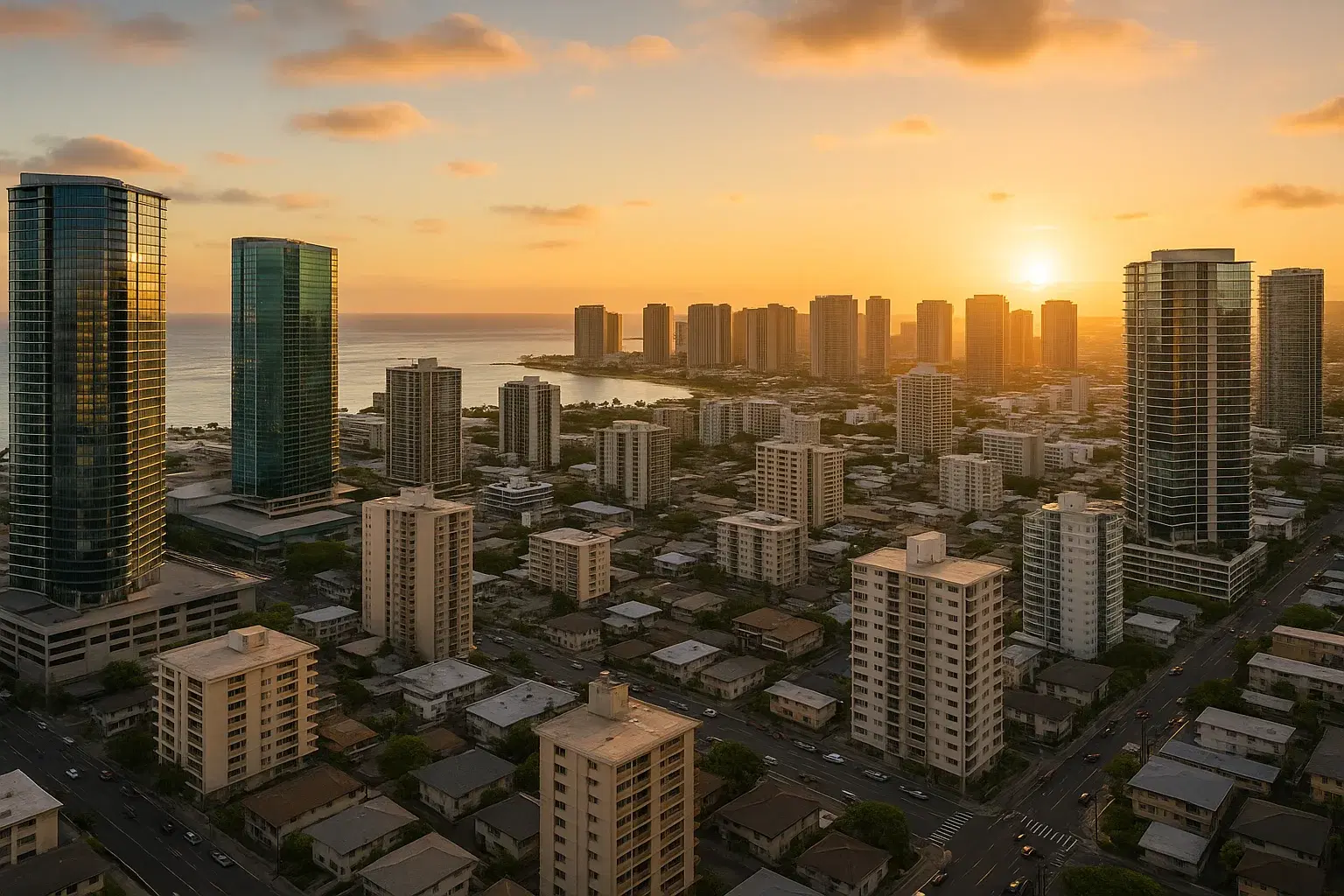
The Great Stalemate in O'ahu's Condo Market
Listen to this article:
From Frenzy to Stalemate: How O'ahu Reached 'Balanced' Territory
O'ahu's condo market has quietly crossed an important line. After years of 1-2 months of supply during the COVID boom, we've now spent much of 2025 and early 2026 with roughly 6-7 months of condo inventory on the island. In classic real estate language, that's a shift from a strong seller's market to what professionals call "balanced," even leaning toward buyers in some segments.
The numbers tell the story. In February 2025, Locations pegged condo Months of Remaining Inventory (MRI) at 6.0 months and explicitly labeled that "the balance point." By June 2025, O'ahu condo MRI climbed to 7.3 months, a 17‑year high and firmly in buyers' market territory. As 2025 closed, MRI settled back around 6.1 months and hovered at roughly 6.0 months in January 2026, according to local broker commentary. Meanwhile, single‑family homes sat closer to 3.5 months-tighter, but no longer in bidding‑war mania.
Yet prices have not collapsed. The condo median has eased only single‑digits off the peak-down about 4-6% year‑over‑year at points in 2025-while some months even showed modest month‑to‑month gains. Median days on market for condos have stretched into the low‑40s, and only about 12% of condos close above asking, a far cry from the COVID frenzy but still evidence of selective heat.
This combination-elevated inventory, longer market times, but only mild price giveback-is what I'd call the "Great Stalemate." Buyers finally have options and negotiating room. Sellers, still anchored to COVID‑era highs, are slow to move on price. Instead of a dramatic crash, we're seeing a slower, more uneven rebalancing that plays out building by building, neighborhood by neighborhood.
Three Condo Segments Quietly Tilting Toward Buyers
Islandwide metrics hide the real story: which types of buildings are softening, and which are still defending their prices. When I'm analyzing condos for clients in Honolulu-especially in Waikiki and the urban core-I'm not just asking, "What is O'ahu doing?" I'm asking, "What is this building type doing?" Right now, three segments stand out as increasingly buyer‑favorable.
1. Older walk‑ups and 1960s-1980s towers. Areas like Salt Lake and Leeward O'ahu, dominated by older mid‑rise and high‑rise stock, showed around 9.4-9.5 months of condo inventory by mid‑2025. These buildings often carry rising maintenance fees, aging plumbing and elevators, and new insurance realities. Buyers who actually read AOAO minutes and reserve studies are using upcoming assessments as leverage. A realistic 2026 scenario: a 1970s Salt Lake 2‑bedroom with $900+ in monthly fees lists at $575,000, sits 60+ days, and ultimately closes around $525,000-roughly 9% under ask-after the seller agrees to cover a pending plumbing assessment.
2. Large AOAO complexes with very high fees. In parts of Waikiki and Ala Moana, some resort‑style or amenity‑heavy towers carry $800-$1,500+ monthly fees. With more inventory on the market, fee‑sensitive buyers simply bypass these buildings, shrinking demand. That's where I've seen buyers negotiate 5-10% off list plus credits for assessments or closing costs when there are several similar units available.
3. Luxury towers in Kaka'ako and Ala Moana. The Ala Moana-Kaka'ako sub‑market hit about 9.9 months of condo MRI in 2025-near a full year of supply when you include high‑end product. Developers quietly offer incentives instead of headline price cuts, but resale sellers don't have that luxury. One plausible pattern: a resale 2‑bedroom initially listed just under $1.2 million sits for 70+ days and eventually closes at $1.08 million-around 10% under ask-paired with seller‑paid AOAO transfer fees or a furnishings credit to get the deal done.
Where Sellers Still Win: Tight Micro‑Markets and Turnkey Units
Balanced doesn't mean flat everywhere. Even with O'ahu condos sitting around six months of inventory overall, some pockets behave like it's still 2021-especially for clean, move‑in‑ready listings. Understanding these micro‑markets is crucial if you're a buyer hoping for a discount or a seller debating how aggressively you can price.
Three sub‑markets stand out in the data. Kailua, Waipahu, and Mililani each show roughly 4.1-4.7 months of condo supply-noticeably tighter than the islandwide average and closer to a mild seller's market. Add limited buildable land, strong local owner‑occupant demand, and commuting patterns that favor these communities, and you get a very different feel than in the high‑rise corridors of Ala Moana or Salt Lake.
In practice, that can look like two very different weekends. In an older Waikiki walk‑up with dated finishes, high fees, and lingering insurance questions, a unit might sit for two months before attracting an offer 8% under asking, with the buyer negotiating credits for deferred maintenance. Meanwhile, up in Mililani, a renovated 2‑bedroom in a well‑managed complex, with moderate fees and two parking stalls, hits the market at a realistic price and draws three to five offers in the first week. The winning buyer stretches 3-4% over ask and waives minor cosmetic repair requests to stand out.
This split shows up in the statistics: even in December 2025, with condo MRI over six months, about 12% of O'ahu condo sales still closed above asking. In my experience, those over‑ask deals are rarely happening in high‑fee, high‑inventory towers. They're happening in well‑run, fee‑sensible buildings in communities like Kailua and Mililani where inventory is genuinely scarce. For buyers, that means being prepared to move quickly and competitively in these pockets. For sellers, it means you can still command strong prices-but only if your unit is priced accurately and shows well.
COVID Peak Anchors: Why Prices Stay Sticky Despite More Supply
If inventory has doubled or tripled from COVID lows, why haven't prices reset more dramatically? The answer is part psychology, part math, and very specific to how O'ahu's condo stock is financed and maintained.
On the seller side, I see a lot of anchoring to 2021-2022 highs. An owner in a Waikiki tower remembers a neighbor's 2022 sale at $600,000 and treats that as the "real" value, even though mortgage rates are higher, fees have increased, and there might now be five similar active listings in the same complex. The unit hits the market at $615,000 instead of a more realistic $565,000-$585,000. After 60-90 days, a price reduction follows, and the eventual sale often lands near what could have been achieved quickly with proper pricing from day one.
Buyers, by contrast, are anchored to the monthly payment. When principal and interest at today's rates plus $800-$1,000 in HOA dues and higher insurance come together, they're not just comparing this building to last year's sale-they're asking, "What does my all‑in cost buy me across the island?" That's why some buyers are trading "prestige" for practicality: shifting from a view unit in a high‑fee tower to a more modest building near rail or in Mililani where fees are lower and parking is reliable.
The stalemate emerges in the middle. Entry‑level, fee‑sensible units in tight sub‑markets are still moving-sometimes over asking. High‑fee, older, or purely investment‑oriented condos in oversupplied corridors can sit for months unless sellers accept 5-10% below their anchored expectations. Structural costs like land, construction, and now insurance put a floor under how low prices can go in the long run, while human psychology slows the adjustment down. Instead of a sharp correction, we get longer market times, more back‑and‑forth in negotiations, and a slow drip of price reductions until reality and sentiment finally meet.
Investors, Rail, and Insurance: A New Risk-Reward Equation
For investors who bought condos betting on the rail, transit‑oriented development (TOD), or a quick normalization in insurance costs, the shift to 6-7 months of inventory is not a footnote-it's a regime change. When absorption slows, the margin for error in your underwriting shrinks, especially in buildings with complex AOAO dynamics.
Along the rail corridor and in West and Central O'ahu, the TOD thesis still has merit. Areas like Waipahu and Mililani already show lower condo MRI-around 4-4.7 months-which supports the idea that well‑located, fee‑sensible projects near transit nodes can maintain healthy demand. But proximity to a station doesn't rescue a building with underfunded reserves, major structural work ahead, or volatile insurance premiums. In older high‑rises, recent insurance hikes and stricter reserve requirements after high‑profile mainland failures have turned some pro formas upside‑down. What looked like a solid cap rate on paper in 2021 can feel thin in 2026 once new premiums and assessments are fully factored in.
Higher baseline inventory also changes exit risk. Investors counting on easy resale or a quick condo flip now face longer days on market and more scrutiny from buyers' lenders and inspectors. Liquidity is there-but not at any price. I'm increasingly seeing a spread between buildings with strong governance, documented reserves, and completed life‑safety work versus those with vague plans and looming projects. The former may only give back a few percent in price but still find ready buyers; the latter trade at an effective discount via lower contract prices, heavier concessions, or simply very slow absorption.
In this environment, the real due diligence edge is not just in analyzing rent comps or rail maps-it's in reading AOAO budgets, insurance histories, and reserve studies line by line. Elevated inventory has made that building‑level risk more visible, and buyers are pricing it in.
Playbook for 2026: How Buyers and Sellers Can Win the Stalemate
A "balanced" condo market on O'ahu doesn't mean nobody can win. It means outcomes depend much more on strategy and building choice than on riding a rising tide. Whether you're buying or selling in 2026, the playbook is more nuanced than it was during the COVID frenzy.
For buyers:
- Think micro‑market first. Don't let the 6‑month islandwide MRI lull you into a false sense of security. In high‑inventory zones like Ala Moana-Kaka'ako, Salt Lake, and parts of Leeward O'ahu, push harder-5-10% under ask plus credits are realistic when a building has multiple similar actives. In tighter markets like Kailua, Waipahu, and Mililani, be prepared to move fast and occasionally bid slightly above ask for well‑priced, turnkey units.
- Underwrite the AOAO, not just the unit. Review reserve studies, budgets, and insurance history. High or rising fees aren't automatically a deal‑breaker if they're funding real long‑term stability-but they should be reflected in the price you're willing to pay.
- Use time as leverage, not an excuse. With longer days on market, you don't have to rush, but you also shouldn't assume every seller is desperate. Target buildings and segments where the data-MRI, DOM, number of actives-truly support aggressive negotiation.
For sellers:
- Price to today, not 2022. If your building or sub‑market sits at 7-10 months of inventory, a "test the market" price can easily turn into a stale listing. Align with recent closed comps and adjust for fees and upcoming work.
- Lead with transparency. Clean AOAO documentation, clear disclosure of completed or ongoing projects, and a well‑presented unit can justify stronger pricing even in a balanced market.
- Use concessions strategically. Credits for assessments, modest closing cost help, or flexible timing can bridge the gap for buyers without tearing down your headline price and future comps.
O'ahu's condo market in early 2026 isn't a boom or a bust-it's a negotiation. The investors, owners, and buyers who recognize the "Great Stalemate" for what it is, and adjust to building‑level realities, are the ones who will come out ahead over the next cycle.
Sources: Analysis based on public statistics and commentary from Honolulu Board of REALTORS®, Locations Hawaii research reports (2025–2025 OREO and market updates), local broker blogs, and islandwide condo inventory, price, and days-on-market data through early 2026.
Disclaimer: This article is provided for general informational purposes only and does not constitute legal, financial, or real estate advice. Market conditions change frequently; readers should conduct their own due diligence and consult qualified professionals before making decisions.