Ala Pono Pedestrian Bridge: History, Challenges, and Path Forward
Listen to this article:
Project Overview and Purpose
Ala Pono is a planned pedestrian and bicycle bridge across Honolulu's Ala Wai Canal, intended to connect Waikiki with the McCully-Moiliili area. It will span roughly 300 feet from Kalaimoku Street on the Waikiki side to University Avenue on the mauka (inland) side. The primary goal is to provide safe, direct access for people on foot or bike, improving multimodal connectivity between neighborhoods that are currently separated by the canal. At present, the Ala Wai Canal has only bridges at its far ends (Kalakaua/Ala Moana and McCully/Kapiolani), leaving about a 1.5-mile gap with no crossing in the middle. This forces pedestrians and cyclists into long detours or unsafe routes. By adding a mid-canal crossing, Ala Pono aims to "enhance public safety for people walking and bicycling" and support Honolulu's Complete Streets initiative for sustainable, equitable transportation. City officials also envision the bridge as a potentially artistic, culturally inspired elementin the landscape, given its location near Waikiki's tourist district.
Origins – The idea of a bridge at this location is not new. In fact, city planners discussed an Ala Wai crossing for decades – it was originally proposed as a vehicular bridge more than 50 years ago, back when Hawaii was still a U.S. territory. Those early plans never materialized. The concept resurfaced in the 2000s with community discussions about a University Ave–Waikiki bridge. Initial pitches in the late 2000s met resistance – for example, Moiliili resident Laura Ruby began opposing the idea as early as 2007. The modern Ala Pono project took shape around the mid-2010s when the City revived the plan as a pedestrian/bicycle-only crossing(no cars) to address mobility needs. By 2018, Honolulu's Department of Transportation Services (DTS) launched a formal study and outreach effort to move the project forward.
Planning Timeline and Key Milestones
The Ala Pono project has progressed through several phases of study, public input, and approvals over the years. Below is a chronological timeline of major activities, meetings, and milestones:
- September 2018 – Community "Kickoff" Meetings: The City held introductory community meetings (Sept 22 and 24, 2018) to present the Ala Wai crossing concept and gather initial ideas. Residents were polled on their "big ideas" and preferences for a crossing (surveys were offered in English, Japanese, Korean). These early sessions helped shape the project's Purpose and Need and evaluation criteria. (Notably, even at this stage, some community members voiced concerns about the project's impacts, foreshadowing debates to come.)
- 2018–2019 – Alternatives Analysis: DTS and its consultants conducted the Ala Wai Crossing Alternatives Analysis to examine all options for improving access over the canal. They evaluated multiple strategies – building a new bridge at various locations, enhancing or widening existing bridges, even non-bridge ideas like an aerial tram – as well as the "no-build" alternative. Each alternative was scored for feasibility, environmental/cultural impacts, and how well it met the project's purpose. By early 2019, public feedback and technical analysis identified a new bridge near University Avenue as the top choice, outperforming other alternatives. This location scored highest in improving connectivity for the UH Manoa-to-Waikiki corridor, which is one of Honolulu's busiest travel pairs. A public meeting in March 2019 (at Waikiki Community Center) shared the analysis results and confirmed community support for the preferred alignment. The University–Kalaimoku Street alignment then advanced to engineering and environmental review.
- March 2021 – Draft Environmental Assessment (EA): After further design refinement, the City published a Draft EA in March 2021, as required by Hawaii and federal law. The EA analyzed potential impacts on traffic, historic sites, park land (triggering a U.S. Section 4(f) evaluation for parks), waterway ecology, cultural resources, and more. A virtual community meeting was held on March 30, 2021 to present the findings and proposed design. During the 30-day public comment period, over 200 comments were submitted by agencies and community members. Notably, many comments expressed concerns about the bridge's height and visual prominence, as well as its social impacts – we'll detail these concerns in the next section. The project team responded by adjusting the design: the bridge's tower height was lowered by 10 feet to reduce visual impact, and access ramps were tweaked for better pedestrian/bike flow. After the comment period closed in April 2021, DTS began preparing the Final EA, while also initiating a formal Section 106 historic consultation (since the canal area has historic significance and recreational use).
- 2022–2023 – Approvals and Funding: Progress slowed somewhat during the height of the COVID-19 pandemic, as in-person outreach was limited and some reviews delayed. (The City noted that the process was taking longer "because we are not rushing" and they wanted extensive community input.) By mid-2023, momentum picked up: In June 2023, Honolulu won a major federal grant ($25 million) for the Ala Pono bridge. This was on top of a prior $25 million federal commitment, bringing total federal funding to about $50 million – roughly 80% of the updated $63 million project cost. Local officials hailed this as a turning point that "pav(ed) the way for progress", since funding was often cited as an obstacle. With City Council support (the Council kept the project's matching funds in the budget), the bridge moved closer to reality. However, the influx of funding also renewed public scrutiny of the design and costs (see Community Reactions below). In early September 2023, two state senators even hosted a town hall meeting to air community concerns, given some residents felt their opposition had not been heard. By late 2023, DTS indicated it was finalizing the environmental review and preparing for procurement – original timelines had optimistically targeted construction start by summer 2023, but that did not happen due to the pandemic and extended public outreach.
- Late 2024 – Design Charrettes: In response to ongoing community pressure, the City organized public design workshops (charrettes) on Nov. 20 and 23, 2024 at Ala Wai Elementary School. Hundreds of residents attended these sessions to review and vote on various bridge design concepts. DTS presented 10 different bridge configurations and also welcomed citizen-proposed ideas, ending up with 19 distinct design alternatives being evaluated. Participants filled out surveys and rated each design option, providing a clear sense of which styles were most and least favored by the public. (The next section will discuss the design options and feedback in detail, including the debate between making the bridge a bold "icon" vs. a simple structure.) The charrettes were a direct result of community requests – even the City Council, in approving the project's funding, had required consideration of alternatives to the initial design that many found controversial. By all accounts, these November workshops were very successful in gathering input: nearly 300 people participated, representing Waikiki, Moiliili, McCully and beyond. In February 2025, DTS published a comprehensive report of the charrette results online for transparency.
- 2025 – Final Approvals: In the first half of 2025, the project cleared important remaining hurdles. By June 25, 2025, the City and Federal Highway Administration (FHWA) executed a Section 106 Memorandum of Agreement (MOA), resolving historic preservation concerns. This MOA outlines measures to mitigate any impacts on historic or cultural resources, and its signing "clears the way for the environmental review to be finalized." With that done, DTS anticipated publishing the Final Environmental Assessment (and obtaining either a Finding of No Significant Impact or other decision) by late 2025. Concurrently, DTS has been drafting the Request for Proposals (RFP) so that it can procure a design-build contractor soon after environmental clearance. According to officials, the plan is to solicit bids in early 2025 and select a contractor based on best design and cost by the end of 2025.
Design Evolution: Iconic Vision vs. Community Preference
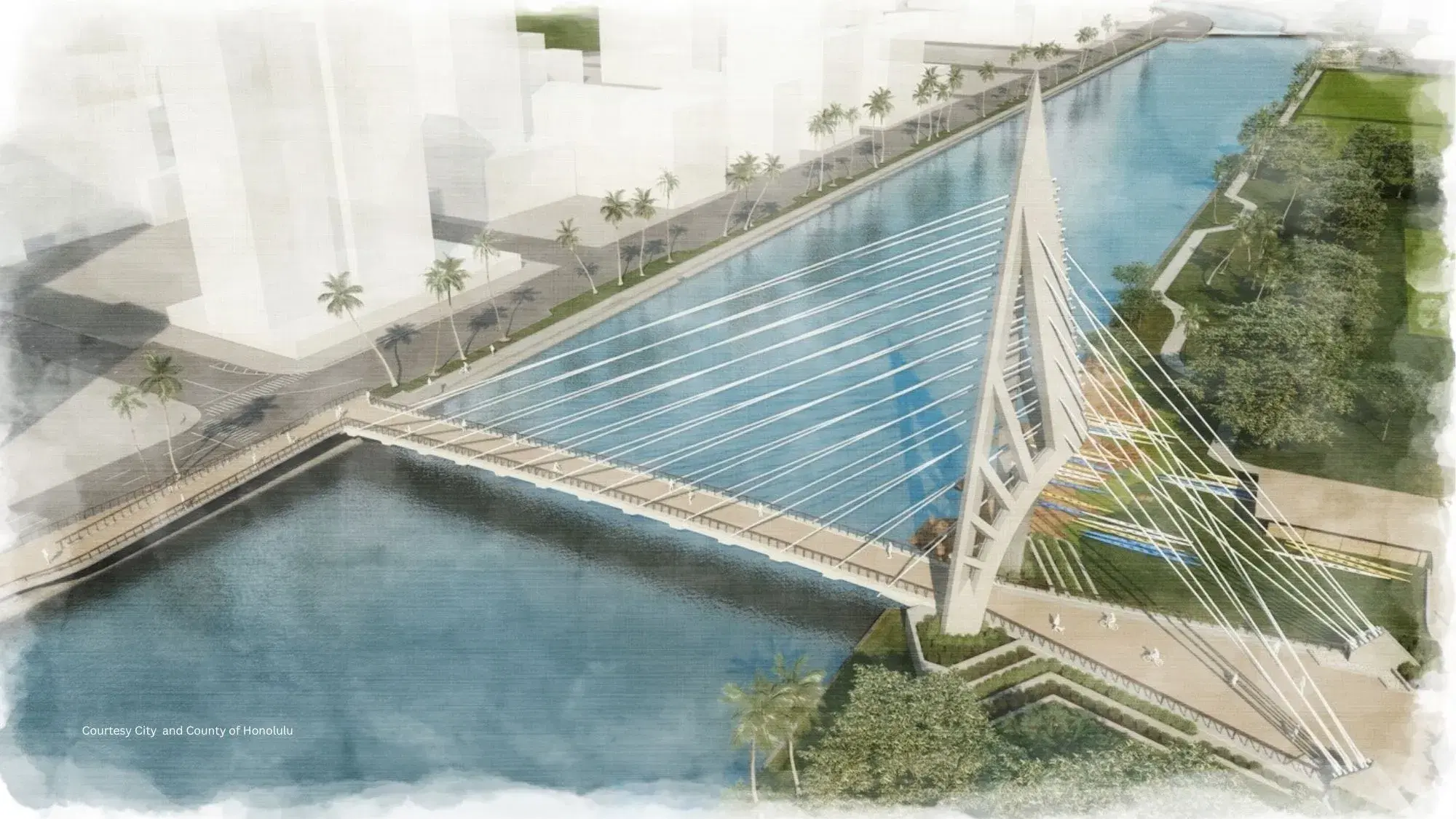
Original conceptual rendering of the Ala Pono bridge design (cable-stayed). The initial design featured a tall single-tower span with no supporting piers in the canal, aiming to be a new visual landmark.
From the outset, the City's design team leaned toward a cable-stayed bridge – a modern design with a prominent tower and cables – to achieve the required 300-foot clear span without any supports in the water. The initial concept unveiled around 2019–2020 featured a dramatic cable-stayed structure rising roughly 180 feet high at its peak. City leaders, including DTS Director Roger Morton, saw an opportunity for a signature piece of infrastructure, describing the goal to build not just a utilitarian crossing but potentially a new city landmark. The bridge's aesthetic was inspired by Hawaii's environment and culture (some renderings evoked a canoe sail or fishnet pattern, symbolizing the canal's aquatic heritage). Engineers chose a clear-span design without any piers in the canal because the Ala Wai is heavily used by outrigger canoe clubs and other paddlers – placing support pillars in the water would impede these activities. As DTS Deputy Director Jon Nouchi explained, a more modest bridge with mid-canal supports was considered but rejected; any supports would have to be extremely large (bigger than those on existing car bridges) to withstand flood forces, since the new bridge must be higher for flood safety. Thus, the trade-off was a taller, cable-supported structure on land, keeping the canal waterway completely open for paddling. The artistic, bold designalso aligned with the City's early vision of the bridge as a "modern, artistic, and vibrant element" for Waikiki's skyline.
However, as designs were refined and shared, public reaction to the large cable-stayed concept was mixed. Some community members applauded the idea of a striking architectural icon – for example, a UH design student at one workshop said "I like landmarks" and favored the original tall design. But many others felt the scale and style were out-of-place. Critics said a towering bridge would "block the view of Diamond Head" from certain angles and dominate the low-rise, park-like character of the canal banks. Concerns were raised that it looked overbuilt "for heavy traffic" despite being only for pedestrians/bikes. By the time of the Draft EA in 2021, plenty of feedback urged a more low-profile structure, leading the City to shave 10 feet off the tower heightin the EA revision. But even that didn't fully quell the criticism.
Community-inspired alternative concept for the Ala Pono bridge (low-profile design). At public workshops in 2024, residents showed strong interest in simpler bridge designs that would be less imposing and blend into the environment.
During the November 2024 charrettes, this debate came to a head. DTS presented a wide array of design alternatives – from variations of the cable-stayed idea to arch bridges, truss bridges, flat beam bridges, and more (some even quite whimsical). Residents voted and commented on each. The feedback was clear: a significant portion of the community preferred "a simpler, lower-profile design that seamlessly blends into the surroundings." In other words, many people wanted a safe, functional bridge that does not become an oversized landmark. Several of the top-ranked designs in the charrette results were those with minimal visual bulk – for example, concepts with a shallow arch or low twin-girder profile, and railing designs that wouldn't obstruct views from the bridge or afar. On the other hand, the original single-mast cable design (which had been widely publicized earlier) scored lower in popularity at these meetings, due to its perceived visual intrusion. This community input prompted officials to emphasize that no final design has been chosen yet – instead, the upcoming design-build RFP will ask bidders to incorporate the community's preferences. The procurement will be a design competition of sorts: contractors will propose detailed bridge designs, and the City will select the proposal that offers the "best value" considering both aesthetics and cost. It's worth noting that all proposed designs must still meet engineering requirements (span, flood clearance, structural safety). This likely means the final bridge, even if simpler in appearance, will use creative engineering to avoid mid-stream supports or to integrate with planned Ala Wai flood control walls (the U.S. Army Corps of Engineers is proposing 6–9 foot high flood walls along the canal for a separate $1 billion project). City officials have stated that the bridge designs on the table "are all designed to fit with" the flood wall plan and other future improvements like the Ala Wai Boulevard bikeway. As the design evolves, additional community amenities are being considered too – for example, upgrades to nearby park facilities and cultural features (improving restrooms, adding interpretive signage, etc.) have been discussed as possible accompaniments to the bridge.
Community Concerns and Reactions
From its inception, the Ala Pono project has generated intense public debate, reflecting broader tensions in Honolulu's urban development. Here are the major points of contention and support voiced by various stakeholders:
- Neighborhood Fears of Crime and Homeless Impacts: Perhaps the most visceral opposition has come from some residents on the Moiliili/McCully (mauka) side, who worry the bridge will provide an easy conduit for Waikiki's problems to spill into their community. Waikiki is a busy tourist district and has higher rates of petty crime and homelessness compared to the quieter residential areas across the canal. As one area resident put it, "The only thing I can see it benefiting is anyone who's stealing anything from the tourists in Waikiki getting out quickly." This sentiment – that the bridge might facilitate quick getaways for thieves or movement of vagrants – was echoed in multiple forums. Some fear an uptick in burglaries or vandalism in neighborhoods like Moiliili if a direct footpath from Waikiki is created. It's essentially a social concern: bridging the physical gap may also bridge an economic and social gap, bringing unwelcome activity. Honolulu officials have acknowledged these concerns but note that the bridge itself doesn't create crime – they argue that better connectivity can benefit locals (e.g. workers, students) and that public safety measures can address crime regardless of infrastructure. Still, the perception of increased crime risk remains a key reason a segment of residents (including longtime opponent Laura Ruby) have opposed the project.
- Cost and Funding Concerns: With an estimated price tag of $63 million, the Ala Pono bridge prompted "sticker shock" for many residents. Even though 80% of the funding is coming from federal sources, people have questioned whether the cost is justified for a pedestrian bridge. Comparisons have been made to similar projects elsewhere – for example, a 2015 pedestrian bridge of comparable length in Reading, UK was built for about £5.9 million (≈$11 million), an order of magnitude less. "That's crazy," remarked the head of the Hawaii Bicycling League regarding the $60m+ estimate, even as he supports the bridge's purpose. Why so expensive? DTS officials have offered explanations: Hawaii's construction costs are generally high; the Ala Wai soil conditions are poor (requiring deep foundations); seismic design standards here are rigorous; and the bridge is slightly larger in span than some foreign examples. Additionally, building to withstand future flood levels (the bridge must be high enough not to "be overtaken by flooding") adds cost. Construction inflation post-COVID has also driven up estimates. Despite these rationales, taxpayer skepticism persists, especially given Honolulu's history of big projects running over budget (rail transit being a recent example). Some residents worry the City's 20% share (~$13 million) could be better spent on other local needs if the bridge isn't essential. Others counter that turning down $50 million of federal money for a needed safety project would be unwise. In summary, while federal funds have made the project financially feasible, the high cost remains a talking point – used by critics who call it a "bridge to nowhere"and by supporters who emphasize getting the design right so money isn't wasted.
- Environmental and Cultural Impact: The Ala Wai Canal and its surroundings are not just empty space – they constitute a significant urban ecosystem and cultural landscape. Wildlife advocates have raised concerns about how construction and presence of the bridge might affect species like native waterbirds. For instance, at an April 2022 Waikiki Neighborhood Board meeting, a resident pointed out that the endangered Hawaiian stilts (ae'o) and other birds use the canal area and could be disturbed by the new bridge or increased foot traffic. Any required lighting on the bridge also raises issues (to avoid disorienting seabirds at night). The City's EA did examine flora and fauna impacts and did not find any insurmountable issues – but skeptics felt a full Environmental Impact Statement (EIS) should have been done to thoroughly study these aspects. Culturally, the area around the bridge landing (Ala Wai Neighborhood Park and Canal) has significance: historically, Waikiki was a fertile wetland and the canal itself, completed in 1928, is a historic engineering feature. Some community members worry that adding a modern structure could detract from the historic ambiance or require alterations to park land (a Section 4(f) evaluation was done because park space is being used). The completed Section 106 MOA addresses mitigation – for example, interpretive displays or cultural markers might be installed to honor the area's history, and the design will be sensitive to sightlines of landmarks like Diamond Head. Nonetheless, the call for an EIS became a rallying cry for opponents in late 2024: petitions circulated demanding a more exhaustive review of how the bridge could alter neighborhood character and the environment. It's important to note, however, that the 2021 Draft EA concluded the project is not likely to have significant impacts, which legally supports issuing a Finding of No Significant Impact (FONSI) instead of doing a lengthier EIS. Absent new information, regulators were inclined to accept the EA – a stance frustrating to those who feel impacts are being downplayed.
- Quality of Life and Aesthetics: Beyond specific environmental effects, many locals simply dispute whether the bridge will improve their quality of life. Some Moiliili residents view it as primarily benefiting Waikiki and tourists, rather than the adjacent communities (a classic "not in my backyard" perspective). They note that the City's justification often mentions tourists enjoying "safe, affordable transportation" too, feeding the narrative that this is to help visitors or Waikiki businesses. On the Waikiki side, by contrast, some residents are enthusiastic because the bridge could relieve traffic (fewer cars if more people walk/bike) and provide a new recreation option (strolling over the canal). Real estate observers have even noted that improved walkability via the bridge could boost property appeal on both sides of the canal in the long run. When it comes to visual aesthetics, as discussed earlier, opinions diverge: Should the bridge be a landmark piece of architecture, or a background infrastructure? In community meetings, you'd hear statements like "If it is going to be this big structure, it should represent the aquatic lifeline of Hawaii" (i.e. have an artistic design) versus "I just like the simple ones" that don't stand out. This is a classic conflict between those who embrace Honolulu's growth and urban identity and those who prefer it remain a more low-key tropical town. The bridge, in a way, symbolizes that clash – its design debateis about more than engineering, touching on people's feelings about development, modernization, and preserving views.
- Support and Advocacy: On the pro-bridge side, there are numerous supporters including transportation advocates, many Waikiki businesses, UH students, and residents who commute by bike. The Hawaii Bicycling League (HBL) has been a vocal champion, arguing that "the project is vital for safety, connectivity, and ensuring affordable transportation options for residents and visitors." HBL and other groups have encouraged members to speak up in favor at neighborhood boards and City Council, balancing out the louder critics. Supporters emphasize that current crossings are inconvenient and dangerous for non-drivers – for example, a UH Manoa student living near campus might work in Waikiki but has to either detour to McCully Street (which "isn't a very pleasant experience" for walking/biking) or to Kapahulu Avenue, adding significant time. A straight-line connection could dramatically cut travel time and encourage more people to leave cars at home. They also point to the City's policy goals: reducing carbon emissions, promoting healthy lifestyles, and addressing Honolulu's notorious traffic congestion. In that light, Ala Pono is more than a local shortcut; it's a key link in the citywide bike/ped network (plans are underway for protected bike lanes feeding into the bridge on both sides). Some even see the bridge as an economic booster, tying the University community closer to Waikiki jobs and businesses. In summary, supporters frame Ala Pono as a long-overdue piece of infrastructure in a city that has lagged in pedestrian amenities. They acknowledge concerns but feel issues like security can be managed with design (lighting, cameras) and policing, whereas the benefits of connectivity will be lasting.
In community meetings and neighborhood board sessions through 2022–2025, all these perspectives have been aired. The Waikiki Neighborhood Board, for instance, has not taken a formal stance against the bridge; its members have generally been interested in design updates and ensuring local input is considered. They were reassured that funding was secured in the City budget as of 2022 and that DTS was addressing issues raised. On the other side of the canal, the McCully–Moiliili Neighborhood Board and residents like Laura Ruby have been hubs of opposition. Ruby's activism even prompted city leaders to hold the 2024 design charrettes and keep exploring alternatives. This dynamic shows that while official agencies are moving forward, they have had to accommodate a truly wide range of community sentiments.
Next Steps and Timeline to Completion
As of late 2025, the Ala Pono project is poised to transition from planning to implementation. Several critical steps remain, but the finish line is in sight:
- Environmental Clearance (Late 2025 / Early 2026): The City expects to finalize the Environmental Assessment by winter 2025/2026, after incorporating all the feedback and the stipulations from the Section 106 MOA. If the authorities determine that there are no significant impacts (as anticipated), a Finding of No Significant Impact(FONSI) will be issued. This would officially conclude the planning/environmental phase. (Should an EIS somehow be required – which is unlikely given prior conclusions – it would delay the project further, but no such decision has been made.)
- Design-Build Procurement (2025): Immediately after environmental clearance, DTS will release the Request for Proposals for a design-build contract. Design-Build means one team will be selected to complete the final design and construct the bridge. The RFP is expected to go out in early 2025, and bids will likely be evaluated by late 2025. The selection won't be based on lowest price alone; the City will weigh design quality, community preference alignment, and cost in a "best value" selection process. Roger Morton noted they hope to have three finalist contractors in the running, each bringing creative design solutions within the budget. By around the end of 2025 or very early 2026, we should know what the final bridge will look like and who will build it.
- Construction Start (2026, projected): Once a contractor is on board and designs are finalized, ground-breaking can occur. There may be some lead time for detailed engineering and permitting, but construction could begin as soon as mid-2026 (assuming no further legal challenges or funding hiccups). Both the City and community are keenly aware of the Army Corps' separate Ala Wai Flood Control project – coordination will be necessary if that project (which could involve construction of flood walls and other work along the canal) proceeds in parallel. The City has indicated that the bridge's construction can be integrated with or sequenced around the flood control measures.
- Bridge Opening (Estimated 2028): The construction is expected to take about three years to complete. A Civil Beat report noted an estimated completion around 2028 if all goes according to plan. This timeline puts the opening roughly a decade after the initial community outreach in 2018 – a long journey for what will ultimately be a short walk or bike ride across the canal. During construction, residents can expect some disruptions around the Ala Wai Neighborhood Park and possibly along Ala Wai Boulevard for construction staging, but these will be managed to minimize impact on daily life. Upon completion, the City projects the bridge will attract about 25,000 trips per week (over 3,500 crossings per day) as people embrace the new connection.
- Follow-up Enhancements: After the bridge is open, there may be further Complete Streets improvements on connector routes. For example, University Avenue is slated to become a "complete street" with better bike lanes leading to the bridge, and Ala Wai Boulevardis planned to have a two-way protected bikeway that will link into the bridge entry on the Waikiki side. These complementary projects have their own timelines (Ala Wai Blvd's overhaul will happen during a repaving project, potentially around 2026–27). By the time the bridge is finished, ideally a network of safe sidewalks and bikeways will feed into it, maximizing its usefulness.
Conclusion
In conclusion, the Ala Pono Ala Wai Bridge has evolved from a decades-old idea into an imminent reality – one that embodies both Honolulu's aspirations and the community's anxieties. The project's history since the late 2010s shows a concerted effort by the City to balance technical requirements, aesthetic ambitions, and public input. There have been bumps in the road: design controversies, organized opposition, and timing setbacks – but each challenge led to more engagement and ultimately a better-informed design process. If the current schedule holds, within a few years residents and visitors will be able to walk or bike over the Ala Wai Canal on this new bridge. Whether Ala Pono becomes a beloved city icon or just a convenient shortcut (or both) will depend on its final form and how well it addresses the community's needs. For now, it stands as a case study in urban planning: a project where accessibility, safety, culture, and community voices intersect, much like the bridge itself will intersect communities on either side of the Ala Wai. The next few years will be critical as the bridge moves from plans to concrete (or perhaps steel) – and Honolulu will be watching closely to see if Ala Pono truly lives up to its name, "the right path."
Sources: Honolulu Department of Transportation Services Ala Pono project website and Complete Streets reports; official City press releases and FAQs; Hawaii Office of Environmental Quality Control publications; Honolulu Civil Beat; Hawaii News Now; Hawaii Bicycling League; Waikiki Neighborhood Board minutes; and other community sources.
Disclaimer: This article is provided for general informational purposes only and does not constitute legal, financial, or real estate advice. Project timelines and details are subject to change; readers should consult official City sources for the most current information.